Philippines – Slow Boats, Slow Travel

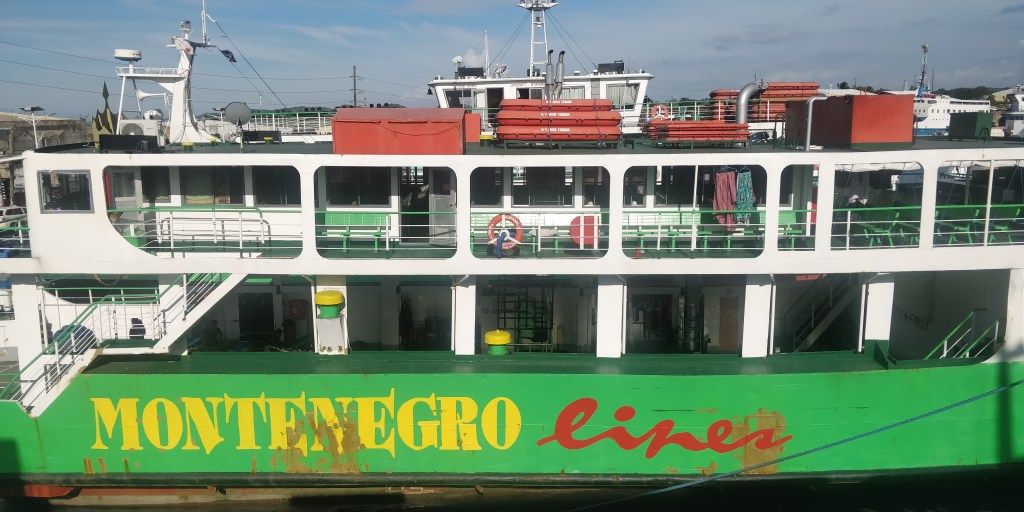
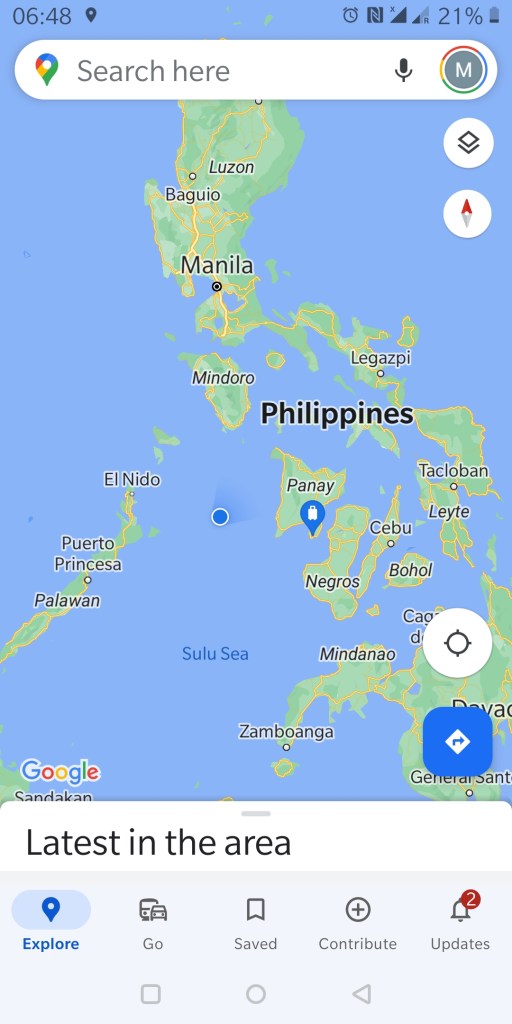
The signs were ominous from the beginning, there was very little information online about the ferry from Iloilo in Panay that sails across the Sula Sea to the island of Palawan, the most westerly region in the Philippines. The scant information available was contradictory, it went twice a week or maybe once a week,  it left at midday or 3pm or maybe 8pm. It seemed to depend on mood or wind and tide. We went to Iloilo on a Friday hoping to sail on Saturday or Sunday and went in search of tickets for the Montenegro ferry. On a hot crowded street, we walked past the ‘office’ twice before we found it but we’re able to purchase tickets  in the dark poky office…no internet.. and we understood why we couldn’t book online and the info was so sketchy.  More worryingly, the ferry was moored in the dock just across the street. It had  a pretty name- the Marta Rebecca (or maybe the Maria Rebecca)….the rusting made it difficult to decipher😮.  It had the tired, worn-out look of a vessel that had traveled far, lived long and needed some TLC or preferably retirement. When I asked the man selling us the tickets if the ferry was safe, he laughed and said ‘yes, of course’ and that he would be sailing too. I’m not sure if he meant that we would have the consolation of all going down together😮.
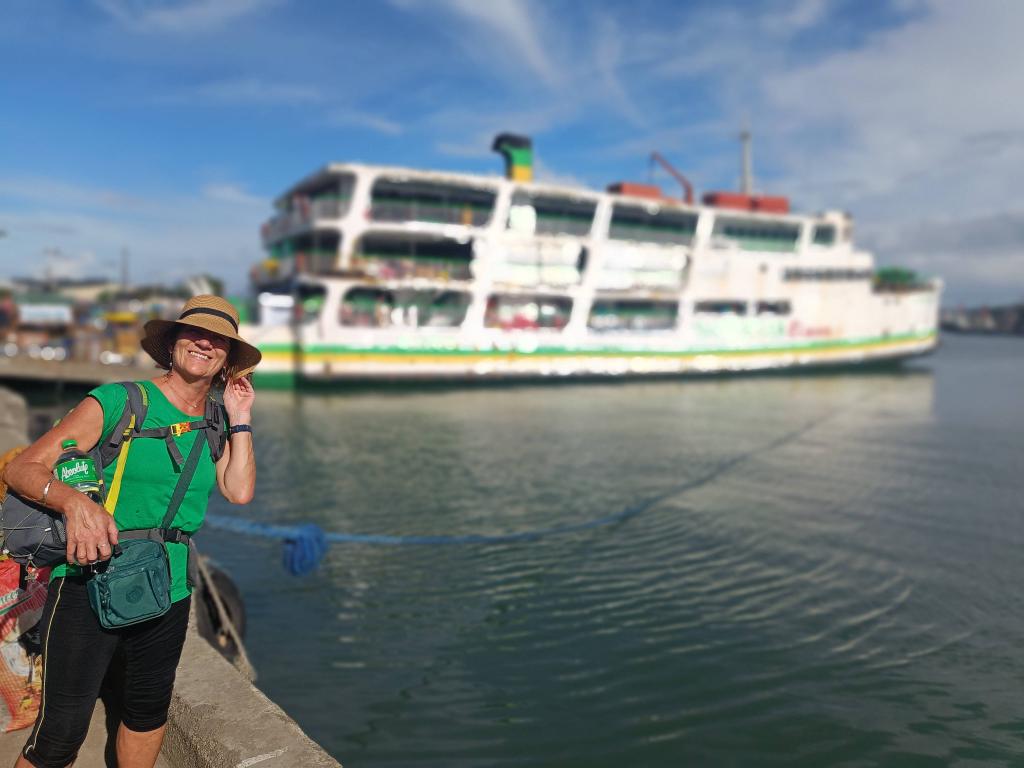
It was Paddy’s Day so after relaxing in our hotel (Castle Chateau @ 20€ a night with swimming pool and air-con), we went in search of an Irish bar without success(maybe the only town in the world without an Irish pub)and had to make do with an Italian restaurant where the live music was fantastic especially the saxophone player🎷🎹☘️
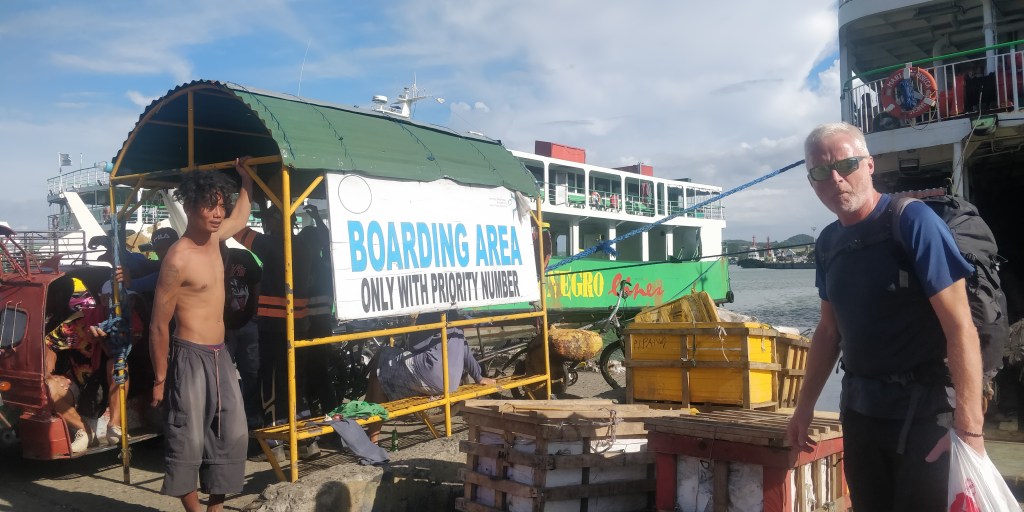
Boarding in Iliolo

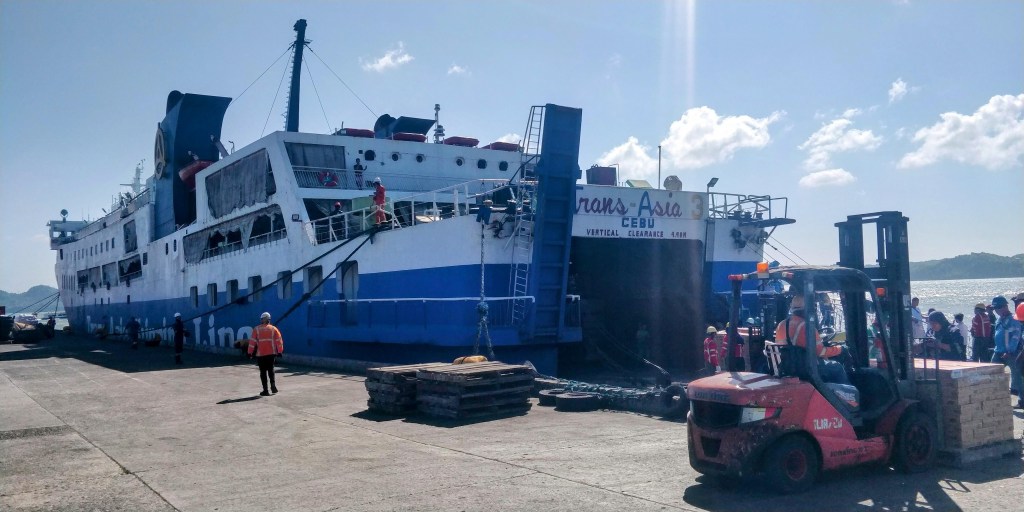
We were due to depart at 5pm and we arrived at the dock at about 3.45pm. The loading was in full swing – pallets of goods, bags of vegetables, drums of what looks like kerosene , pallets of coca cola, farm equipment, crates of water melons and fishing tackle. It was chaotic. The aisles were filled up with cargo and still more was hefted on board.  When we eventually found our bunks, they were crammed with goods, no room for us. The assigned bunk beds numbers were completely arbitrary….three decks of goods and people and children. Other passengers said to just grab a space, any space.
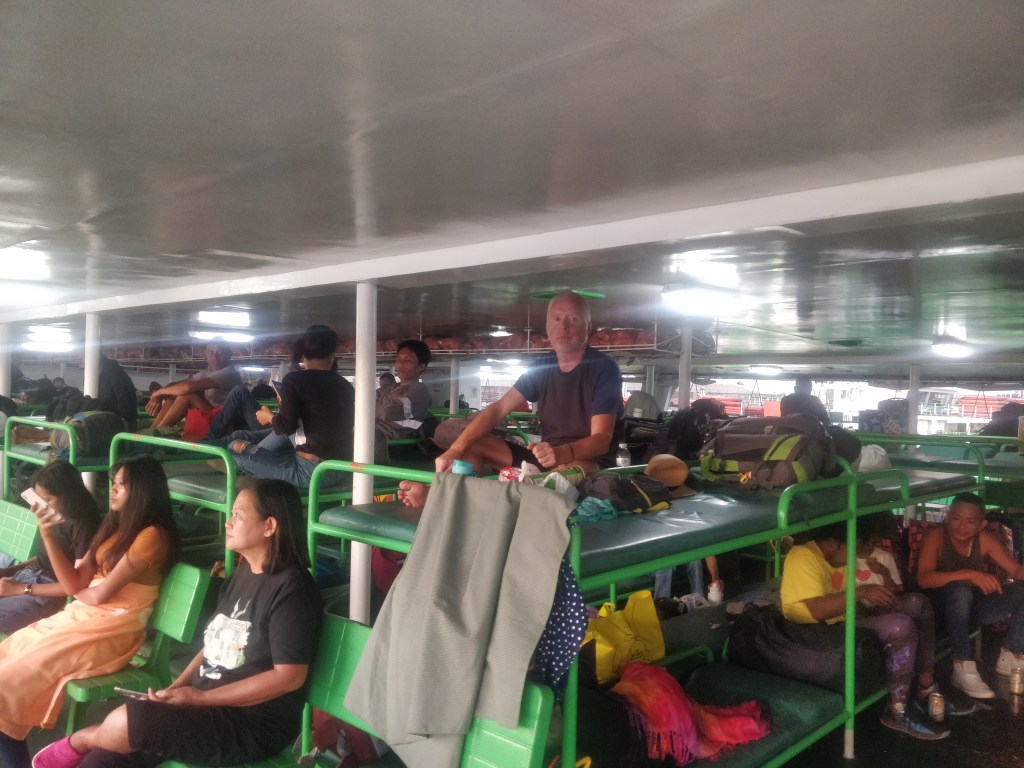
‘Home’ on Board

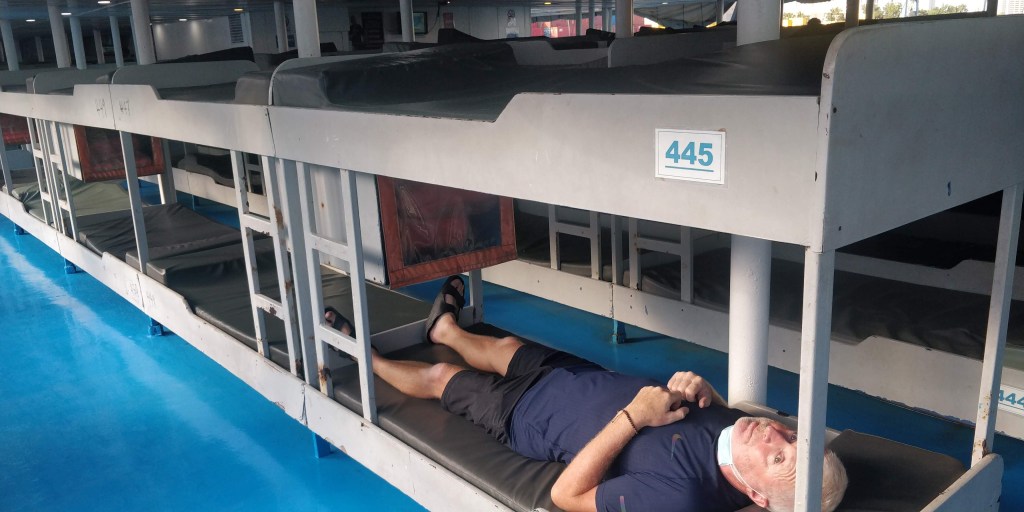
We settled on the top bunk of the top deck for a few reasons. it might be safer if the ferry went down. and we would get more ventilation because the sides were open.  Our last long -distance ferry was beginning to look like a luxury hotel in comparison to our current home for at least 36 hours. The ferry was filthy and we hadn’t even left port.  A man on the bottom bunk was shouting into his phone and drinking beer. There were 80 bunk beds on the top deck in four rows,  room for 160 people on this level with no privacy at all. Roosters in ventilated boxes provided the entertainment, harmonizing from the deck under us like a barber shop 🐓🐓🎶🎶.
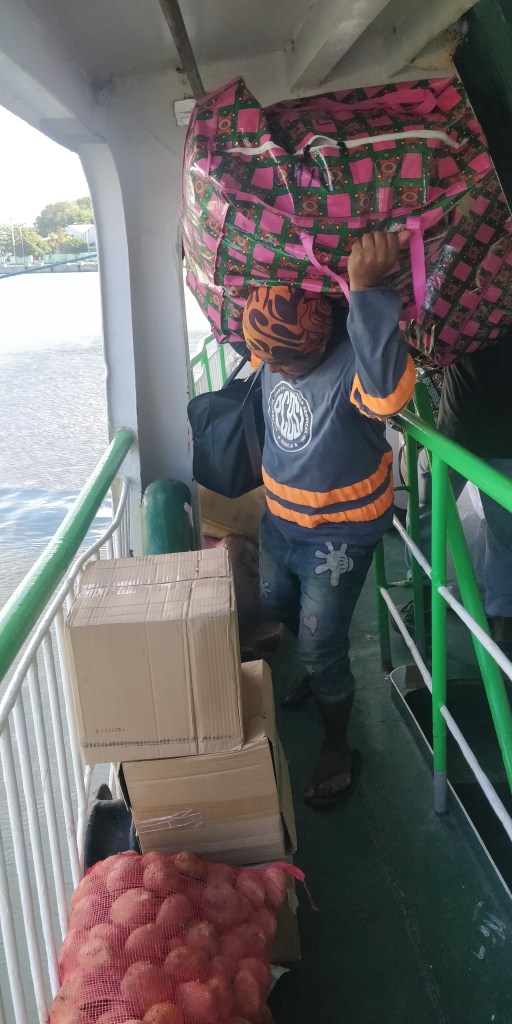
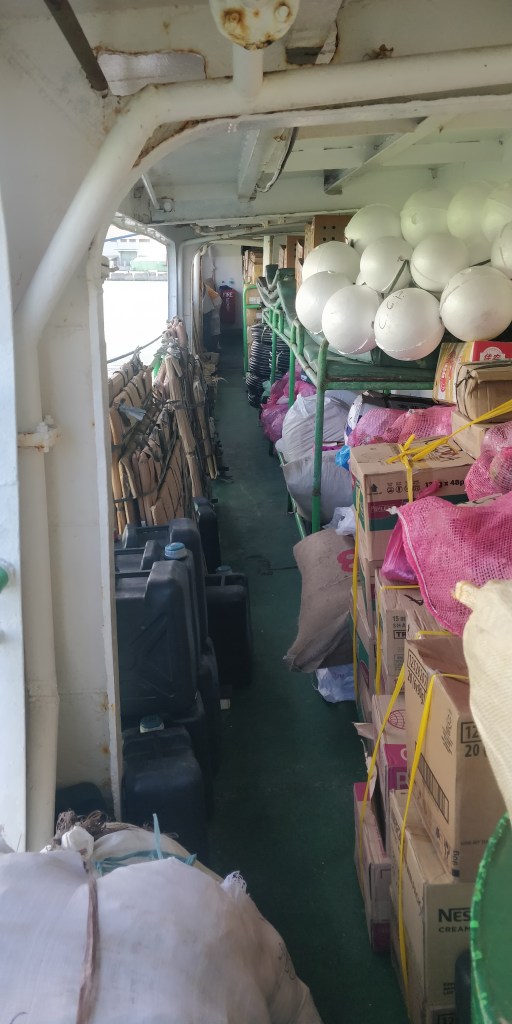
Our Designated Bunks😴

We were late leaving by about an hour and a half…slow travel indeed. At first, our progress was gentle along the strait of Iloilo, a lulling soothing motion for a few hours. The loud man on the phone spilt his can of beer on the floor which turned as slippery as a skating rinks. We lay on our bunks, designed for short people.( Just about Ok for me but Caoimhin was dangling from both ends). It wasn’t cold but the ocean breeze became stronger and circled around us as the night wore on. The towel and sarong that I wrapped around myself flapped like a sail as the wind, pulled and tugged from all sides. At times, the sea splashed loudly against the sides of the ship but all was relatively quiet on our deck once the drunk man passed out. By dawn, my face felt salt encrusted, my eyelashes were glued shut and my mouth was parched. I had been limiting my water intake since we boarded to keep trips to the toilets to an absolute minimum.
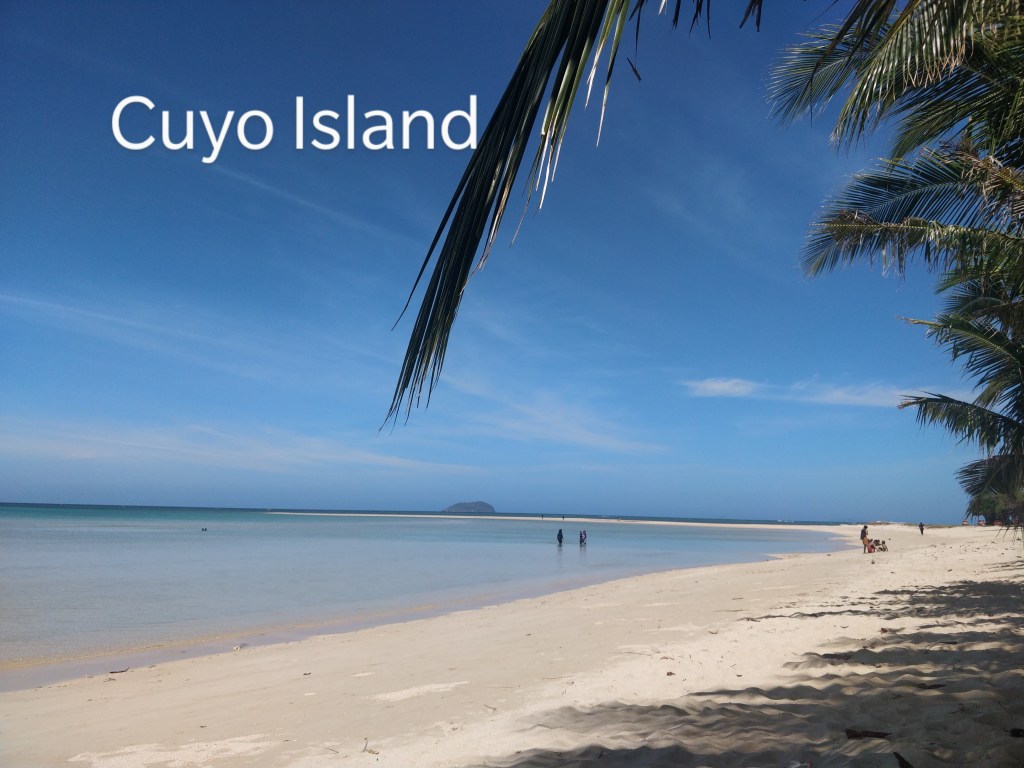
Remote Cuyo Island appeared before us like mirage at about 8am. Goods were unloaded and other cargo loaded in a disorganized dance that involved much shouting and lots of men. We wobbled down the gangplank which was literally two slippery planks of wood, placed at an almost vertical angle. Cuyo was a tantalizing vision of turquoise waters and white sand. We wandered around the market where slabs of raw meat were being fanned to keep the flies away. An old women shouted that she could make up a salad for us -she probably noted the look of disgust on our faces😀.We declined but she kept calling after us about fresh lettuce while wielding a knife!
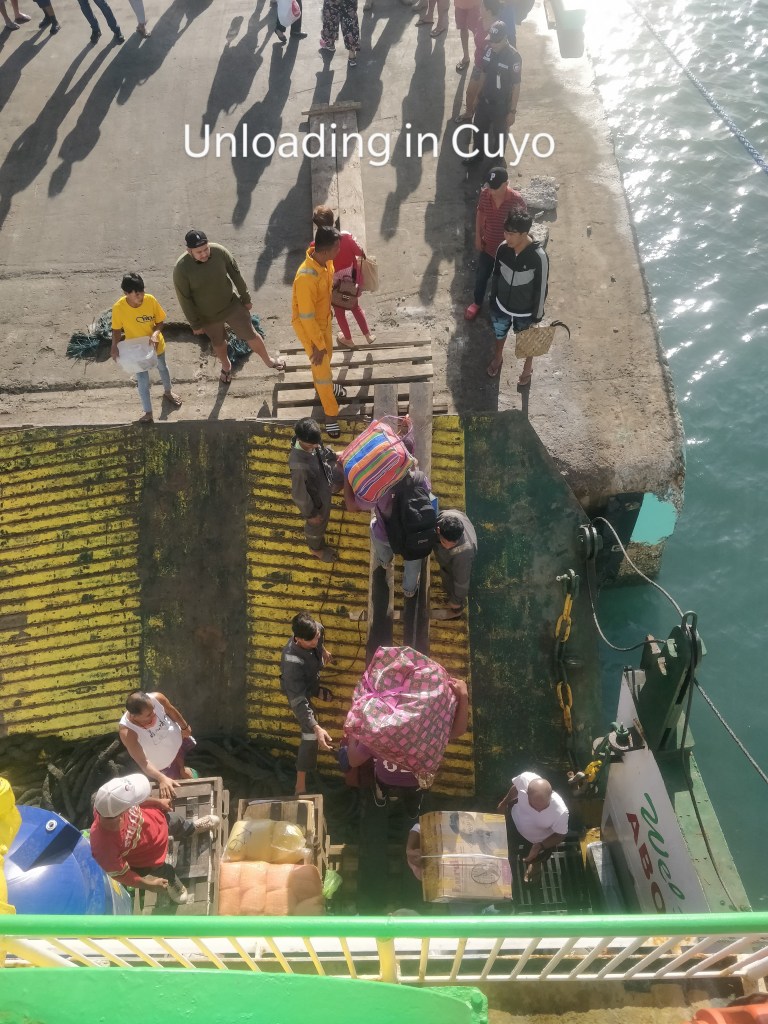
Boat in Cuyo

 The second leg from Cuyo was more crowded as more people got on and few disembarked. There were now more people on board than available bunks. We hung on to our spot even when an insistent guy said that we were in his bunk and waving his ticket. He was right of course but it must have been his first time on the ferry because he didn’t know that ticket numbers meant nothing. Possession was nine tenths of the law and we weren’t going to give up without a fight. Thankfully, the loud drunk was gone but the roosters remained. Sleep which was so elusive the first night, was not an issue the second night… The body can adjust to anything. It was also less windy so there was no tug of war with the towel/sarong😴. People on the boat were travelling for all sorts of reasons – work, to meet family, for a wedding and about thirty teenagers who got on in Cuyo were going to Palawan to sit exams. We were some of the few making the trip for ‘pleasure’.
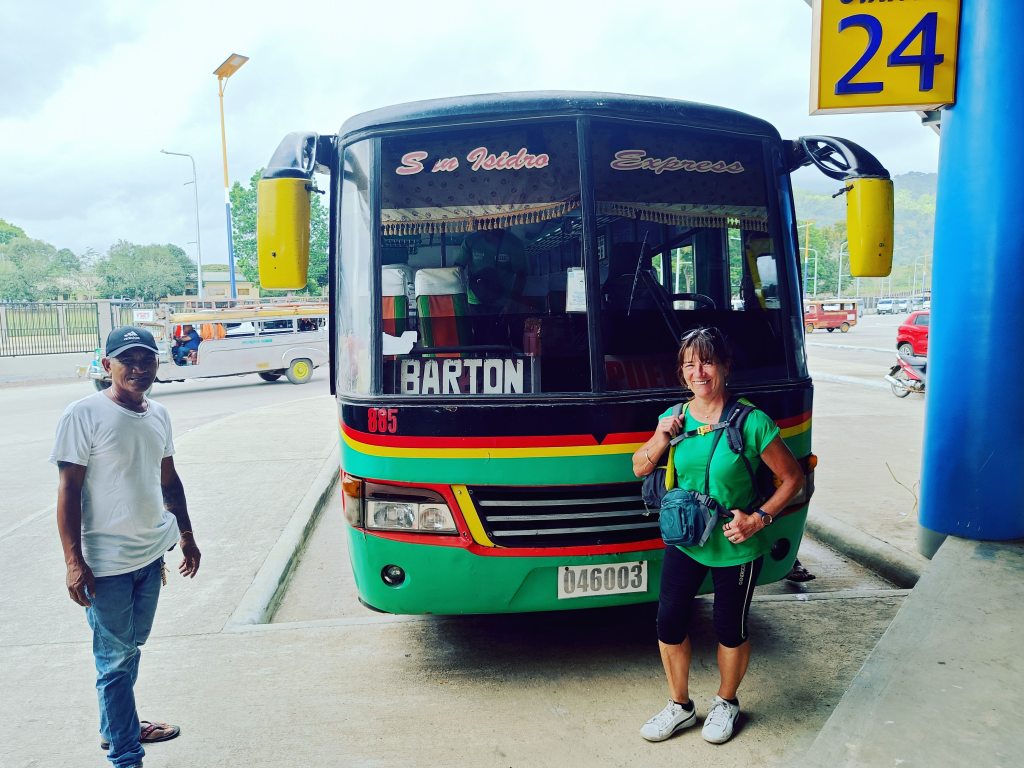
 Puerta Princessa, the capital of Palawan Island,  with its backdrop of mountains was a welcome sight at dawn. After 39 hours on board the ferry, we felt almost institutionalised. We headed to the bus terminal and boarded a local bus to take us on a 4 hour journey to the other side of the island. Raindrops splashed on the windscreen as we wound our way through the jungle interior  up and up and then down to Port Barton and the sea. 

Port Barton was ramshackle and dusty (most of the roads in town are unpaved). It was just a few street running parallel to the beach and a few more running perpendicular. The backdrop was stunning, hills of green-clad jungle on three sides and on the other, turquoise waters lapping  golden sand with bobbing fishing boats and  an astonishing numbers of islands, silhouetted in the distance. There were no high-rise hotels, most were small establishments with just a few rooms. The tourists here were backpackers and independent travelers, no tour groups or tour buses.. 

We loved Port Barton from the first day and we found ourselves extending our stay….just one more day, one more sunset, one more dinner, sitting directly on the beach feeling the sand between our toes, eating fresh fish barbecued on the spot. 
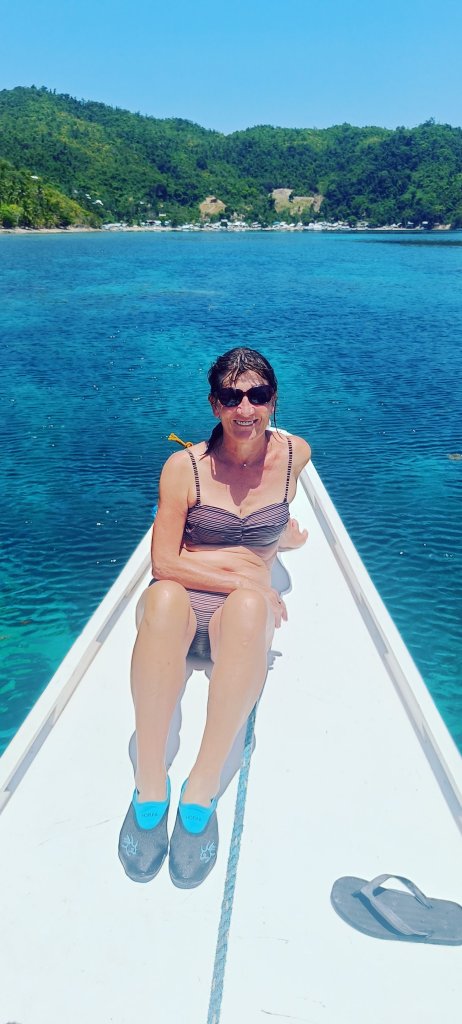
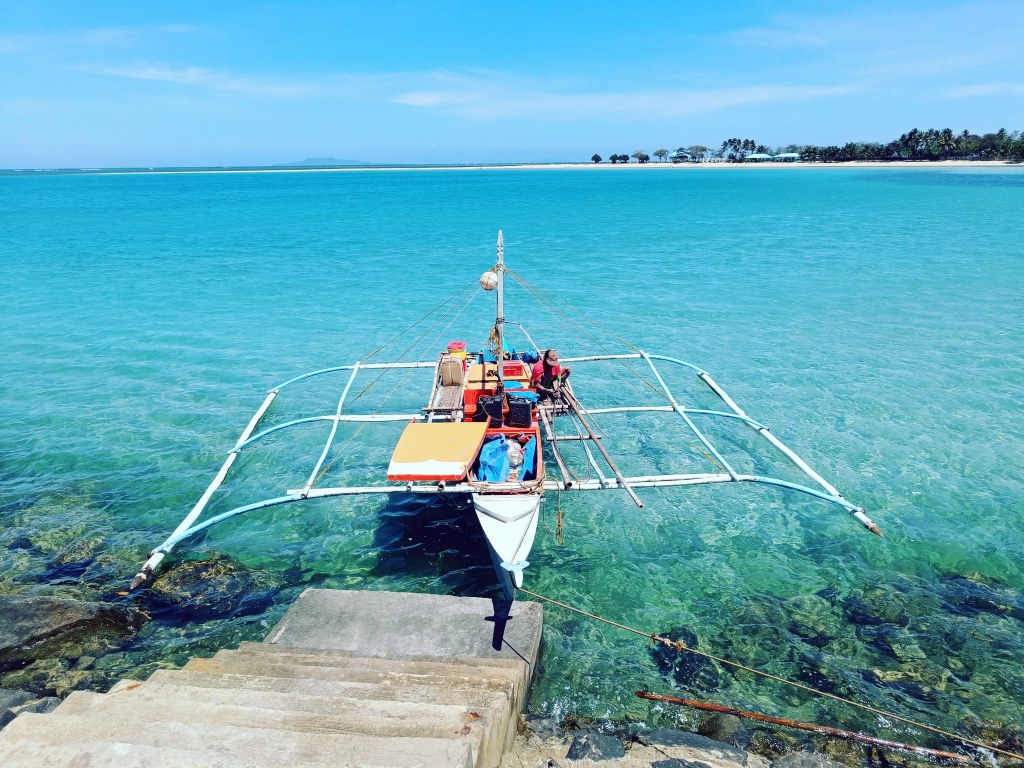
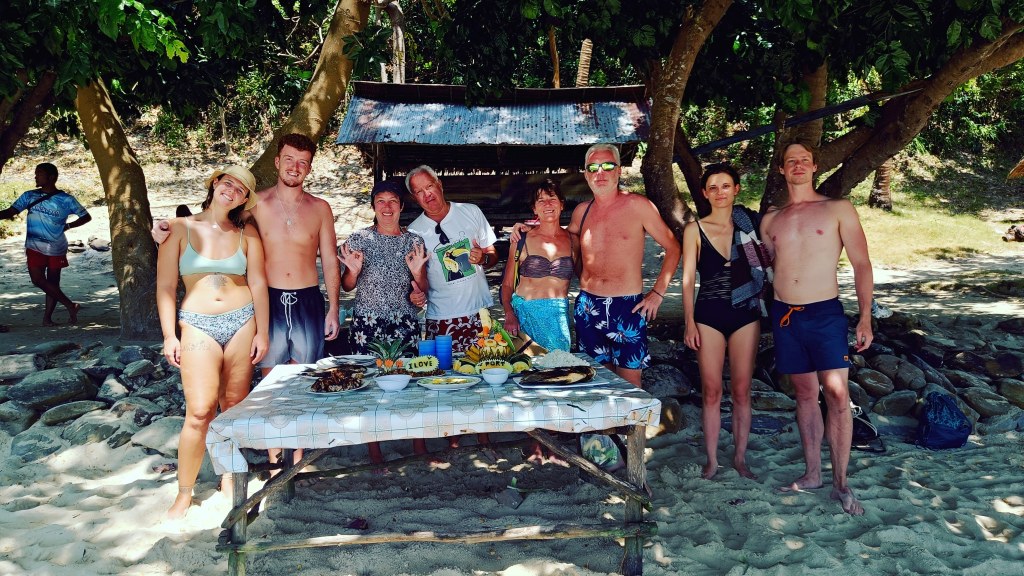
The  boat tour to some of the tiny islands nearby was glorious and probably the highlight, snorkeling in crystal waters with multi-coloured fish, looking for turtles and starfish. Such a perfect day for €20 including a sumptuous lunch on a tiny uni habited island, freshly prepared by the two crew. 
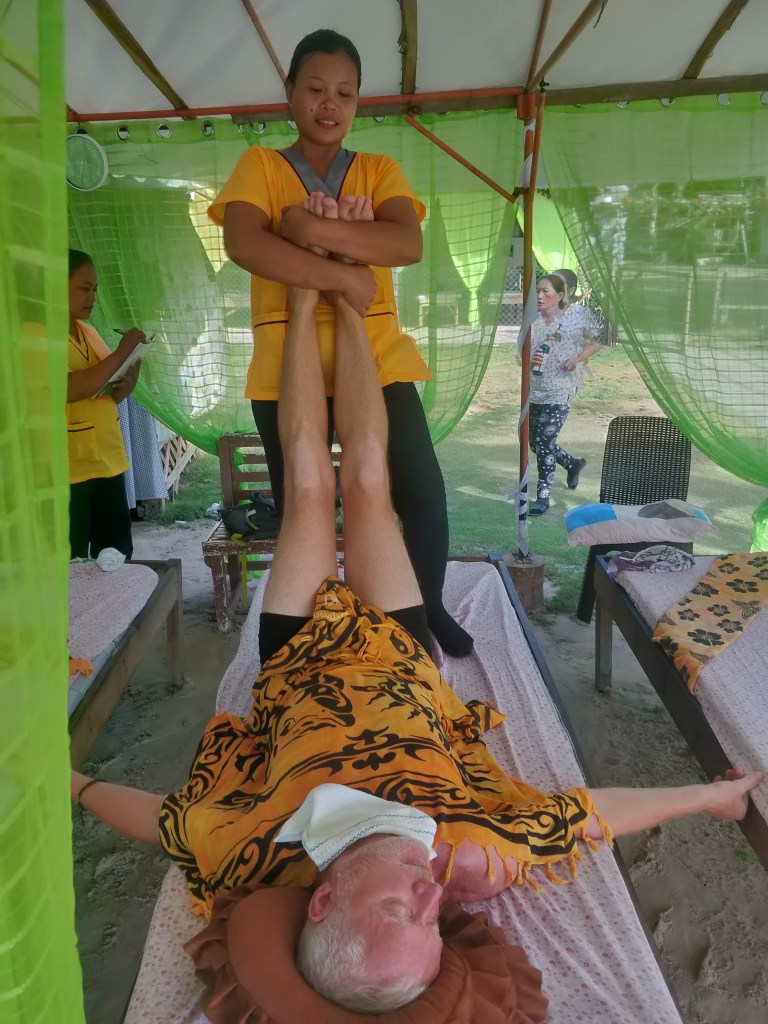
Thai Massage by the Beach😀

Street lighting was virtually non existent so the nights were aglow with stars. The only fly in the ointment in this paradise were the dogs. There were everywhere-under the tables at the restaurants, on the street, in the massage tent. Usually they were gentle and caused no bother to humans but in the middle of the night, rival dog gangs set upon each other and the ensuing battles were ferocious and deafening. We moved from one accommodation to another partly to get away from them. In the second place there were no dogs but there were bloodcurdling catfights outside the bedroom windows.

WiFi and internet on Palawan  is patchy at best and non-existent most of the time and it is particularly poor in Port Barton….very frustrating especially when we are trying to book accommodation, keep in touch with people and do some research. Uploading photos to the blog is virtually impossible. But small worries!
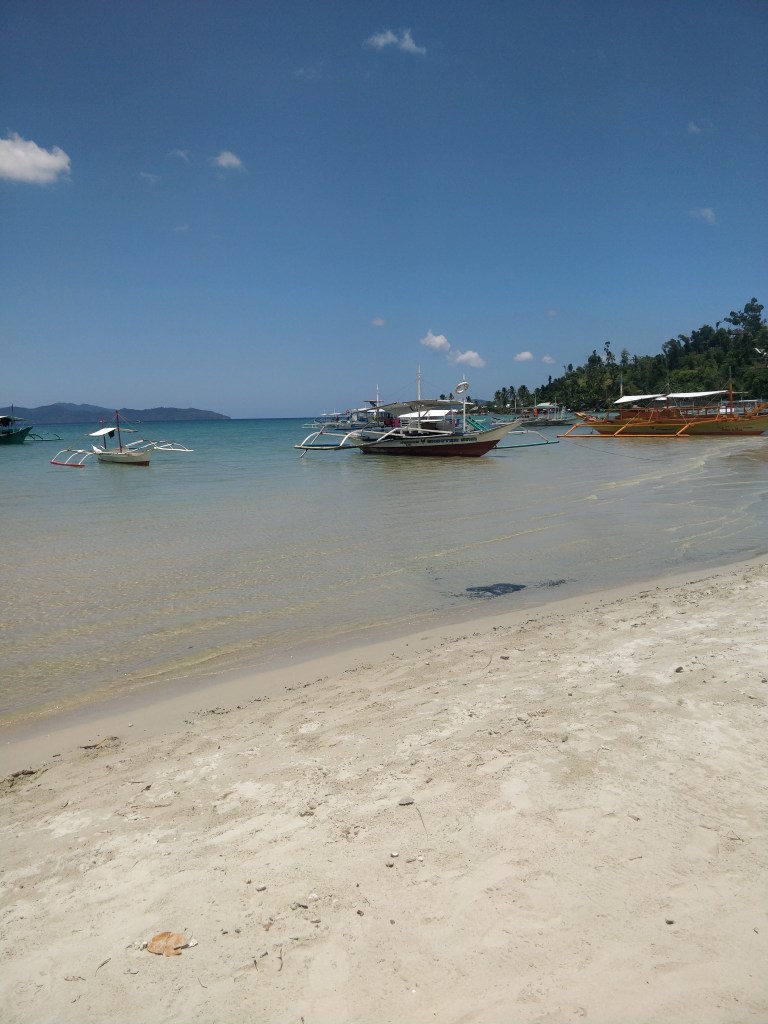
Port Barton Beach

Port Barton has had troubles of its own. Super Typhoon Odette wrecked havoc in this small town in December 2021. knocking down about half the trees along the beach, flattening homes and destroying boats. Quite a few premises never recovered. Odette was unusual because of its ferocity and coming so late in the season and tracking to Palawan which usually escaped typhoons.

Our next move is to a hut in the hills for a few days and then we are heading to a resort on a small private island, about a hours boat-ride from shore where there’s no internet and even electricity is limited.  A French retired couple that we met on the boat trip told us about it and it was surprisingly affordable (about €35 a night). I’ll tell you all about it in the next instalment….if I manage to post it.

Thanks for reading 😎🌞🌞🌞🌞
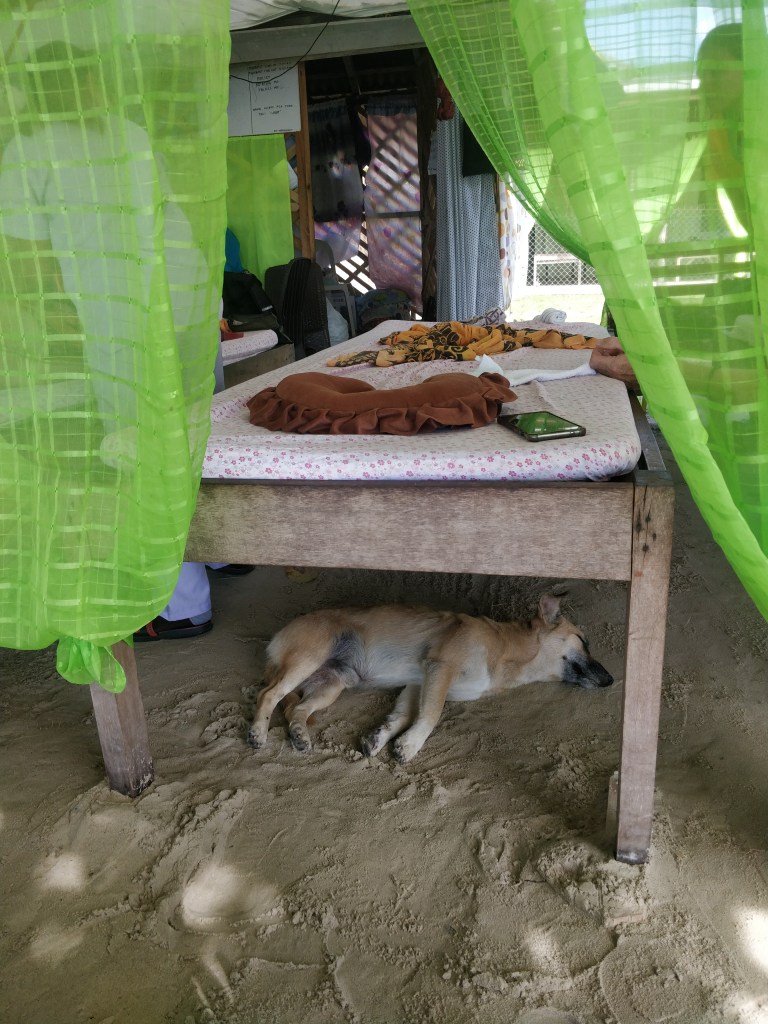
It’s a dog’s life🦮
Philippines – Slow Boats, Slow Travel

Philippines – Boracay, the Paradise Island

Just the whisper of some place-names is like a promise of paradise. One such place is the island of Boracay in the Western Visayas in the Philippines, which has been called one of the most perfect islands in the world on many ‘must-visit’ lists ,  the pinnacle of white- sand, palm fringed beaches where the waters are warm and teeming with fish. But there was trouble in paradise. Lured by photogenic beauty and the quest for perfection, so many people flocked to this tiny island (15kilometres long and less than a kilometre wide at its narrowest) that the delicate balance of nature tipped towards destruction. The people who came to marvel at its beauty devoured it,  their voracious appetites demanding food, shelter, transport, water and sanitation. Hotels were built that violated planning and environmental laws. Sewage and waste management were enormous problems.  In 2018, the President of the Philippines visited the island and declared it both a ‘cesspit’ and a health hazard – a paradise almost lost. So the pearly gates of  Boracay were locked  to tourists for a year so that the island could recover…..which of course meant economic hardship for the residents who relied on tourists for income. The restrictions of the pandemic provided further opportunity for renewal and recovery. Boracay, version 2, opened for business with improved infrastructure and strict enforcement of development rules.

Leaving Cebu

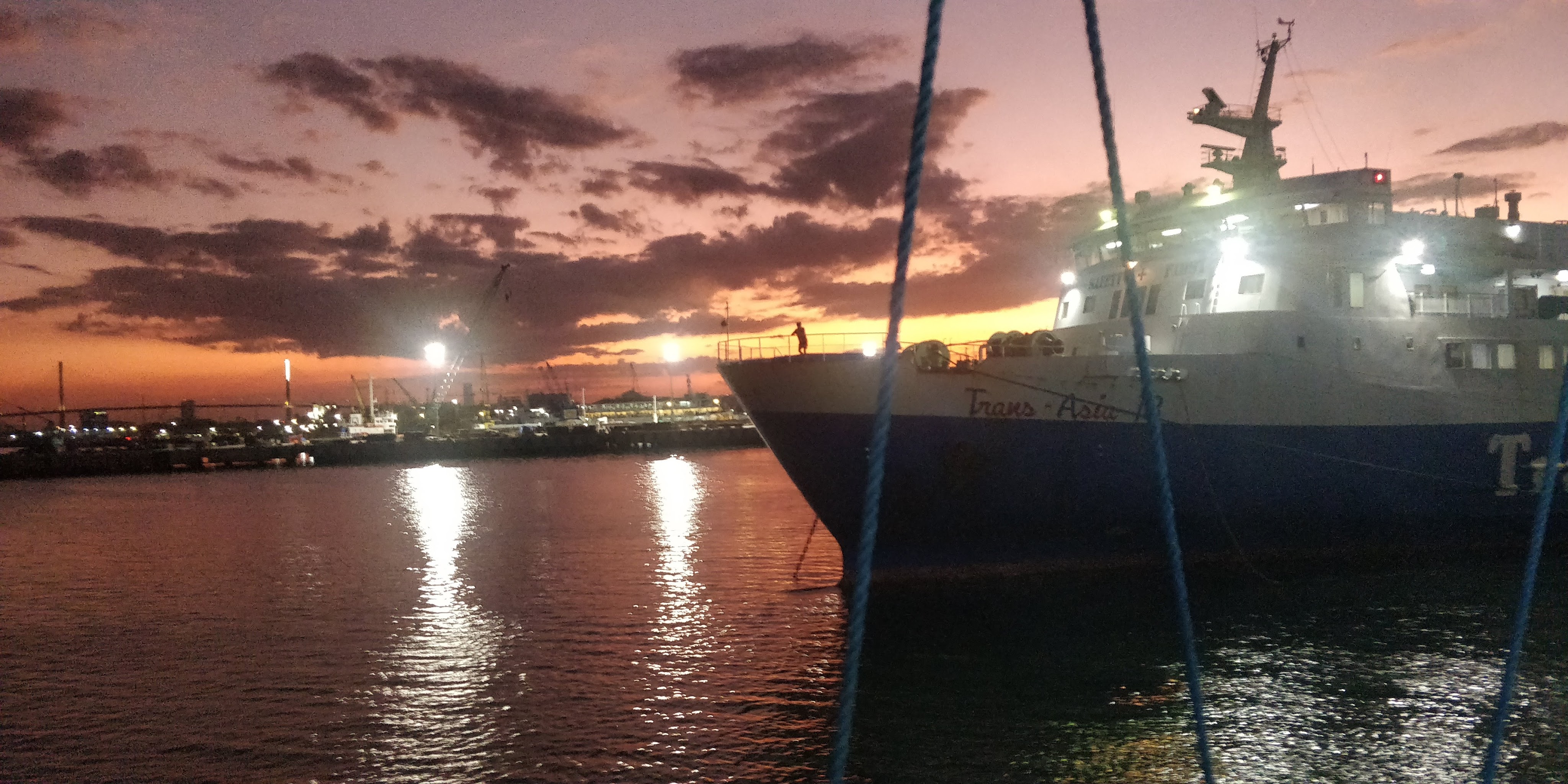
The appeal of Boracay was like a magnet, pulling us in that direction. We were curious to find out why this little island was so special in a country with over seven thousand and six hundred islands, many of the ones we had visited so far were undeniably beautiful.  But our road to paradise was long and arduous. It began with a fourteen hour ferry from Cebu, the Philippines second city after Manila, to Iloilo, the capital of Panay Island. We sailed from Cebu at dusk when the beauty of the setting sun masked both the frenzied activity in the port and the squalor of the nearby streets – hanging telephone wires, broken pavements, fumes and gut-wrenching smells.  The overnight journey cost about €20 each but the ferry was a rust-bucket, probably a charitable description. The steward told  us that they were in the process of renovation but we weren’t sure we believed him. On the positive side,  there were beds for everyone in two different classes, economy class was 5 long rows of bunk beds on deck with canvas sheeting pulled down for shelter from the (warm) winds. Tourist class had air-con and eight bed cabins, four sets of bunk beds. There were no flushing toilets for anyone, just a huge vat of water with a water scooper to put water down the bowl. No water in the taps either. Two large white lumps of air fresheners placed beside the sinks didn’t mask the smell but added a layer of cloying floral something. The restaurant was merely a counter that served Pot Noodles and cold rice &chicken in a white styrofoam tray. But the worst part was the huge number of stowaways – whole families of cockroaches were everywhere.   Most of the human passengers simply crawled onto their bunks, turned over and stayed there for the duration of the journey. When we saw that we had a baby in our cabin, our hearts sank but he was a gorgeous little 7 month old and although he was very good, of course he cried during the night.  I slept surprisingly well, barely aware of the baby or the alarm clock going off in someone’s bag at 4am. The fourteen hour journey stretched to fifteen and a half and by the time we reached Iloilo, we swayed down the plank on sea-legs and growling stomachs. Iloilo was by far the cleanest city that we have visited in the Philippines but we went straight to the bus station to catch a bus to Caticlan. We had about 5 minutes to spare before the bus departed. While the ferry was a disappointment, the bus was clean, efficient and surprisingly roomy but we were glad to reach our destination after 6 hours on the bus mainly along by rice fields with a welcome stop at a local restaurant where we gobbled plates of noodles, rice and delicious fried fish.

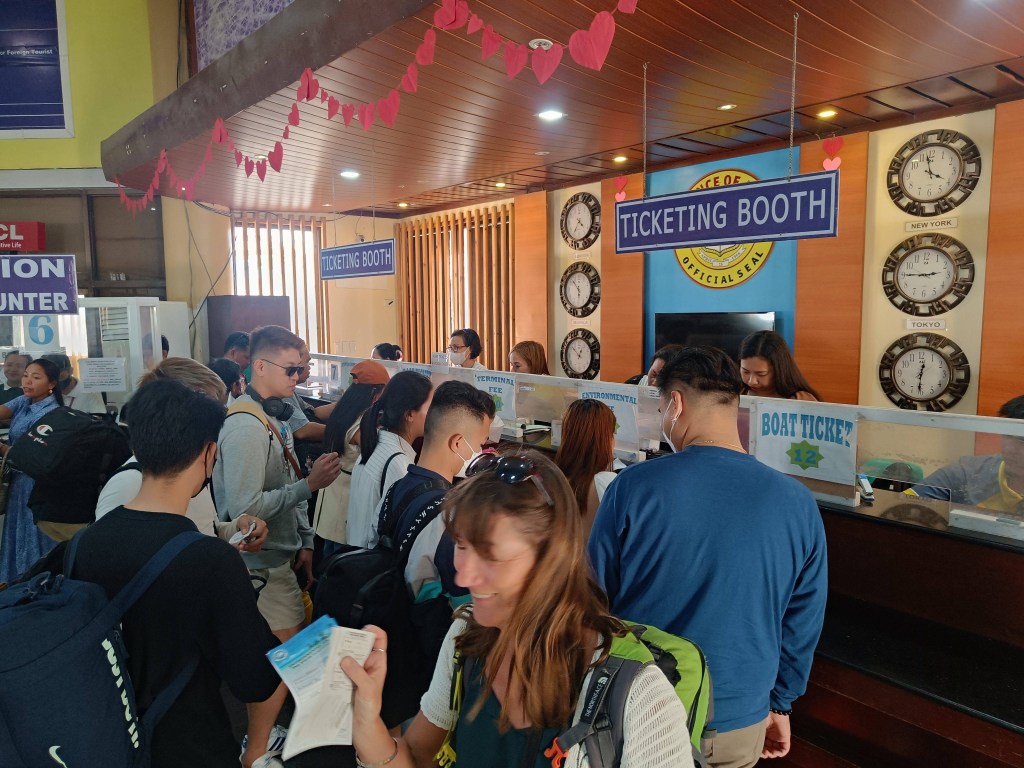
Caticlan was a small port that served the ferry to Boracay Island, visible in the distance. The port building was crowded with tourists, officials and bag handlers moving mounds of suitcases. The noise was reverberating off the tin roof and falling back down on our heads. We had a few more hoops to jump through before we could get on the ferry. First we had to queue to show proof of accommodation on the island….this may be a way of restricting numbers on the island but nobody was allowed on the ferry unless they had pre-booked accommodation. We were given a slip of paper which we had to hand in at another counter and pay our environmental tax (about €5), then armed with proof of that payment, we moved on to pay our port tax (€2.50 at another window) and then finally the boat fare (€1 at yet another window). We marvelled at the vast number of people employed just to get passengers on a boat. The process had to be done in that precise order which wasn’t obvious so people were queuing in the wrong place, changing lines and getting a bit excited. But at last, we were seated on hard yellow planks in a small ferryboat on the way to the paradise island of Boracay.

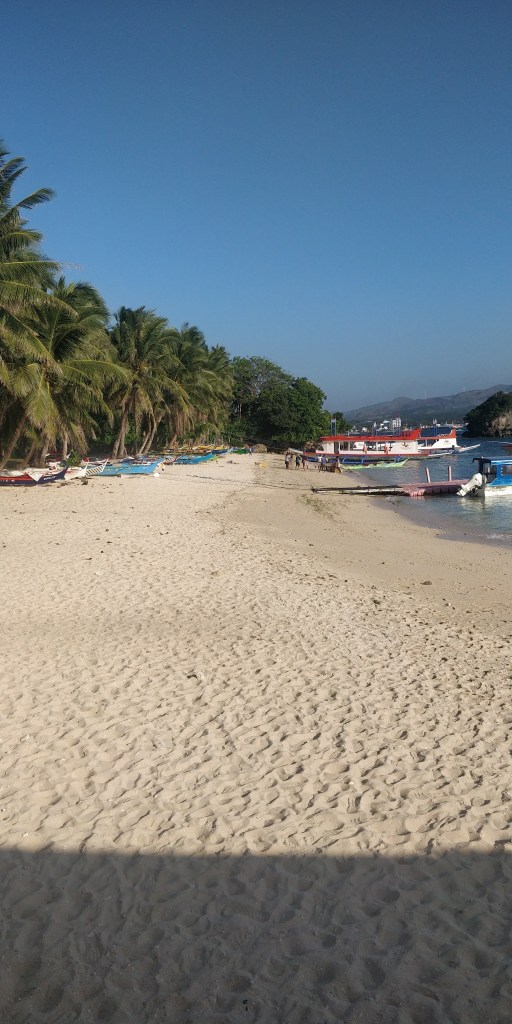
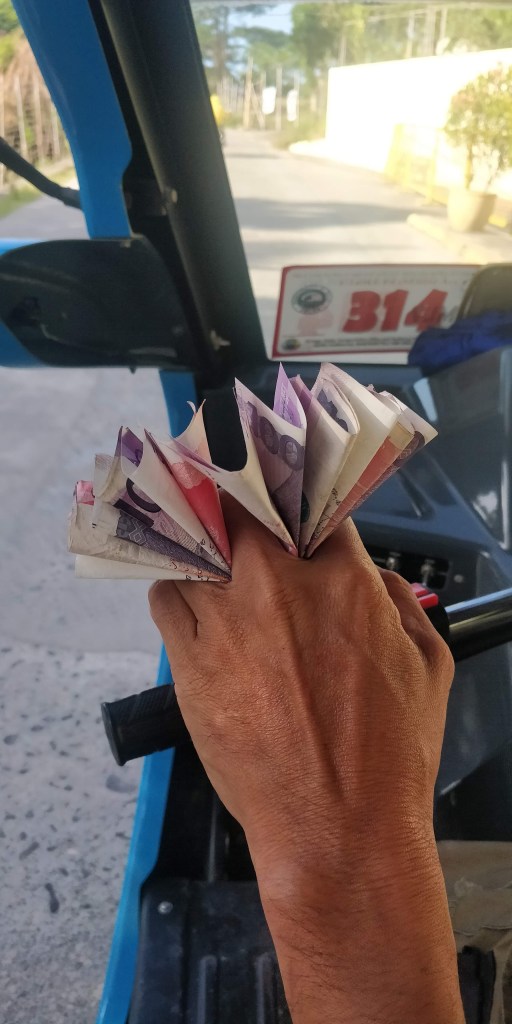
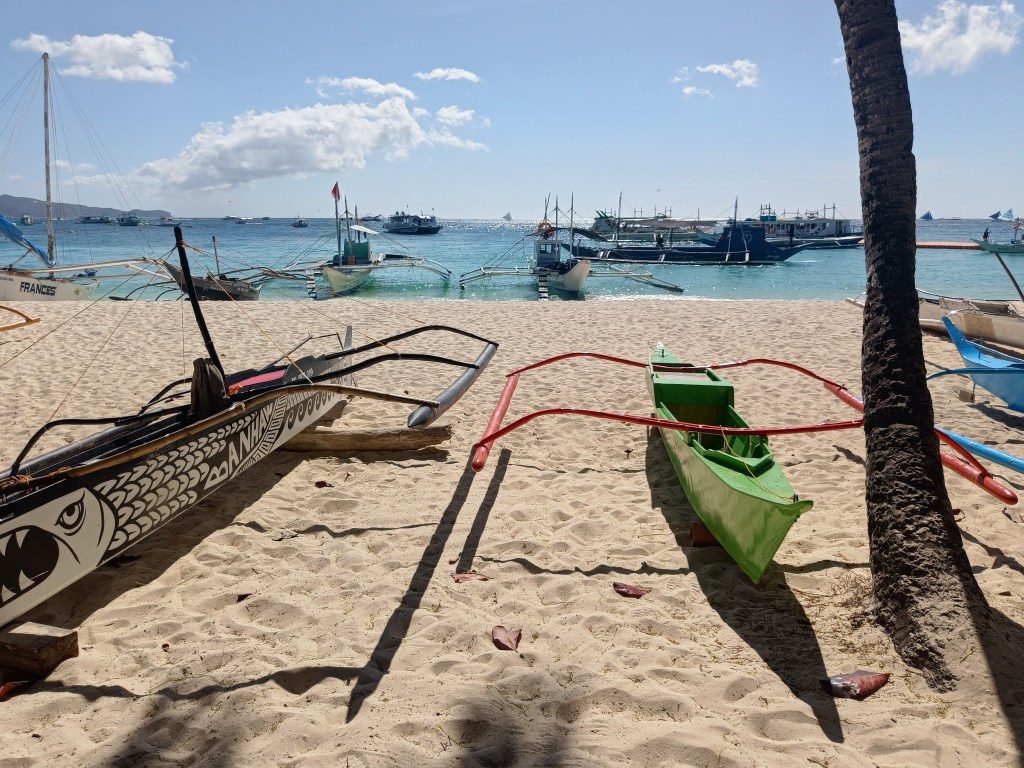
The pier was tranquil in Boracay, turquoise waters lapping on white sand and a strong refreshing breeze swaying the palm trees. The most popular area on the island was the famed White Beach, 3 or 4 kilometres of talcum-powder fine sand but we didn’t stay there – we were on the other side. The rick-shaw guy that took us there had the peso notes arranged between his fingers that made us think that money was king on Boracay. At Happys Homestay in a large but basic room, metres from a small beach where the neighbourhood children played and a few locals (plus the odd tourist) sat on plastic red chairs outside the shop. There was the smell of paint as fishermen painted their boats under the swaying coconut palms. It was beautiful but was it special?

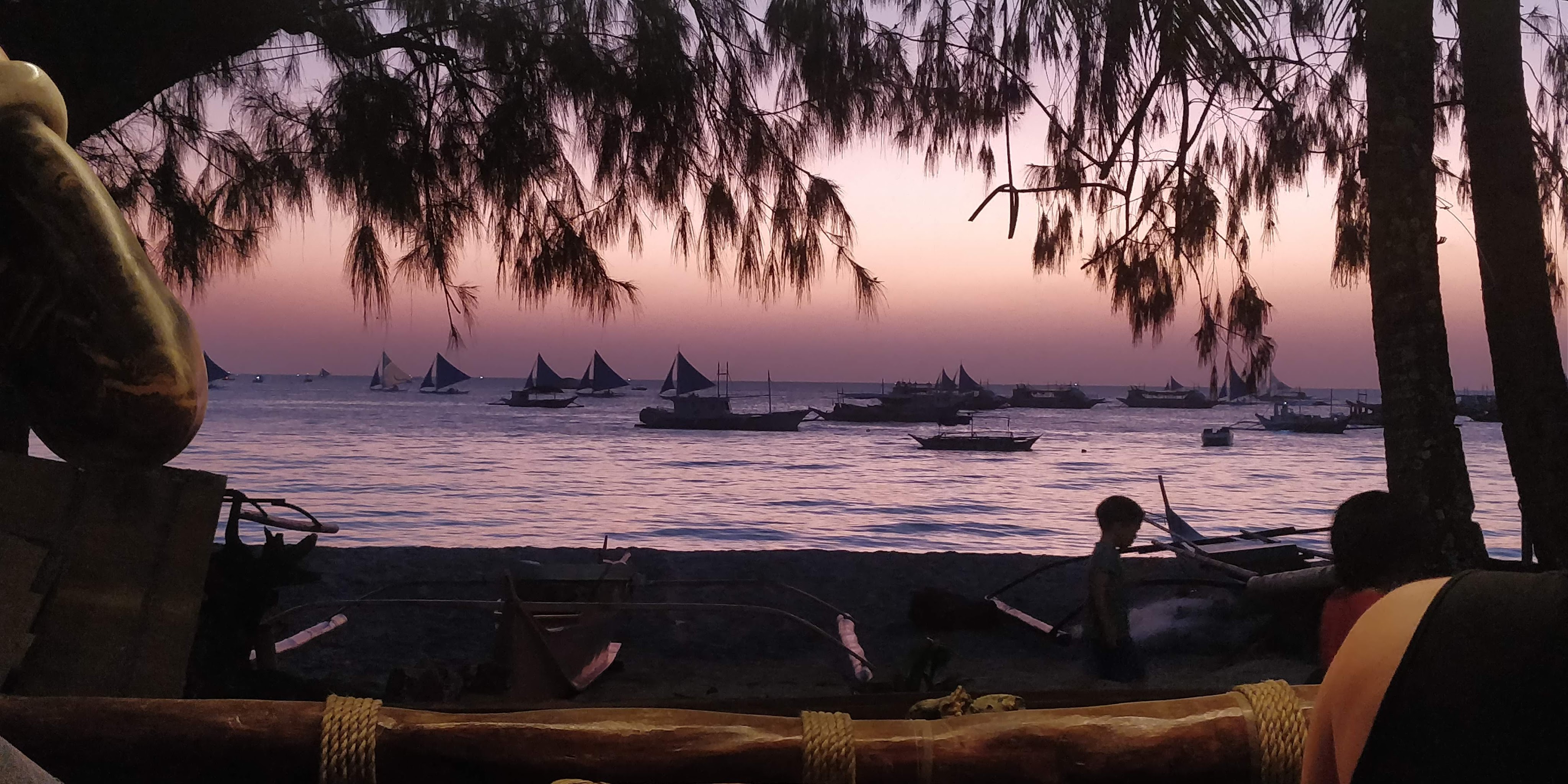
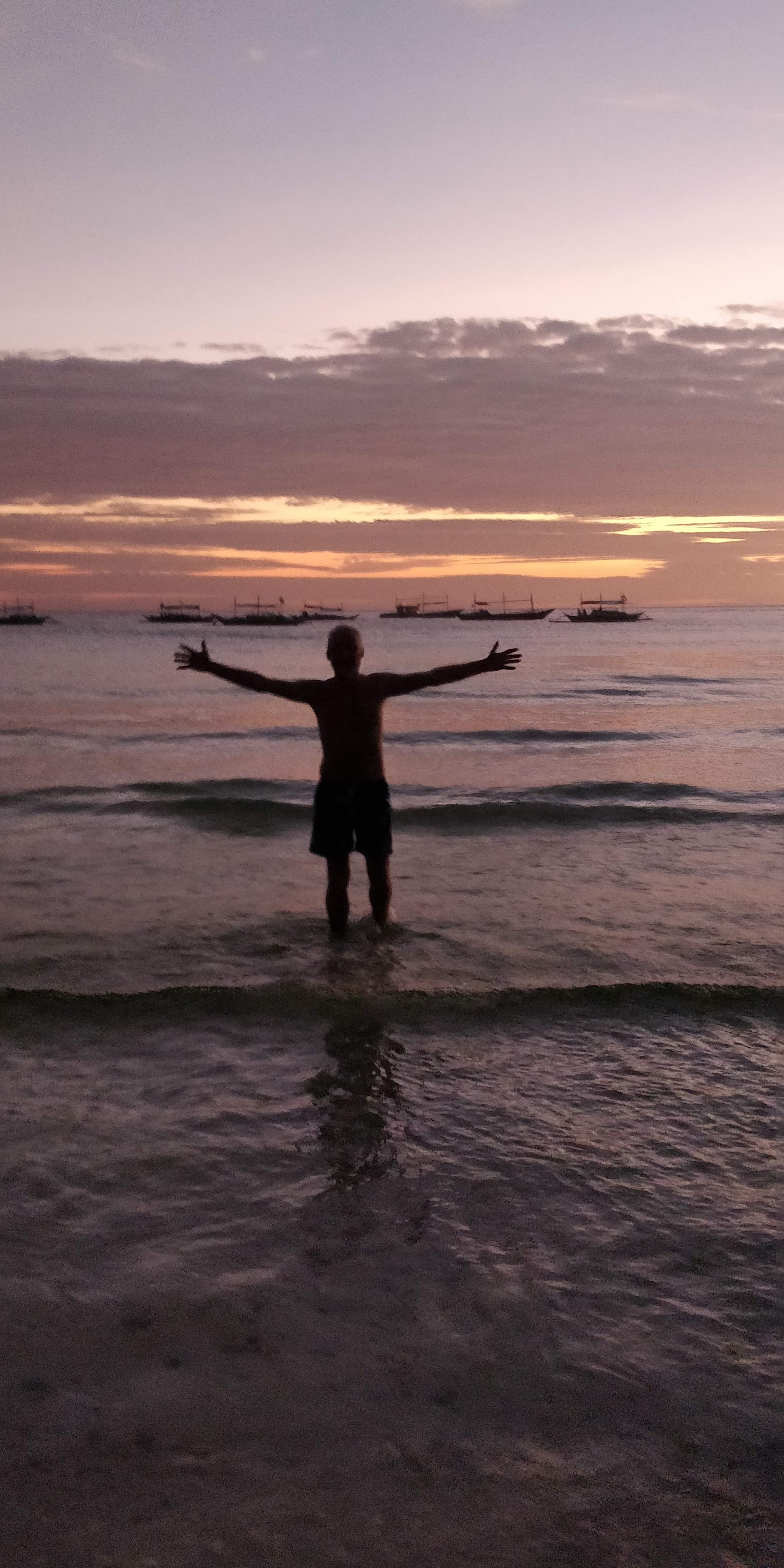
Our First Boracay Sunset

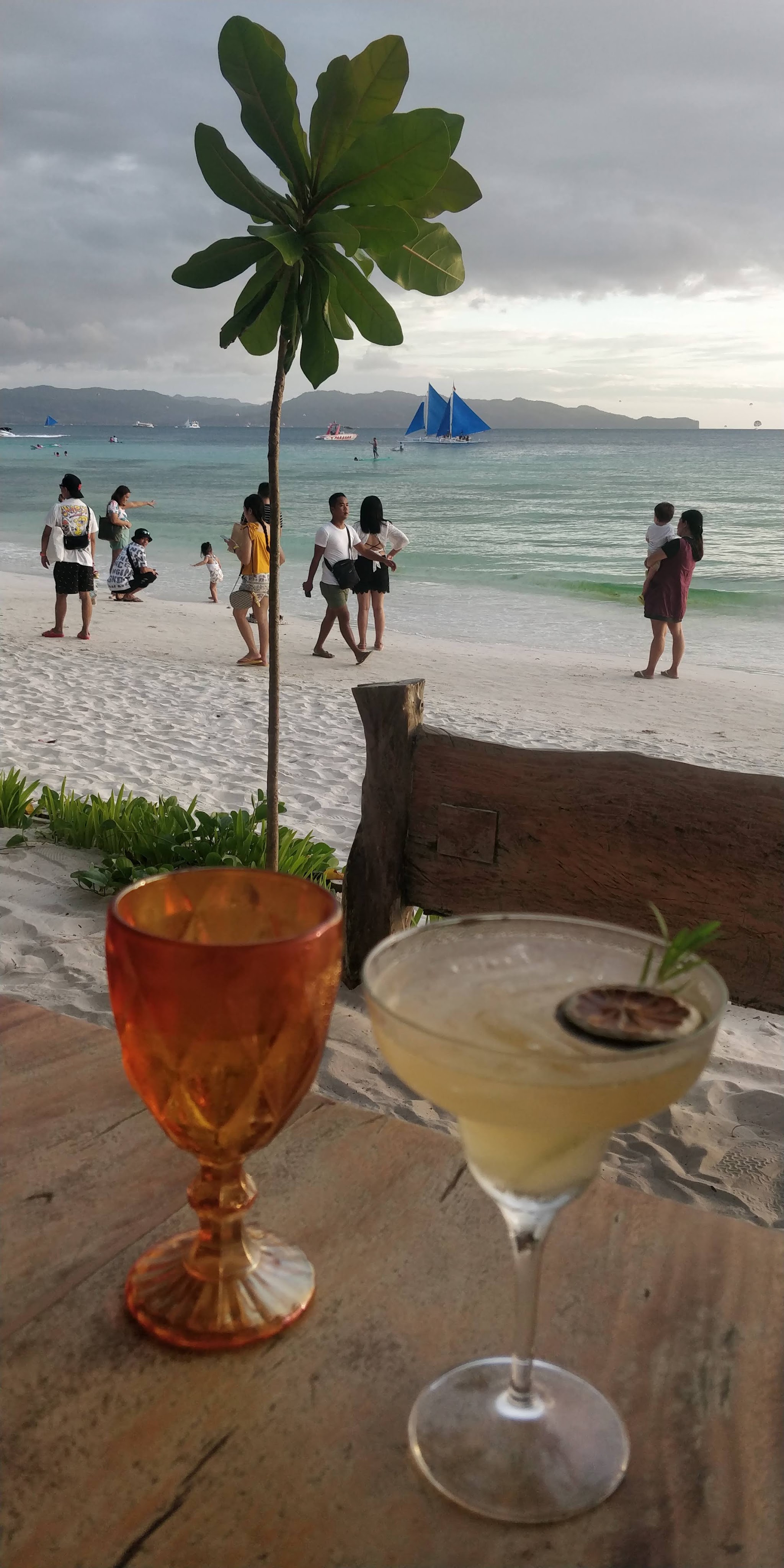
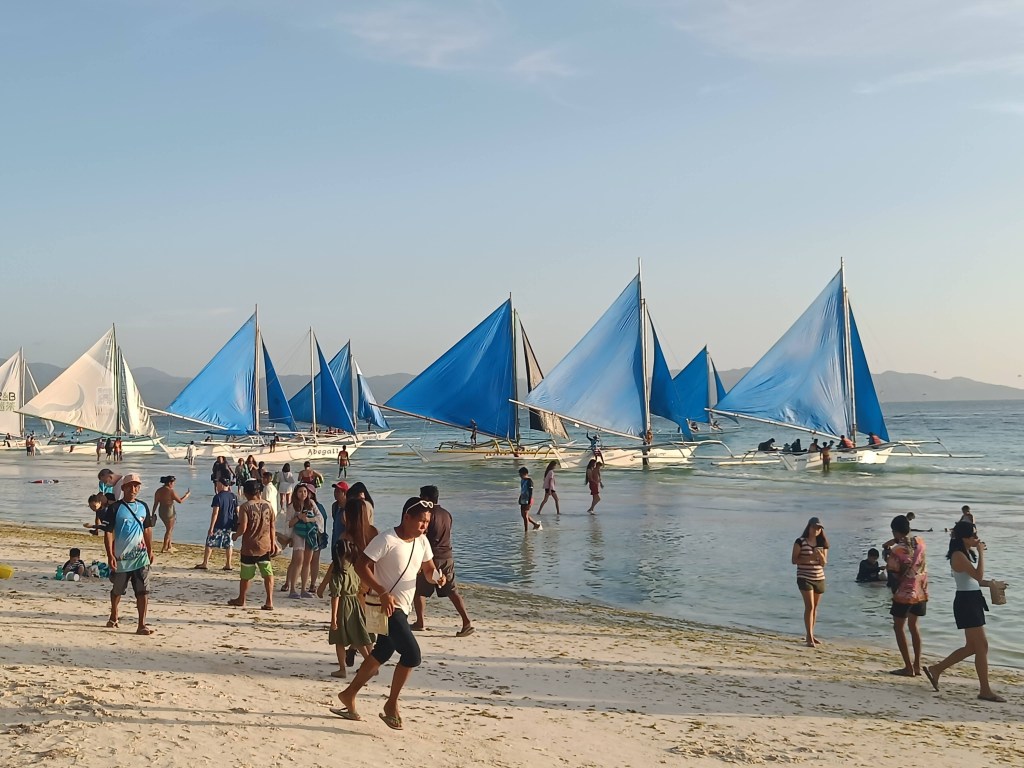
The 40 minute walk to white beach took us by back streets, ramshackle houses, teeming with children, interspersed with tiny shops selling an assortment of sachets – everything from shampoo to ketchup to biscuits is sold in tiny quantities. When I asked about buying teabags, the shopkeeper opened the box of twenty Lipton teabags and asked how many I wanted.   We arrived at White Beach by sunset and sat in a beach-bar looking at the sailing boats gliding past like giant moths with folded wings as the sky darkened and the world went crimson. Sounds idyllic? It wasn’t …  a bald, fat German was having a drunken argument – loud and raucous – with his equally inebriated Filipino wife and there was competing pop music blaring from several establishments. The whole white beach was a continuous strip of cafes, restaurants, hotels and souvenir shops, becoming more crowded the longer we walked until we could barely find space for our feet.  People put laminated cards in front of us, asking (no, imploring) us to eat in their restaurant, take their tour, have a massage, buy the T-shirt.  Maybe it was the tiredness but we were overwhelmed and a bit appalled. One street back from the beach was even more crowded with hotels, designer shops, shopping malls, motorbikes, and tourist vans. Remember this is just a tiny island. Thankfully, a lot of the tricycle rickshaws were electric which at least cut down on the fumes and noise levels. We scurried back to the peace at the ‘local’ side of the island which would be perfect except that there weren’t any restaurants. It was also the blustery side at this time of year…but that also kept the temperatures very pleasant. The winds change direction in June when it becomes calm on this side and wind-ruffled on the White Beach side.

The majority of the visitors were Asian package tour groups, only a tiny fraction of the visitors were backpackers but that meant that there was an incredible variety of food available. We ate Japanese food, Korean ice-cream (surprisingly delicious), Thai dinners and even found some French pastries. One morning we rose at dawn (about 6am) in an attempt to enjoy the beauty of White Beach without the hordes of tourists and touts.  The air was soft and fresh and it felt as if the island had been reclaimed by the locals, going about their business without tourists.  ferrying children to school – many schools here start at 6.30 am,  sweeping and cleaning. But as soon as we stepped on White Beach, we found that we weren’t the only early risers, the place was packed with tourists, mainly Asians posing in search of the perfect Instagram shot which required lots of time, infinite patience, numerous  retakes and rejections until acceptable perfection was reached. At first we stopped so that we weren’t photobombing their shots but there was no end in sight so we just kept walking. It was laughable – young women (mainly) lying in glass bottomed boats, trailing fingers in the water creating the illusion that they were in the middle of the ocean instead of half a metre from shore. But maybe we could learn from them…if only we weren’t too busy enjoying the moment to capture it.

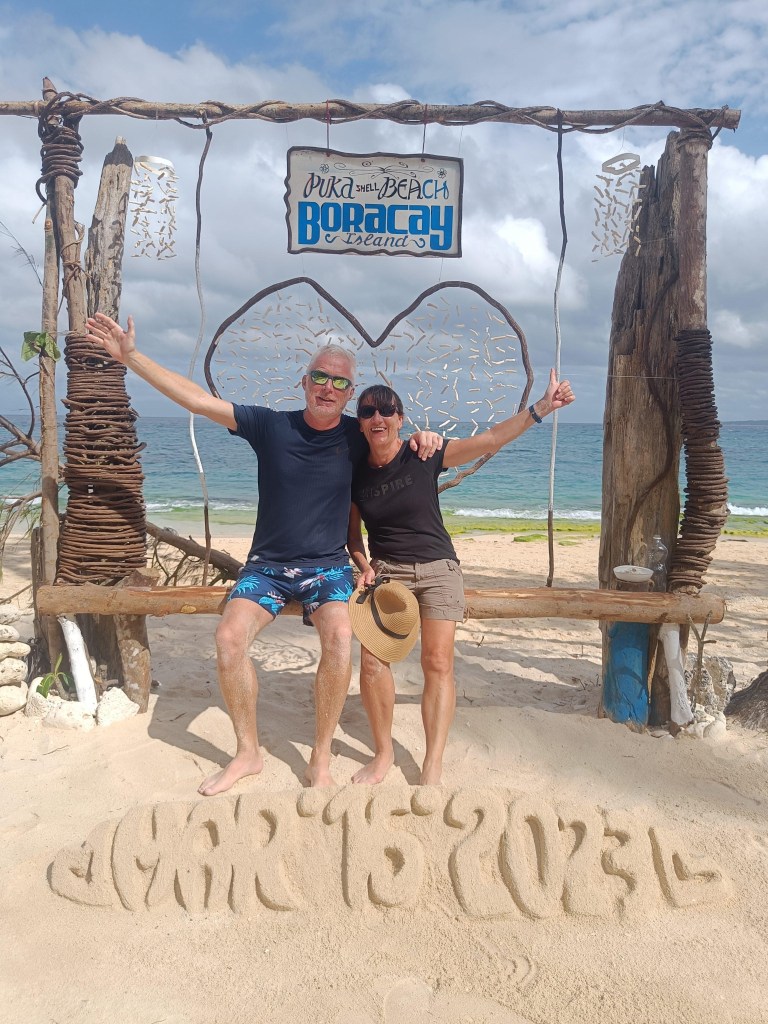
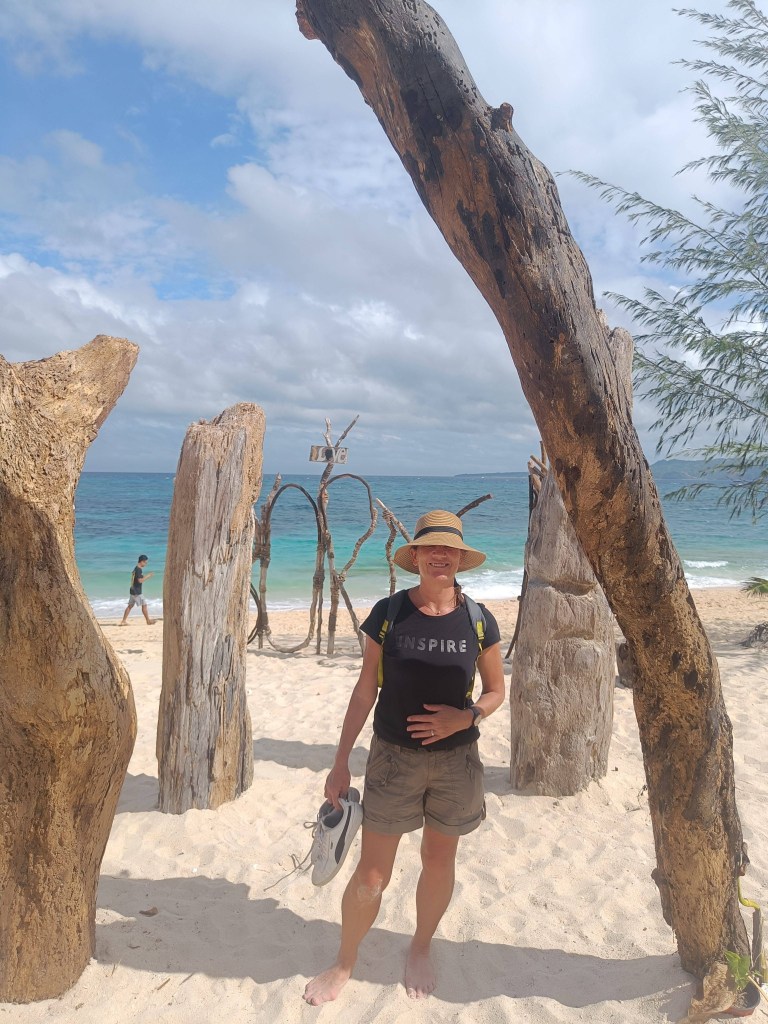
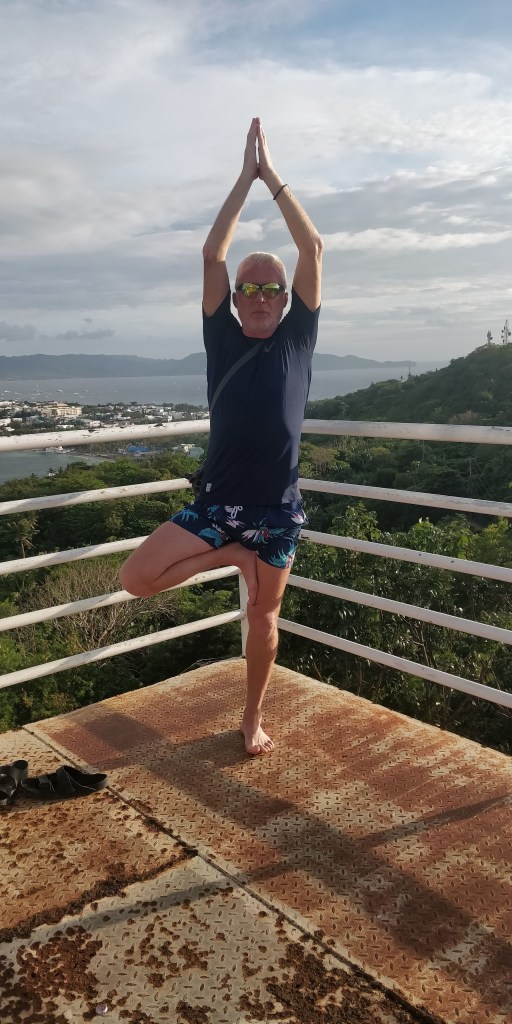
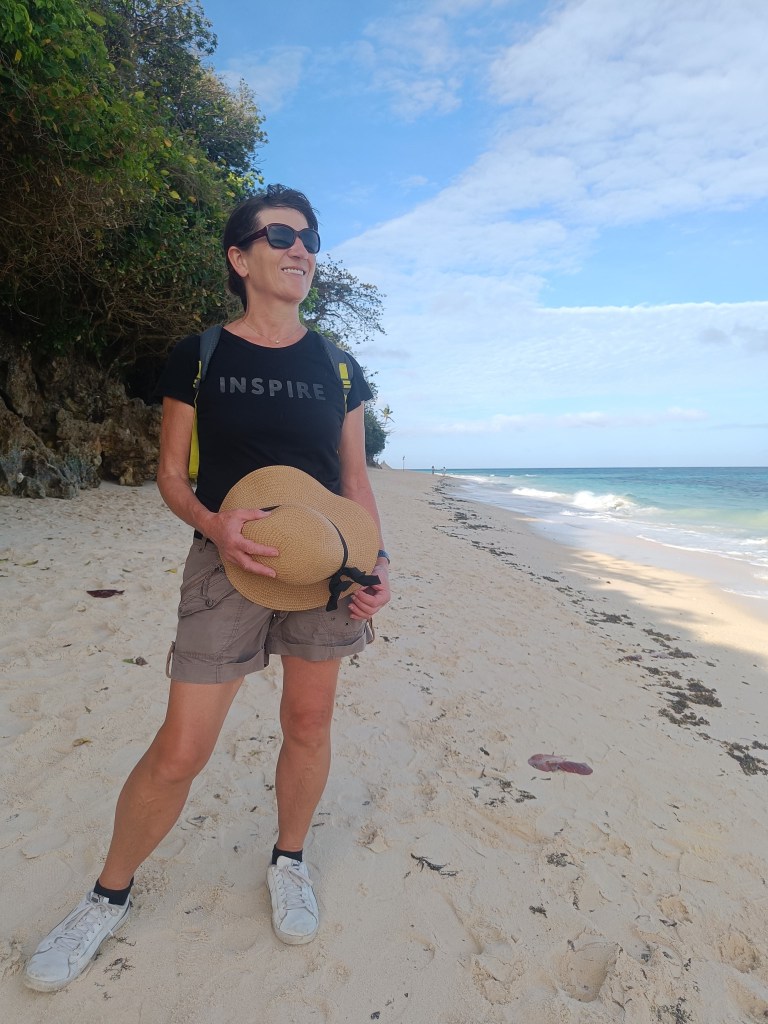
Boracay is beautiful. Lying on that silky white sand looking up at the swaying palms overhead, it was possible to zone out  the crowds. Swimming at dusk in the calm clear waters at the very Northern end of White Beach while watching a phenomenal sunset, was truly enriching. We walked to the highest point, Mt Luho with views of secluded coves, the golf course and the shells of several derelict hotels, abandoned through economic hardship or through contravening planning regulations.  We hiked to Puka Beach, famous for its shells where a lovely local man took photos of us (the cheesy ones with the hearts) while his twelve year old daughter danced on the beach, making a TikTok video. He hoped that some wilderness would be left on the island for nature and home for the monkeys, the pythons and the flying foxes.  The longer we stayed, the more beauty we found on the island and in the seas around it..

Boracay is a cautionary tale about the fragility of the environment and what can happen if rampart tourism is left unchecked. It is very difficult to blame the locals, they are trying to make a living in what is a relatively poor country.  It seems to have bounced back since 2018 but we certainly found the tourist numbers alarming albeit mainly concentrated in the White Beach area. Sustainable tourism is a buzzword but not that easy to implement. Environmental taxes are a good idea – as long as there is accountability.  We are fully aware that we (Caoimhin and I) are part of the problem. We try to stay in small places, as local as possible, eat what the locals are eating,  travel on buses and ferries but we are still showering and flushing toilets.

The Future??

As a penance or maybe as a salve to our conscience, we are heading onwards on Saturday to the island of Palawan on a slow ferry,  a very slow ferry. Details are sketchy and it seems to depend on winds and tides but it could take us thirty- six hours…. or more. Let’s hope it’s a bit better than our last slow ferry. But this St Patricks morning, we are about to Leave Boracay and take a six and a half hour bus journey back to Iloilo, which seems to be the only city in the world with an Irish pub.

Thanks for reading. Wishing everyone the rub of the green and a great weekend ☘️☘️☘️

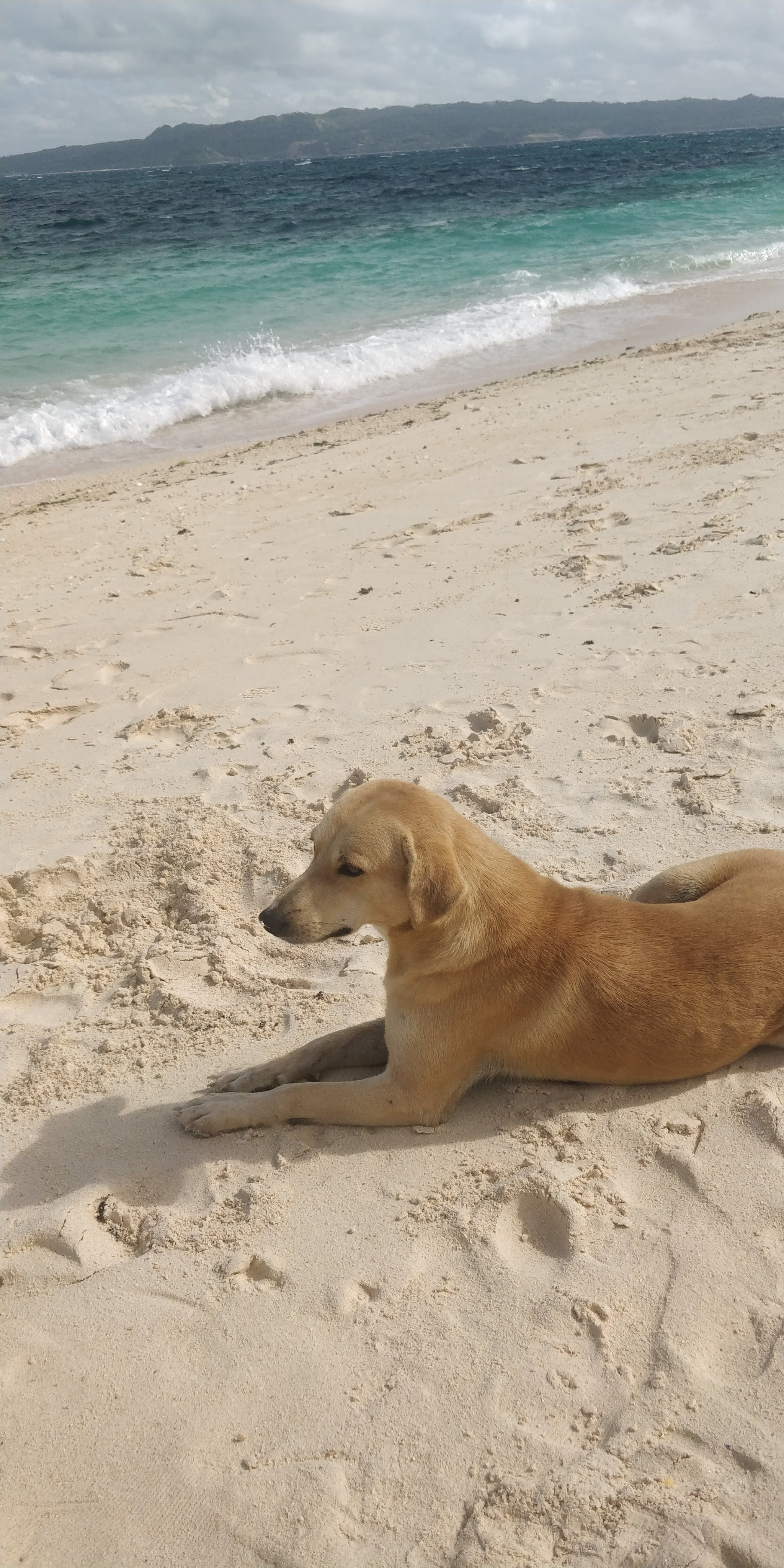
Boracay….where even the dogs are photogenic…but it did require four ‘takes’
Philippines – Boracay, the Paradise Island

Philippines_ Visas and Chocolate

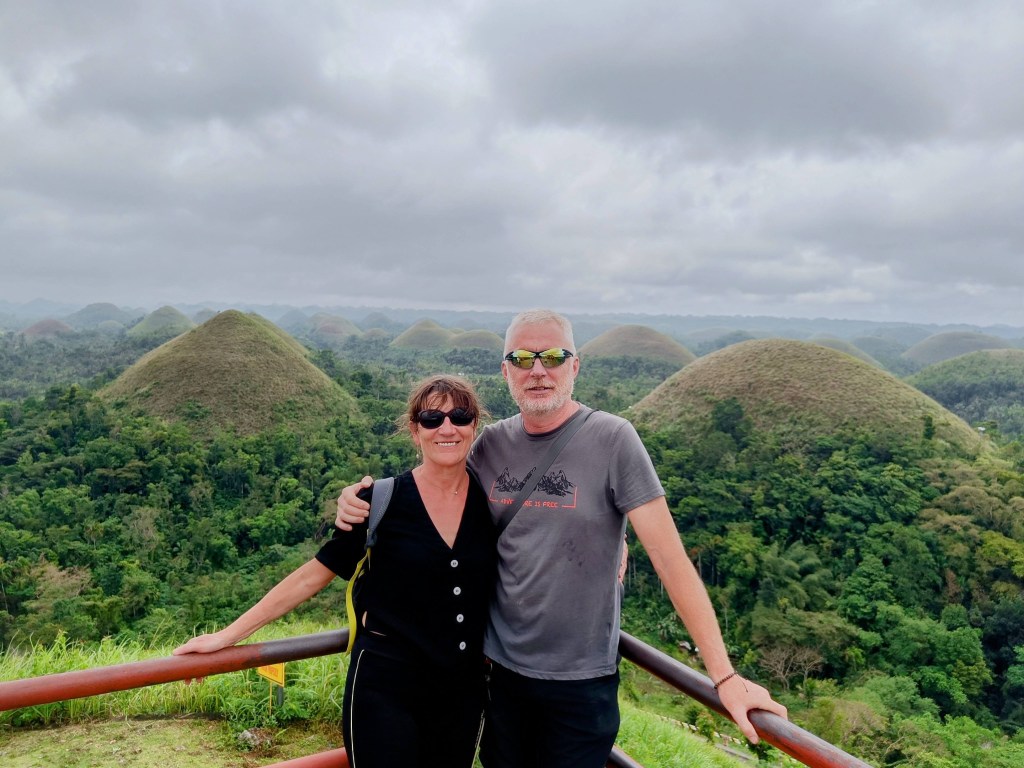
Chocolate Hills

This week was all about extending our visa. On arrival at the airport in Manila, we received a free thirty day visa but  this wasn’t long enough for us as our flight home was in over ten weeks time. The immigration official at the airport told us that it wouldn’t be a problem to extend, we just couldn’t do it there but it could be done in any of the many Immigration Offices scattered around the country. So when we found ourselves in Panglao  where there was an office, we pointed our rented motorbike in that direction  and set off to get it sorted although we had been in the country for only about 10 days,

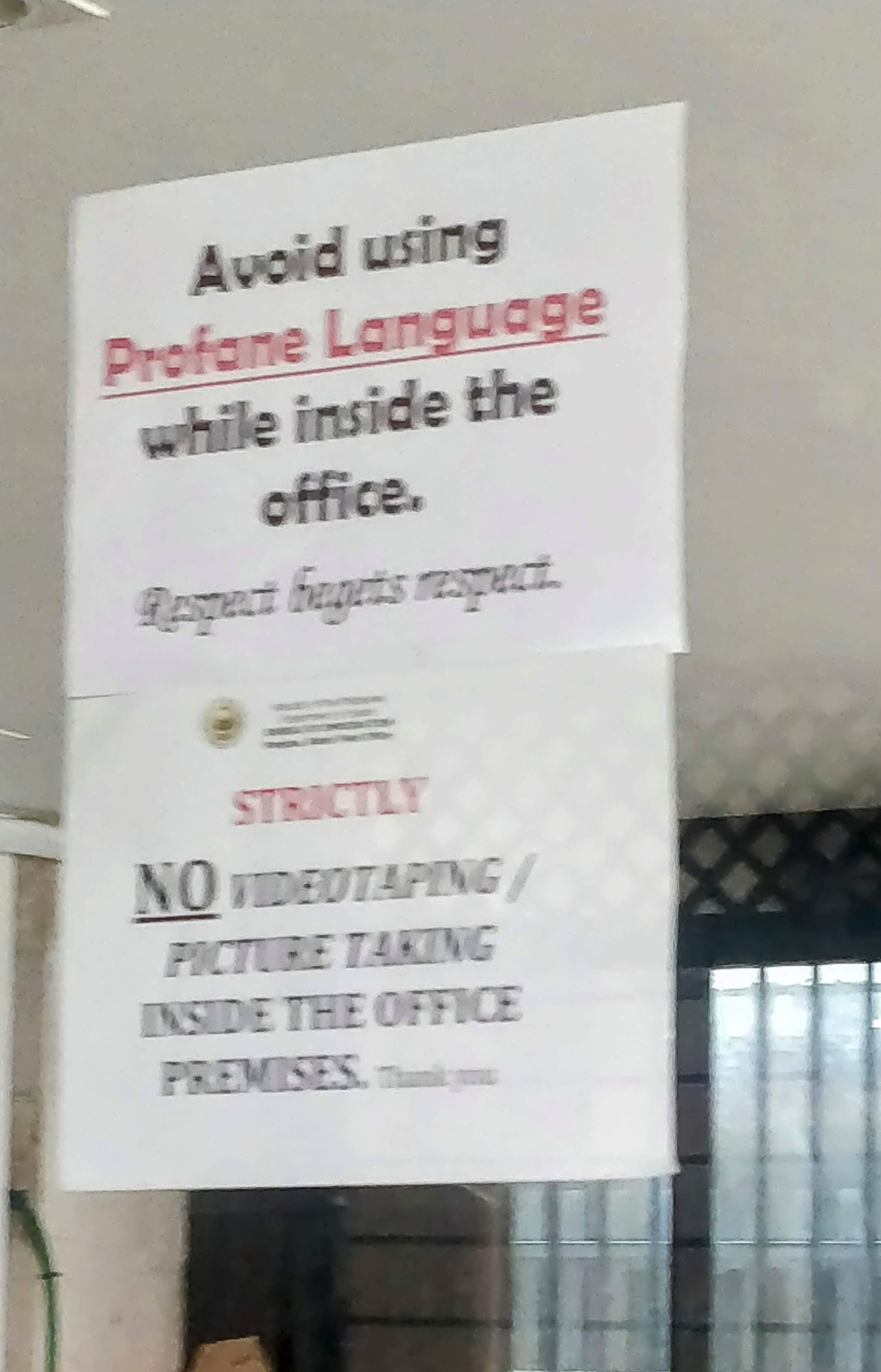
The Immigration Office was small, a counter with a couple of  window hatches and clear glass panel showing the airconditioned office behind with about 8 desks, computers and paper files. Most of the women seemed to be talking and joking with each other. It certainly wasn’t a hive of activity The customer side was stifling with one small fan in the corner and two rows of seats, about half of which were broken. There was a large sign on the glass panel cautioning against using profane language😮. We were told that we had to first apply for a 29 day extension (pay about €50), fill in a form including a hand-drawn map to our accommodation, leave in the passports overnight, pick up them up the following day and  then reapply for another month (pay about €100), drop the passports in again overnight and pick up the next day. It couldn’t be done in one application. The glass panel, the masks that the officials were wearing, poor English and the loud pop music being played in the office side were all barriers to understanding what was required. Most people were scratching their heads in confusion. The officials told everyone to come at 3pm to pick up the passports so there’s a queue out the door at that time. Luckily we ignored the 3pm rule and went at 2pm when it was relatively quiet. But after three lengthy visits and handing over wads of cash (exact amount in pesos only, no bank cards accepted), we have our visas until May. I swear no profane language was used in the transactions😇🤣

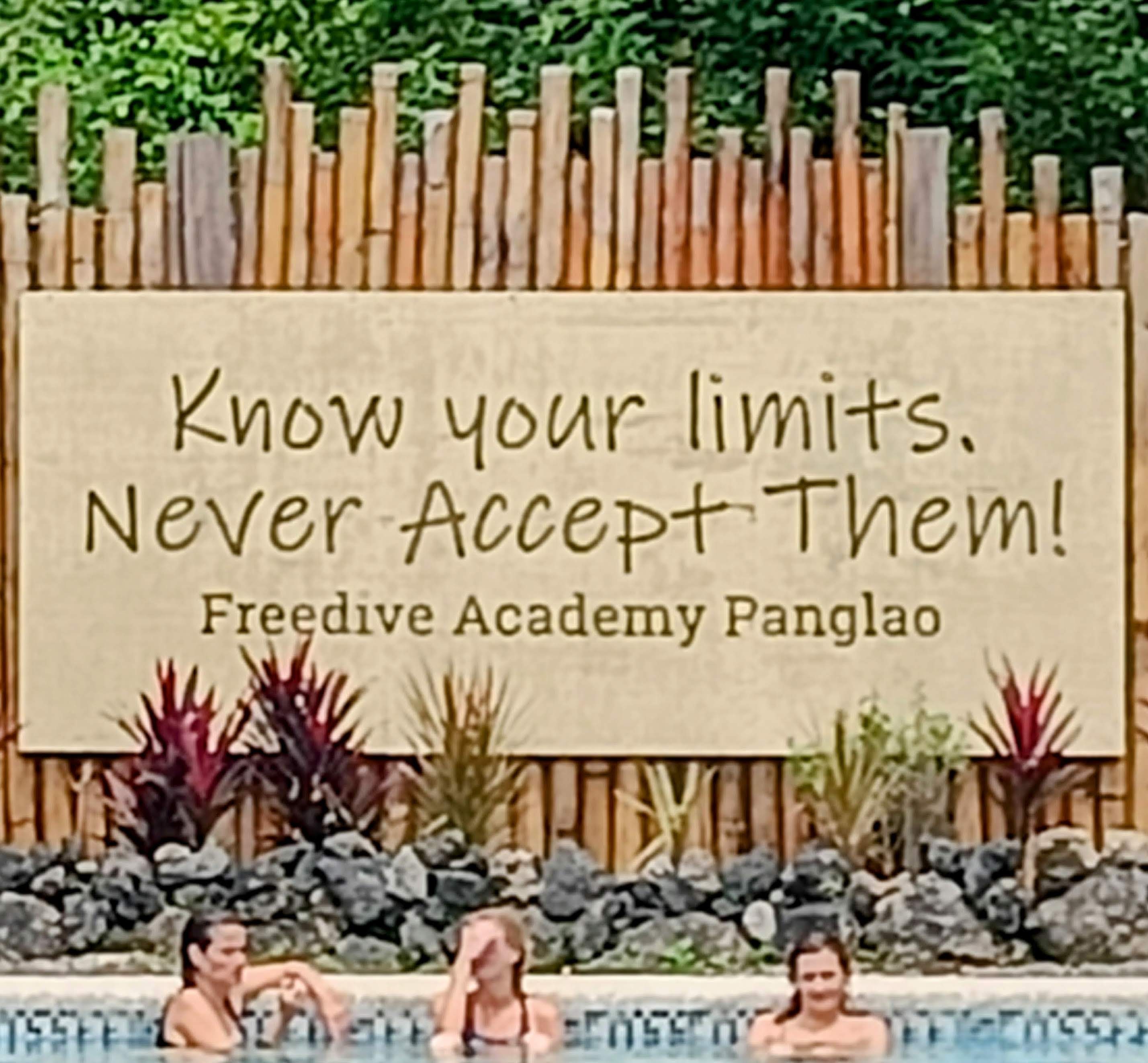
Caoimhin found time to do a freediving introductory course, he has great admiration for fish.  Freediving involves diving without using any equipment and is very popular in Panglao particularly with Koreans who have a couple of dive schools here  exclusively for Koreans. We both visited  the other free-dive centre, run by a very tall focused Austrian. I loved the big quote over the door and behind the pool. Know your Limits. Never Accept Them.  In the case of freediving, I both knew and accepted my limitations.  I opted for a swimming lesson in the pool instead, preferring to stay on the surface of the water….if I can😀.

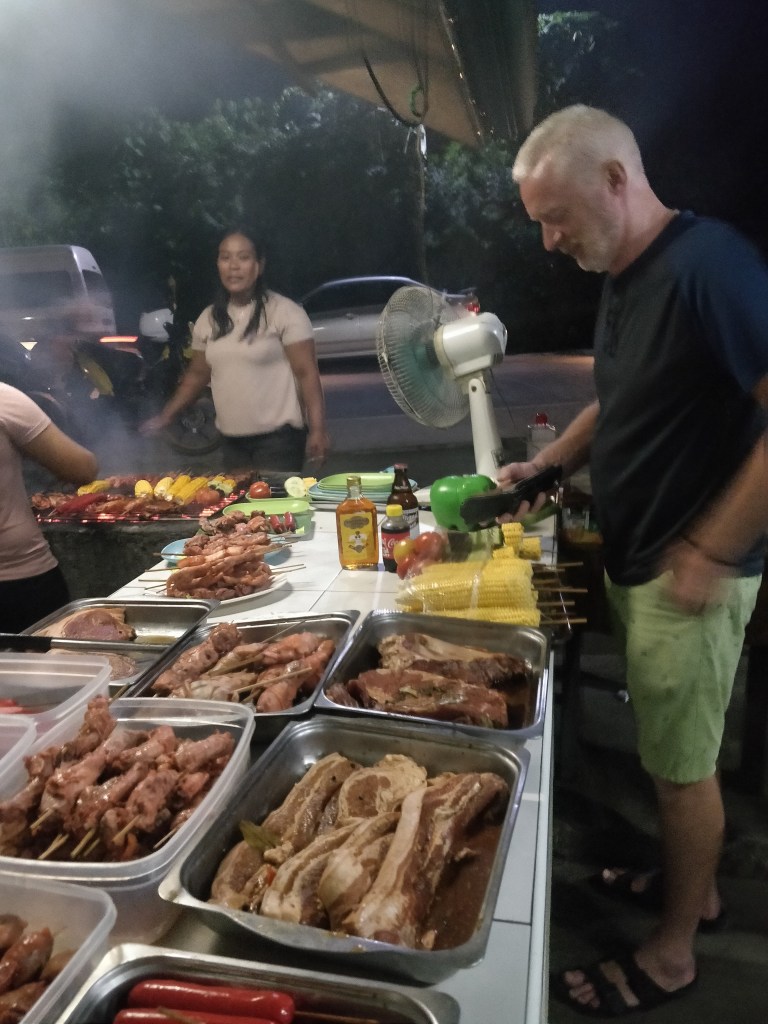
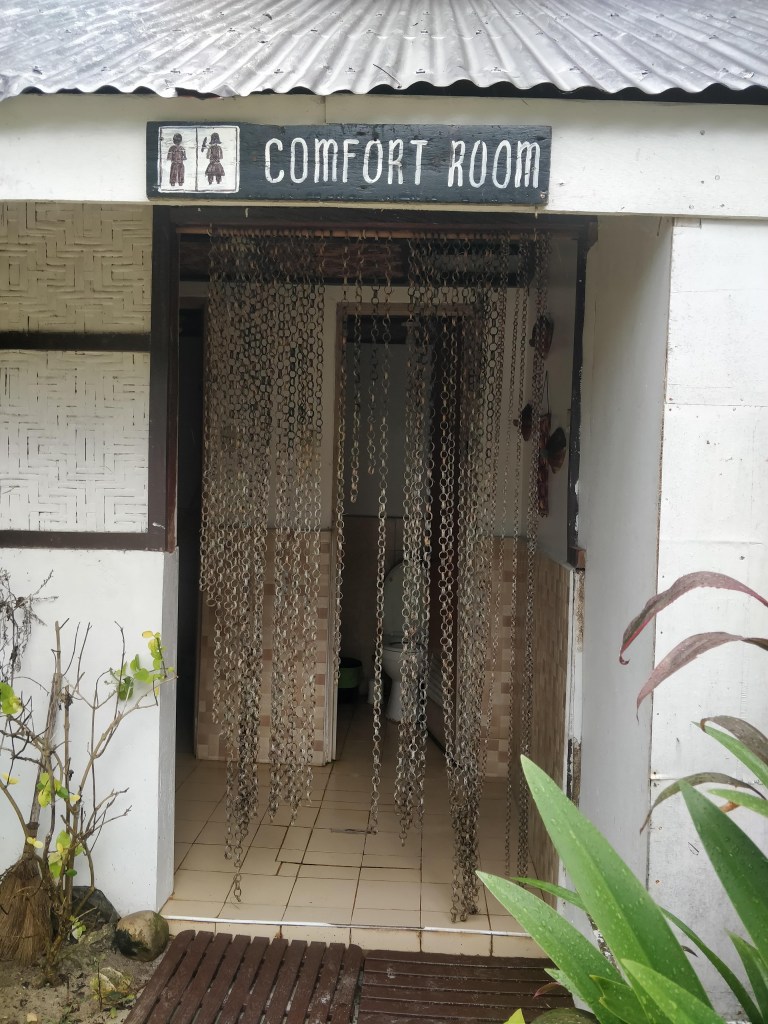
The Filipinos are not fond of knives as a cutlery utensil, usually making do with  a fork and spoon. They love their fried chicken but there were barbecues on Saturday night in Panglao which were a serious meat-fest, washed down with Tanduay rum, Pilsen beer or Red Horse (a potent beer at nearly 7%)😮. Toilets in this part of the world are called comfort rooms – I’m not joking. The mosquitos in the toilets in the accompanying photo certainly looked very comfortable🤣. But usually the standard of cleanliness in most places was high.

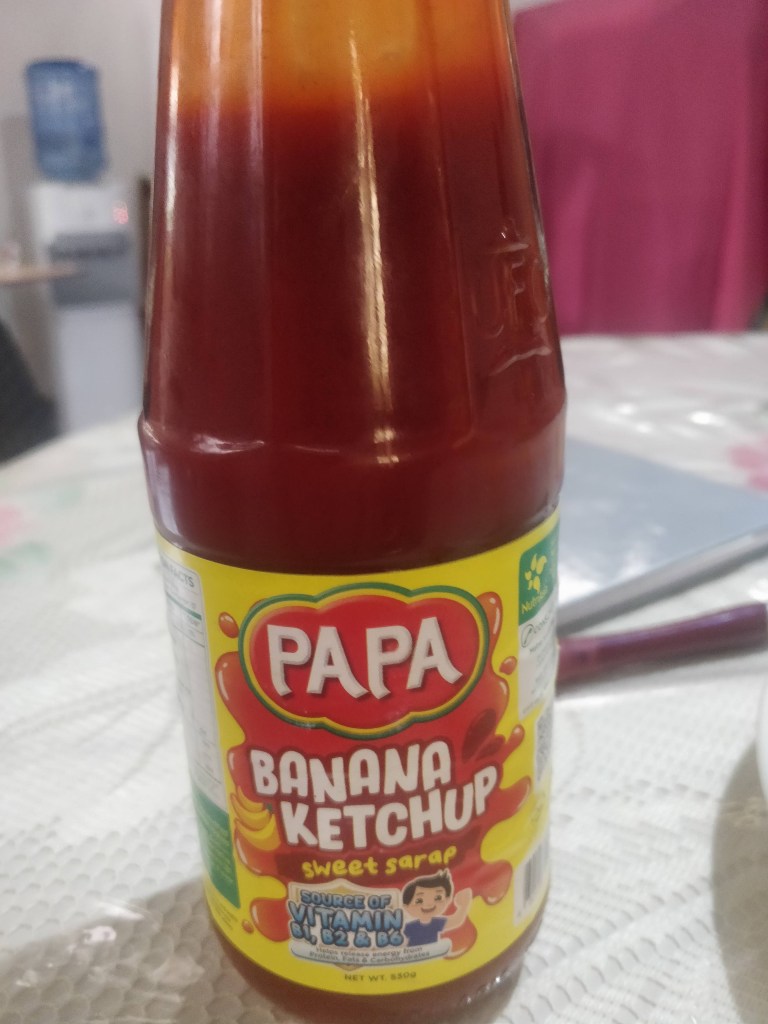
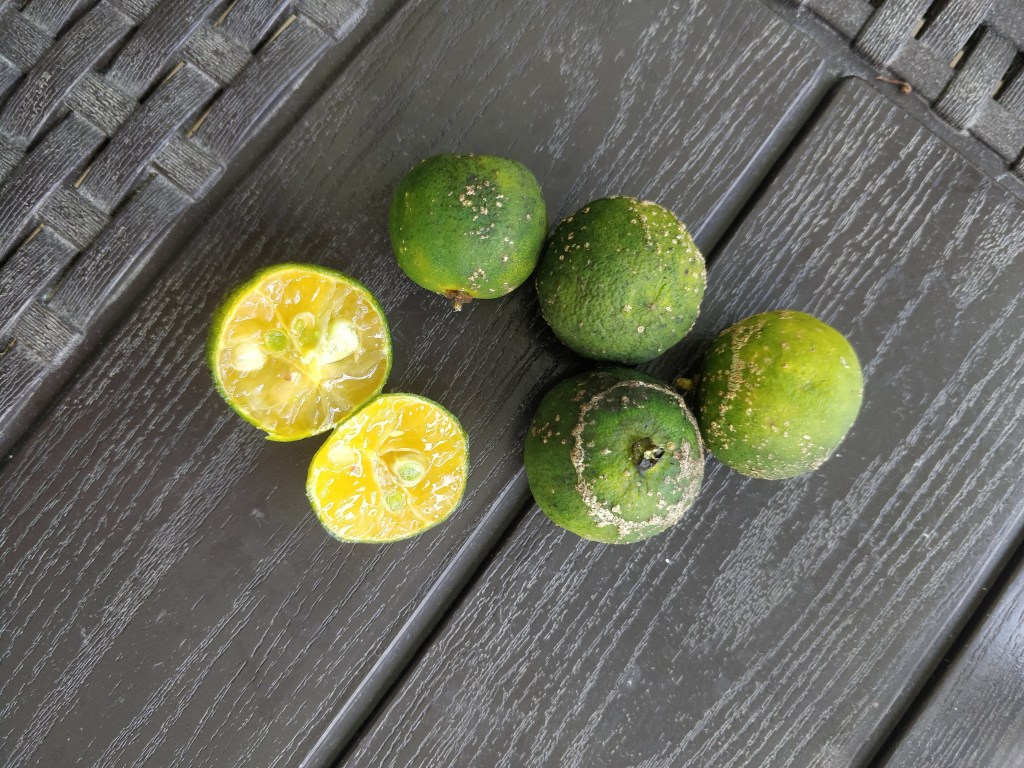
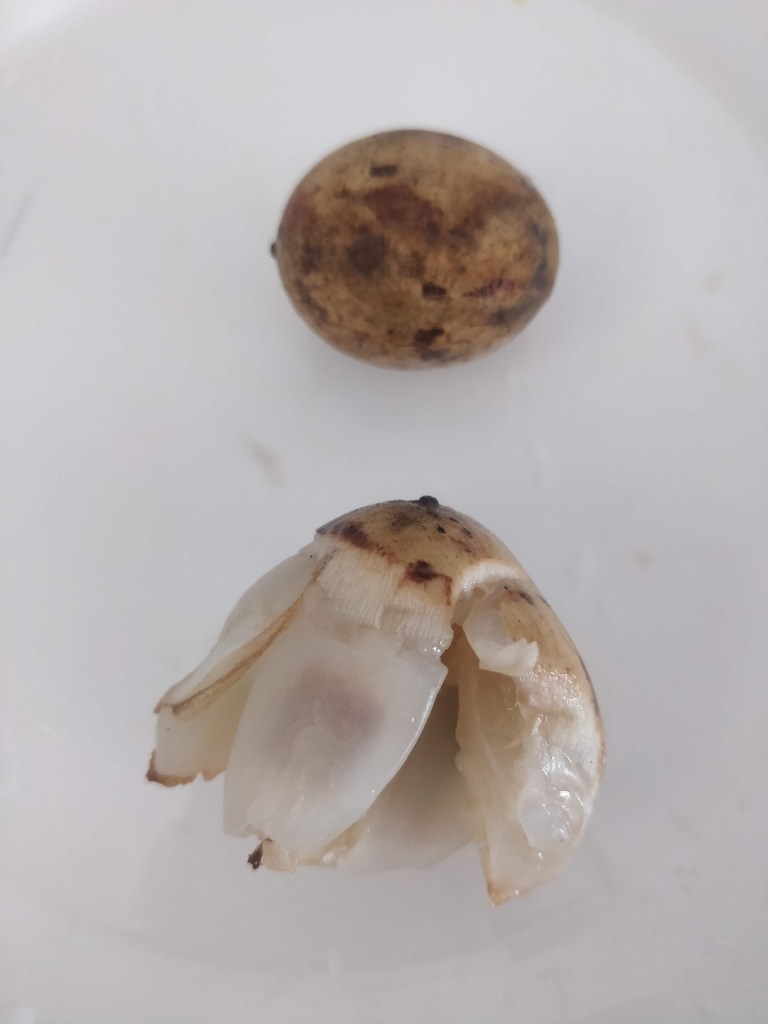
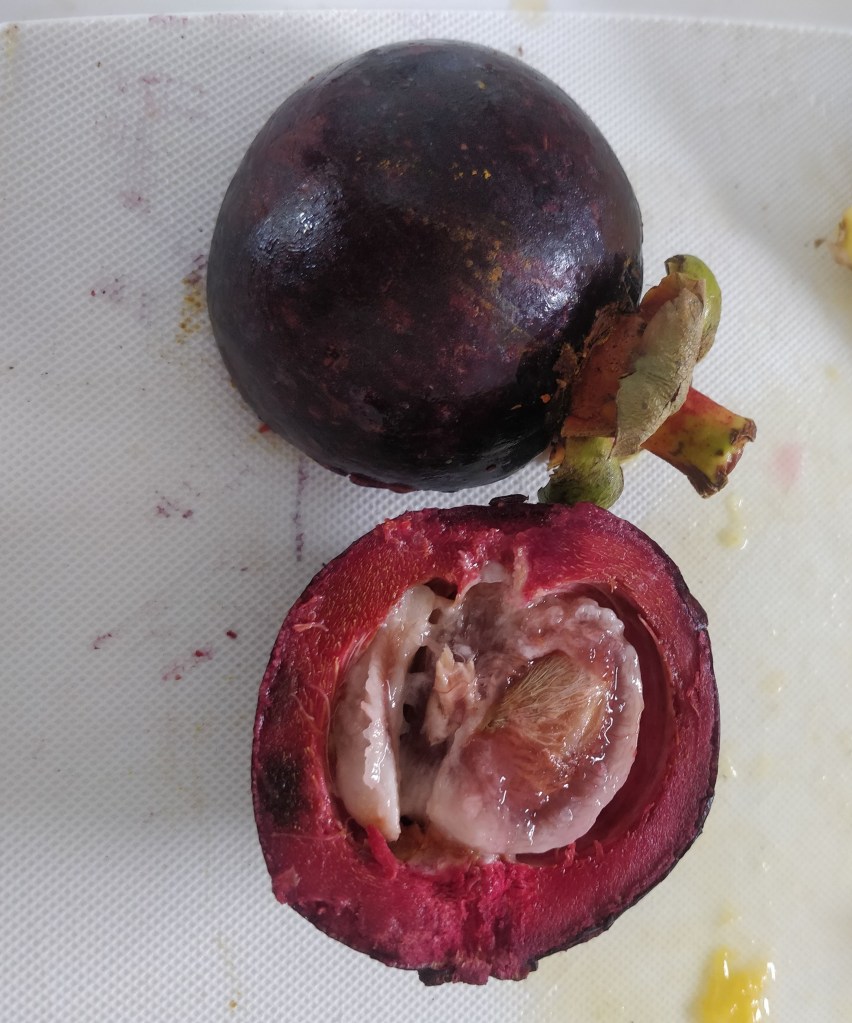
Of all the strange and exotic fruits available here, mangoes must be the most delicious. the depth of flavour was like eating a sunset. No wonder they are the national fruit of the Philippines and were for sale on every roadside, sometimes speckled and battered but always a treat for the tastebuds. Then there’s calamansi, which look like tiny limes but are orange on the inside. They have a sour taste with a sweet after kick and are used in sauces, marinades, drinks or to squeeze over Filipino dishes. When we first saw a basket of lanzones, we thought that they were tiny new potatoes (we got excited for a minute…) but inside the thin peel were small translucent segments which were light, refreshing and tasted a little like a sweet grapefruit.  The mangosteen, a round fruit with a thick, leathery shell and soft white flesh,  were very popular but to us they didn’t really taste of anything. Ube was another fruit/vegetable that we had never seen before but it’s a purple yam that finds its way into many Filipino cakes and desserts. You can’t miss it as it gives a bright purple or indigo colour to cakes. Despite the slightly off-putting colour, it  has a vanilla flavour that’s slightly nutty, delicious in ice cream. Bananas were very plentiful and the Philippines had a novel use for the glut. They made ketchup –  bananas, red colourants and stabilisers equalled banana ketchup…..a bit sweeter than tomato ketchup but very similar.  

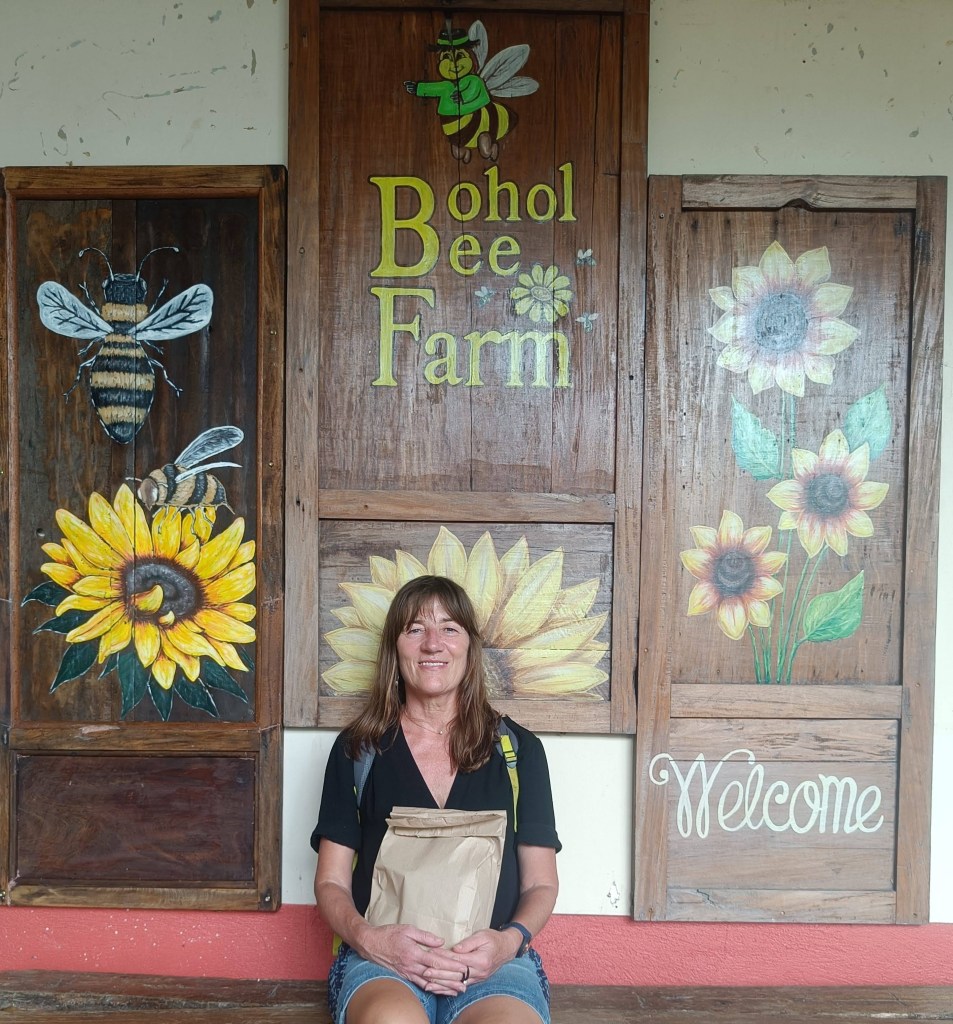
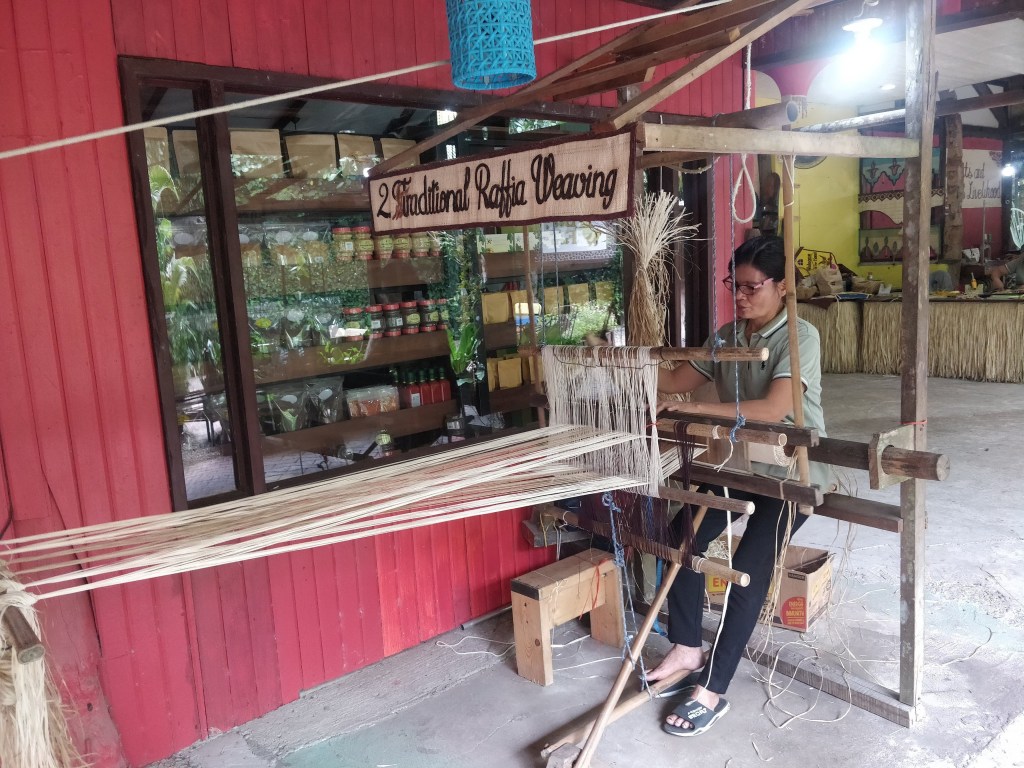
Despite the name, Bohol Bee Farm was a place without bees. It started out as a little concern with a few hives and grew into a big co-operative organic farm employing about 300 locals, mainly women, with people on site giving demonstrations of making leather goods, weaving baskets and making ice-cream. The bees disappeared during the pandemic (for unclear reasons) but it  has a big restaurant, where the emphasis was on locally grown food which was the best we had on the island. We ate delicious salads and mouth-watering squash bread with both a garlic spread and honey….all available to buy in the attached gift shop. But the highlight was definitely the ice-cream. I opted for chocolate (boring, I know) when there were exotic choices like spicy ginger, dragon-fruit and jackfruit. Caoimhin had the purple Ube ( the purple yam that I mentioned above.) Fantastic local development and employment.

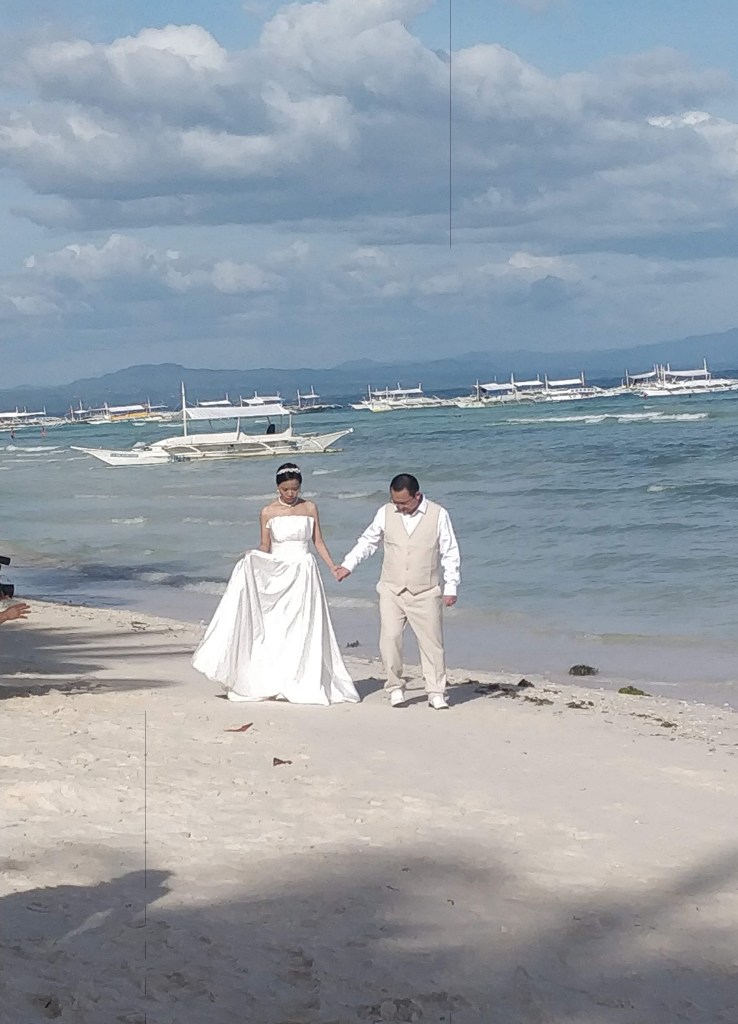
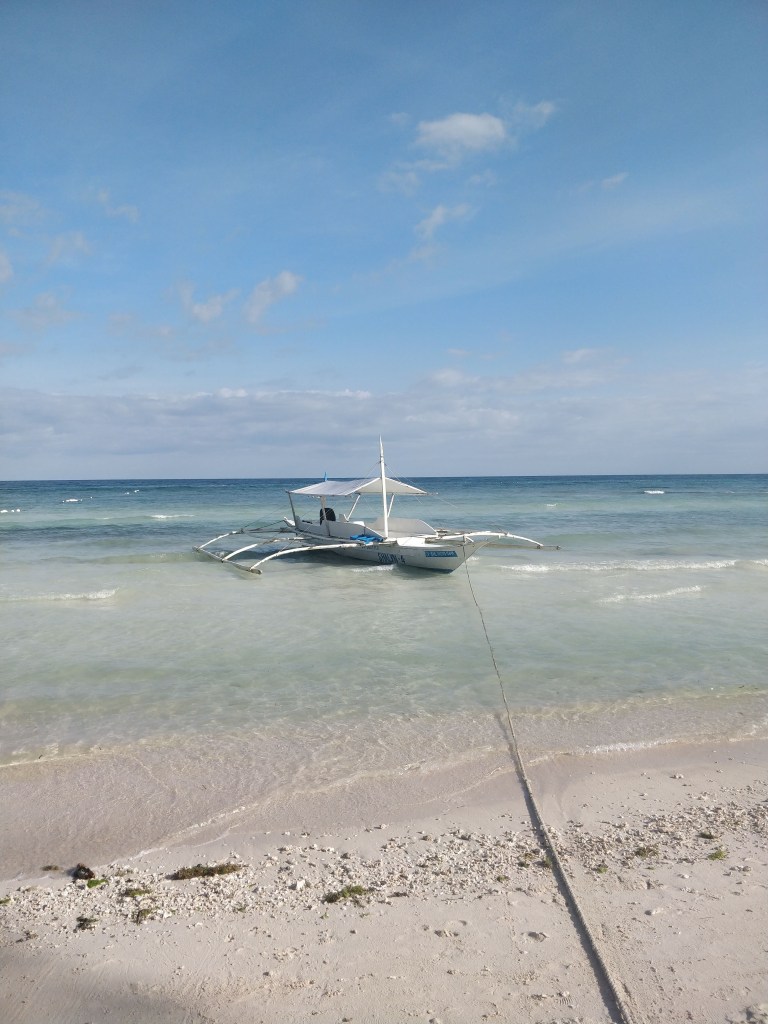
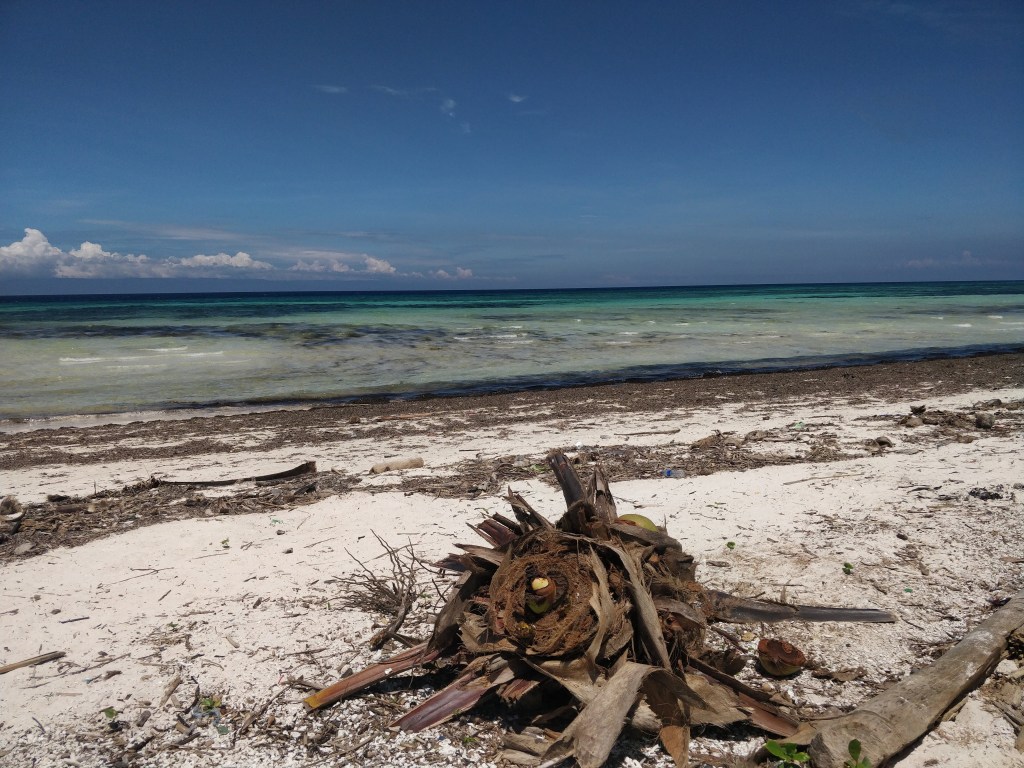
In Panglao, the most famous beach was Alona Beach. Yes, it was beautiful but so busy with tourists and touts wanting to sell you boat tours, souvenirs and massage that one visit was more than enough for us. Quite a few of the other beaches demanded payment for entry- it wasn’t a lot, 100 pesos (€1.70)  but the principle grated a little. We spent a very enjoyable afternoon trying to get onto a beach for free, there were long stretches of beach along the southern coast of Panglao. We sped around on the motorbike, making a U-turn whenever payment was demanded until we reached an isolated spot where a lot of motorbikes parked. We walked  over a rough path through a field of goats and found out way onto the beach, the same beach where we were denied access unless we paid…..kms of uncrowded white-sand with beach bars, no touts, mainly Filipinos enjoying a swim and some karaoke(it was Saturday afternoon and Filipinos love karaoke). There was even a small wedding party on the beach. But we found driftwood and peace the further we walked, just the lapping of water and the boats bobbing on a turquoise sea.

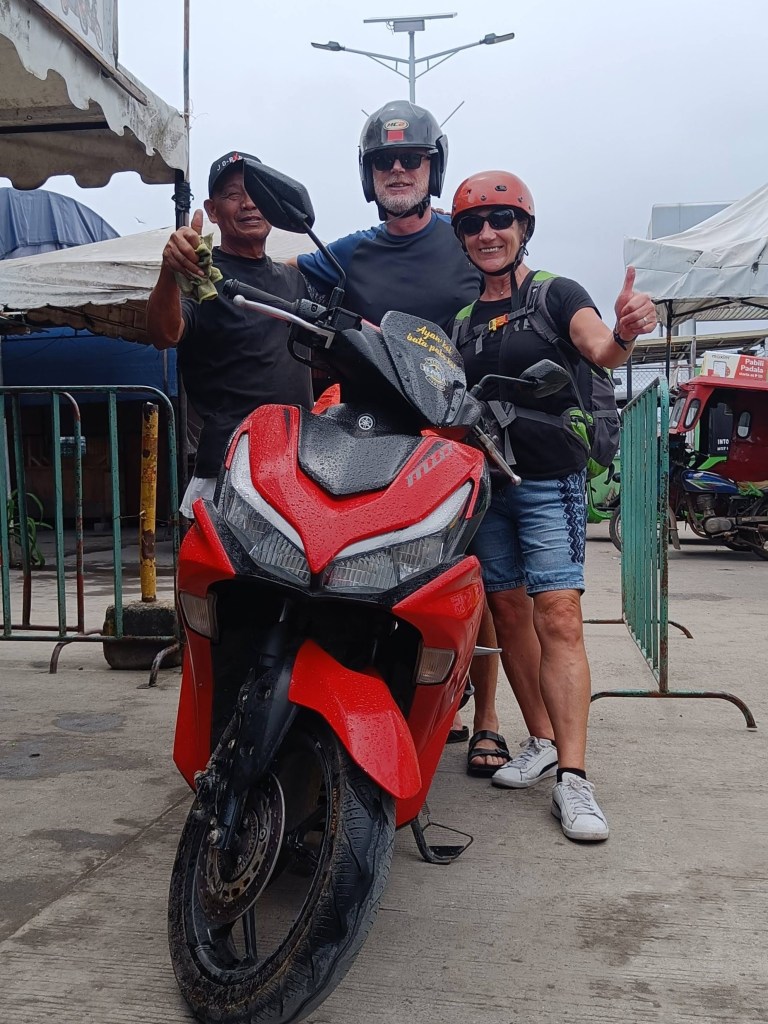
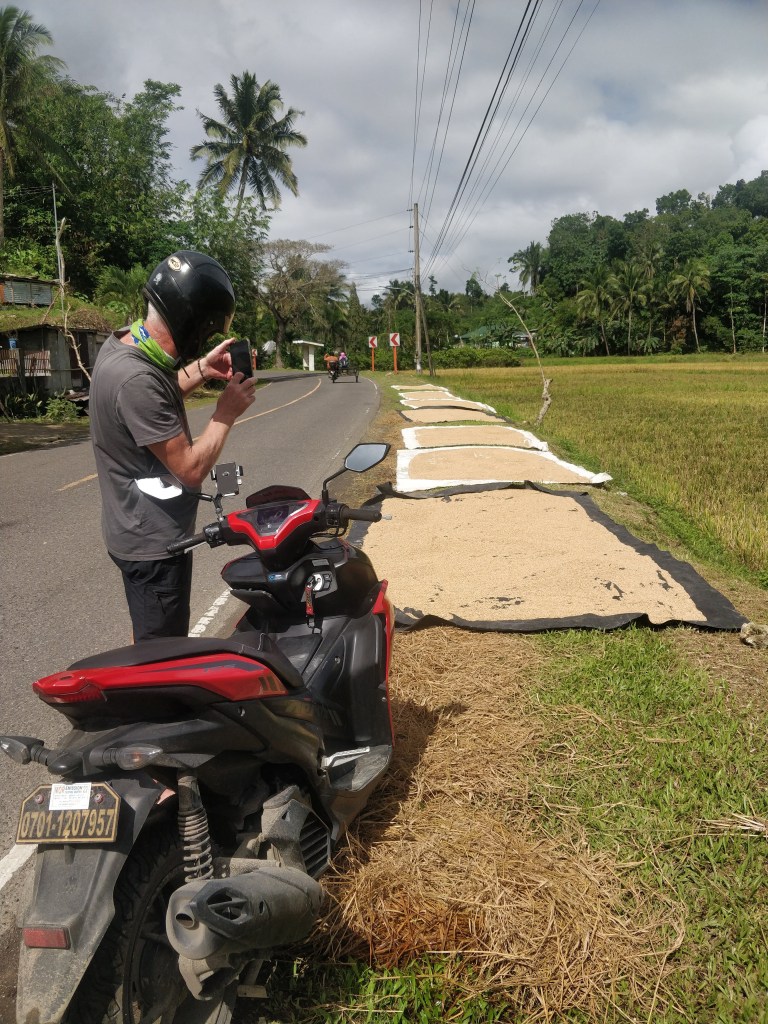
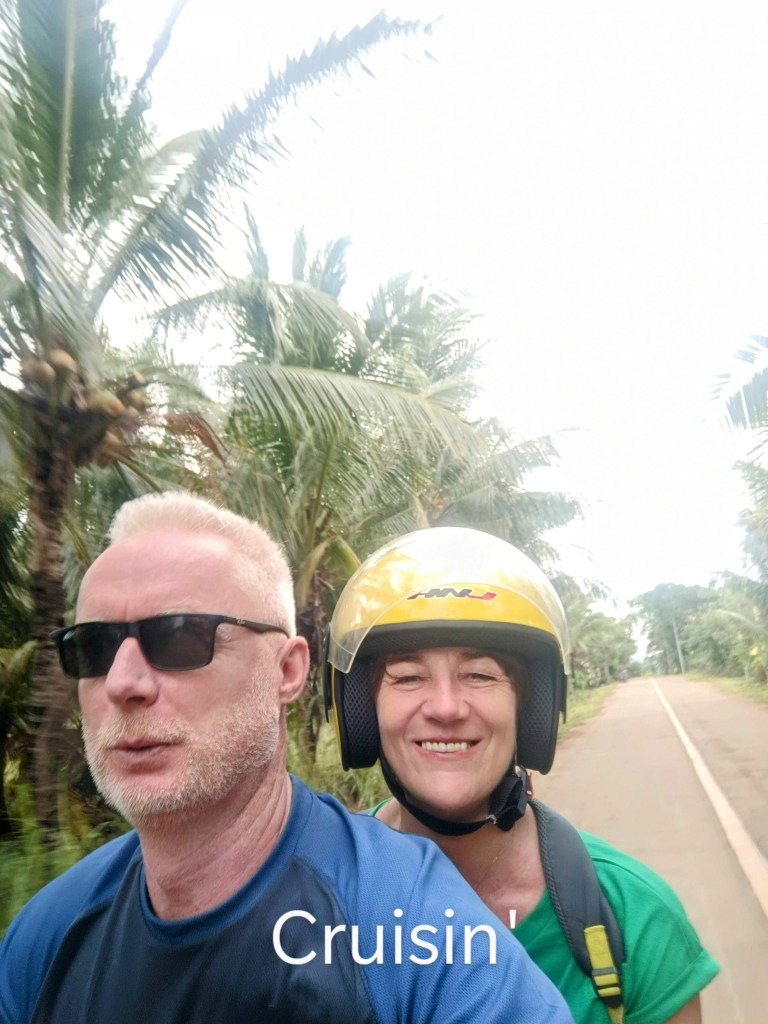
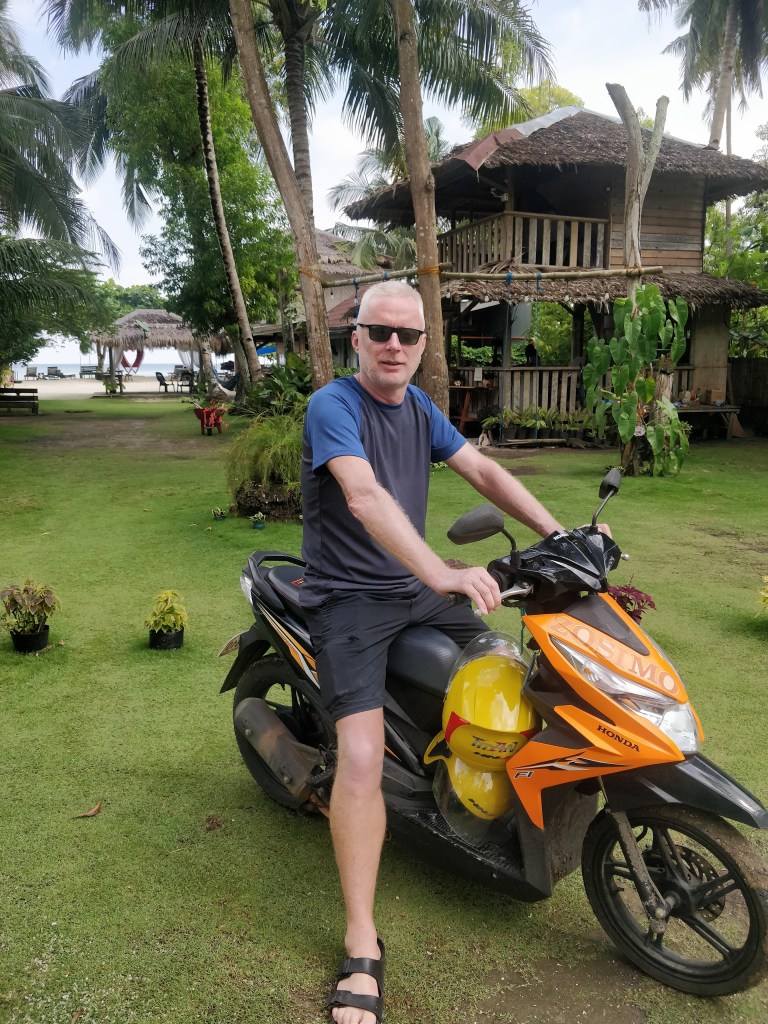
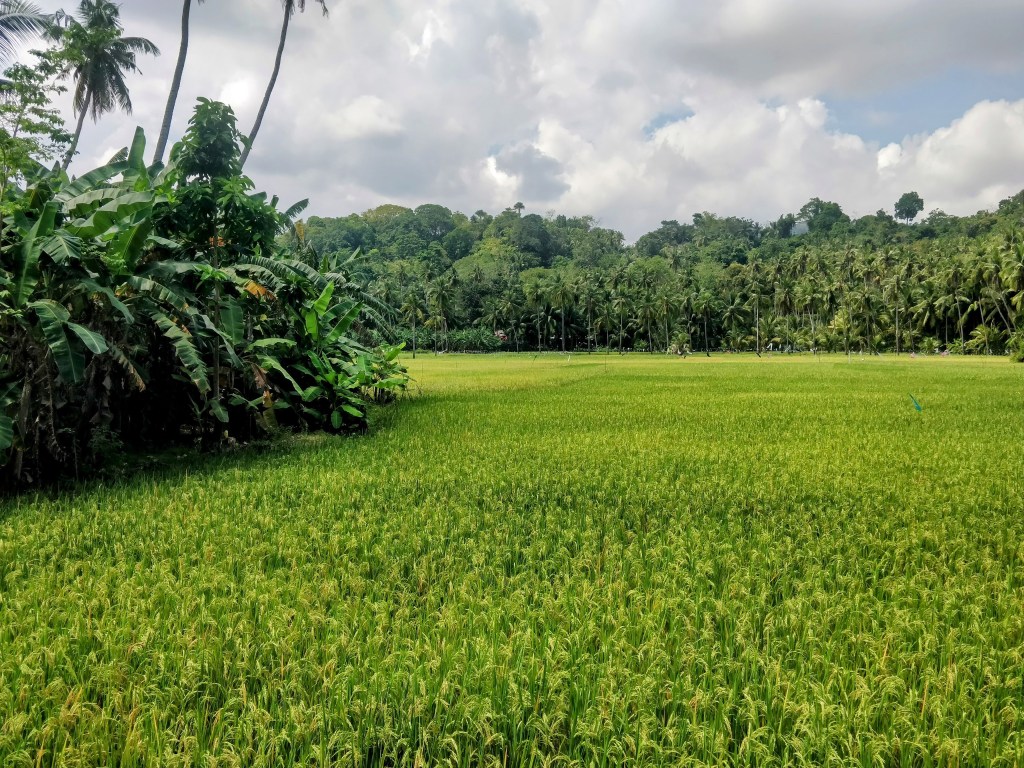
After a week in our (relative) luxury bubble in the Portofino Resort in Panglao, it was time to head for the hills. Searching for a rented motorbike to take us there, we met Mario, a small man with a big smile who stood sipping a beer at midday on an overcast Sunday. Life was good for Mario because since Lonely Planet recommended him in their guidebook, his business was thriving . All thirty two of his motorbikes were rented out to tourists…..he raised his glass to Lonely Planet. He had only one left, a large red motorbike (155cc), the price for which kept decreasing the more we hesitated. Finally we settled on a price and zoomed off wearing helmets that smelt of sweat and wet hair. The day was damp and became wetter, travelling through villages, paddy fields and dense forests until we dripped into Fely’s homestay like drowned rats. We were told that such prolonged heavy rain was unusual in March, usually one of the driest months. We pitied the people trying to dry the rice grains which were spread out on plastic sheets by the side of the road.

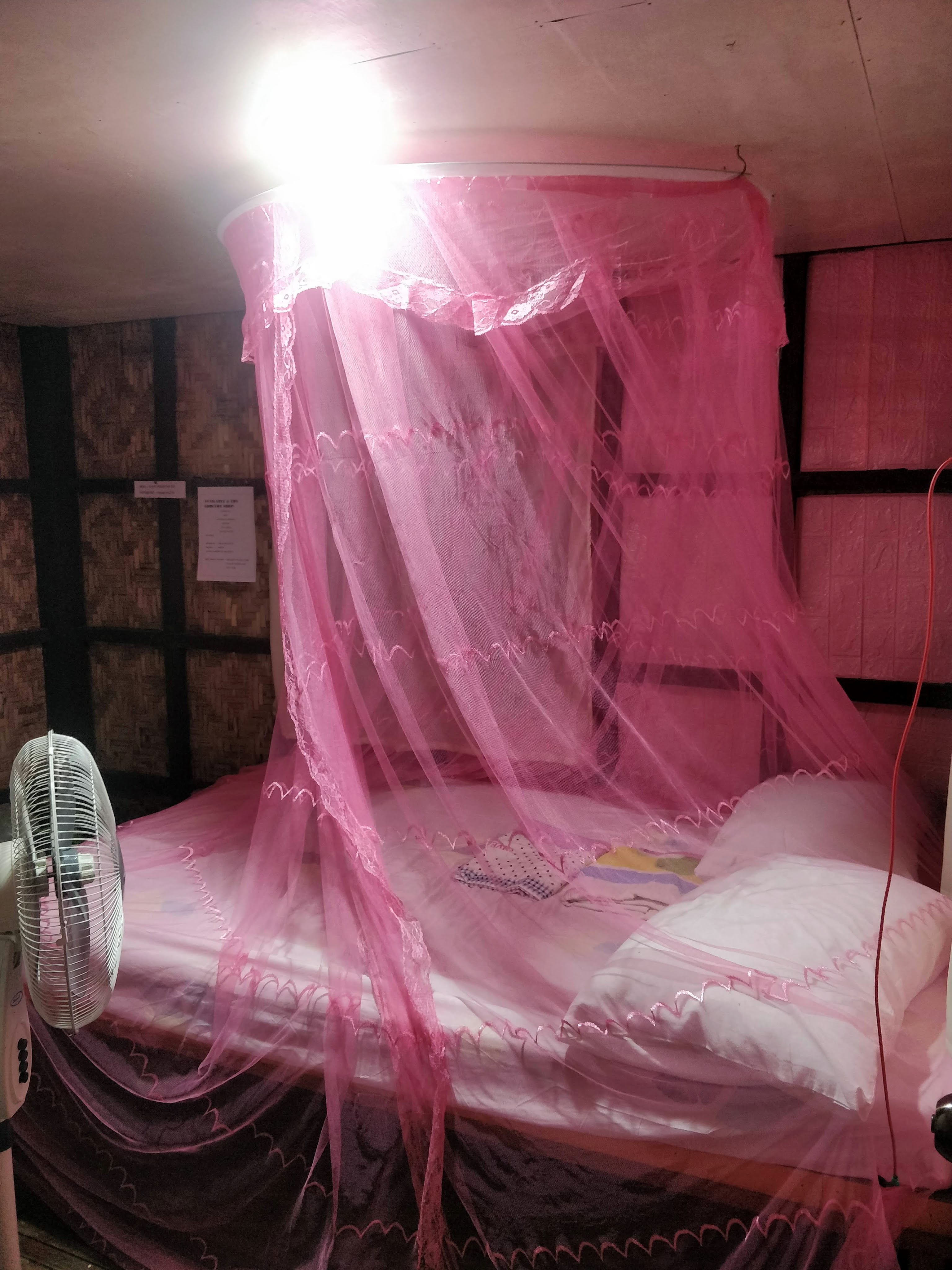
Fely’s was a friendly house in a small village run by Fely and her sister Maria with some help in the shop from their 82 year old mother. All three women were widows. Fely’s husband had died suddenly from a heart attack two years previously leaving a teenage son. Fely was also a teacher in the local elementary school and taught a class of 10 year olds.  With only 16 pupils in her classroom, many Irish teachers would be envious of that pupil/teacher ratio.  Our small room was a riot of pink,  pink walls, pink mosquito net.  The rain hammered on the roof while a little stream flowed almost under the floor so we had water above and below. Maria did most of the cooking and wanted to be me, travelling around the world with a (younger) version of Kenny Rogers…she was a great fan of Kenny. 

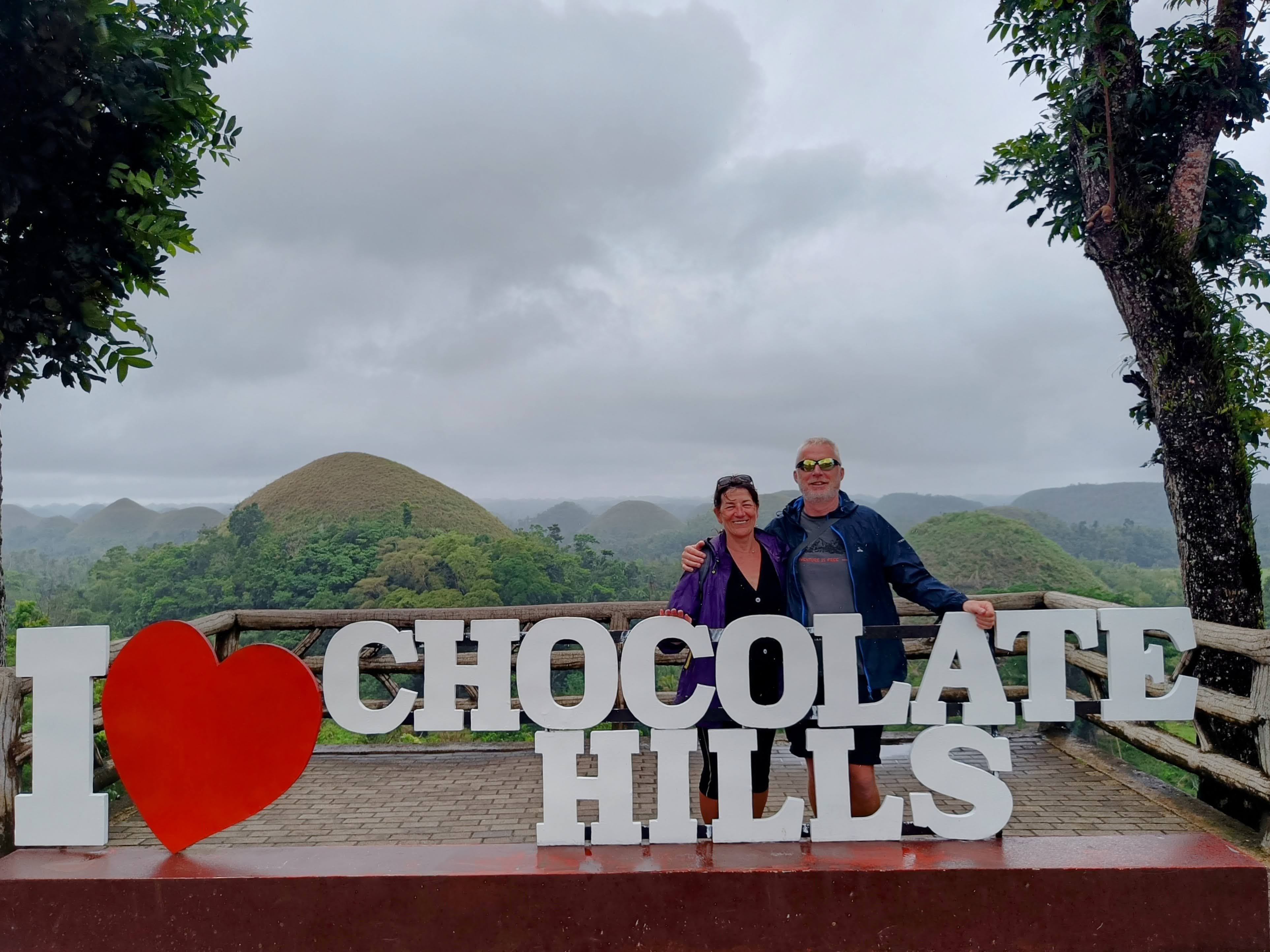
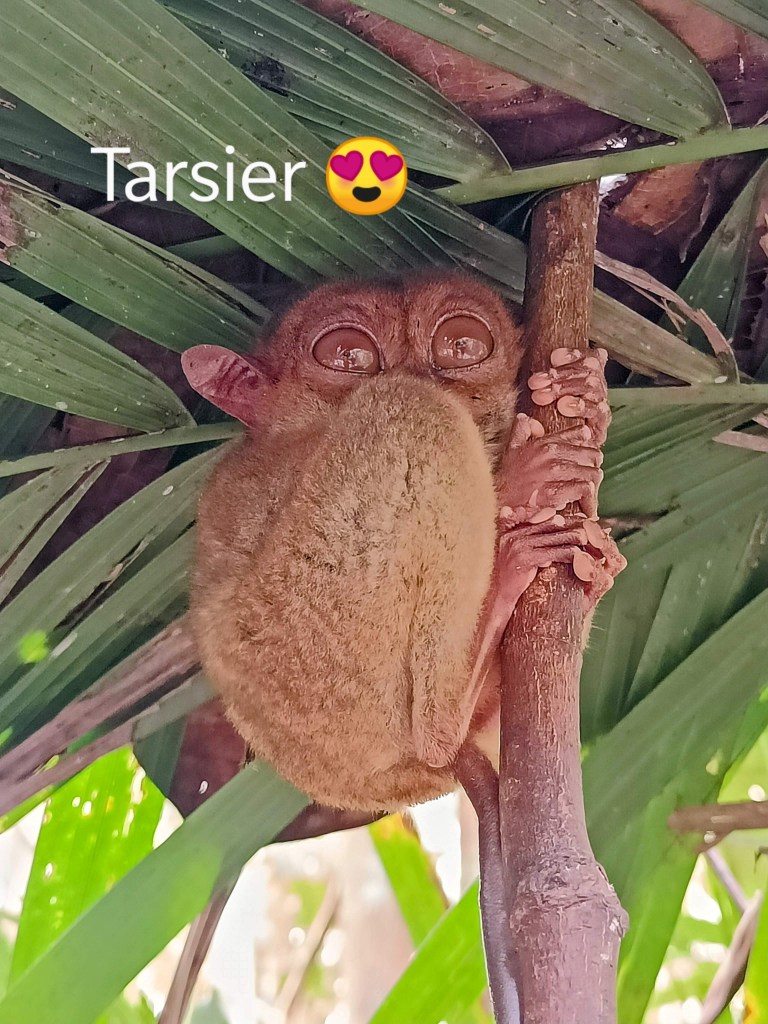
One of the main attractions on the island of Bohol are the famous Chocolate Hills, which weren’t far from Fely’s. The view was reputedly amazing, a series of nearly two thousand cone shaped mounds stretching into the distance, formed in the dim distant past from upheaval in the coral sea and subsequently weathered into these shapes. The hills, usually turned chocolate- brown this time of year, were green courtesy of all the rain. The banks of grey cloud on the horizon the morning we visited meant that they were barely visible at all. The other attraction in Bohol didn’t disappoint us. These were the tarsiers, tiny little nocturnal monkeys that would fit into the palm of a small hand, with eyes so big that they weigh about a third of their body weight and are heavy on the cutie appeal. While guides pointed out where they were resting on the trees, the public was not allowed to get very close.

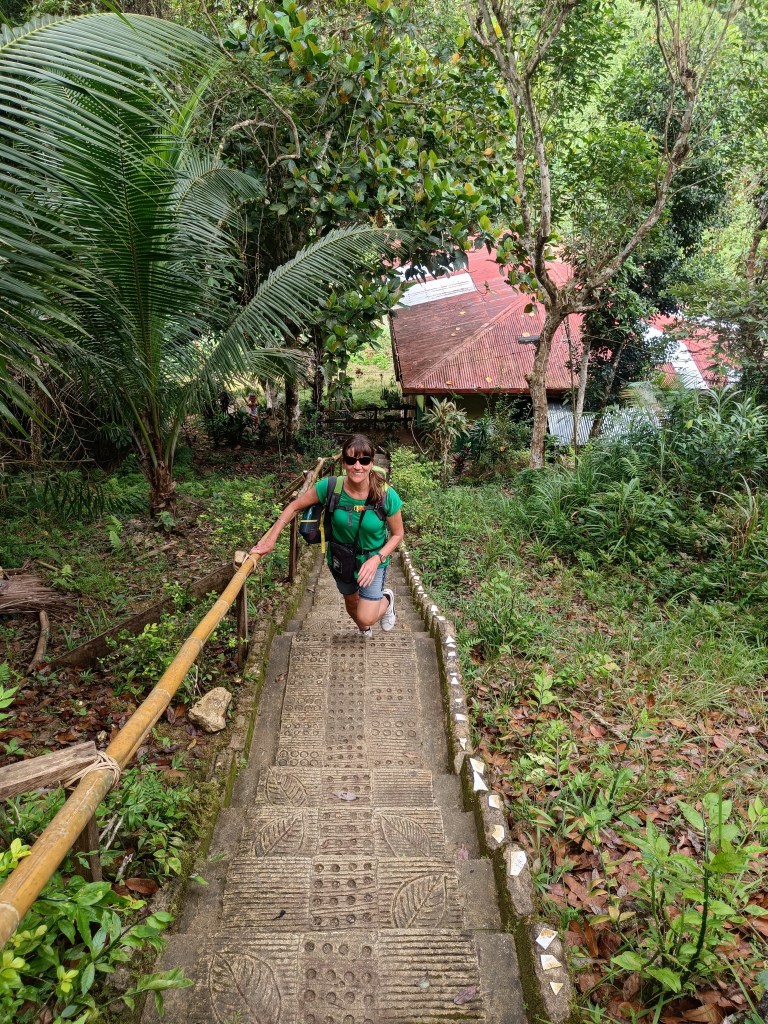
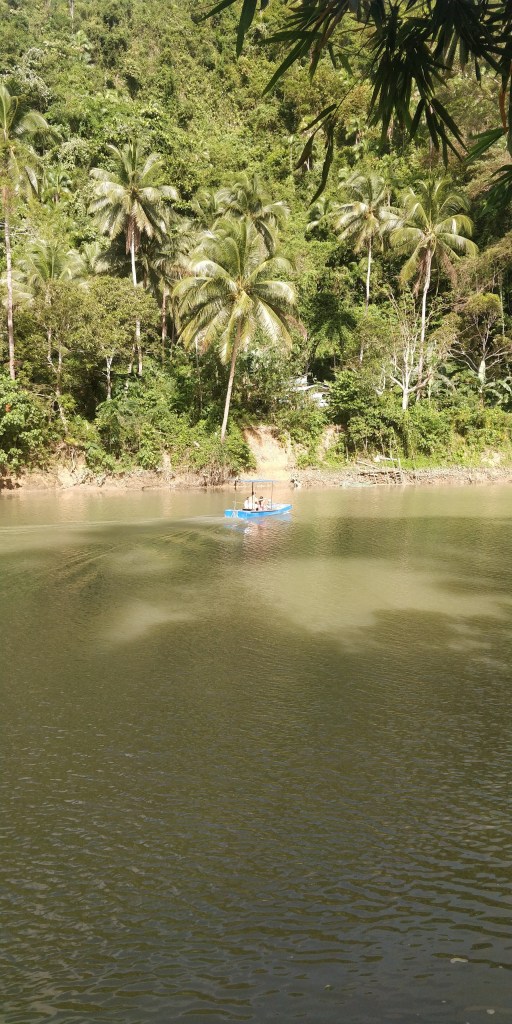
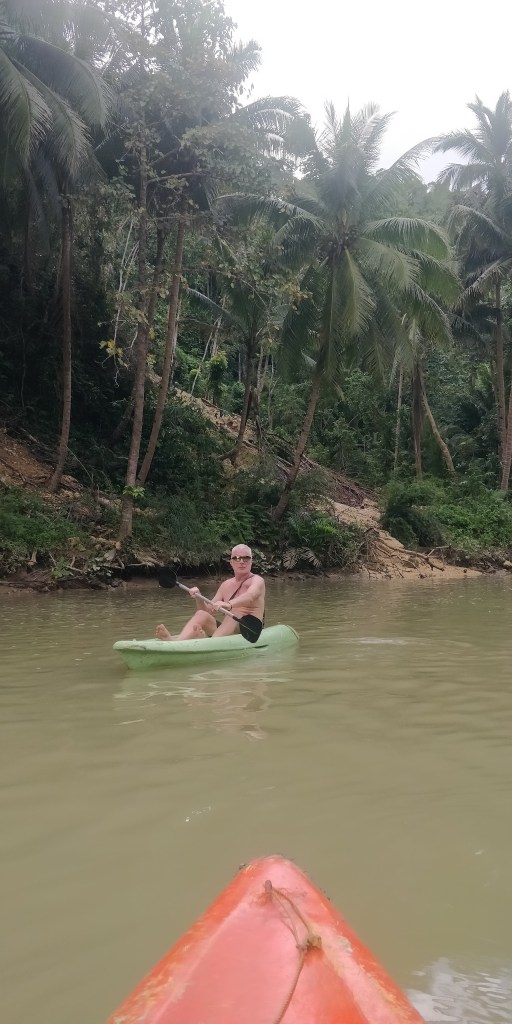
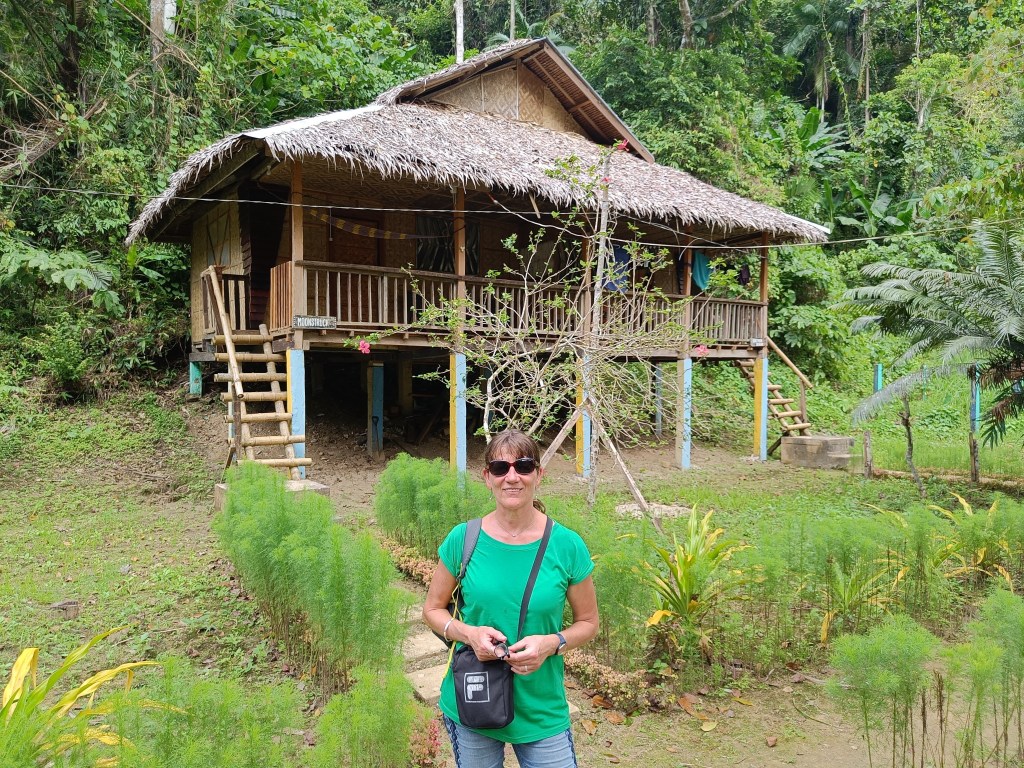
Our next stop was outside the town of Loboc where we stayed in Nuts Huts, rustic bamboo huts by the river.  Access was by a very rough road followed by a long flight of stone steps. Totally charming as long as you weren’t averse to creepy crawlies or exercise – the huts were in a deep valley by the muddy greeny river but reception and restaurant were one hundred and twenty stone steps up the hill and the bumpy roads was one hundred and two steps higher still. We loved lolling by the river, kayaking surrounded by nature, with changing light on the trees and a symphony of cloud, sun and rain overhead. So peaceful without the distraction of WiFi (no WiFi) – apart from the floating restaurants that navigated up and down the river blaring Frank Sinatra and Tina Turner but thankfully only at lunchtime from 11 to 3pm. The nights were insect-loud under our mosquito nets with all sorts of hummings and rustlings, On our first morning , we wanted to do a hike on the opposite side of the river but the boatman was otherwise engaged – he and his whole family were washing themselves in a spring just slightly downstream. He dropped the family off on the opposite bank and came over for us with just a towel wrapped around him and smelling of soap. We hiked past their humble shack of bamboo and tin roof later. The massages we got from some local women were great but so intense that I discovered some aches I didn’t know I had!😁

Its almost time to leave the island of Bohol, with its chocolate hills and cute tarsiers and head on by ferry  to Cebu about two hours away across the sea.

Thanks for reading😎

Philippines_ Visas and Chocolate

Island Hopping in the Philippines😎

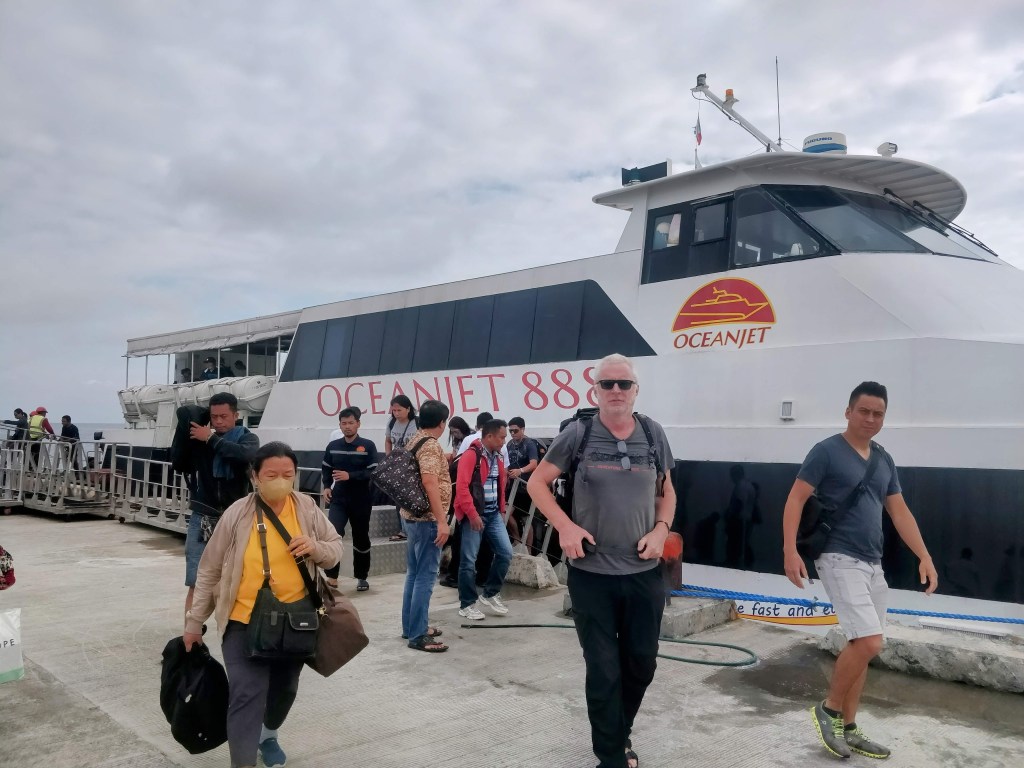
There is no shortage of islands in the Philippines. There are over seven thousand to choose from. After our stay in Manila with its crowded chaos, relentless noise, fumes and poverty, we were eager for fresh air, forests, deserted beaches – basically anywhere that was ‘far from the madding crowd.’ But with a population of 120 million and lots of tourists, maybe we were looking for the unattainable? Siquijor, an island in the Central Visayas appealed to us mainly because our guide book told us it was small and quiet. On a sunny Monday morning, we left our hostel in Dumaguete(we had flown here from Manila), bleary-eyed from lack of sleep,  to catch the 7.10 ferry. The noise of the ceiling fan combined with the swirling heat and the motor bike traffic outside our bedroom window had made for a disturbed night…even for me who could sleep on the floor with a pipe band marching around me.  We had bought our ferry  tickets the day before thinking that all we had to do was turn up. We were wrong. The ferry port was thronged with people and motorbikes still whizzing everywhere.  We had to queue to be assigned seat numbers and queue again to pay a port tax (about 20 cents) and then queue to actually get on the ferry which was crowded (room for at least 500 passengers).

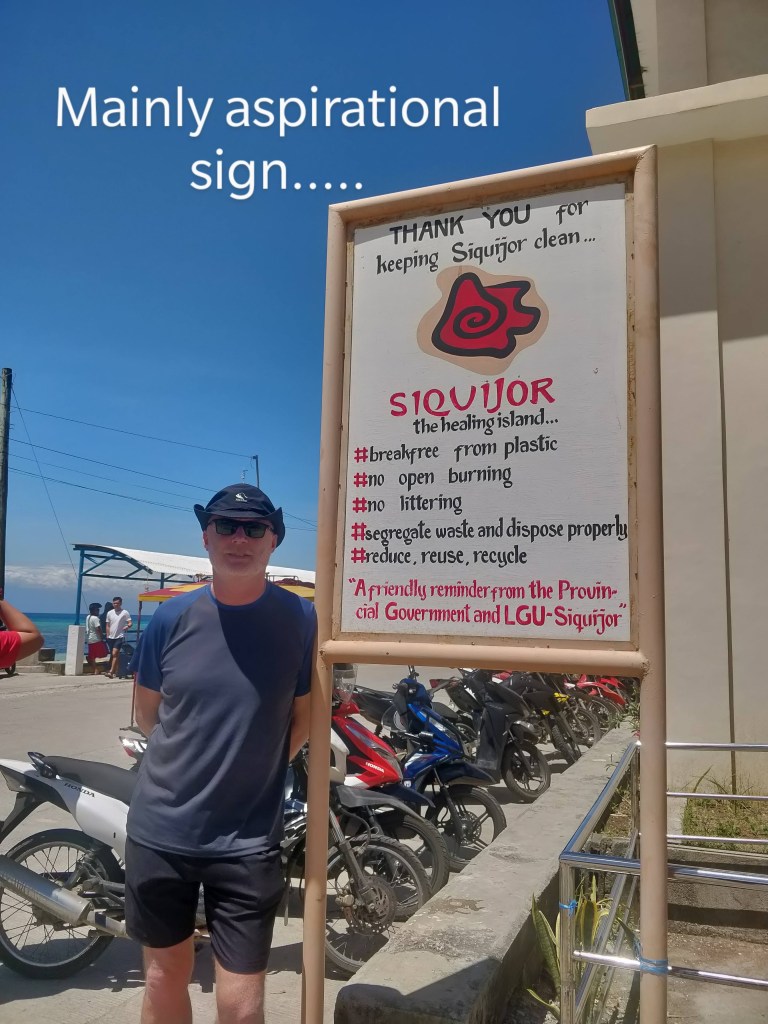
The volume of people on the ferry to a small quiet island surprised us …and alarmed us a little. There were passengers of every age, size and ethnic hue on the boat, some locals but many visiting. This part of the world has had a long Covid lockdown( much longer than Europe) and more people are on the move than ever.  When we arrived on Siquijor (both the island and main town have the same name), there was that frantic flurry of activity that happens when a ferry docks, with people and goods disembarking, lots of shouting,  the calling of taxis, tricycle rickshaws and motorbikes.  But within ten minutes, somnolent peace was restored, the waves from the ferry backwash ceased to crash on the shore, the island absorbed the new arrivals and made them disappear, the touts returned to the shade, the dogs took up their positions sleeping in the middle of the road and relative silence surged in. We would have left too except that we had no money to pay a tricycle rickshaw to take us to our accommodation which we had booked the day before and which was on the other side of the island. Despite a plethora of bank cards, we had virtually no pesos between us and ‘cash is king’ in the Philippines. We had planned to get money out at the port in Dumaguete but the ATMs there were broken. We trudged up the street looking for a functioning ATM. The first three had ‘no money’ or ‘no power’ or  ‘broken’. There was just one more to try…..our last hope. The whirring sound of cash dispensing in the ATM was never more welcome. After all that trauma, we needed breakfast – a big plate noodles, hard boiled eggs and spring rolls filled the spot. Delicious

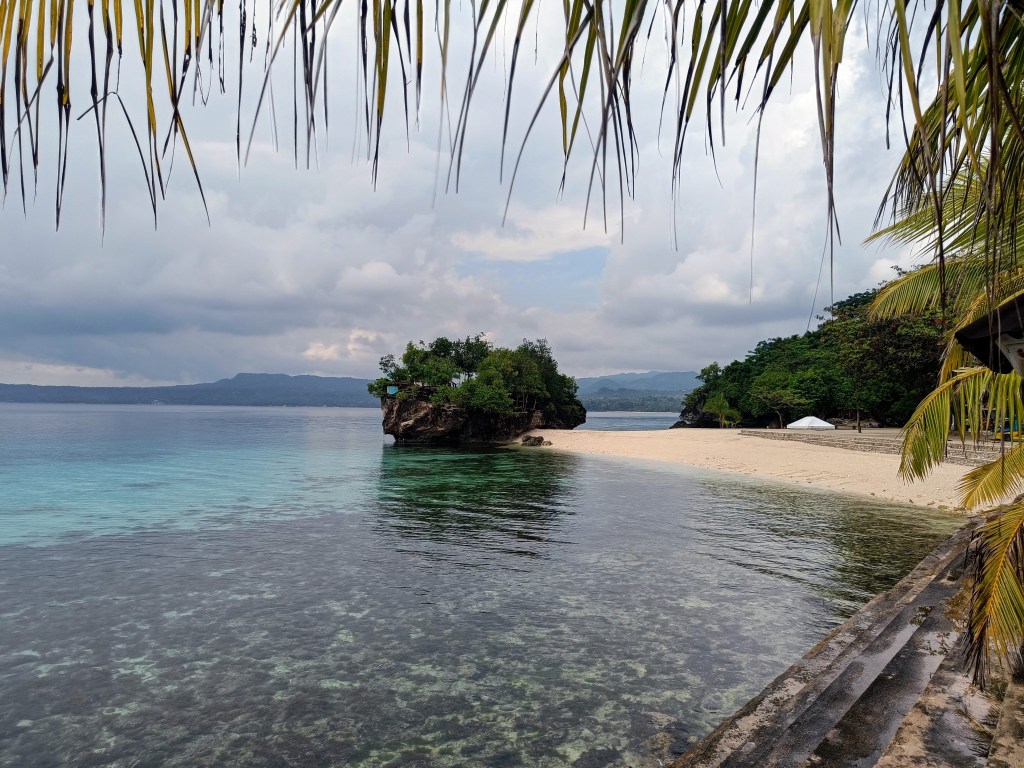
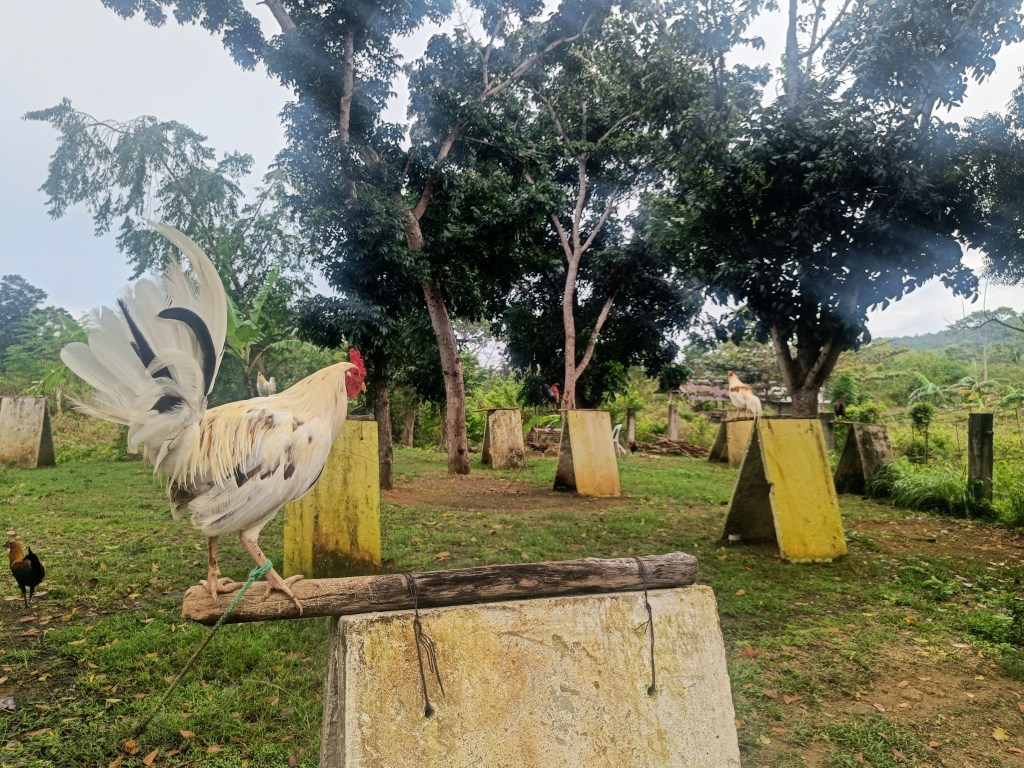
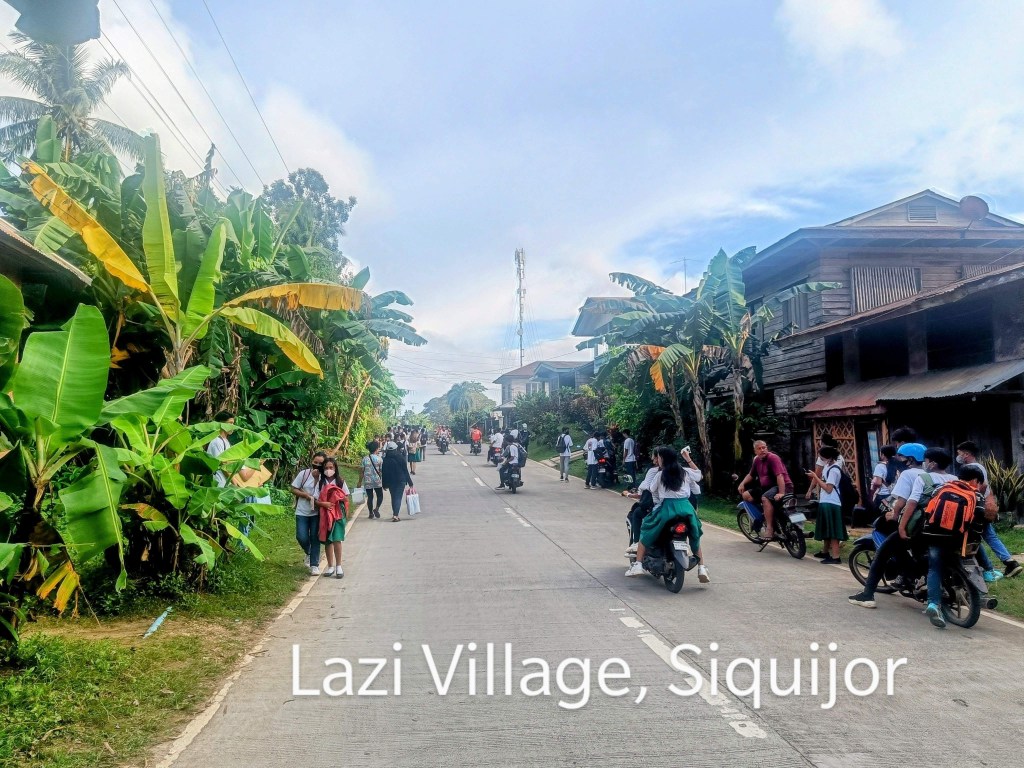
The best and only way to travel around the island is by motorbike or scooter which were very cheap to hire – about six or seven euros a day. The roads were reasonably good especially the one that circumnavigates the island, about 75 kms in total. There were roadworks and road upgrades on many sections but few hold-ups and traffic was light.  Plants had started to sprout on some of the heaps of sand and rocks for road works at the side of the road so the upgrade looked like a long project. The freedom of the motorbike to explore was fantastic.   We sped past the gleaming green of the rice paddies, more emerald than any vegetation at home, past white cattle with their loose-skinned necks and skeletal pale-coloured dogs that all seemed to originate from the same ancestors. We found small coves framed by coconut palms, one idyllic one where swimming was not ‘operational’ (there was a fine for swimming, we didn’t know why) where we met a Chinese man, a devout Christian, who was moving to the Philippines with his family for religious freedom.  In another, a bald effeminate salesman was trying to sell a foot-spa to the elderly owner of a guesthouse which was almost on the beach. He welcomed us with such friendliness, we thought he lived there while the owner soaked her feet in a pink foot-spa. There was the smell of smoke and a soft haze among the trees from the ubiquitous burning of rubbish and vegetation.  And everywhere, we saw an incredible number of schools and groups of children in dazzling white shirts coming from or going to be educated. Education is incredibly important to most Filipinos but many  told us that their children were being educated for export,  people are the greatest export of the Philippines. We were intrigued by the fields of roosters which were tied to a perch and allowed about a square metre of territory each. These seem to be raised for cock fighting but we haven’t seen any cock fights…..yet.

Of course, the roosters might also have a part to play with the other claim to fame of Siquijor. This mystical island is known to have magic potions, shamans, witches and sorcerers and many Filipinos would not wander around after dark on the island. We didn’t witness any spooky going-ons  although when we went in search of the Enchanted River, we couldn’t find it but we could hear the sound of water flowing over small stones. Very strange.  Undoubtedly, there are healers using herbal medicine in the hills of the interior, using local plants and knowledge handed down through the generations and people travel to them in search of healing.

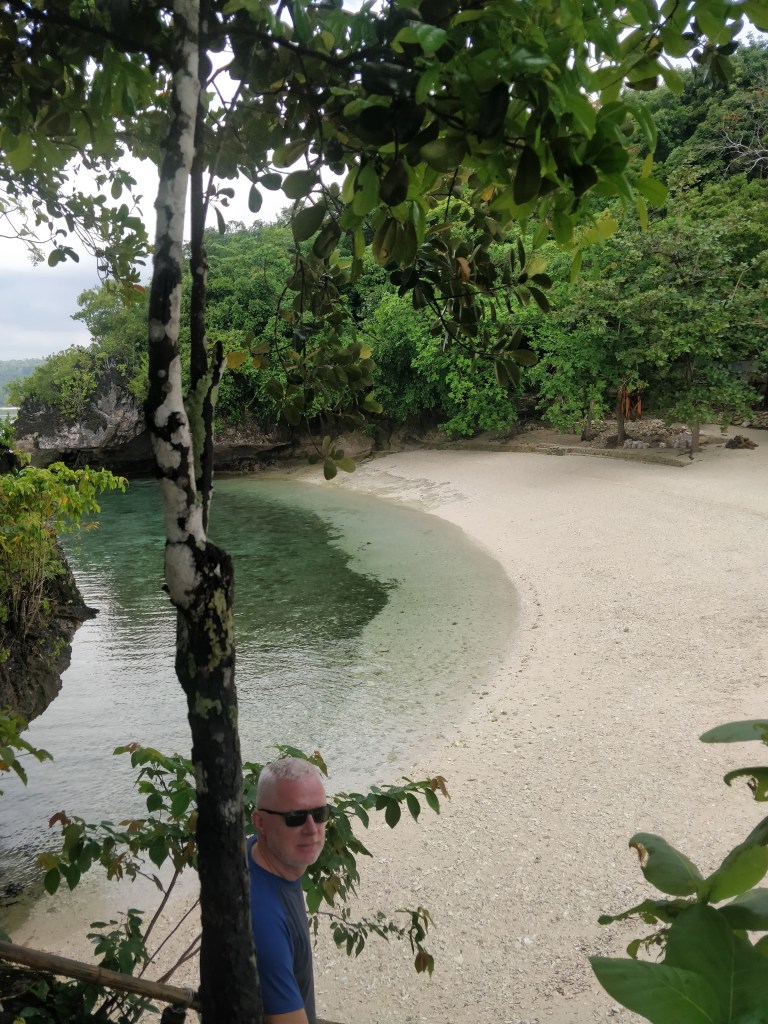
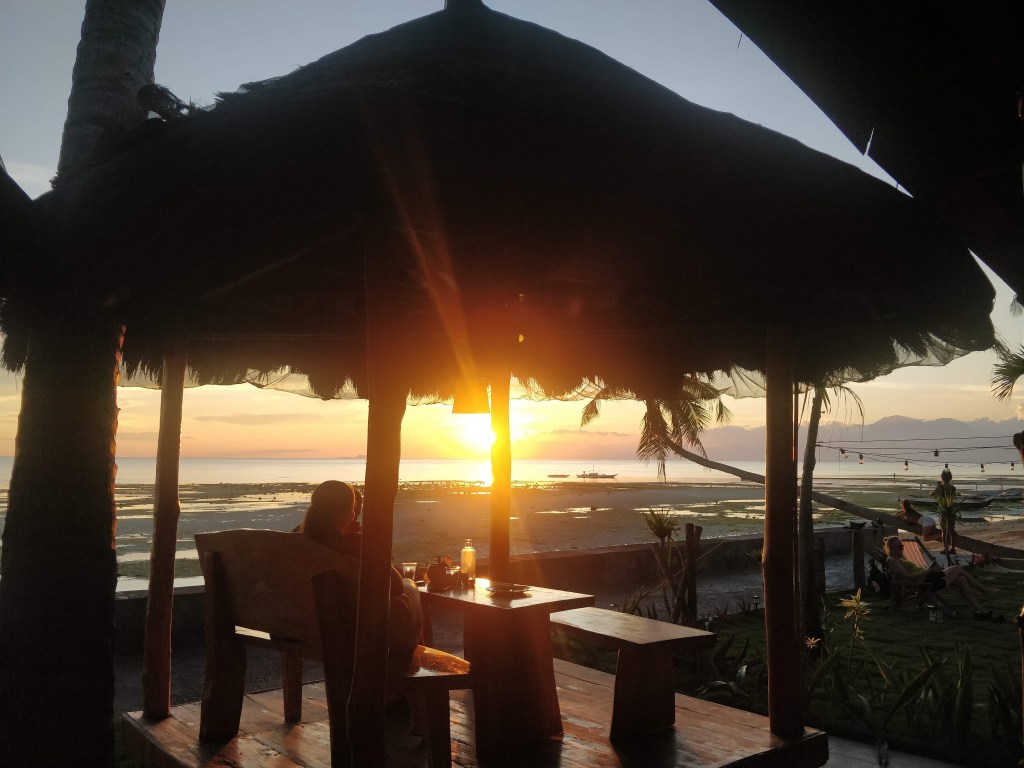
The sunsets were certainly spellbinding, a riot of colour every evening until the sun fell into the sea shortly after 6pm, perfect with a cold beer…especially good from the Republika Beach Bar in San Juan, a place that we kept returning to for the shade and balmy breezes, sea views, friendly dogs and  jazzy music.  We walked along the pale-sand beaches and swam in the clear waters of the many coves, the water was shallow off the coast unless the tide was high. It can be a little rocky so a pair of water shoes is good protection against the rocks, broken coral and  sea urchins. There were several waterfalls and swimming holes if you wanted a change from the sea. The best beach on the island fronted the luxury Coco Grove Resort but as its part of a marine reserve, anyone can visit and snorkel directly from the beach for a small fee (about €1.50)

The first place we stayed on the island- Zosimo’s Inn in Lazi – was quiet except for the roosters crowing and the dogs barking…all night. The second place, Mystical Inn, in San Juan was more a home-stay but we had a huge room with a fan and a balcony. It was much quieter at night but day began early  with hordes of fishermen congregating to chat and trade in the sandy laneway outside our accommodation which was only a few metres from the little beach lined with small fishing boats. The busiest time outside was between 6am and 7am when the throngs would rival Grafton St on a Saturday afternoon.  We had a bird’s eye view from our balcony where swallows and swifts flew past with dizzying speed and barefoot men stood around chatting.

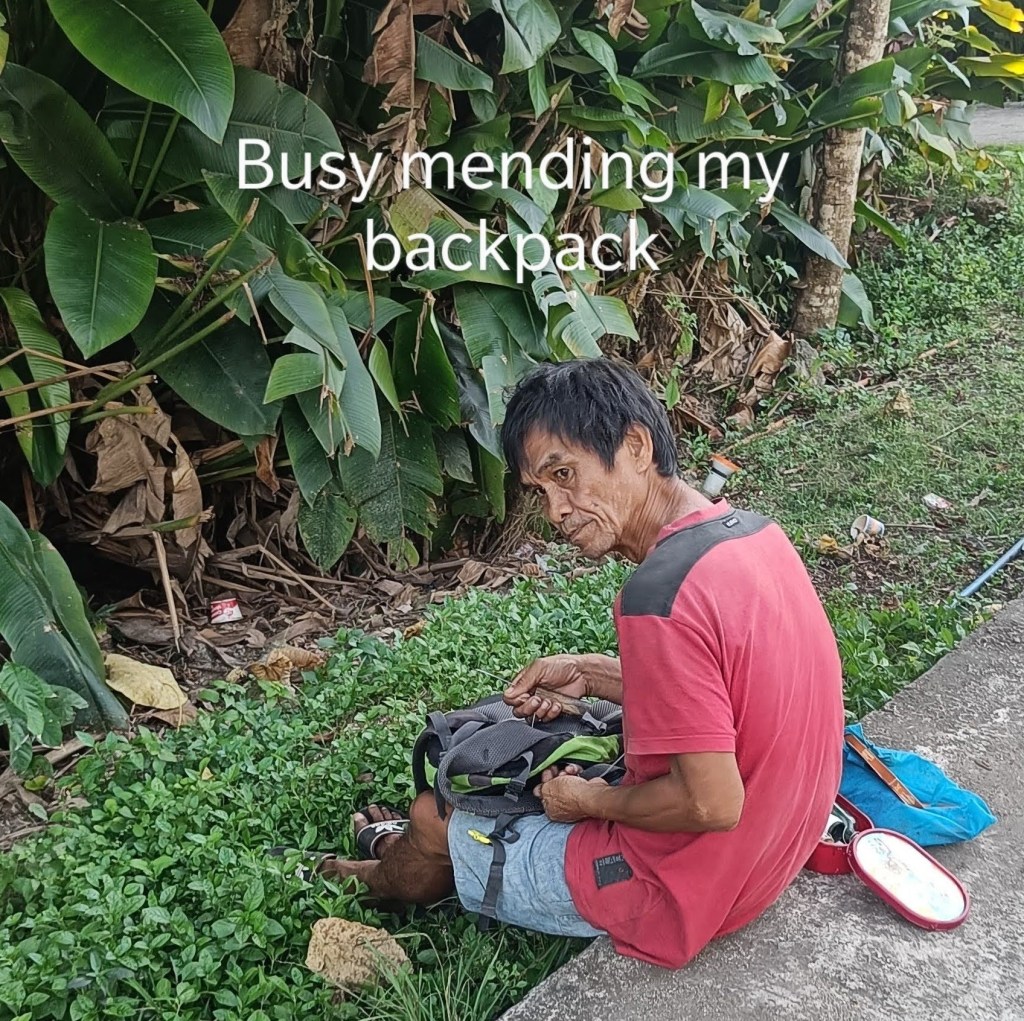
My little green backpack was feeling the pressure of trying to squeeze too much into it or maybe it was falling apart with age. But it was certainly coming apart at the seams. There was a tearing sound when I hefted it onto my back and one of the straps was left dangling, making it impossible to carry. A small tear in the front pocket was yawning into a big hole. I mentioned the problem to Annie, our lovely landlady and suddenly, there was no problem. She got a man on the street to mend it for little more than a euro and so far, so good. The culture of mending things is alive and well here, as are pawnshops. Every little village has one or two and we never saw an empty one.

It’s always hot in the Philippines – about 30C by day and 24C at night – but it has been quite cloudy with intermittent sun and cloud. We have had quite a bit of rain, which is quite welcome as it cools things a little bit. But those warm tropical evenings are gorgeous, when the cicadas are chirping and the smells of the flowers is intense.

Leaving the island of Siquijor was hard – the longer we stayed, the more we liked it but there was another seven thousands islands calling. Out next hop was to Bohol, a two hour ferry ride from Siquijor and again the ferry was full. We are staying in the south western area call Panglao, really another island but connected to Bohol by two bridges. For something completely different, we are staying in a resort with a pool and a large air-conditioned apartment for a week. Luxury indeed at €210  for the week.

Living it up and relaxing. Isn’t retirement great!!!!!!😍

Island Hopping in the Philippines😎