Electric Roadtrip: From the Mountains to the Sea

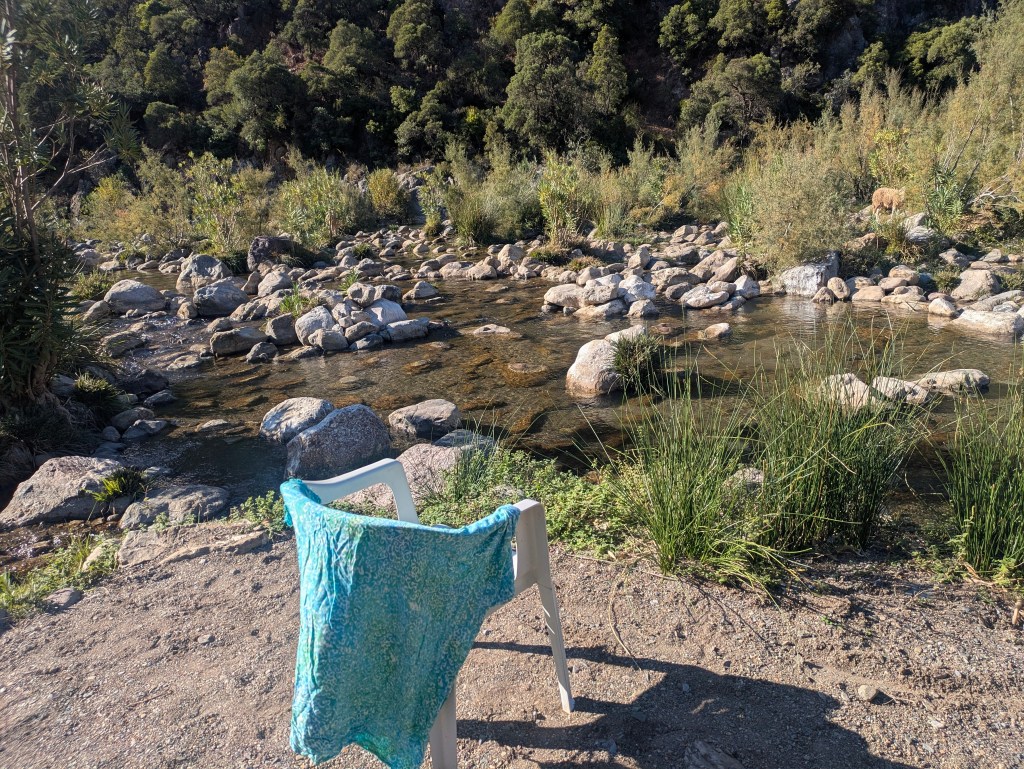
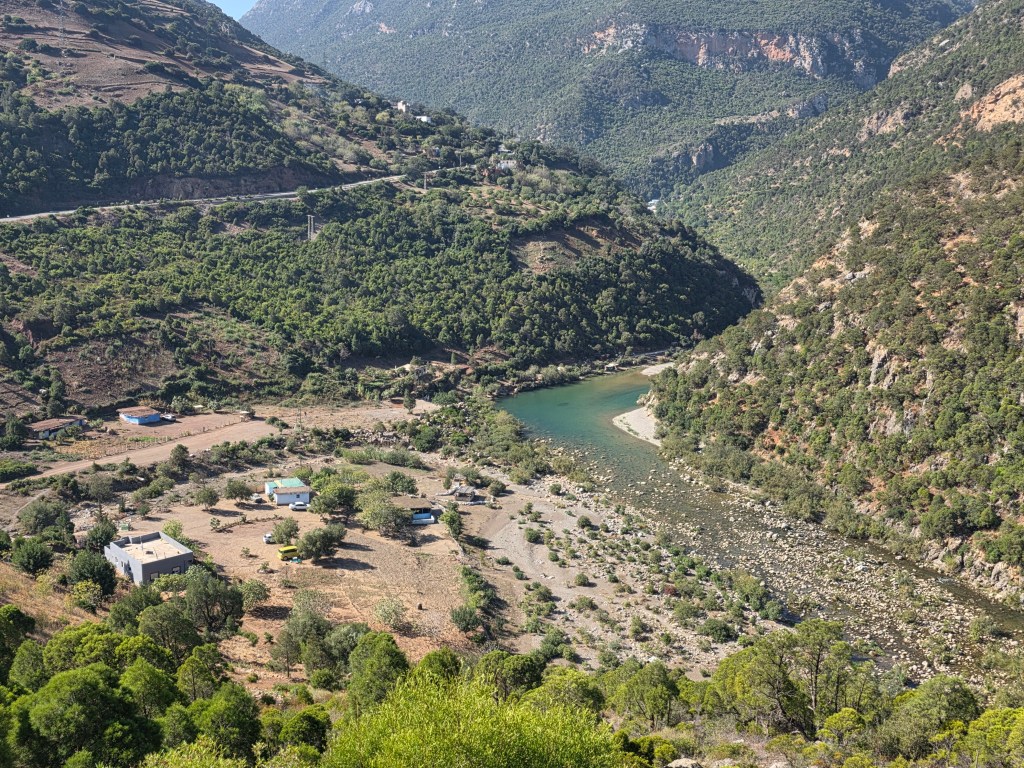
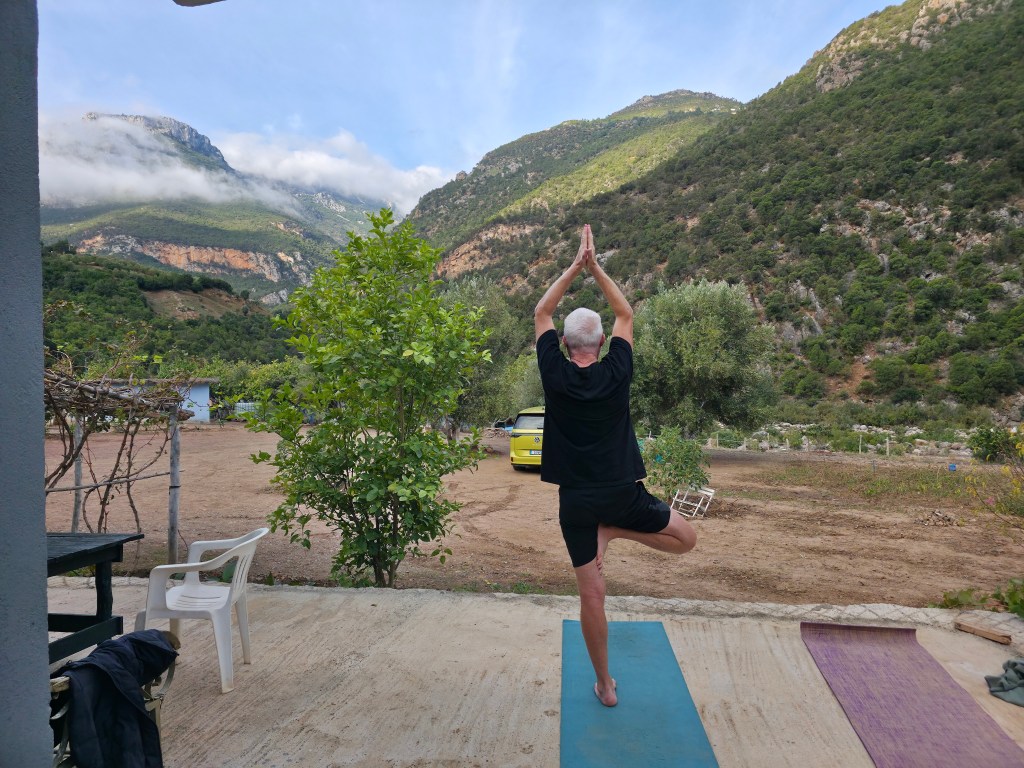
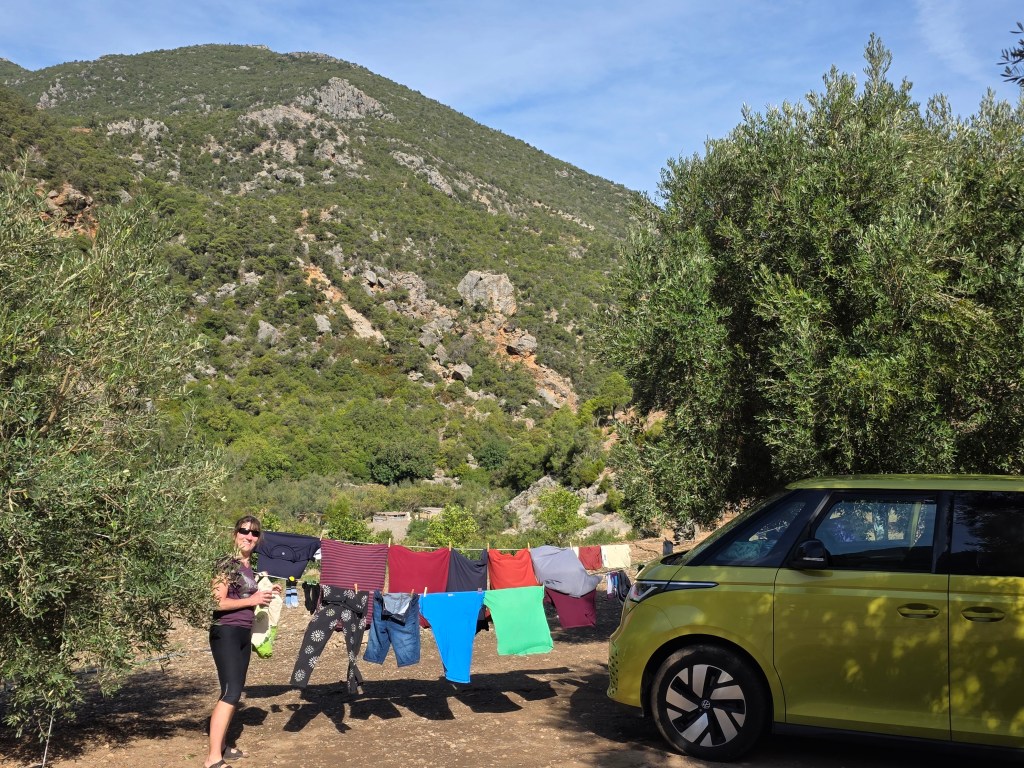
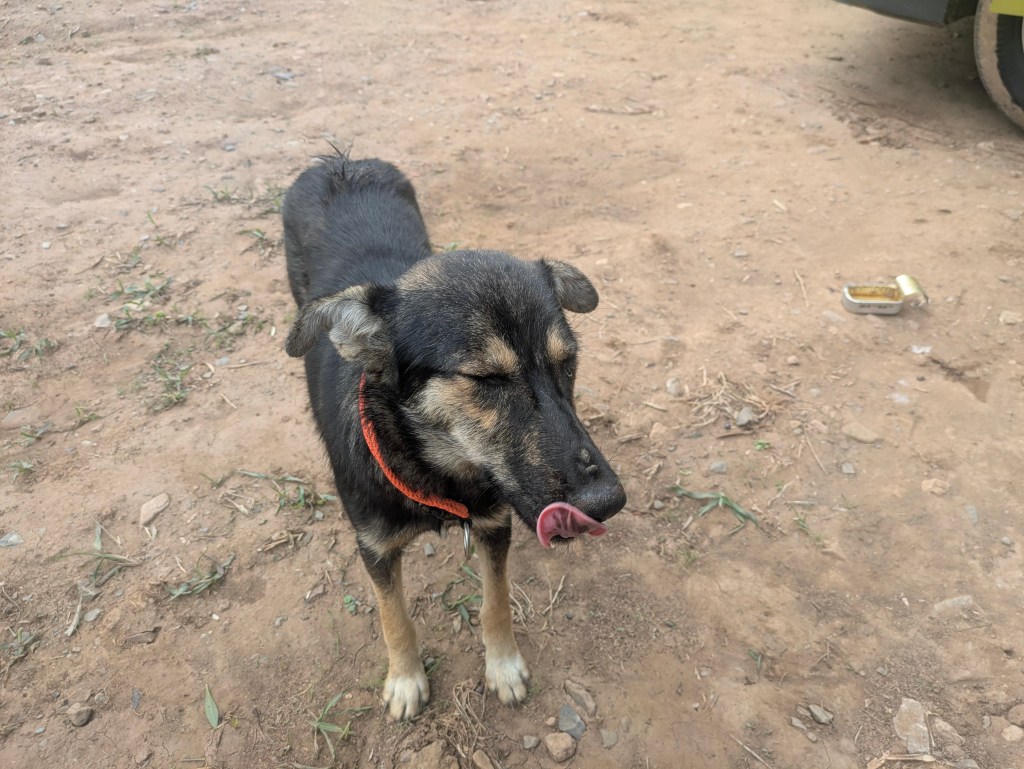
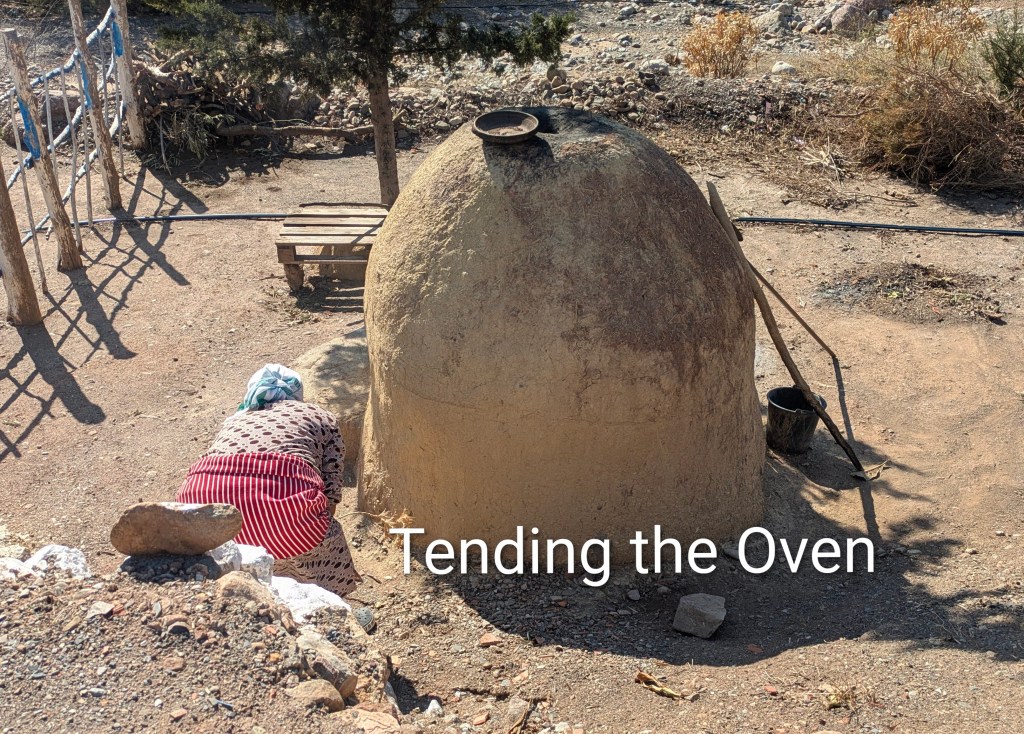
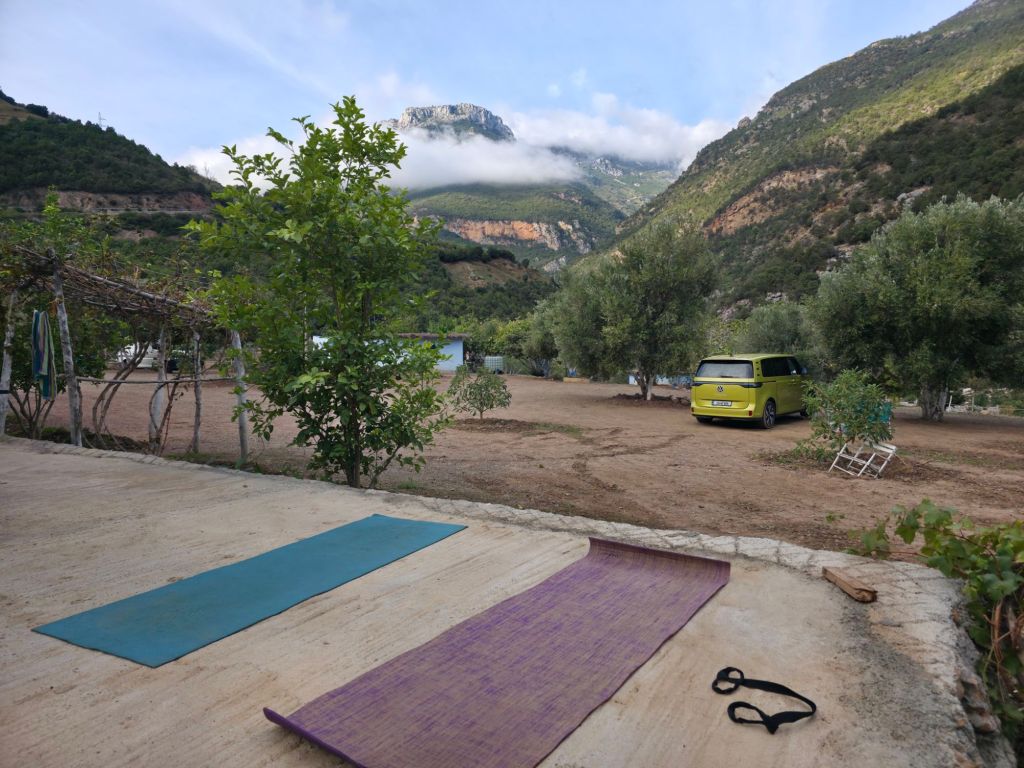
Our washing danced in the breeze on the clothes-line strung up between two olive trees in the rustic campsite in the Rif Mountains in Morocco. The figs had been harvested, and so had the chillies but two lemon trees were full of green skinned fruit although the few avocadoes were still small and hard.  The resident dog befriended us…..all it took was a bit of chicken….he slept beside the van and followed us to the river, as if guarding us or more likely, hoping for scraps.  We chatted to the other few campers who came for a night and then departed, an American couple who were at the beginning of a two year stint around Africa, having shipped a jeep over from the States and a trio of British campervans who were travelling in convoy. We watched the woman make bread in the outdoor oven and water the trees. We sat by the river, hiked in the hills, read, did a bit of yoga and watched the morning sun hit the mountain peaks and slowly  creep down to warm the valley. This tranquil place in the Rif Mountains had put a spell on us, forcing us to slow down. It could have been boring….it should have been…but it wasn’t in the slightest.
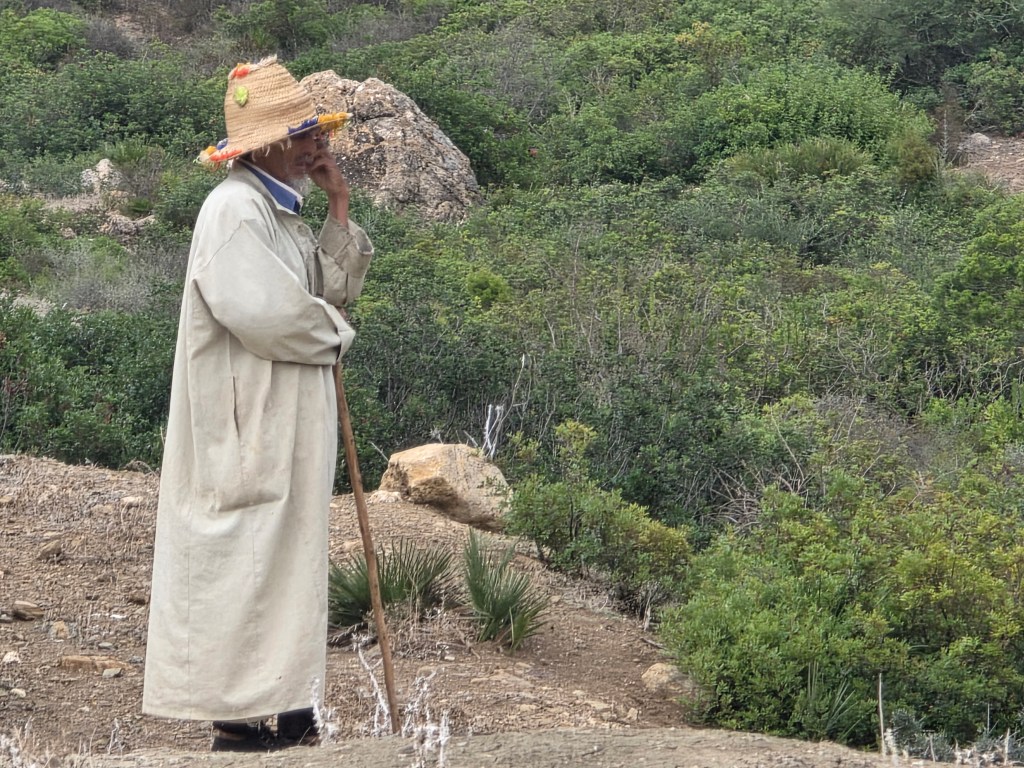
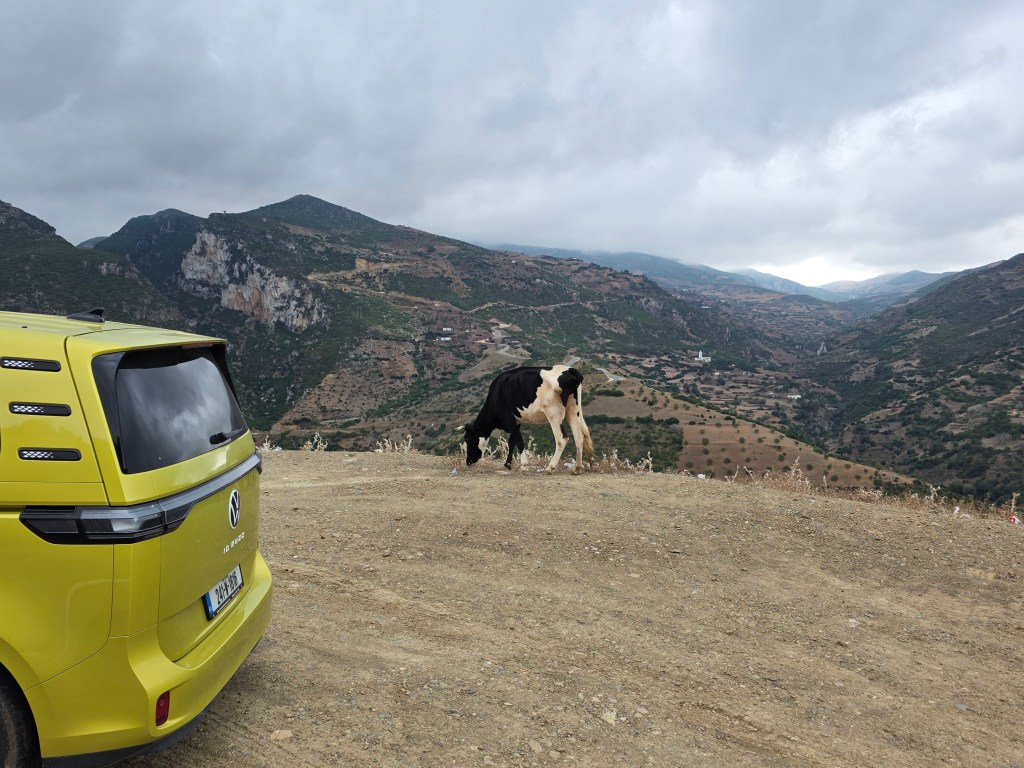
Finally on the fifth morning, we packed up and left, taking the mountain road to climb higher still. A man in a djellaba waved a stick and shouted at his cow on the far side of the road, who scampered off in the opposite direction. The road rose before  dipping down to the Mediterranean Coast.  
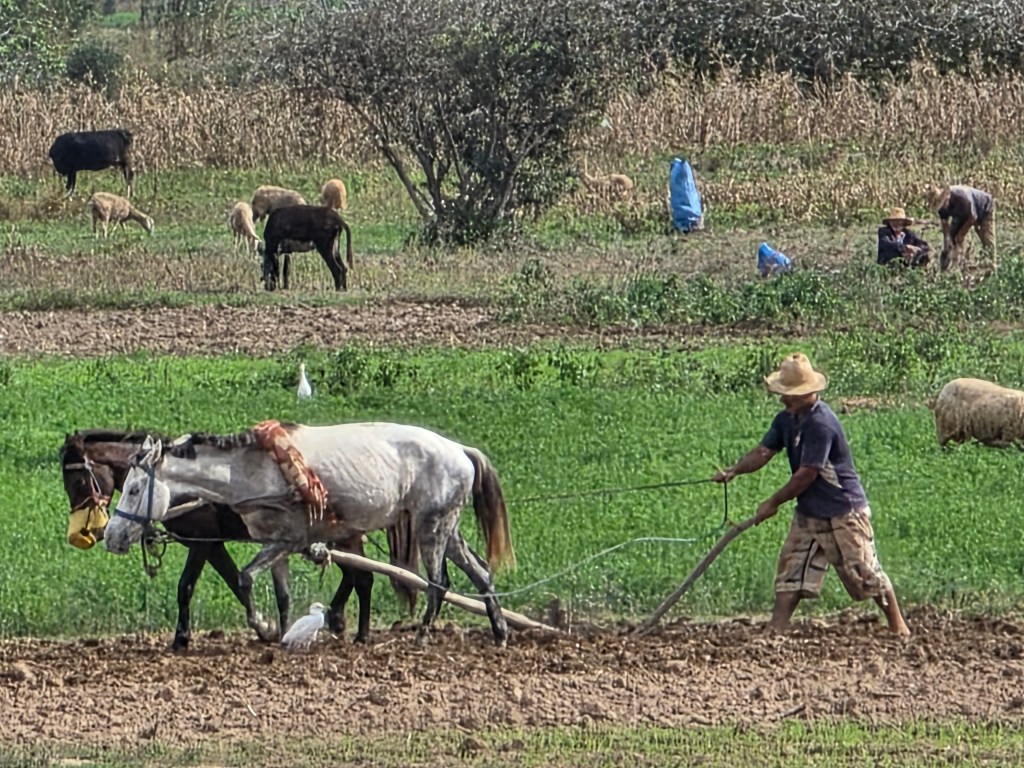
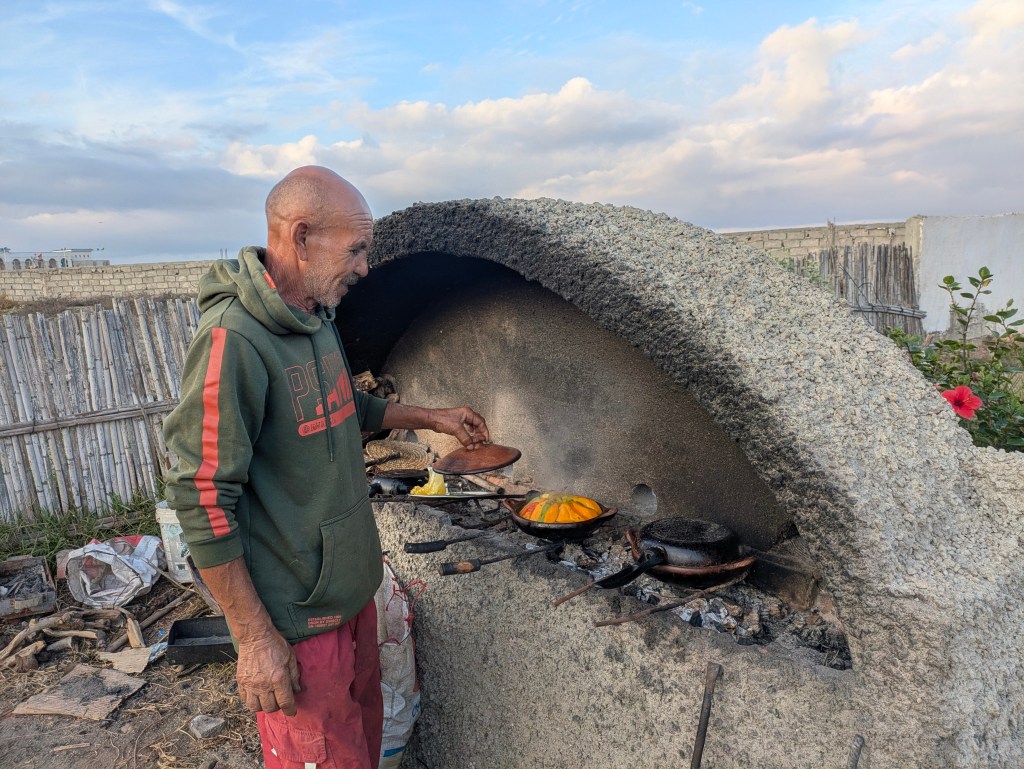
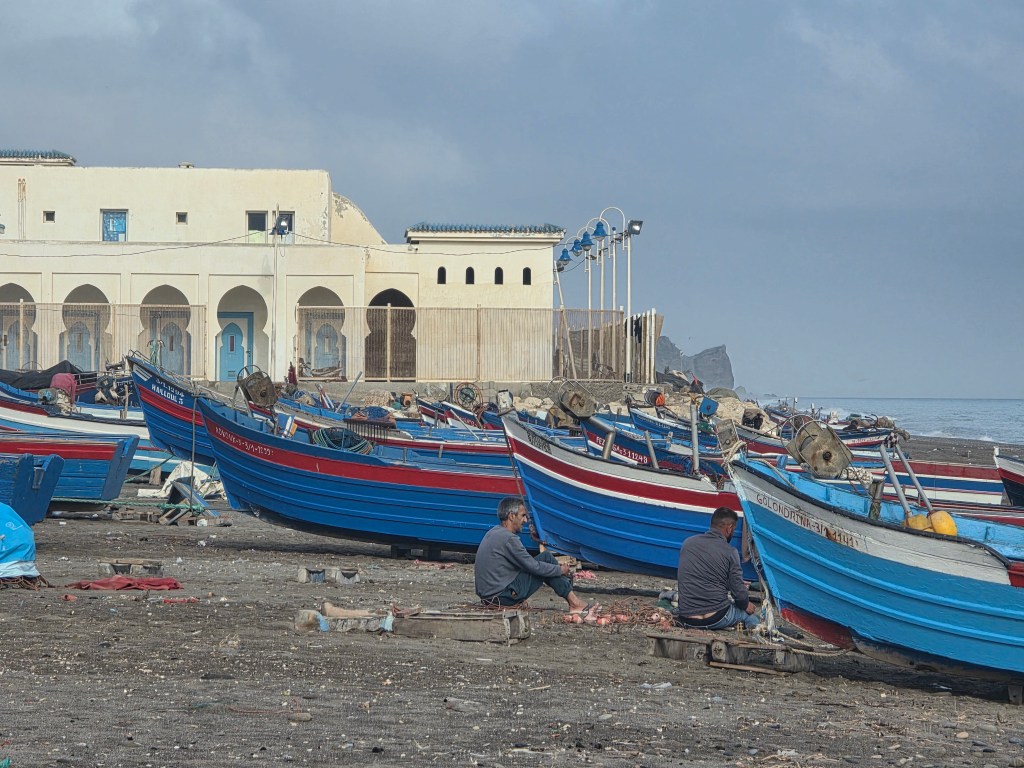
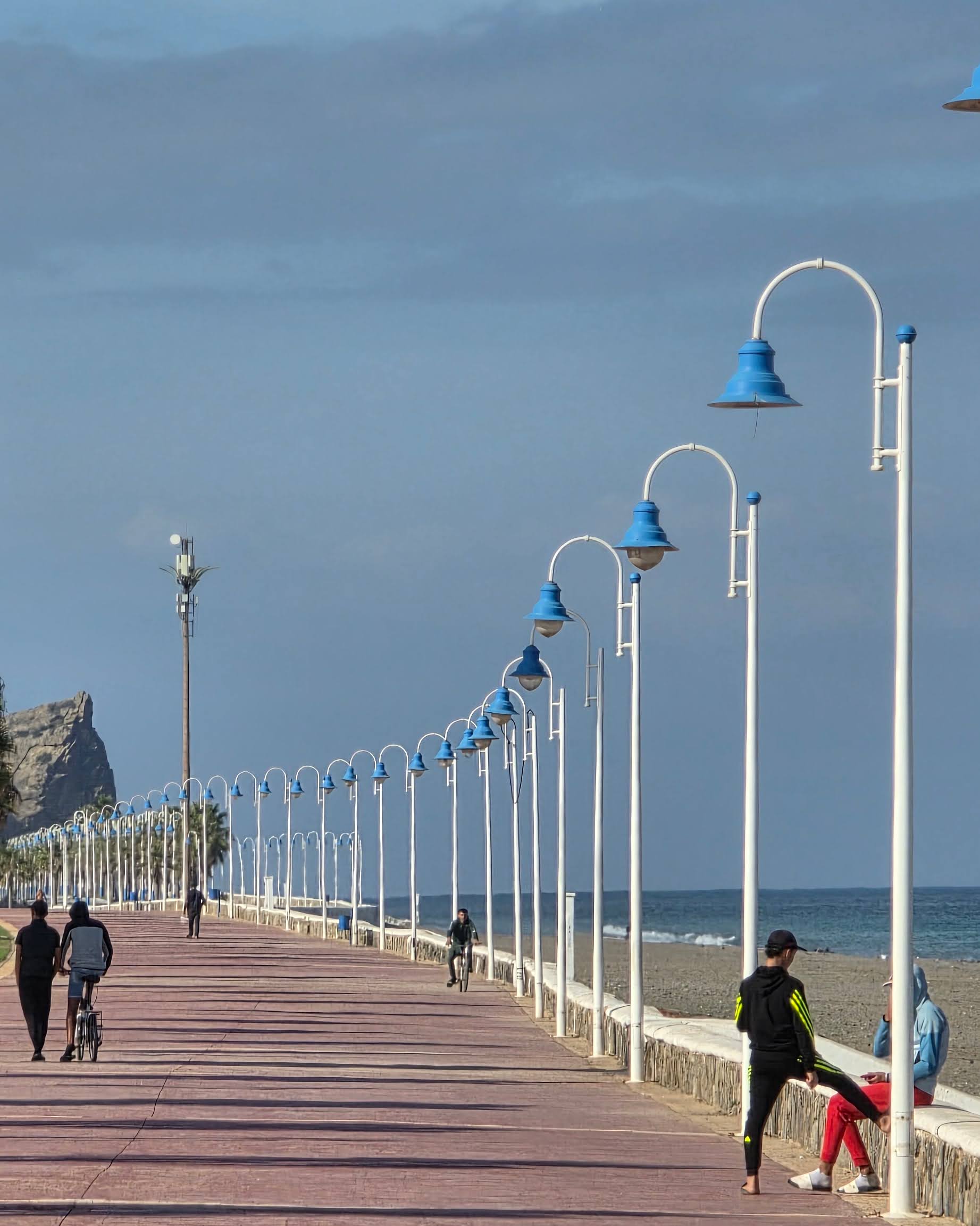
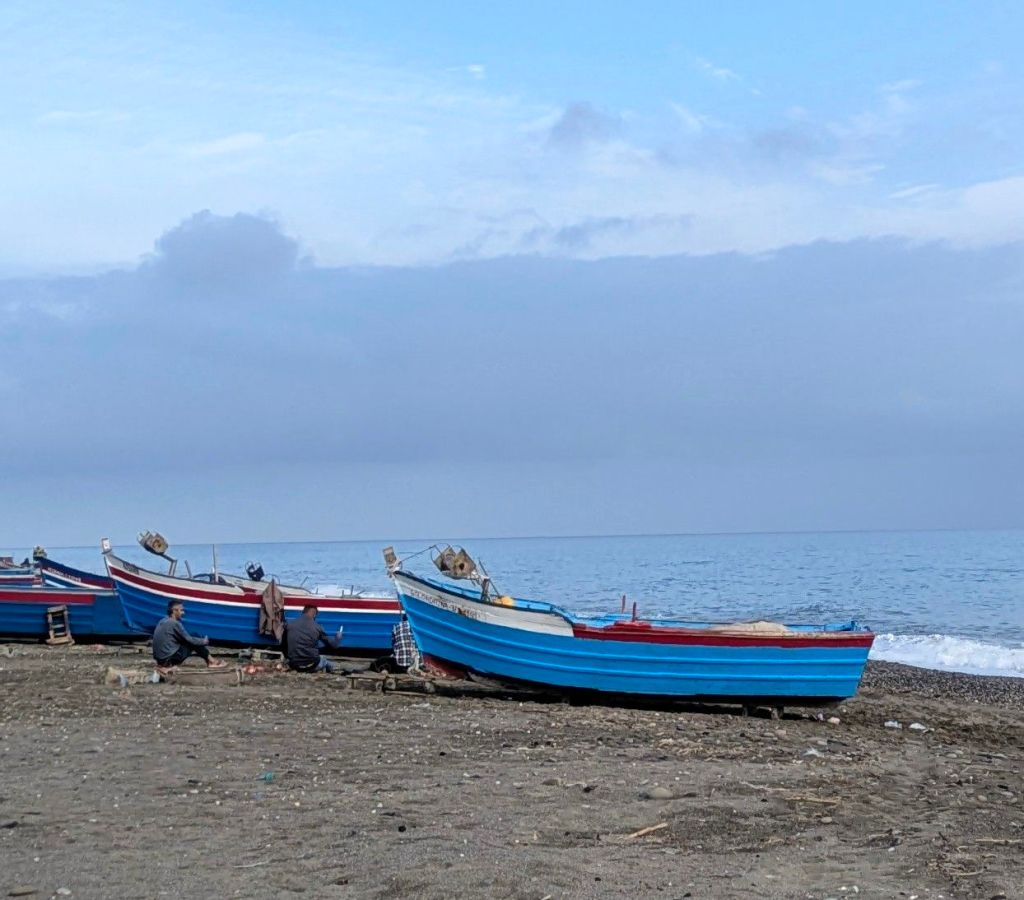
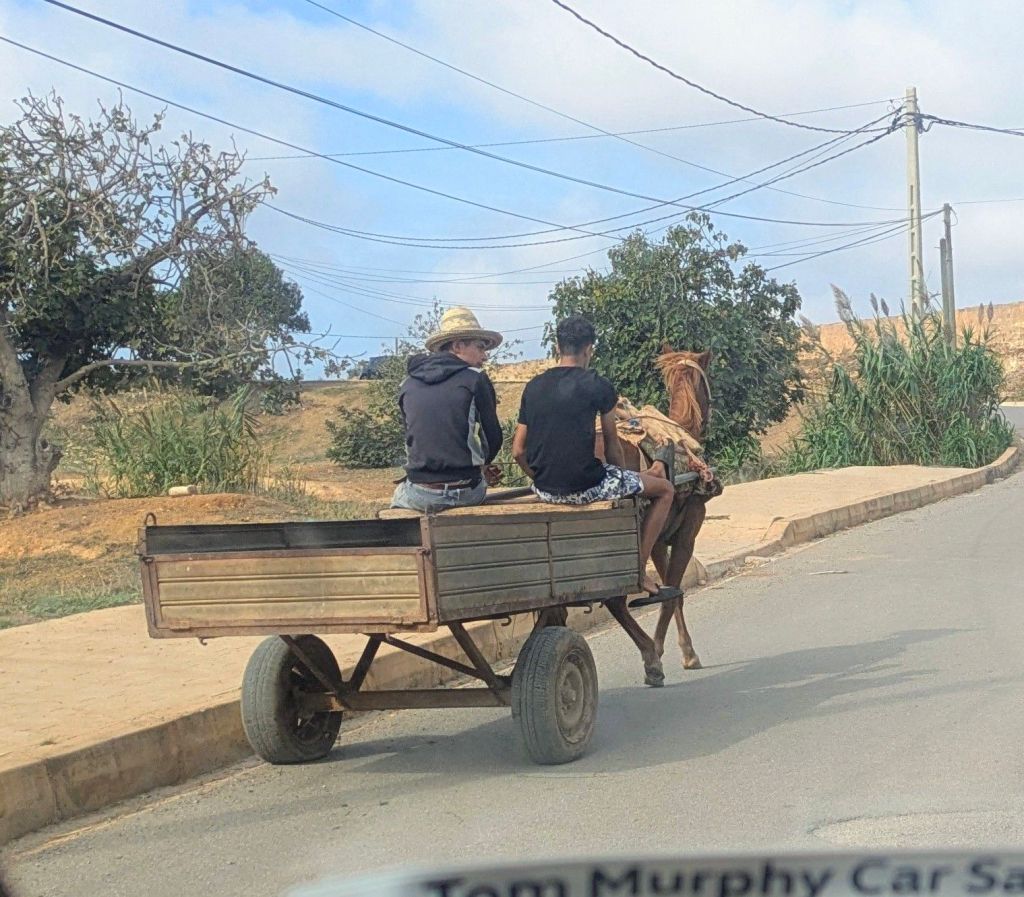
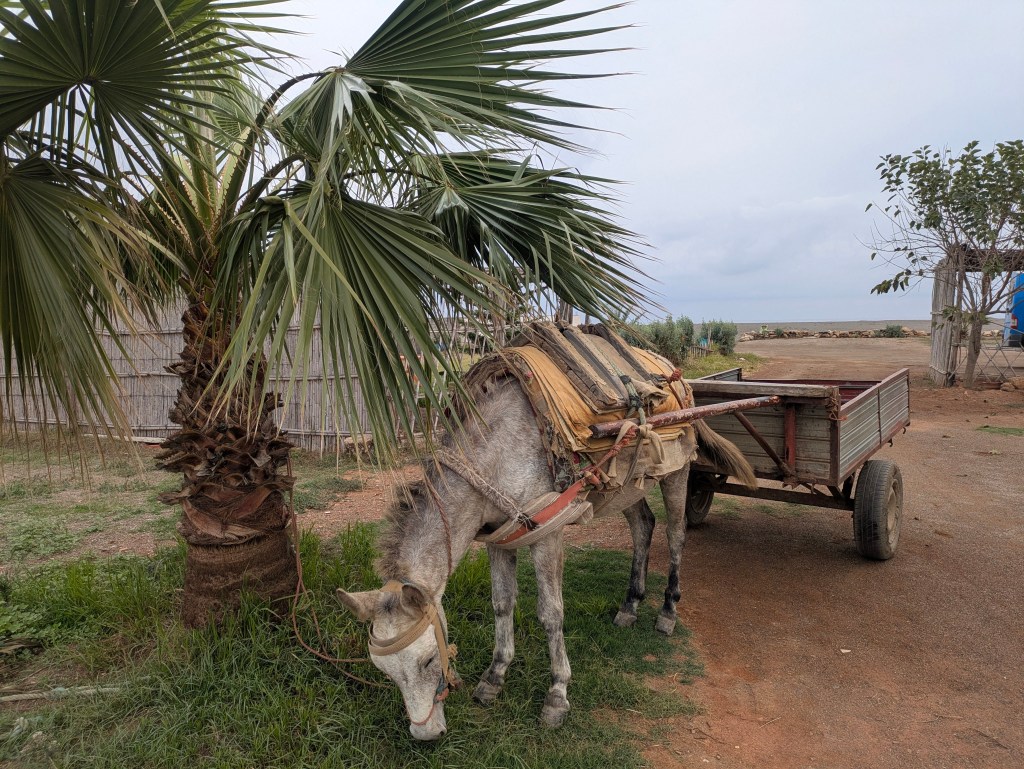
The seaside town of Quad Laou was larger than we expected, with a handsome prom that stretched for more than a kilometre by an (almost) deserted beach. There were fish restaurants, palm trees and few tourists of any kind. We swapped the gurgle of the river at our last campsite for the hypnotic crash of waves, and our dog was replaced by a cat quartet, who danced around us as we ate the tagines that Mr Abdul had prepared for us in his homemade, outdoor oven. It was also peaceful in a different way. Blue fishing boats were on the beach.  An old woman tended a flock of sheep down the road. Mr Abdul worked his small bit of a farm by hand and with the help of a horse and cart, augmenting his meagre living by allowing camper vans to park on his land by the sea, The toilets were squat, ‘flushed’ by throwing a few ladles of water from the bucket. There was no shower although Mr Abdul would bring a bucket of well water to slosh over you…if required.
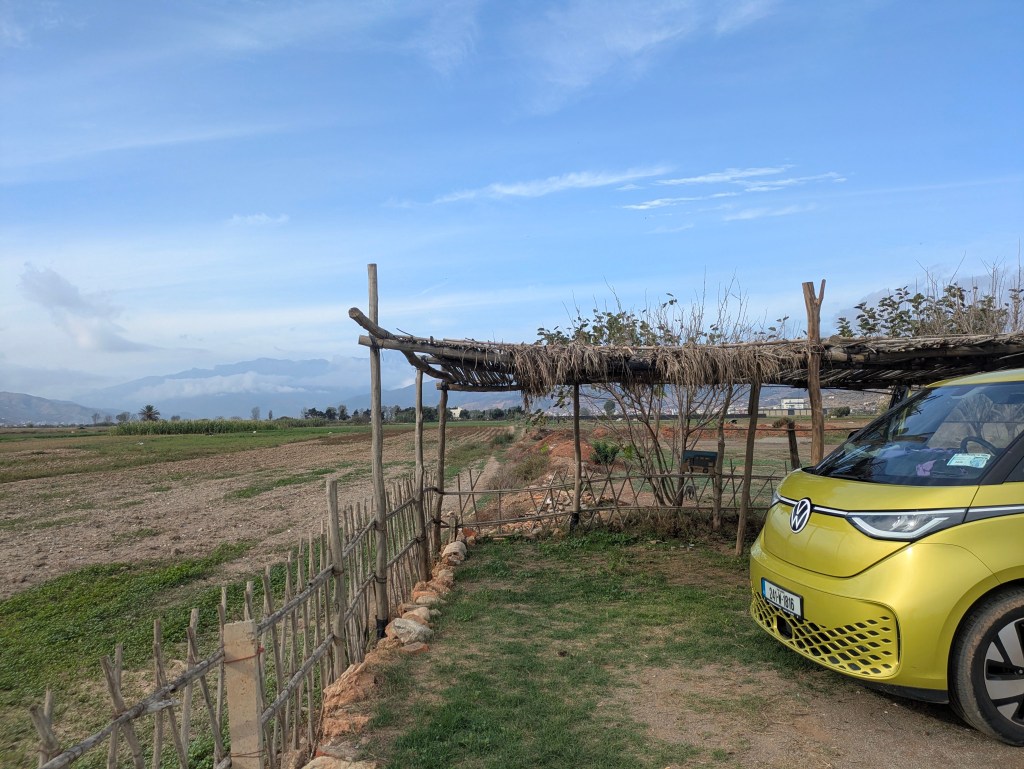
Leaving Quad Laou, we took the spectacular road north that snaked along by the Med where road stalls sold enormous bags of walnuts. Tetuan was the largest town in the area, a prosperous place with all the usual international chains and an old medina with winding streets and alleys. We didn’t stop at any of this…we had one priority….we wanted to get to Ikea on the far side of town, not to buy any furniture or eat meatballs, but to charge the Buzz. It was no surprise that EV chargers were scarce in the area. Charging wasn’t absolutely critical because our recent hops from place to place were relatively short but it would still be reassuring to charge fully. We missed the charging slot by minutes….there was only one. Two women had just plugged in  and said that they would be two hours but at least the Kilowatt charger was working and as usual, it was free to use. Another electric car appeared, also hoping to charge, so there were certainly electric vehicles in Morocco. I went into Ikea to use the bathroom. My visit coincided with  the ‘call to prayer,’ which was broadcast throughout the store on loudspeakers, sounding slightly surreal among the flatpack Swedish furniture.

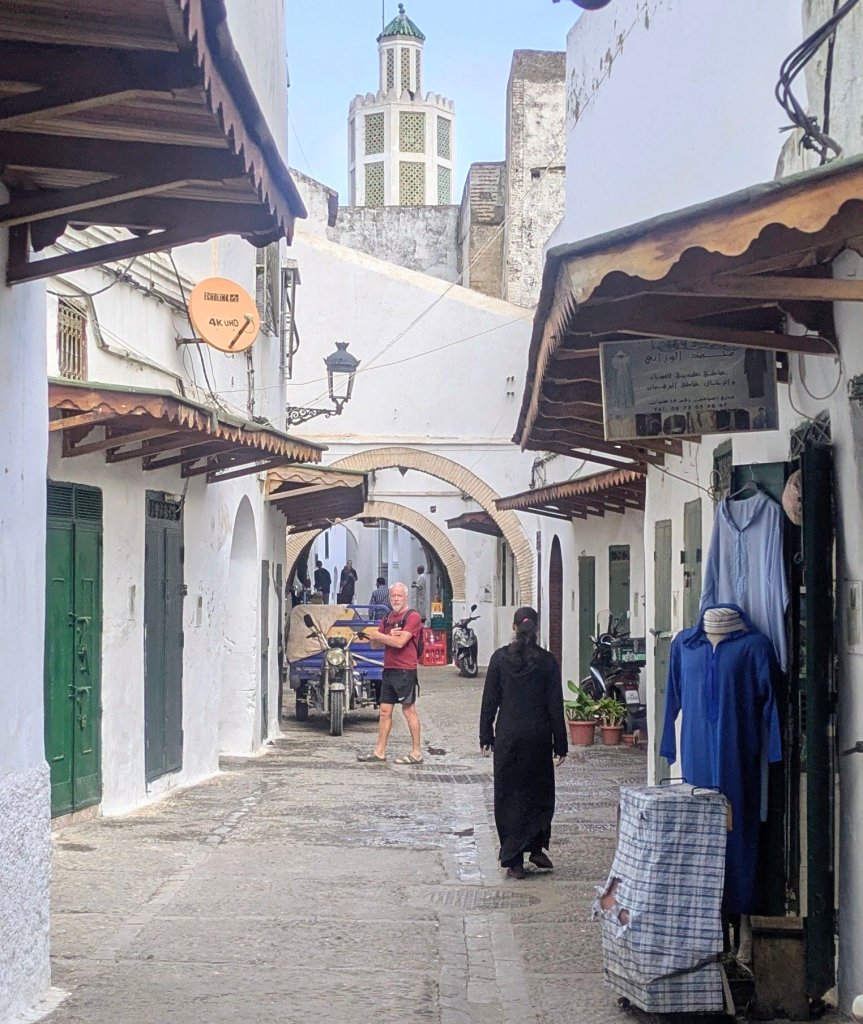
Deciding to return later, we backtracked to the medina in the centre of town which also had a small tannery. This was not in full production, although a ‘clothesline’ of animal skins were draped on the back wall and a pungent smell hung heavy in the air -blood and drains – but not as bad as the hellish tannery in Fez. Tetouan was known as the White City and from the balcony overlooking the tannery, there was views of the pale houses crawling up the slopes while on the other side, the tombs of the dead were equally white and shiny in the sunlight.
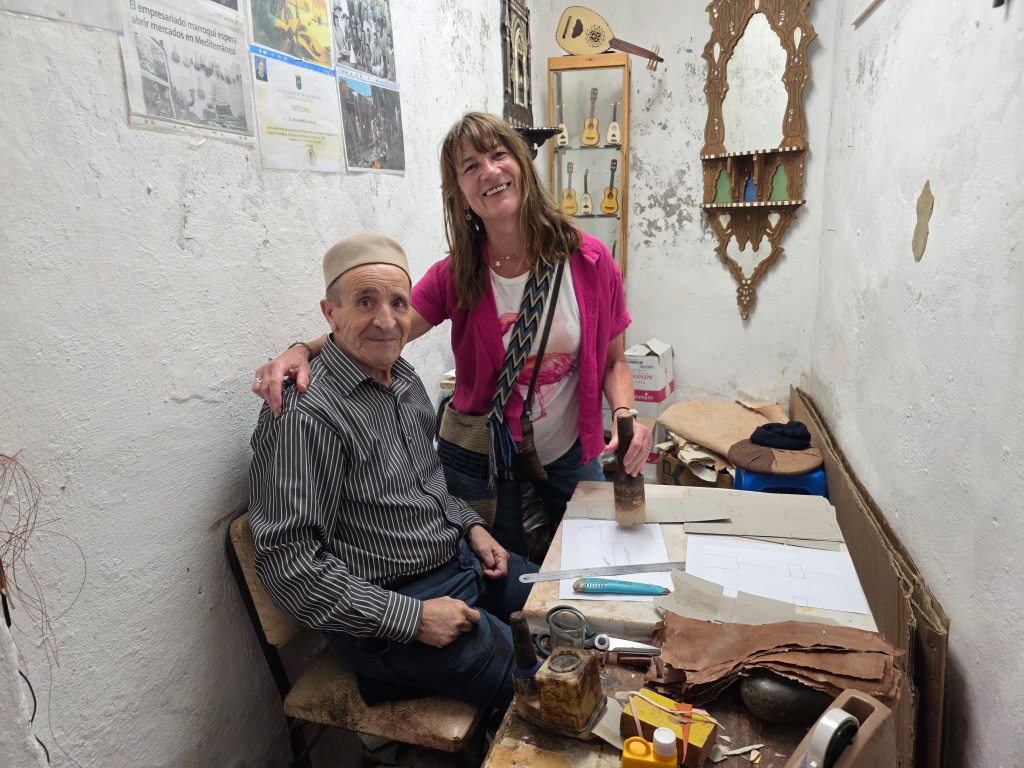
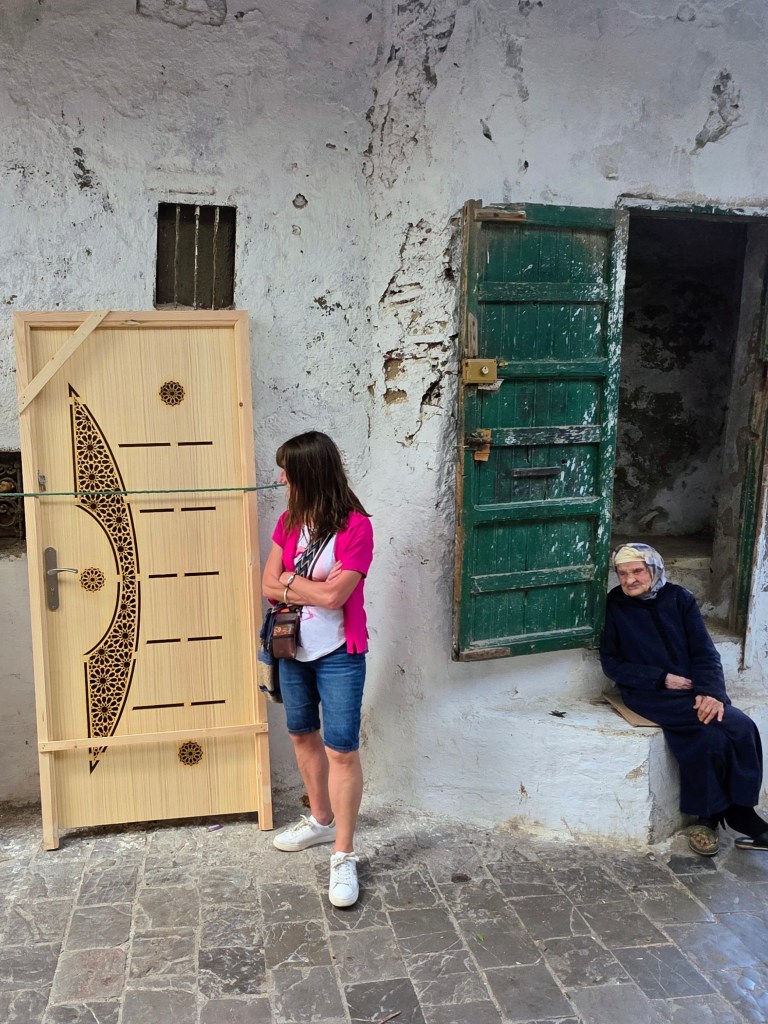
In the Carrefour Supermarket (which unfortunately didn’t have any EV chargers), we couldn’t find the alcohol section which we knew was often slightly separate to the main supermarket. When we asked, people told us that it was outside and around the corner. We wandered around and eventually spotted an unmarked grey door on the side of the building. That couldn’t be it, could it? It looked more like a back entrance to some kind of warehouse. We peeked in. The light was dim, the air was stuffy but the interior was teeming with men (it was all men except for the women at the tills). There was the sound of bottles clinking and cans rolling against each other in baskets. The whole enterprise felt furtive, shady and clandestine. We were delighted. Our meagre alcohol supplies had run out about a week before  Mr Abdul had tried to source us two beers the night before in Quad Laou but despite his best efforts, he was unsuccessful and very apologetic.

Despite the obvious demand, it wasn’t cheap, we’re talking Irish prices for beer and far higher than home prices for wine, except the Moroccan wine which cost about €4 a litre and was drinkable…just about.  At the cash tills, wads of cash were pulled out of pockets, crumpled notes smoothed and the balance made up with coins. Most paid in hard cash although it was possible to pay by bank card.

            We parked in a hotel carpark beside other camper vans, reheated the leftovers from the previous day’s tagines (the portions were enormous) and enjoyed our wine, giggling at the process involved in acquiring it.
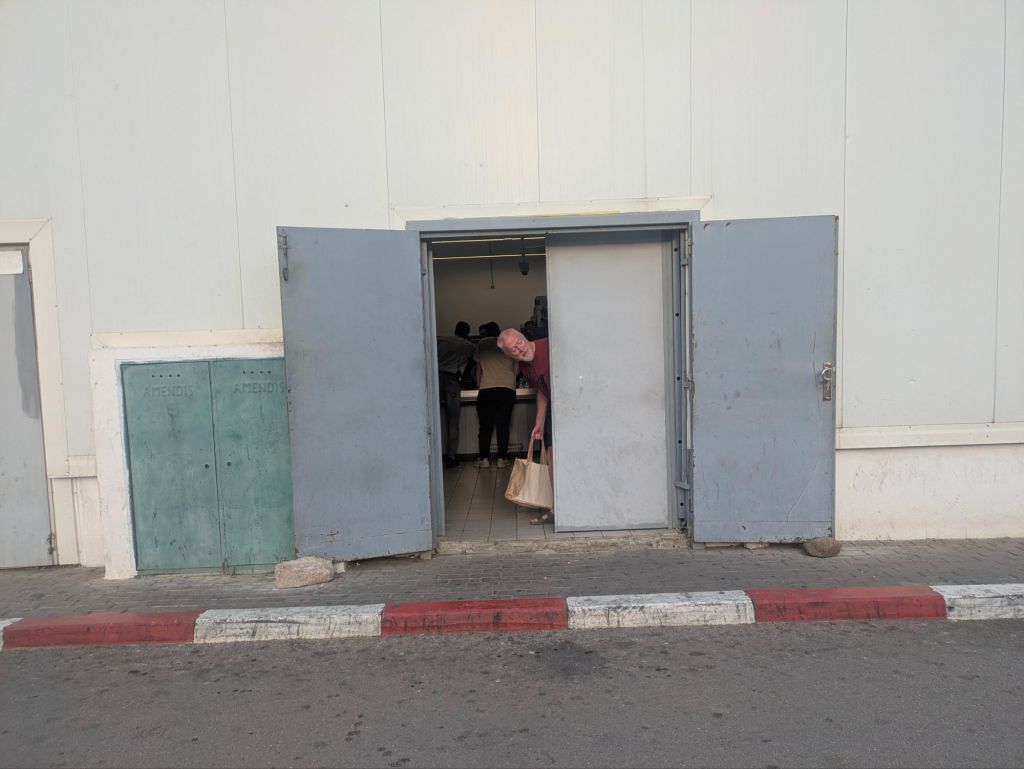
Does anyone see me????

The following morning we were in Ikea before 8.30am, plugged in and charging. Moroccans don’t seem to get up early. All the nearby cafes were closed and shops rarely opened before 10 or even later in the medina. While we were waiting in the van, another EV’s pulled up beside us. The driver told us that although Ikea store doesn’t open until 10am, the restaurant was open for breakfast at 9am. So we enjoyed a three-egg omelette each, made in front of us, with bread rolls, orange juice and coffee for about €7. A bit of local knowledge is a wonderful thing.
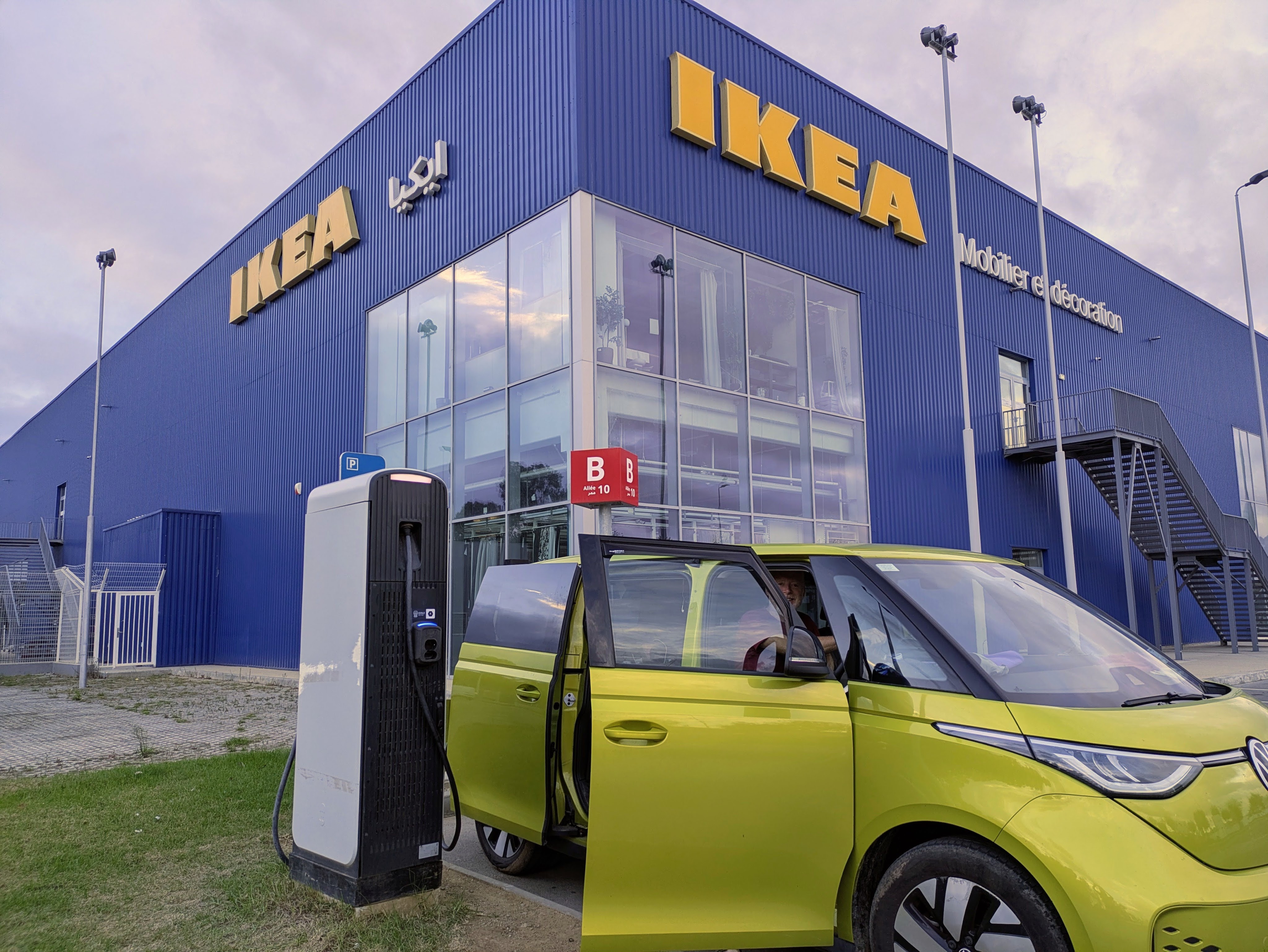
Happiness is…….an EV charger❤️

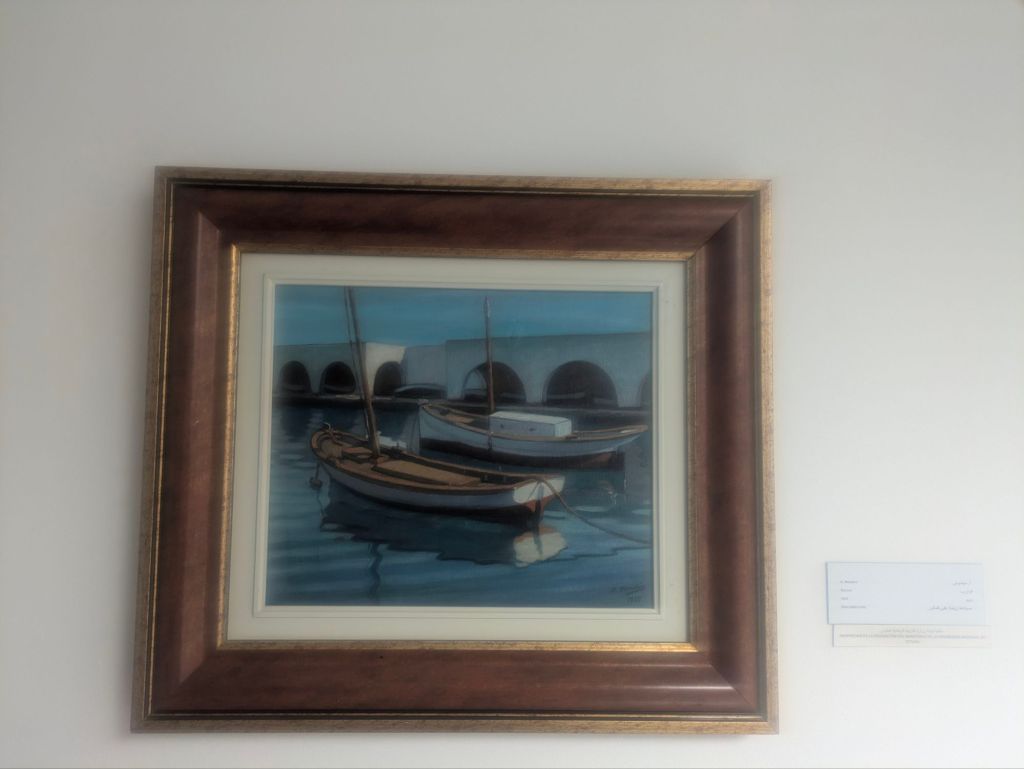
Campsites in the area were scarce so we rented an apartment (mainly because we were in need of a shower, there’s a limit to what sprays of CK one will camouflage). This was such a bargain and so comfortable at €19 a night that we booked it for a second night and enjoyed a ‘culture’ day of visiting museums and a lovely art gallery.
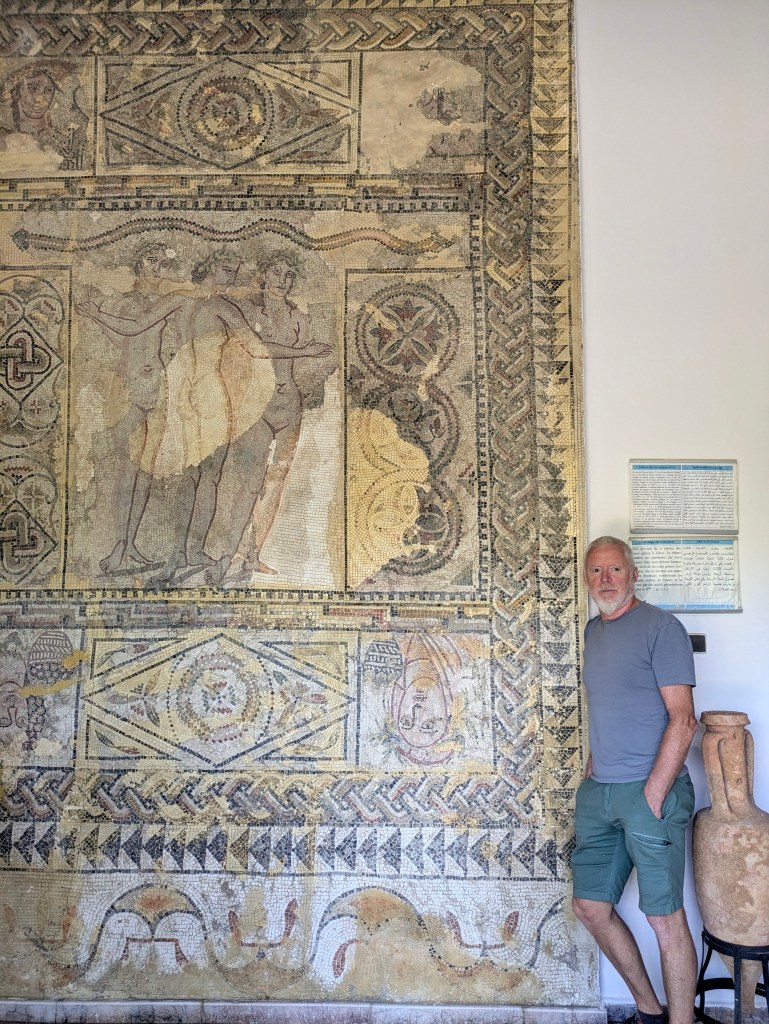
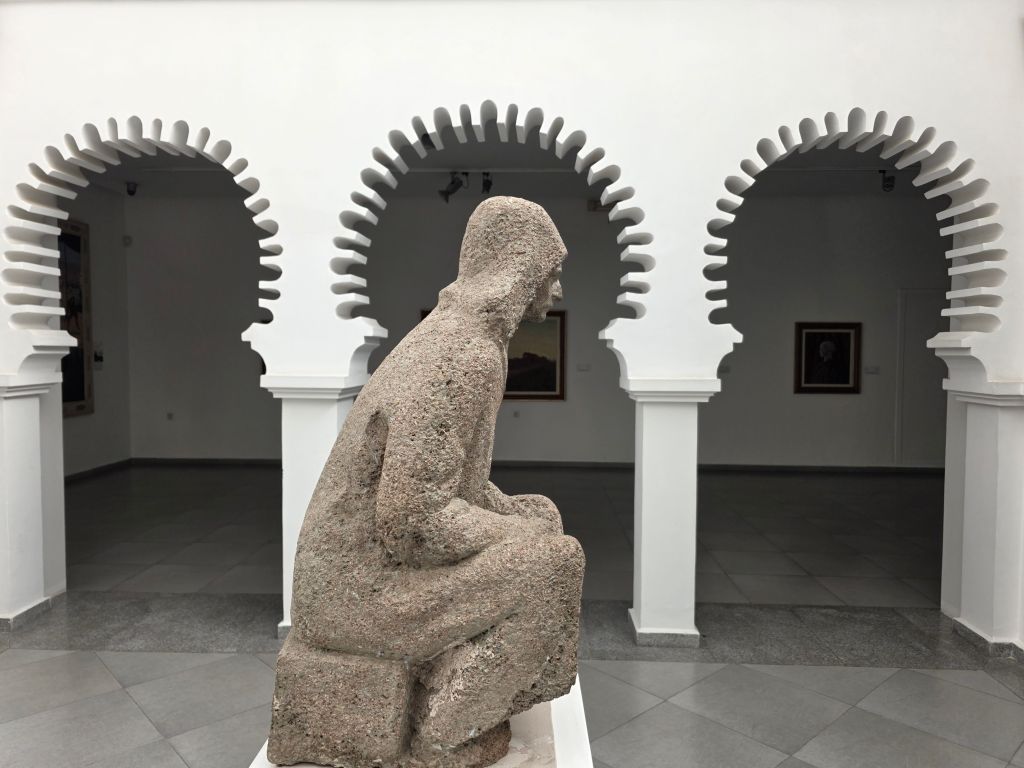
Tomorrow we will head to the border and hope that our exit from Morocco will have less drama than our entrance. If the border crossing goes smoothly, we will spend tomorrow night in Ceuta, the Spanish city on the African continent and get the ferry to mainland Spain the following day.

Thanks for reading

A bientot
Electric Roadtrip: From the Mountains to the Sea

Campervanning in North Mayo: A Scenic Adventure

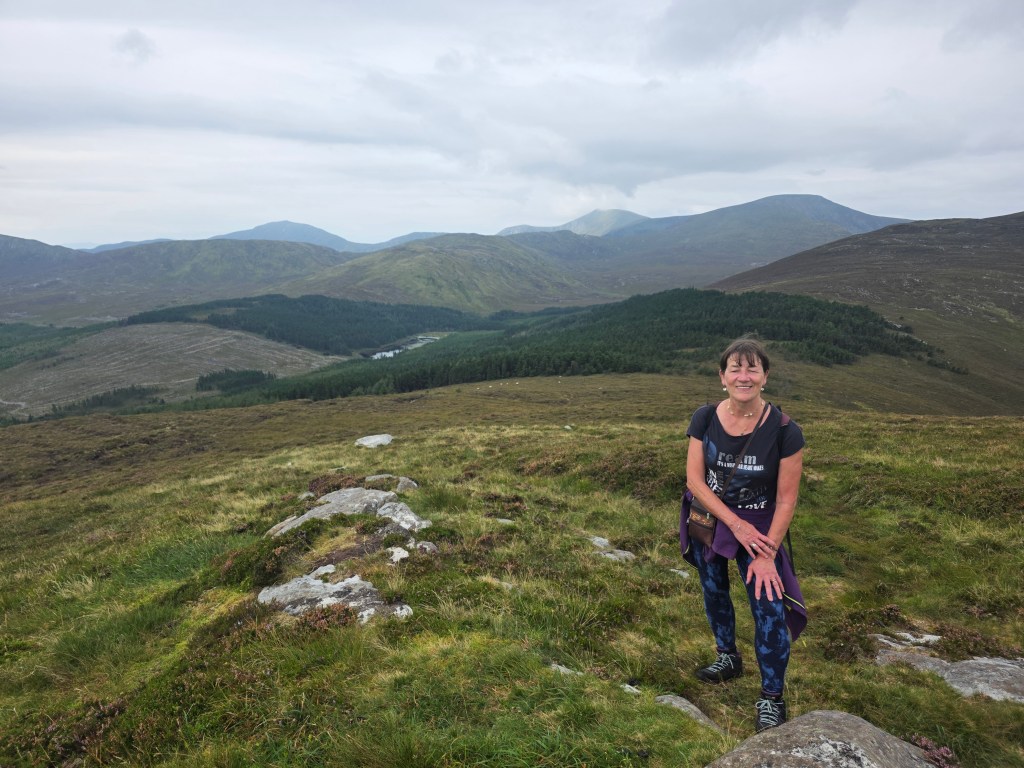
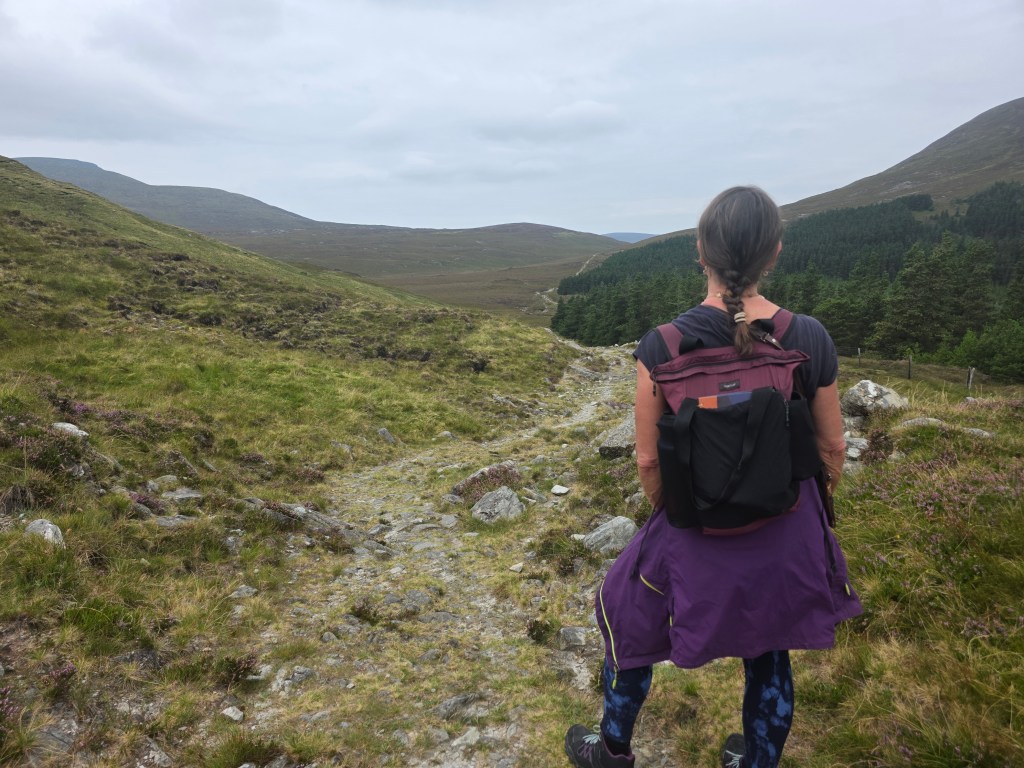
It was a week to remember, a week in late August, spent campervanning around Mayo, a week of spectacular walking on stunning coastal paths, pristine white-sand beaches, lonely bogs and remote mountains and even a pilgrimage route, Tóchar Phádraig,  an ancient druidic path to reach Croagh Patrick.

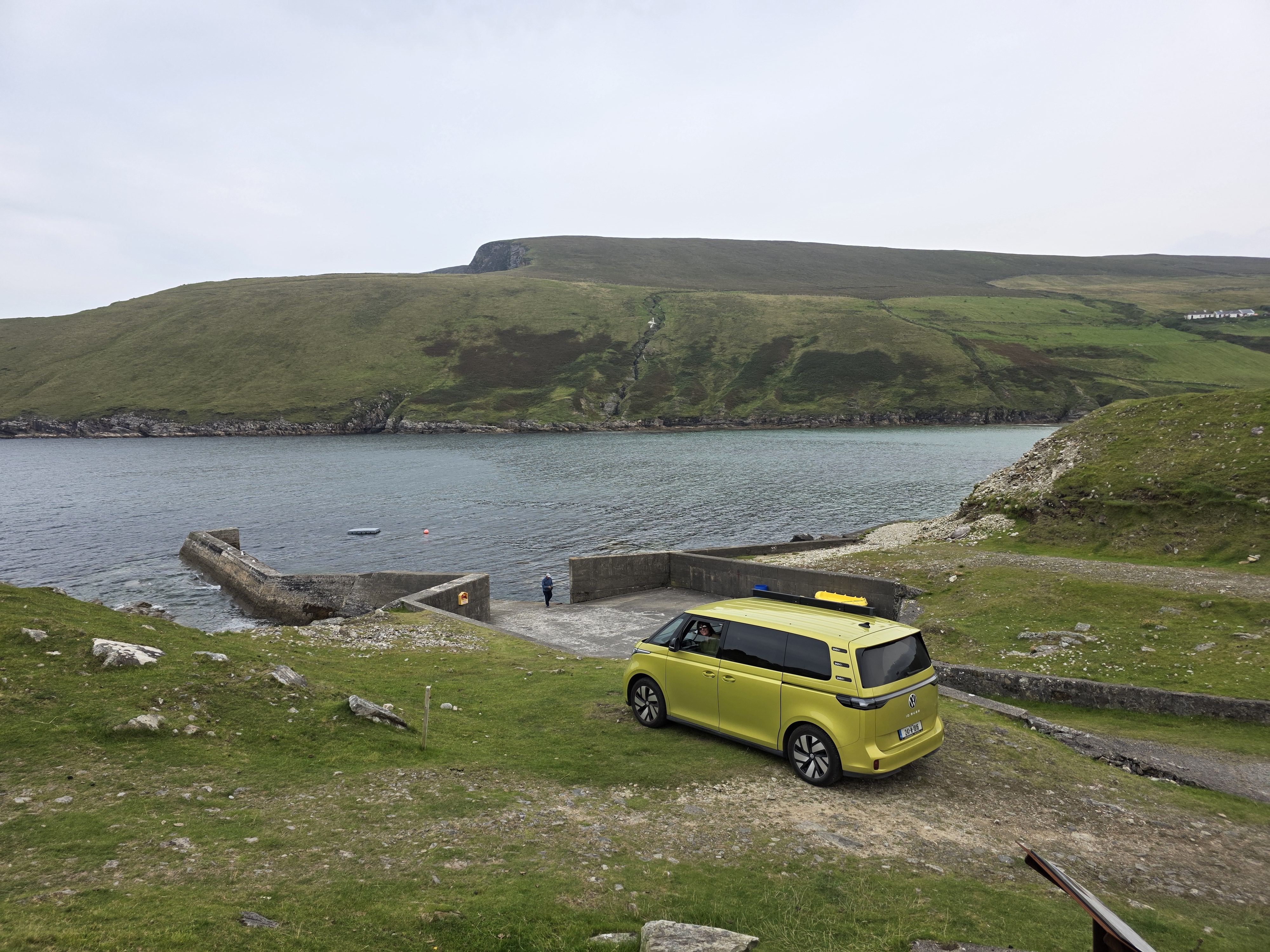
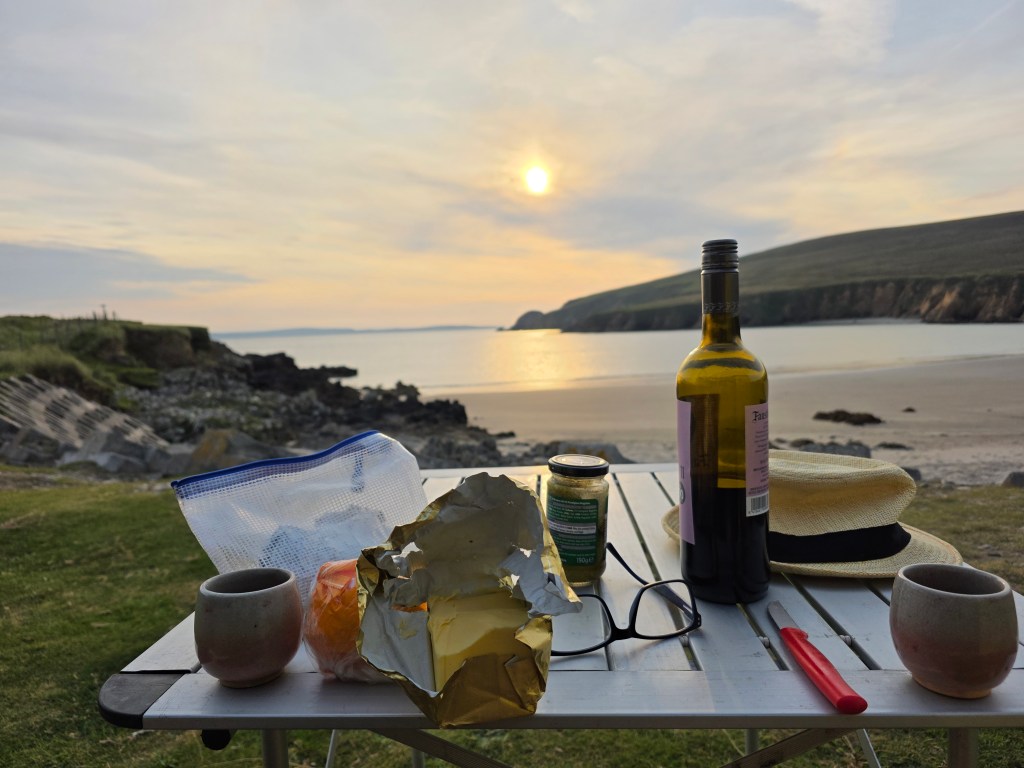
We started at Portocloy Beach on the far North-West Mayo Coast in a Gaeltacht area. If ever the phrase ‘off the beaten track’ was appropriate, it was here. We watched a lone gull, the only sign of life, gliding and swooping over the calm harbour waters.  There were no crowds, cafes, shops or bars, just a picture-perfect beach, isolated by miles of blanket bog and nestled deep into a natural harbour, Carrowteige Cove, a safe haven for swimming or snorkelling and a little pier for fishing boats. There were temporary toilets in place for the summer months which was good news for us as we were sleeping in the van (the ID Buzz).

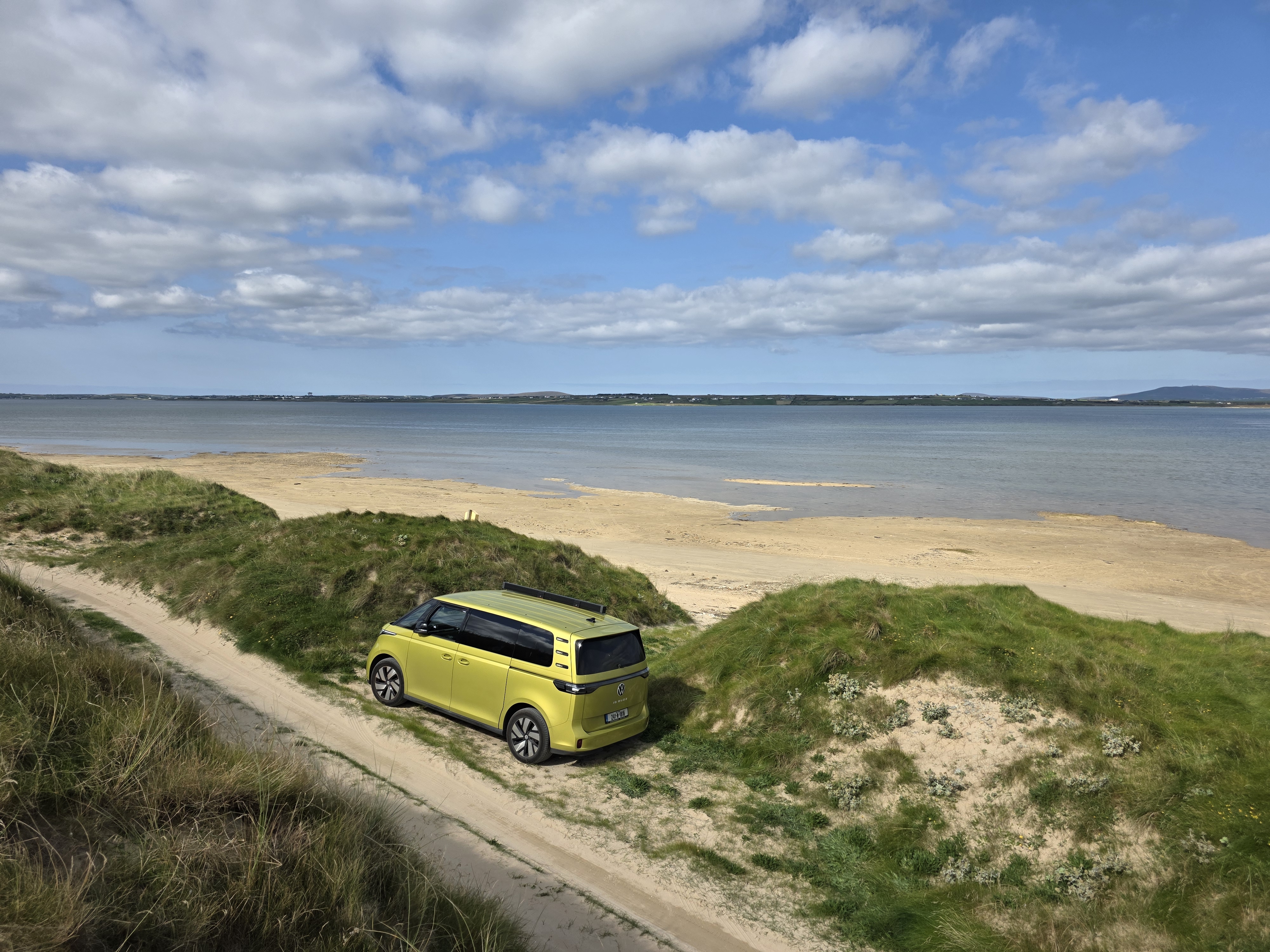
Parked up at Portacloy Harbour

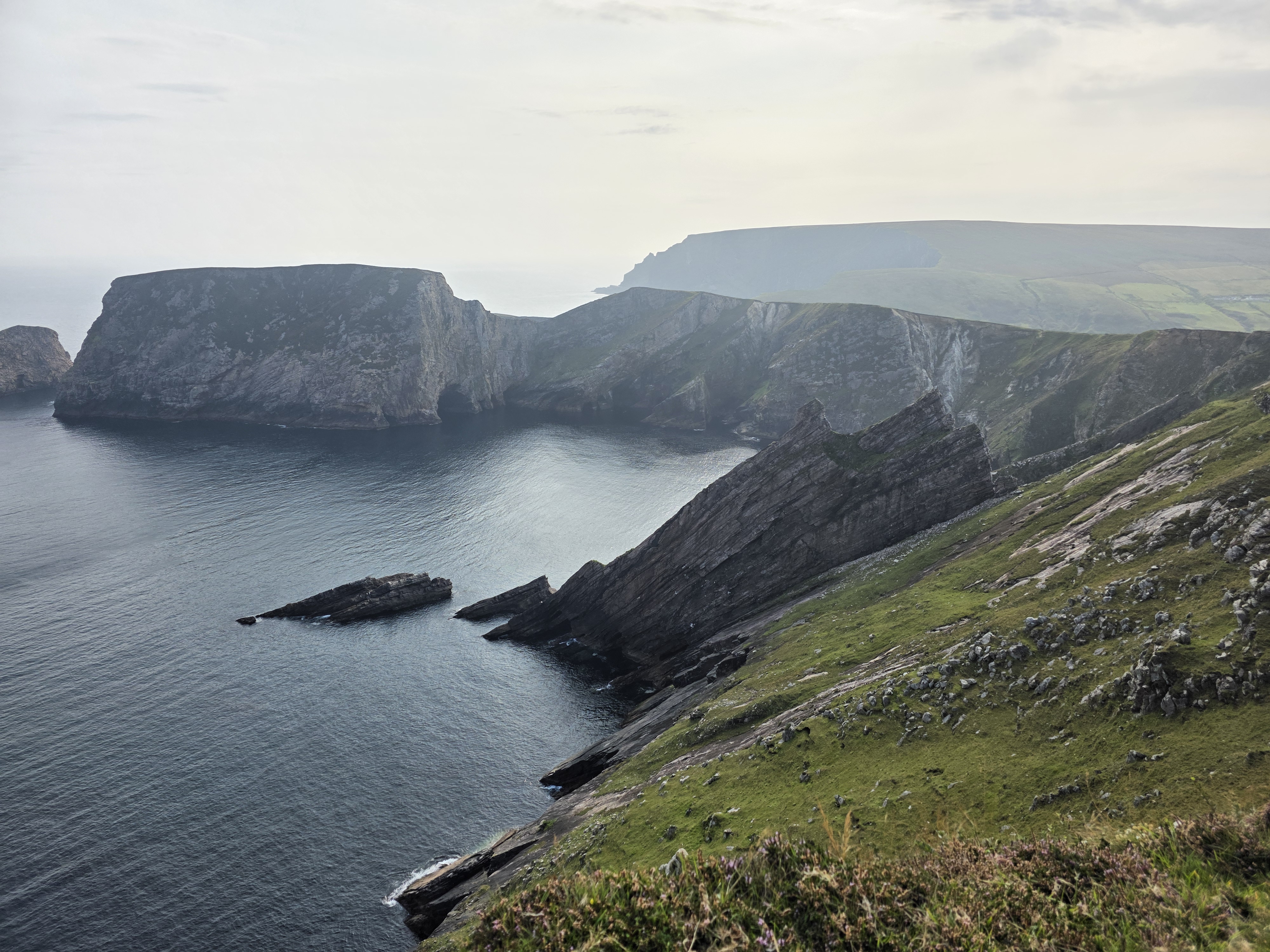
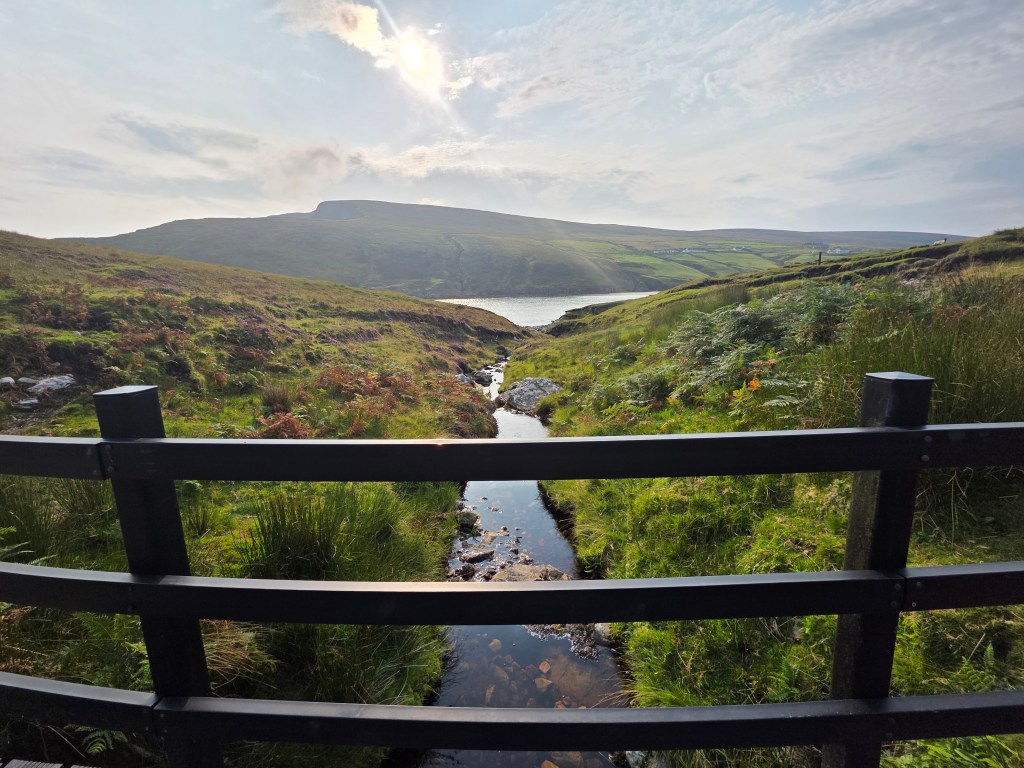
Portocloy Beach is also the start point for a truly spectacular cliff walk along the sea edge all the way to the extraordinary cliff views of Benwee Head (Binn Bhuí). This walk has a combination of rolling hills, expansive bog views, dramatic cliffs, jaw-dropping ocean and sea stack views, and more sheep than we could count. It is a well-marked trail with black poles and purple arrows, clearly visible on a beautiful cloudless day. The weather was perfect for us, blue skies with a light breeze, perfumed from the heathers, but on gusty days, care would be required because of the trail’s proximity to steep cliffs. We hiked an out and back route (about 13kms) but it is also possible to do the Carrowteige Loop Walk, which covers much of the same trail but is looped.

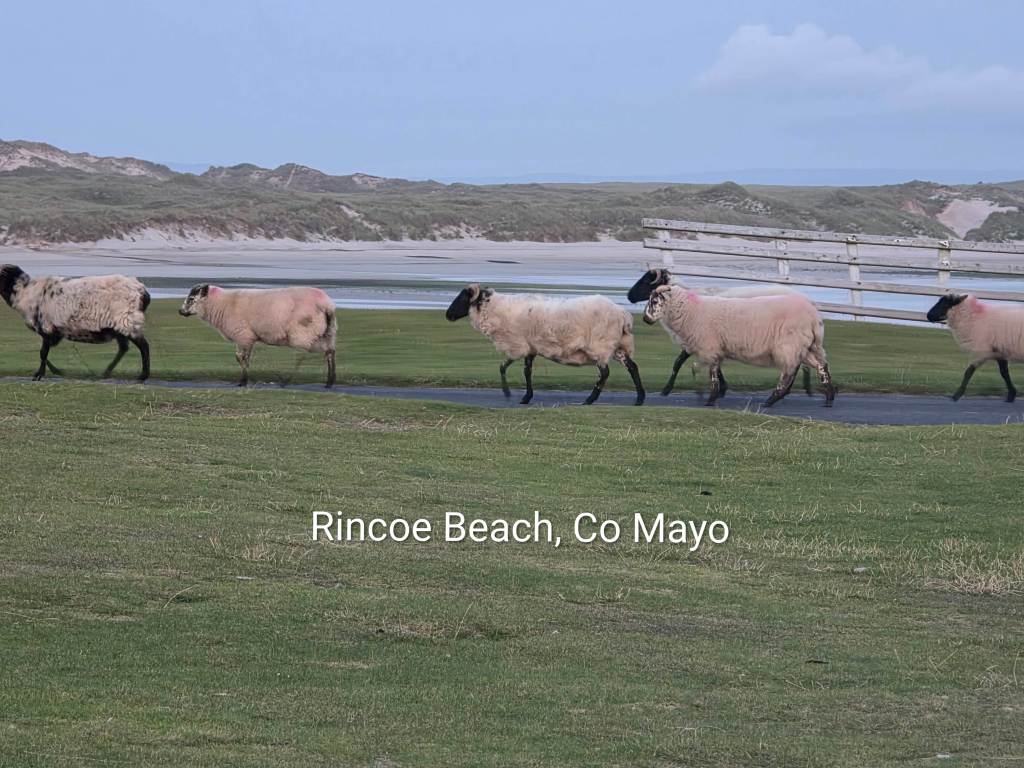
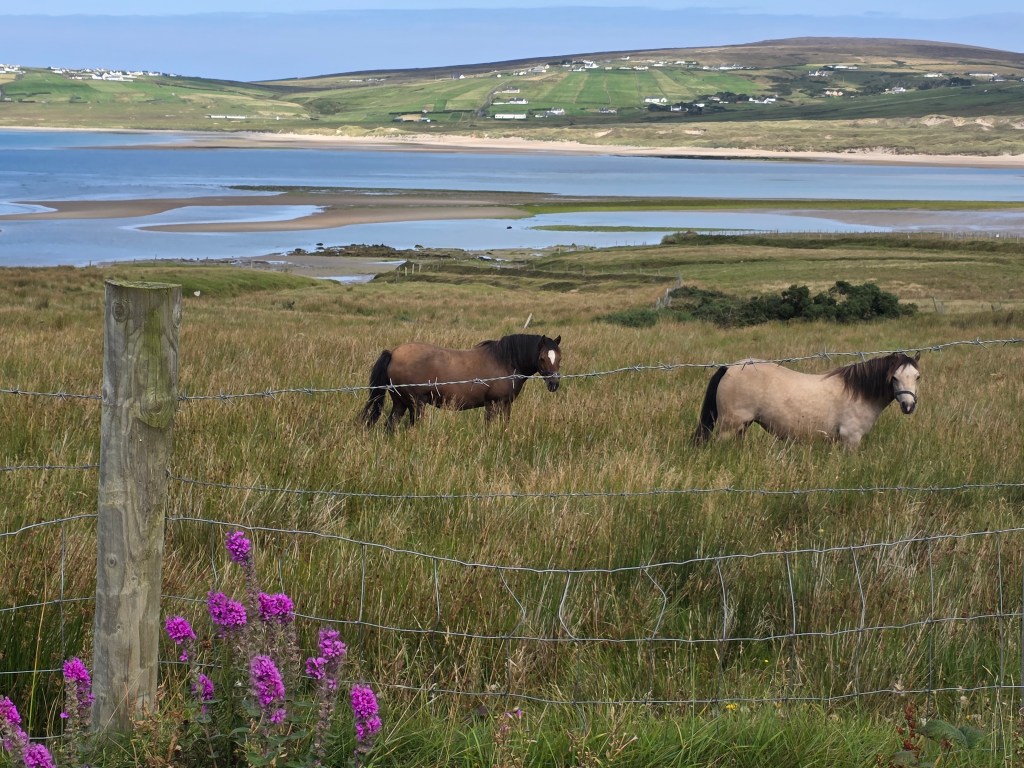
Rincoe Strand was only a ten-minute drive from Portocloy. It looks out across Broadhaven Bay towards the Mullet peninsula with a sandy beach on either side of a small peninsula. There were far more sheep than humans with the sound of bleating mingling with the lapping waves……until two busloads of Irish language students arrived for a swim in the crystal- clear waters… but peace came ebbing back when they scrambled onto their buses after about an hour, leaving a few campervans and the sheep.  We walked uphill past the walled graveyard to Connolly’s Pub (Teach Conghóile), a cosy place with spectacular sea views where a couple of locals were sipping pints. The whole area had a desolate beauty with hardly a tree or bush…it almost felt like we were on an island with the sea and water in every direction. A local man, who now lives in Wexford, told us with nostalgia of the ‘good times’ growing up here, when children ran wild and free, and fishermen travelled to England to find work during the winter months and boys, as young as thirteen, went to Scotland to pick potatoes, known as the tattie hokers.

After Rincoe, we headed south along the coast, stopping for lunch in Belmullet before continuing to Claggan Island, Mayo’s newest island, having only being officially declared an island in 1991. The tiny island is situated on the northeastern corner of Blacksod Bay, about 12km from Belmullet. It is linked to the mainland by a narrow, sandy causeway that divides Tramore Bay from Blacksod Bay and it is circled by beautiful sandy beaches in every direction you look with some amazing views of Achill and the Mullet Peninsula. It was easy to spot the first-time visitors…they were the ones driving on the rough sandy road while the locals used the beach.
Driving around the roads of North Mayo, we kept seeing signs for Tír Sáile without knowing what it was. By the time it registered that this was a Sculpture Trail, we had passed most of them. Tír Sáile  originated in 1993 when fourteen site-specific sculptures were installed in spectacular locations around the coast (sáile is seawater). One of the sculpture was on Claggan island, titled ‘Acknowledgment’, a 50m long sculpture of stone and earth, a tribute to the anonymous dead, whose memories have been lost in time. 
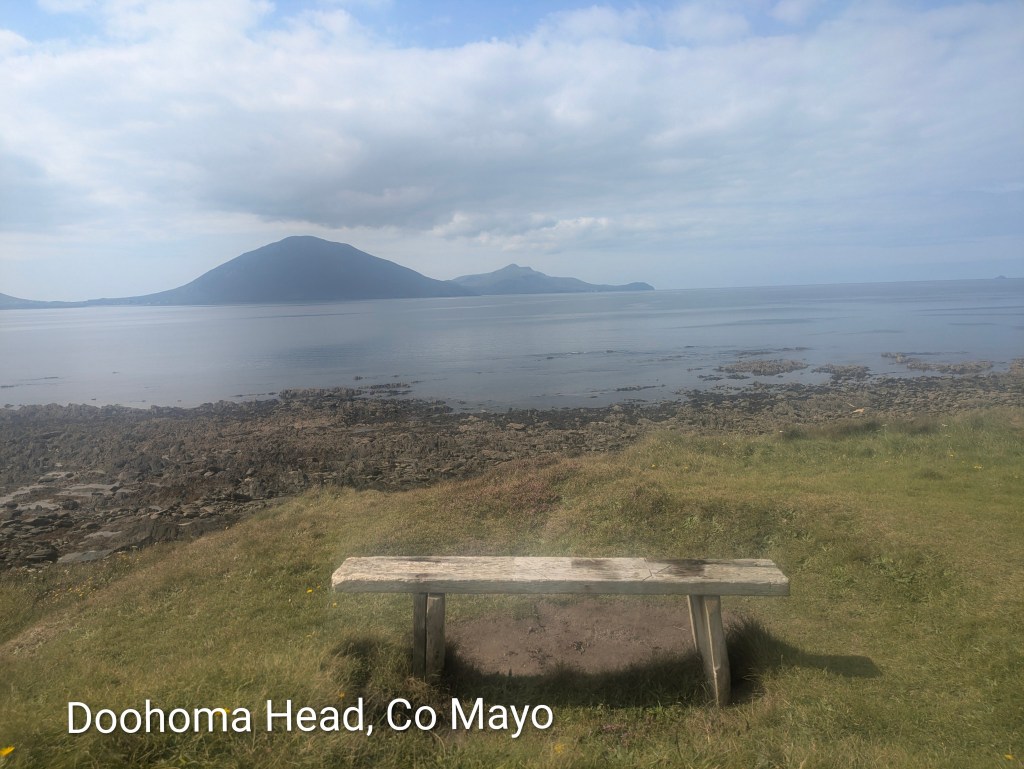
South  of Claggan Island, there seemed to be an unending supply of more white-sand beaches with the distinctive silhouette of Achill Island on the horizon in the distance.  Doolough Beach was empty apart from a man walking five dogs who told us that whales were spotted in the area the day before. Doohoma Head had a wooden seat with a dreamy Achill view but it was time for us to turn inland towards the mountains.

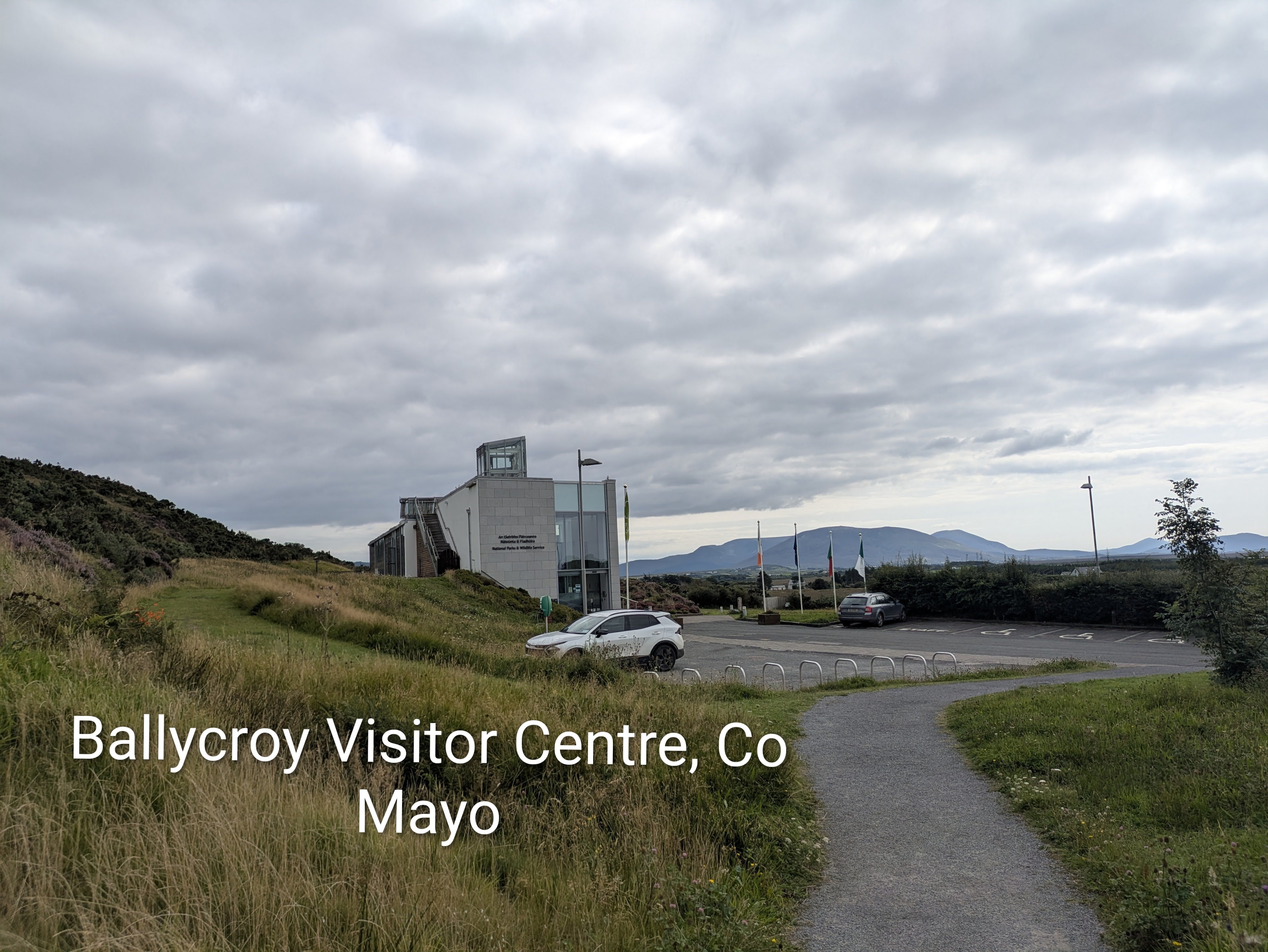
We stopped at the Ballycroy Visitor Centre in Wild Nephin National Park, a modern building full of light and clean lines with knowledgeable, enthusiastic staff and a lovely café. Wild Nephin National Park is huge –  a vast 15,000 hectares of uninhabited and unspoilt wilderness, dominated by the Nephin Beg mountain range and the Owenduff Bog, one of the last intact active blanket bog systems in Western Europe. Martin, who worked in the centre, explained the vision for the future with conservation plans for reforesting the park with native species and  a focus on education.

Just inside the visitor centre was a huge star-studded poster with the caption ‘The darkest skies reveal the brightest stars’ because Nephin has some of the darkest, most pristine night skies in the world and is officially certified as a Gold Tier standard International Dark Sky Park.  The Mayo Dark Sky Park extends across the entire National Park….there was even a viewing platform on the grounds of the visitor centre. The best time for star-gazing is the clear crisp winter months but it is possible on any night for visitors to see with the naked eye thousands of twinkling stars, other planets in our solar system, the Milky Way and even meteor showers…if they are lucky.

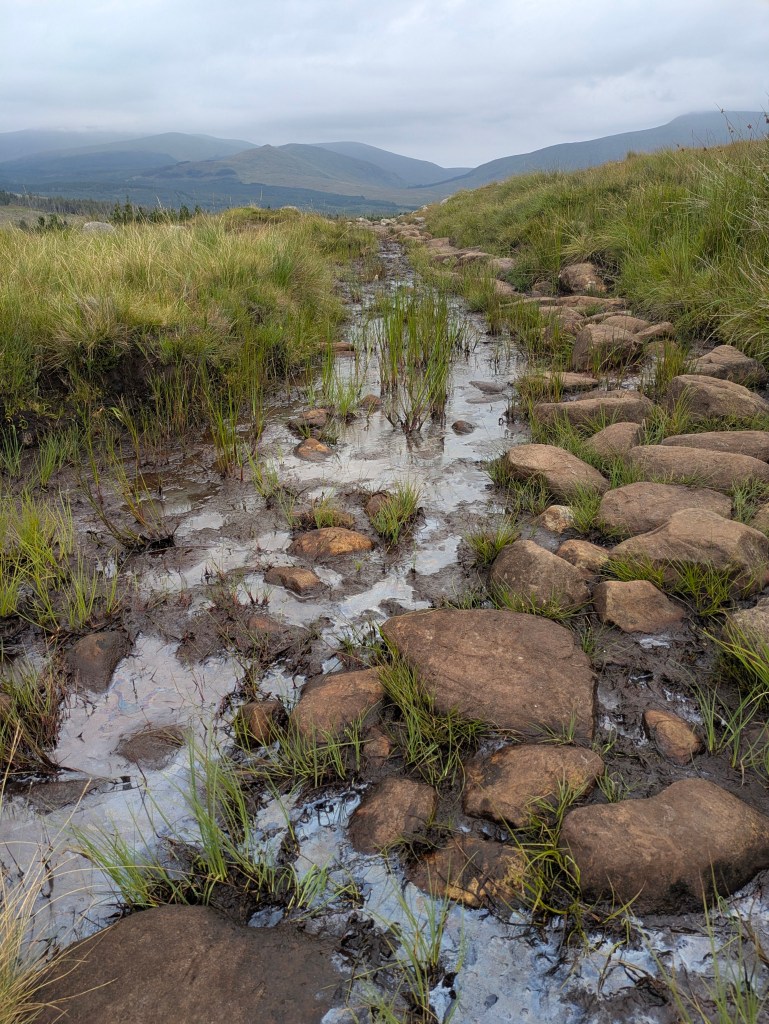
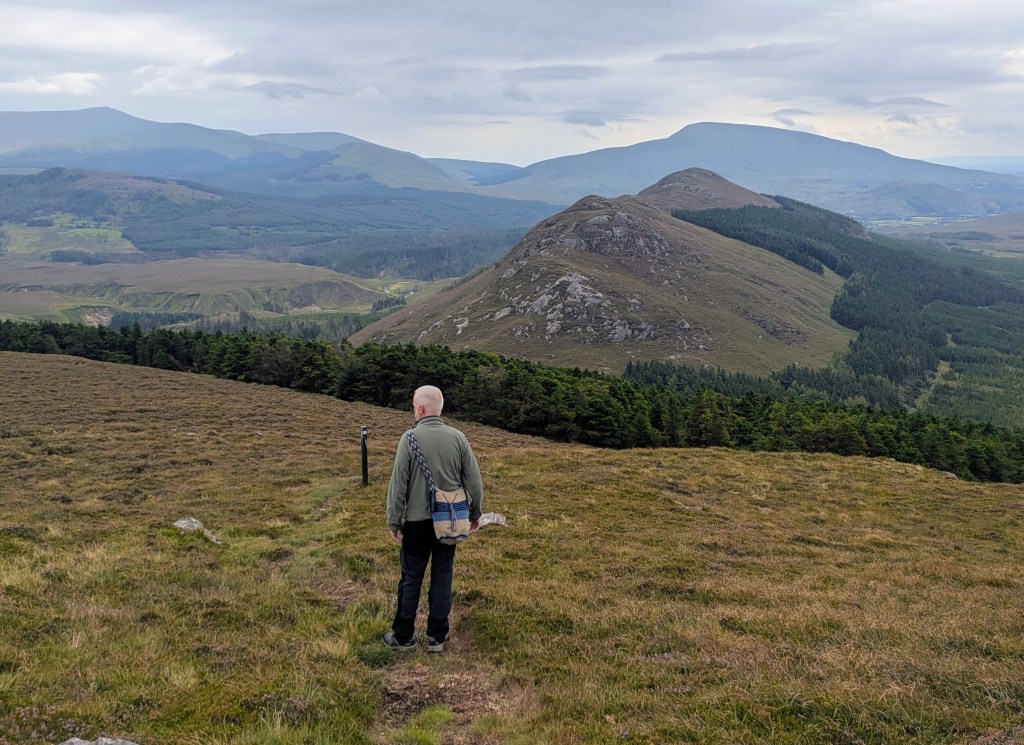
On Martin’s advice we headed to the Letterkeen Trailhead, about a forty minute drive, northeast from the centre,  a trip into wilderness and blizzards of midges at dusk. Unfortunately the skies remained cloudy for us that night with only a smattering of stars but the Letterkeen Loop walk the following morning was gorgeous, with different terrain from stony sheep paths, forest trails to sucking boggy paths where we almost lost a boot. Although the air was thick with moisture, it didn’t actually rain. We enjoyed panoramic views of inky-black lakes, brown streams and a feeling of deep isolation and silence. Nephin has been called ‘the loneliest place in the whole country’ because of the absence of human habitation and mobile coverage is patchy. We didn’t meet a single person on the trail although there were a few cars parked at the trailhead, which also had spotless port-a-loos.  

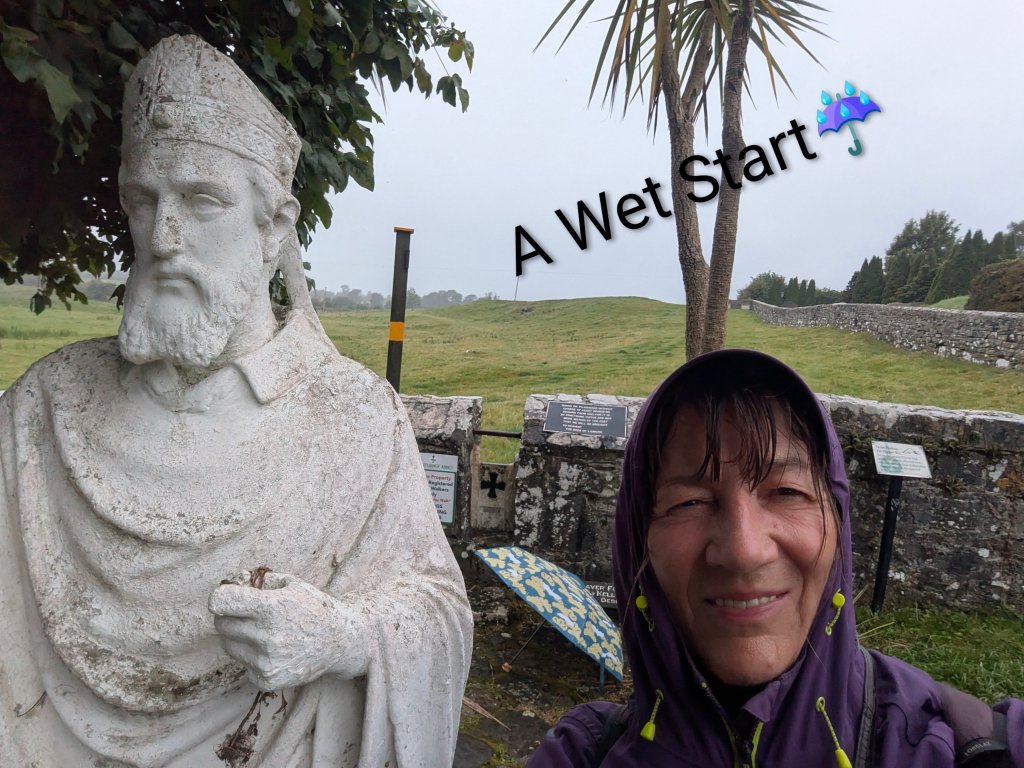
Our next stop was Ballintubber Abbey, founded in 1216 and one of Ireland’s oldest surviving abbeys and the hub of the ‘Irish Camino,’ and one of the five medieval pilgrim paths of Ireland. It is the starting point for Tóchar Phádraig, an ancient pilgrim path that stretches to Crough Patrick.

Tóchar Phádraig predates St. Patrick, originally built about 350AD as a chariot route from Rathcruachan, the seat of the kings and queens of Connacht, to  Cruachan Aille, as Crough Patrick was called in Pre-Christian times, a mountain sacred to our pagan ancestors.
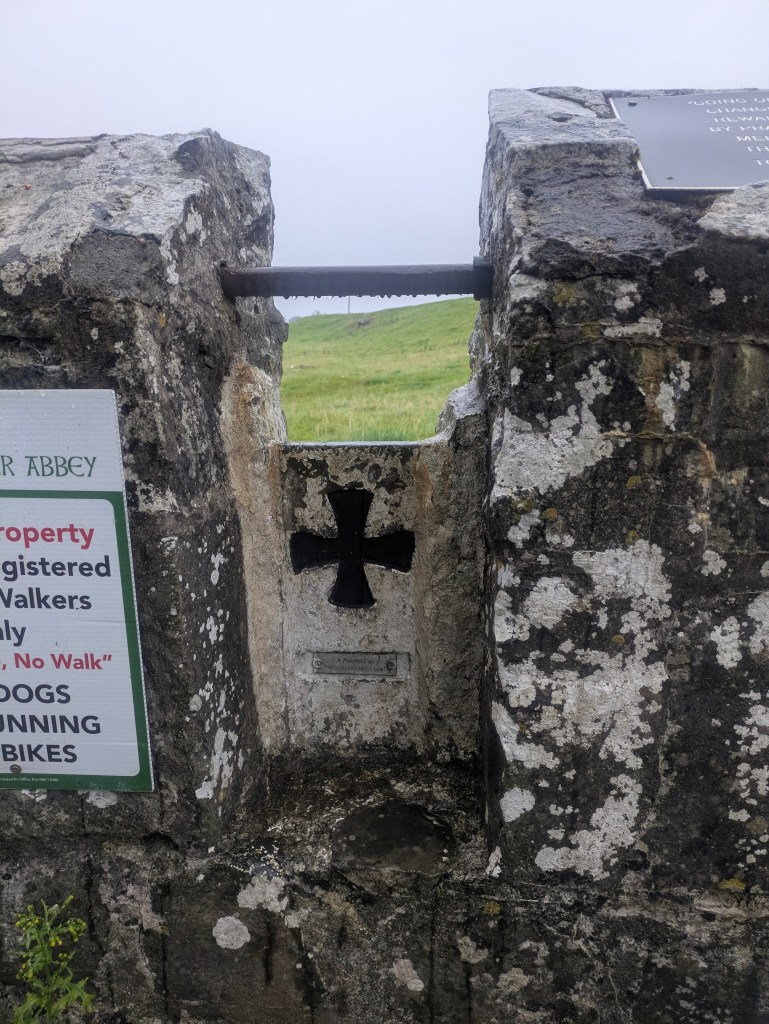
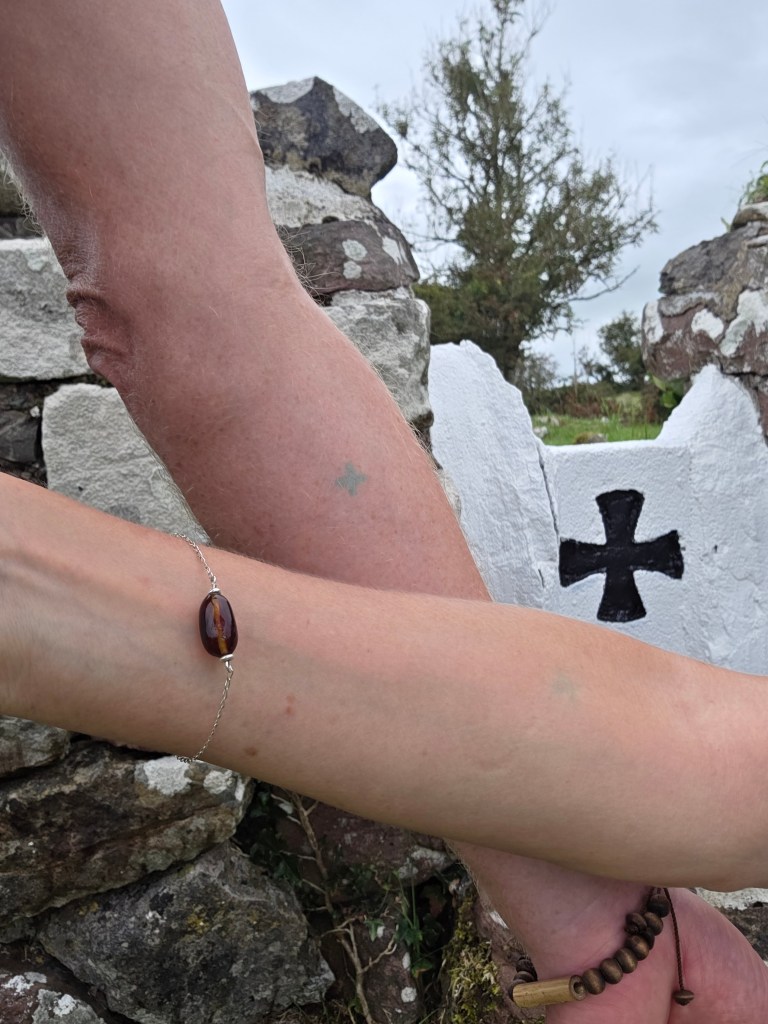
Pilgrims must register in the Abbey before setting out, where they will receive maps, advice and a booklet which gives some information on the many points of interest along the way. We registered on Friday afternoon so that we could get an early start on the 35kms route the following morning as the office opened at 9.30am. The walk can be broken into two parts, the first section to Aghagower with its round tower, and the second section to Crough Patrick but we hoped to complete it in one go.  We were branded on the back of each forearm with a small green cross, evidence that we had registered and paid our dues should any farmer or landowner request proof.

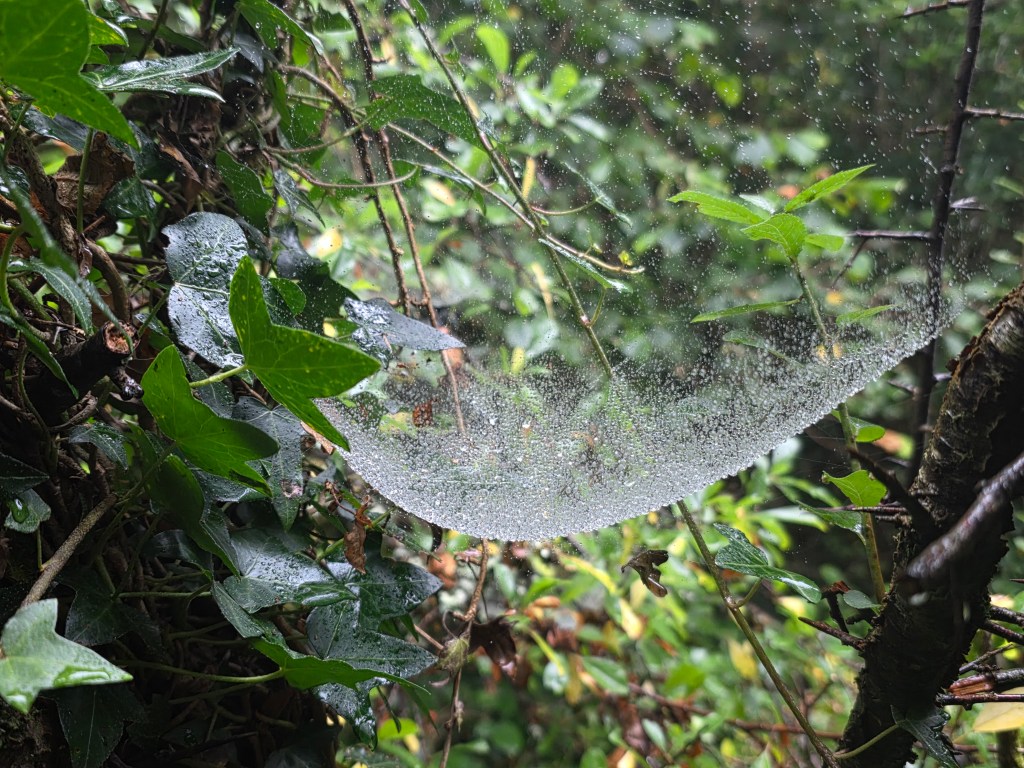
The morning started grey, in a light drizzle, the type of West of Ireland rain that was very wetting but the day cleared after an hour or two. The camino wound its way through open farmland, fields of grazing cattle, sheep and a few horses. We trekked through woodland and forests, stepped over countless stiles with the Tóchar cross sign etched into the stone and tramped along country lanes past hedgerows laden with abundant bounty – blackberries, sloes and haws and moisture drizzled cobwebs.

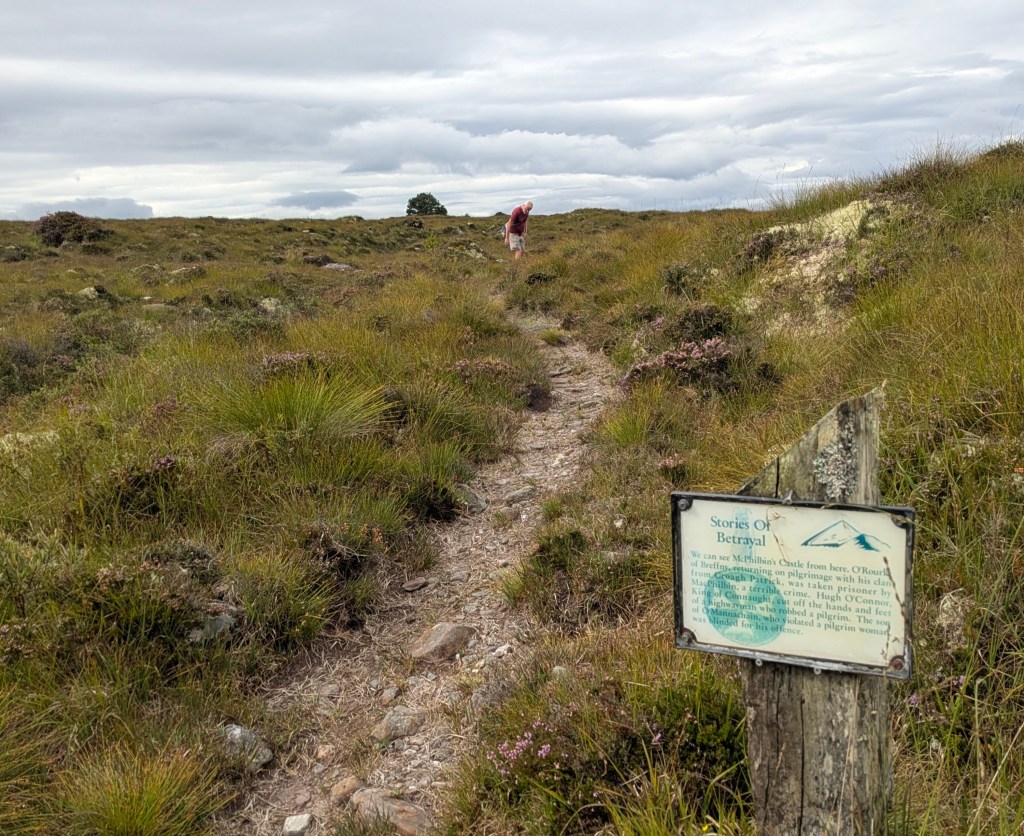
There were numerous storyboards, highlighting points of interest, a welcome opportunity to stop and read. This was not only a spiritual pilgrimage but also a cultural and historical journey through the ages, a fascinating blend of pagan and Christianity, a place of history and pre-history where every tree, stone and rock had a story to tell – mainly of famine, hardship and betrayal but also of healing and goodness. Sometimes in the silence, all I could hear was the beating of my heart and the sound of my boots on the earth. While the first section was predominantly off-road, the second section was mainly on paved country roads and laneways.

With our damp start and the high wet grass, our feet were wet from the very beginning and we contemplated giving up at the halfway point but we persevered. Crough Patrick loomed out of the landscape, a focal point since ancient times,  and seemed to beckon us forward although for long sections, it didn’t seem like  we  were getting any closer as we plodded along. There were signs saying ‘No complaining’ in several places which we tried to obey.

 Although the trail was well-marked, we managed to lose it several times, back-tracking until we picked it up again. There are several guided walks each year, organised by the Abbey, which would be easier as we wouldn’t have to concentrate on finding the markers ourselves but we were a week too early for the August guided pilgramage. We finished with a sense of achievement…. and exhaustion with shrivelled feet… after a long day of blisters and contemplation.

We barely scratched the surface of what North Mayo has to offer but one thing is certain, we will certainly return if we can.  If stunning scenery, amazing deserted beaches, superb hiking  and starry skies are your thing, then Mayo is definitely the place to go. The locals are an added bonus, probably the friendliest people in the whole country and certainly the most talkative.

We had no problem with the electric van, charging it in Ballina and in Westport.  This van trip was so successful that we are considering going further afield. Might it be possible to drive to Istanbul or Casablanca…..and back?

Thanks for reading

Campervanning in North Mayo: A Scenic Adventure

Japan: Highs and Lows

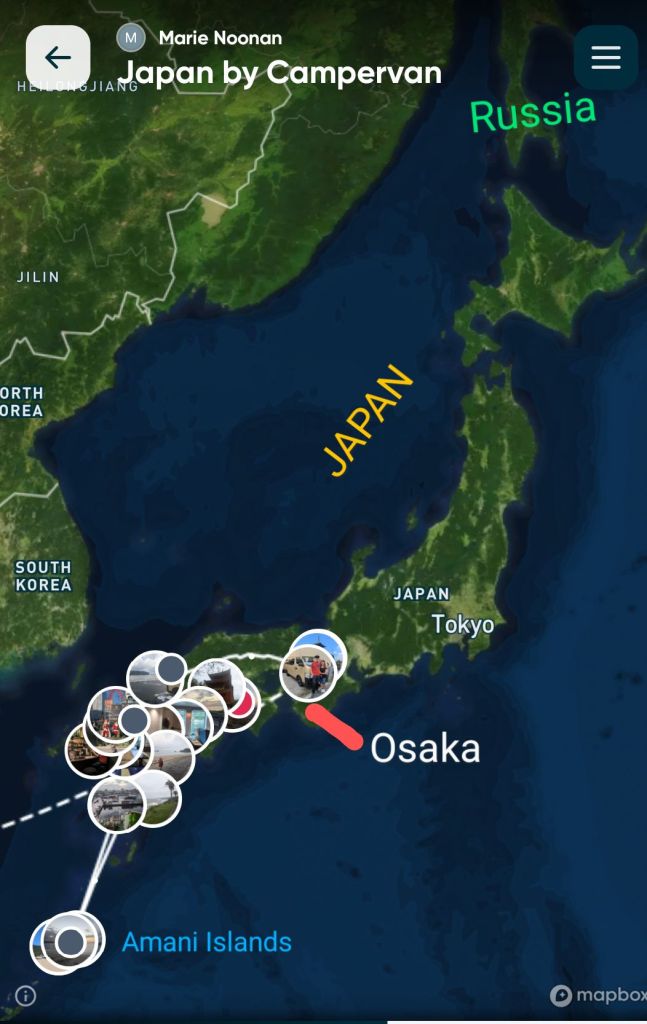
screenshot_20241130-101223~34194303731757339452.

Now that we are back home from our six-week trip in a campervan around fascinating Japan, it’s  time to reflect on our experience. We flew into and out of Osaka and in between travelled a circuitous route in South Western Japan  through the large islands of Sikoku and Kyushu, often changing course because of the weather. Japan is about five and a half times the size of Ireland but feels much bigger, stretching from within touching distance of Russia in the extreme north to islands in the East China Sea that almost nudge Taiwan.

I’ve included a dozen highlights but I could easily have included a dozen more. So here we go…..

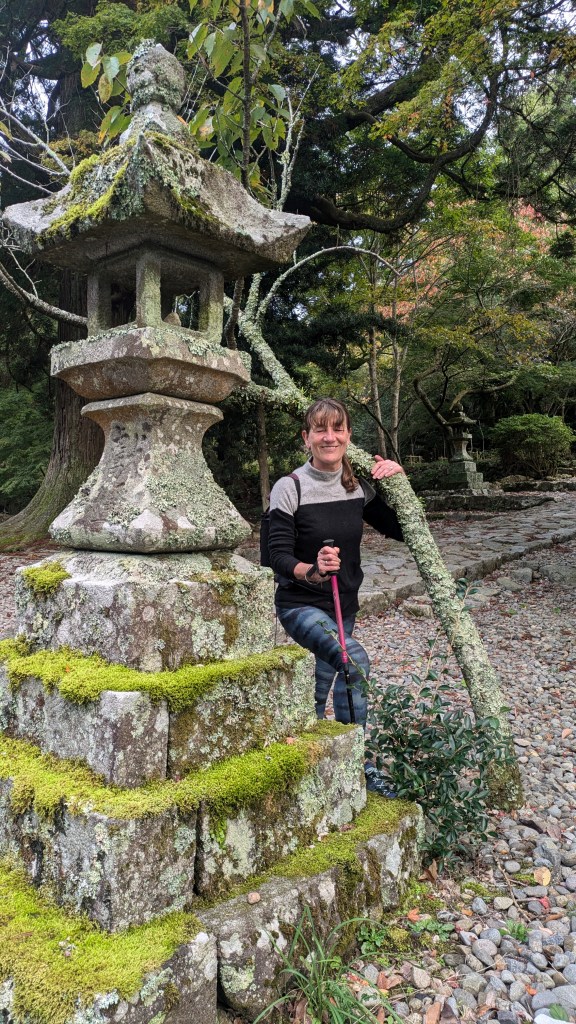
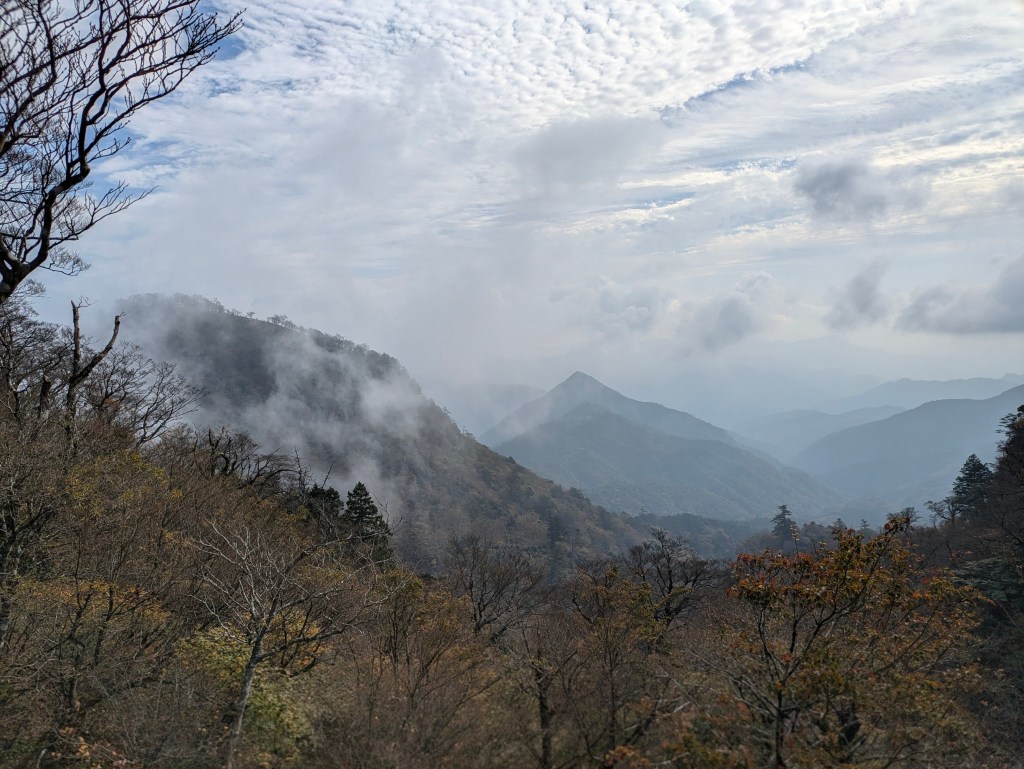
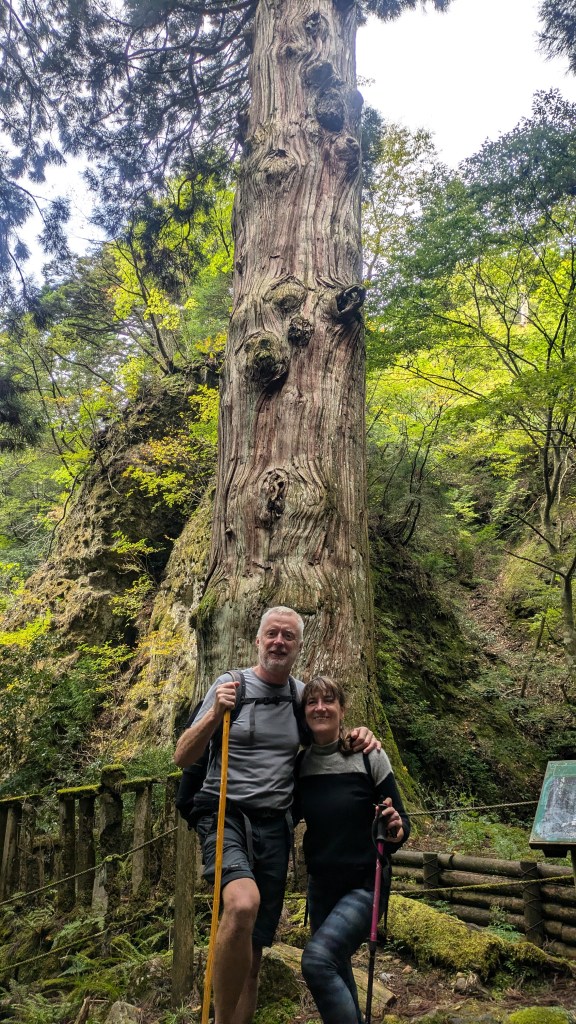
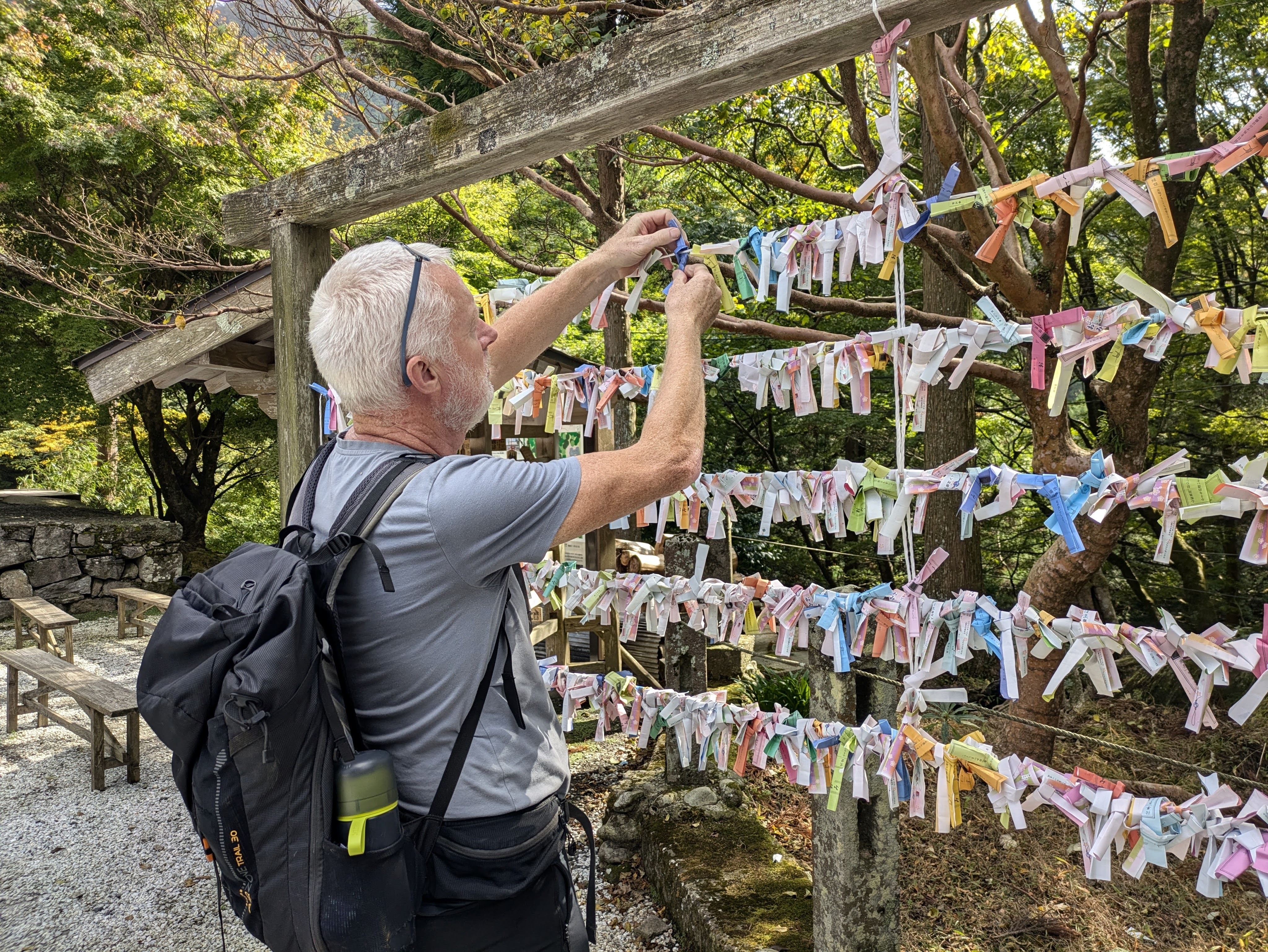
Climbing a Holy Mountain .Japan is a mountainous, heavily-forested country with many sacred mountains but for us, the most special was Mt Hiko in Kyushu, a place where hundreds of years ago, white-clothed monks trained in strenuous physical activity, believing that this was the path to enlightenment. We hiked past countless, moss-shrouded shrines towards misty summits on a glorious Autumn day with the leaves dressed in their burgundy and golden finery. This was truly a spiritual experience especially as we seemed to be the only two people on the mountain. On the way, we also paid homage of the resilience of  Onisugi, a huge cedar tree estimated to be around 1,200 years old.

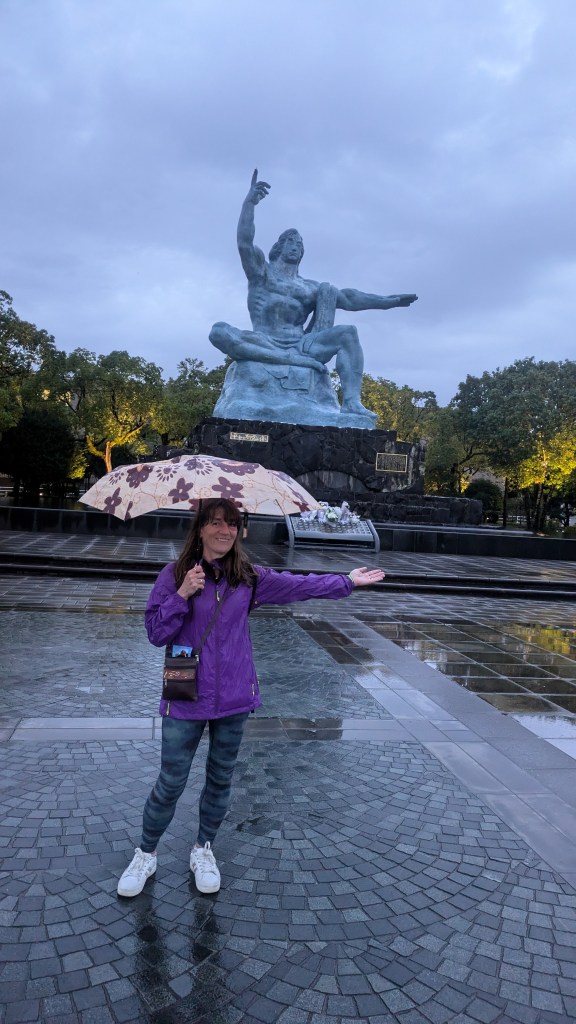
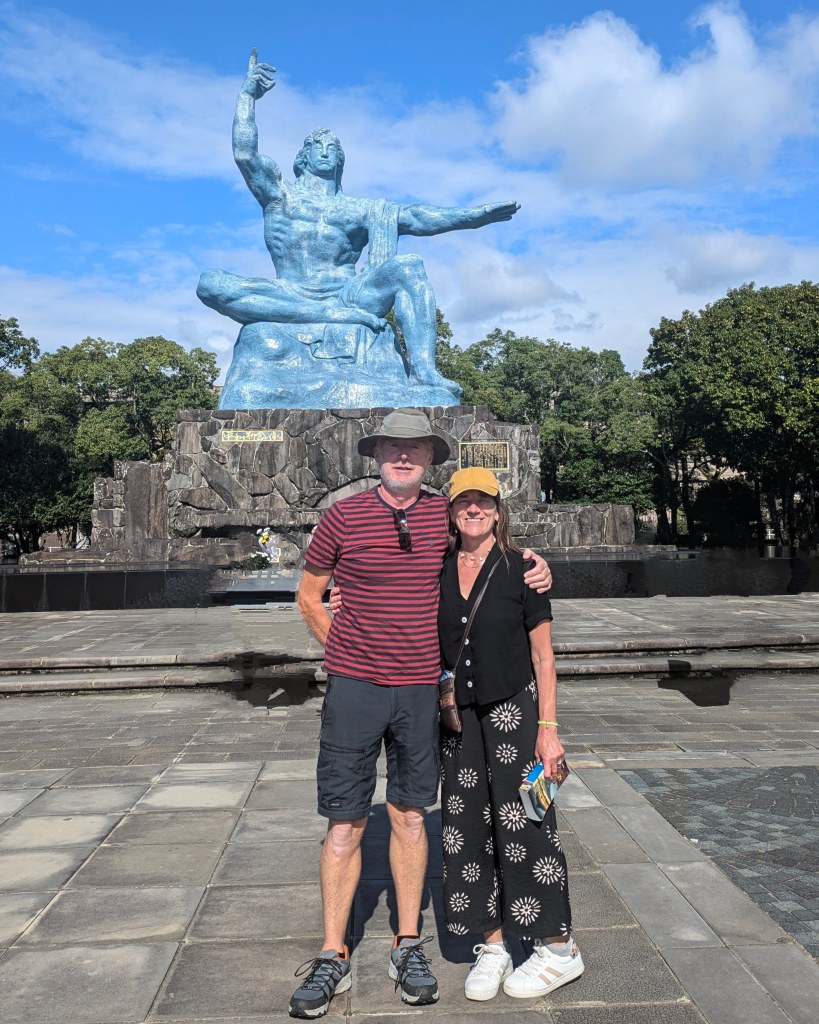
Hell on Earth. Nagasaki could be in the category of lowlights but it belongs here in the highlights. We spent two days here, the first with torrential rain which felt like it might never stop and the second with skies so blue, it almost hurt our eyes.  This was almost a metaphor for Nagasaki, a beautiful city which exuded a firm belief in hope and brighter days after tragedy. Visiting the Atomic Bomb Museum was harrowing, so harrowing that I don’t think our minds were able to comprehend the immensity of it all. I will just copy here an inscription on a bridge near the centre of devastation.

At 11,02am on August 9, 1945, an atomic bomb exploded in the skies over Matsuyama. The stream, Shimonakawa, flowing through the eastern part of the neighbourhood, was soon filled with the corpses of victims who died groping for a drink of water, or mortally burned and wounded, collapsed and perished there. A survivor who witnessed the scene the following day described it as follows. ‘I crossed the half destroyed Maysayama Bridge over Shimonakawa. There were so many corpses under it that they formed a dam in the stream. It was like a vision of the Apocalypse, a living hell on earth. Not a speck of cloud tainted the sky above, but the earth below was a panorama of carnage and destruction.’

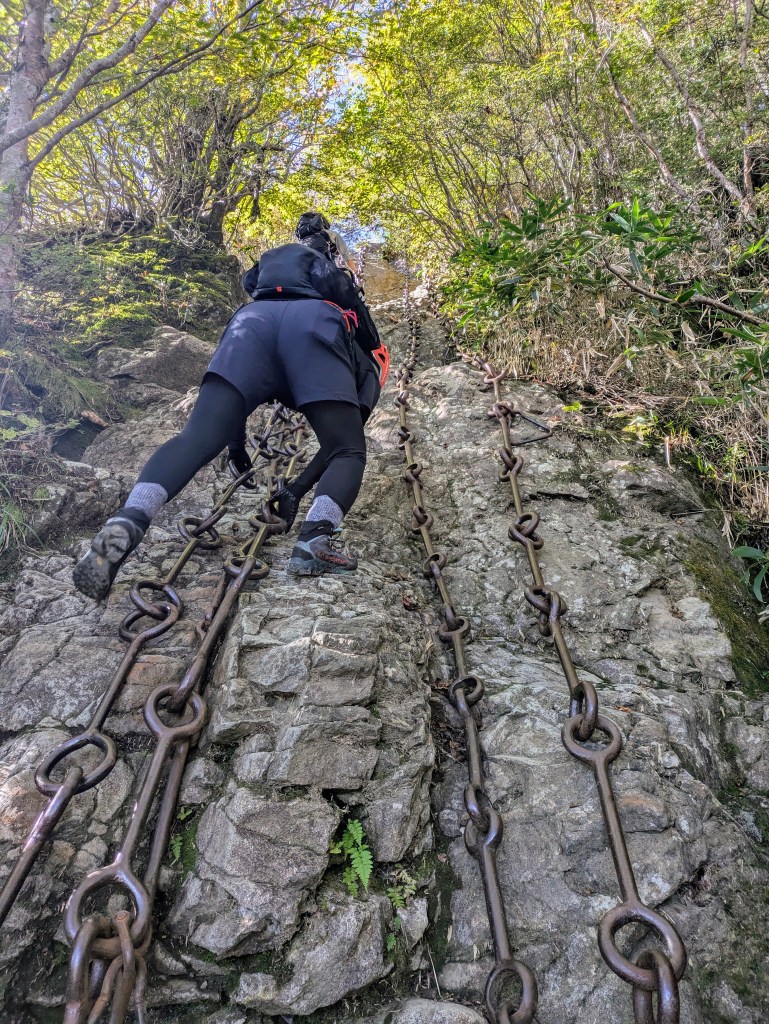
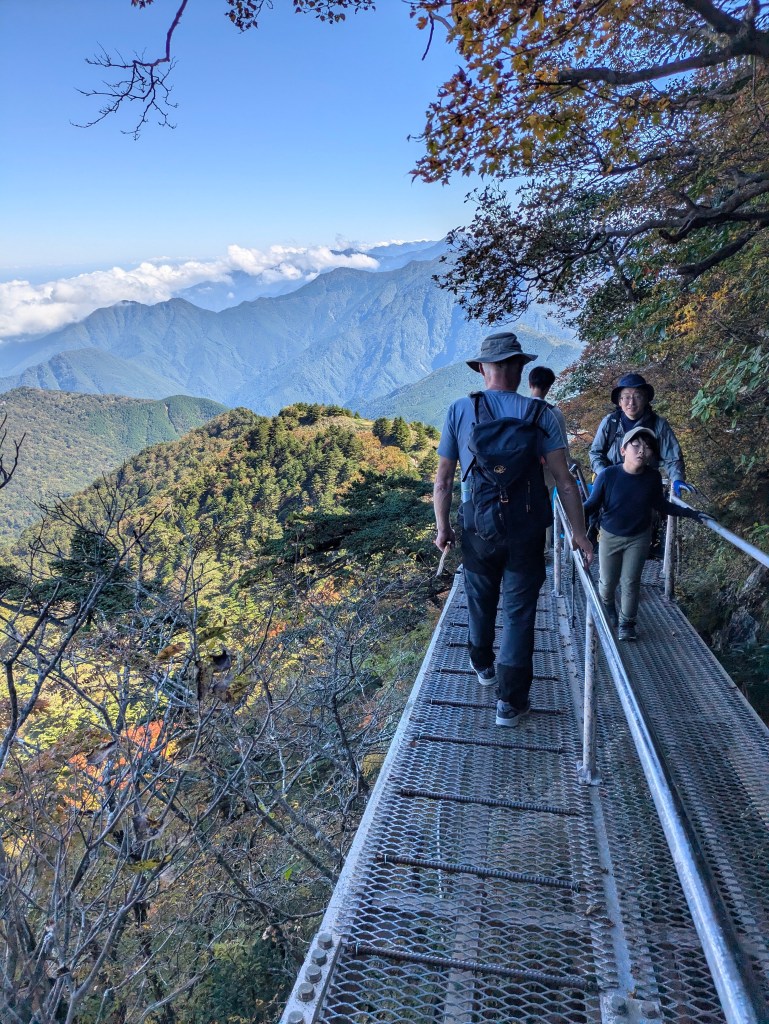
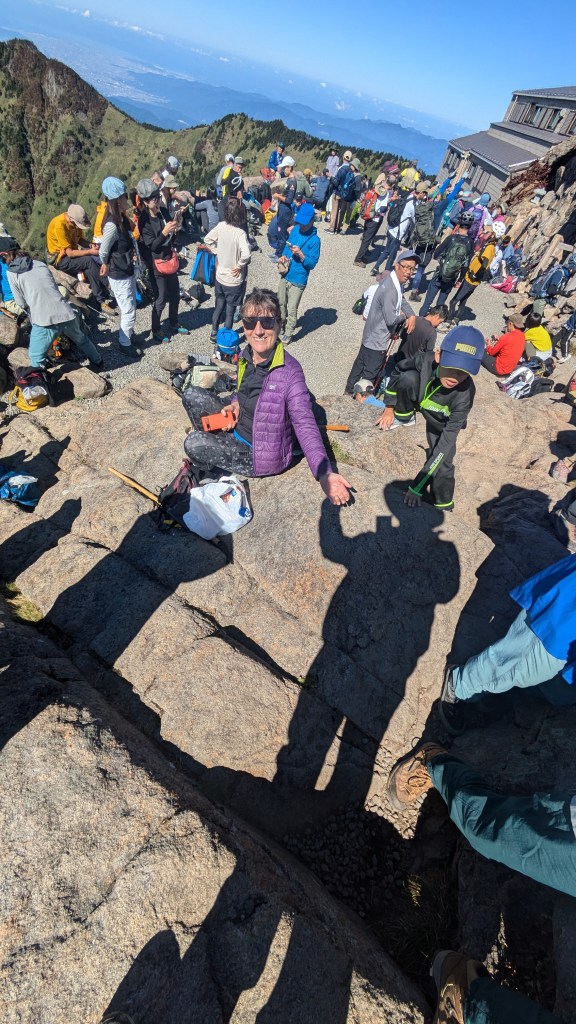
Getting high on Mount Ishizuchi Mount Ishizuchi, the highest mountain in South Western Japan, was an entirely different experience to our Mt Hiko hike. We trekked on a blue-skied Sunday, it was the Sports Day public holiday weekend which promoted an active lifestyle and we weren’t alone. The climb started on gradual paths that became steeper, much steeper.  In some nearly- vertical sections, steel chains were embedded into the rock as an aid to haul ourselves up. It was exhausting but fun, surrounded by many friendly Japanese.

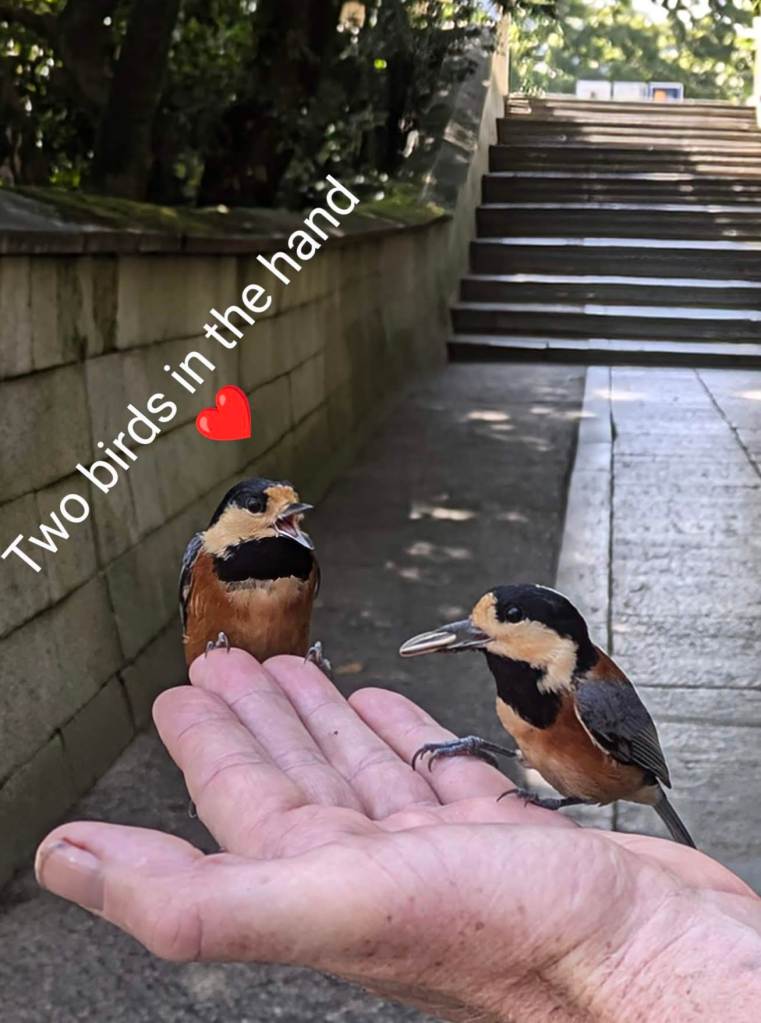
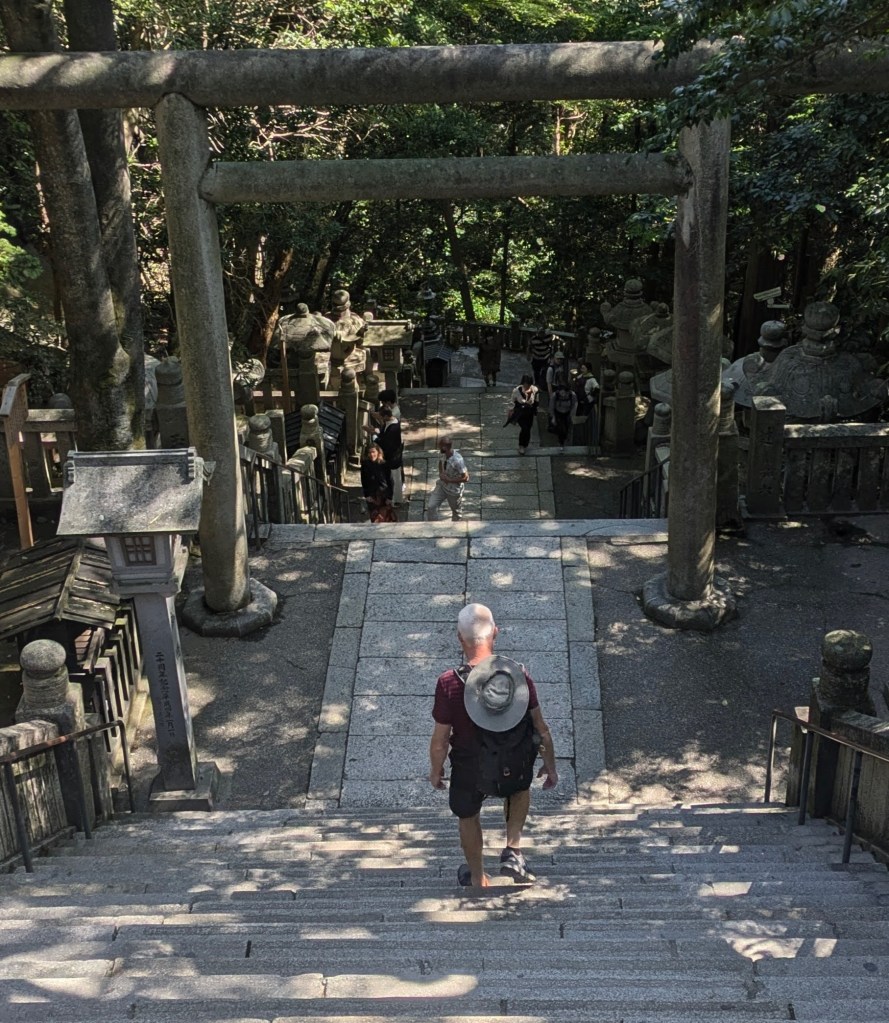
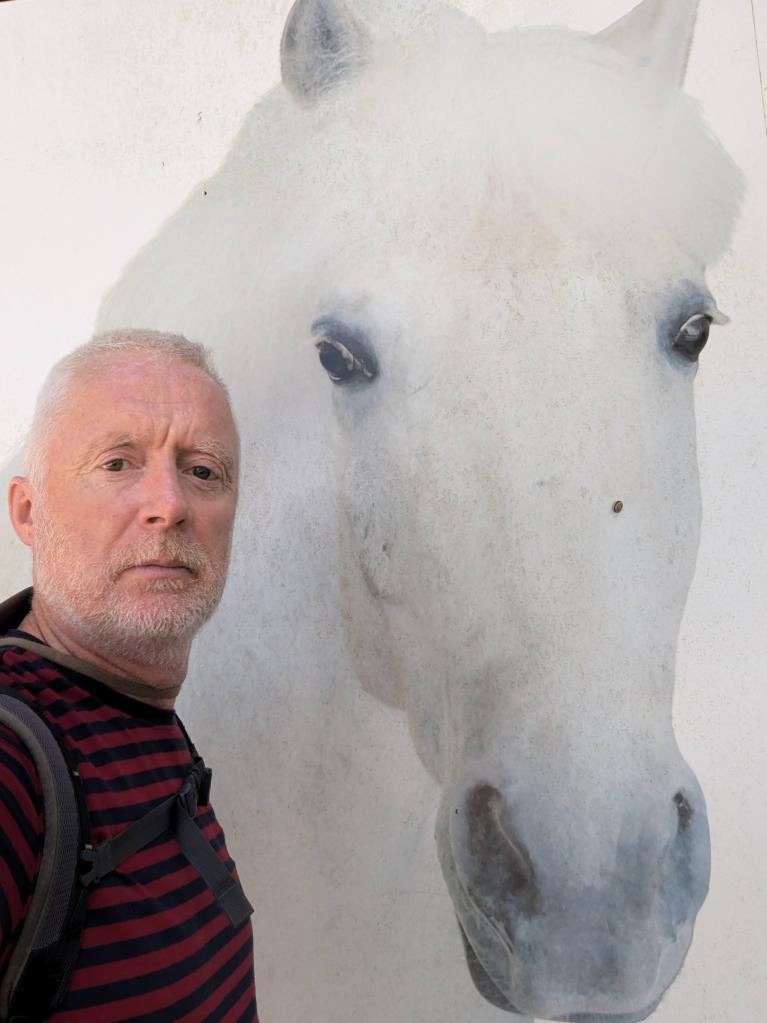
Stairway to Heaven We visited the charming little town of  Kotohira, famous for its proximity to the Shinto shrine, Konpira-san, which is dedicated to sea-farers. In a country of islands, this is a very popular shrine, nestling in the forests of Mt Zozu above the town and requiring a climb  of a whooping 1340 steps.   Arriving in the early morning, there was an air of serenity, broken only by the clattering on each step of a man wearing wooden clogs.  Little birds chirped and landed on our outstretched hands looking for seeds. We passed a stable of beautiful white horses which were considered so divine that they could only  be ridden by the gods.  

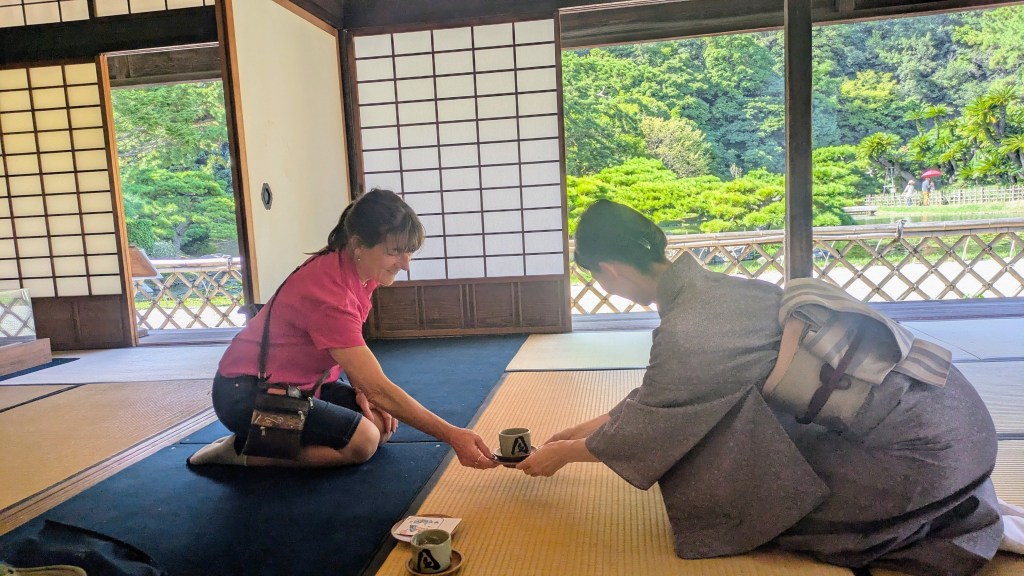
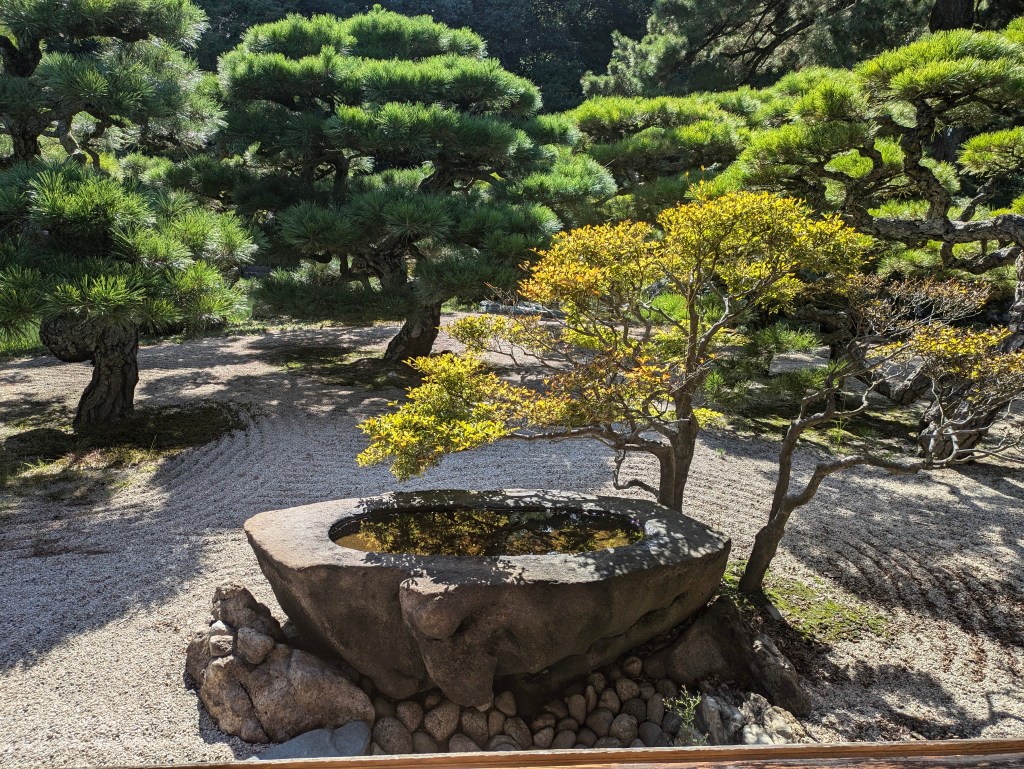
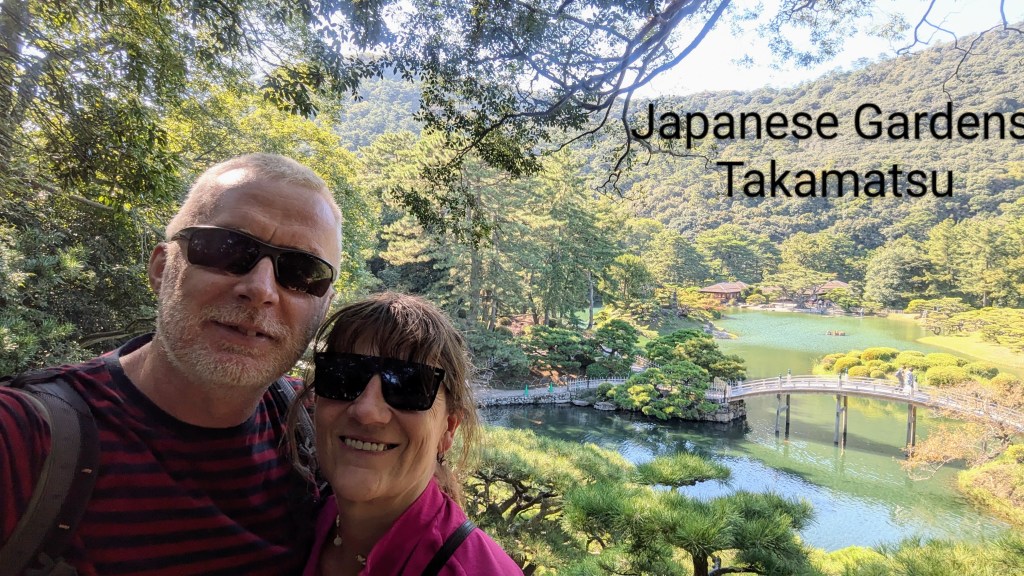
Tea and Shade We were charmed with a visit to  Ritsurin Gardens in Takamatsu with it’s beautiful teahouse of bamboo, screens and cushions. The windows framed the outside view like serene paintings and we drank tea to the gentle sound of flowing water from the small waterfall outside. In the coolness of the teahouse, we began to appreciate the Japanese fascination with light, shade and symmetry and to understand the philosophy that ‘less is more’

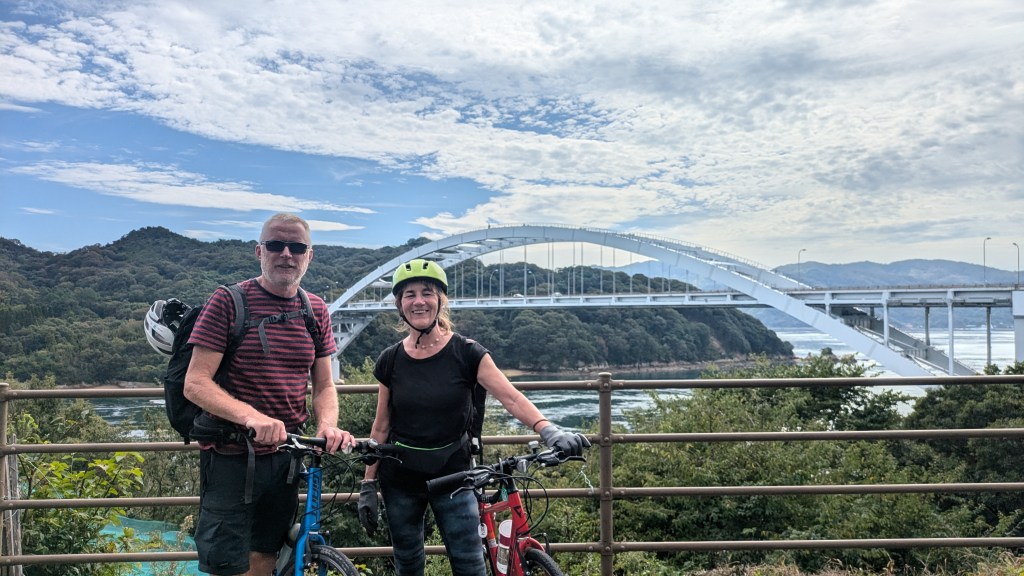
Island Hopping by Bike  The Shimanami Cycleway is an island hopping adventure by bike, traversing several islands in the inland Seto Sea which are linked by magnificent bridges. The 75kms route joins the town of Imbari in Shikoku Island with the town of Onomiche in Honshu. Cycling along the Kurushima Bridge which has a span of almost 5 Kms was a memorable experience.  Ships passed in the turbulent  waters beneath us while traffic whizzed by on the bridge. There were sublime views in every direction of mountains, islands, sea and the bridge itself.  

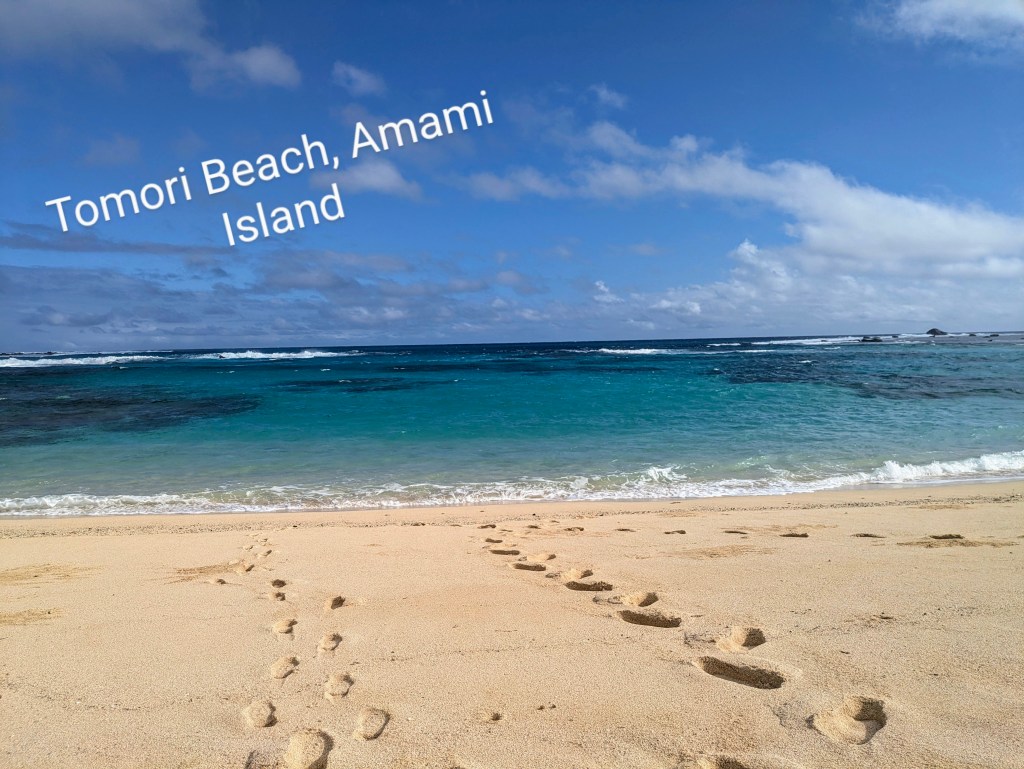
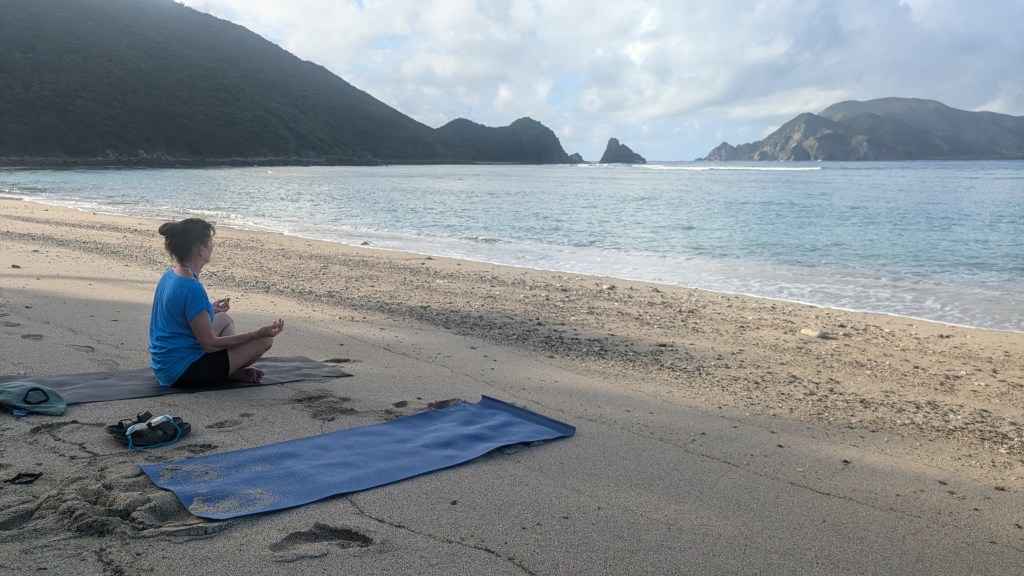
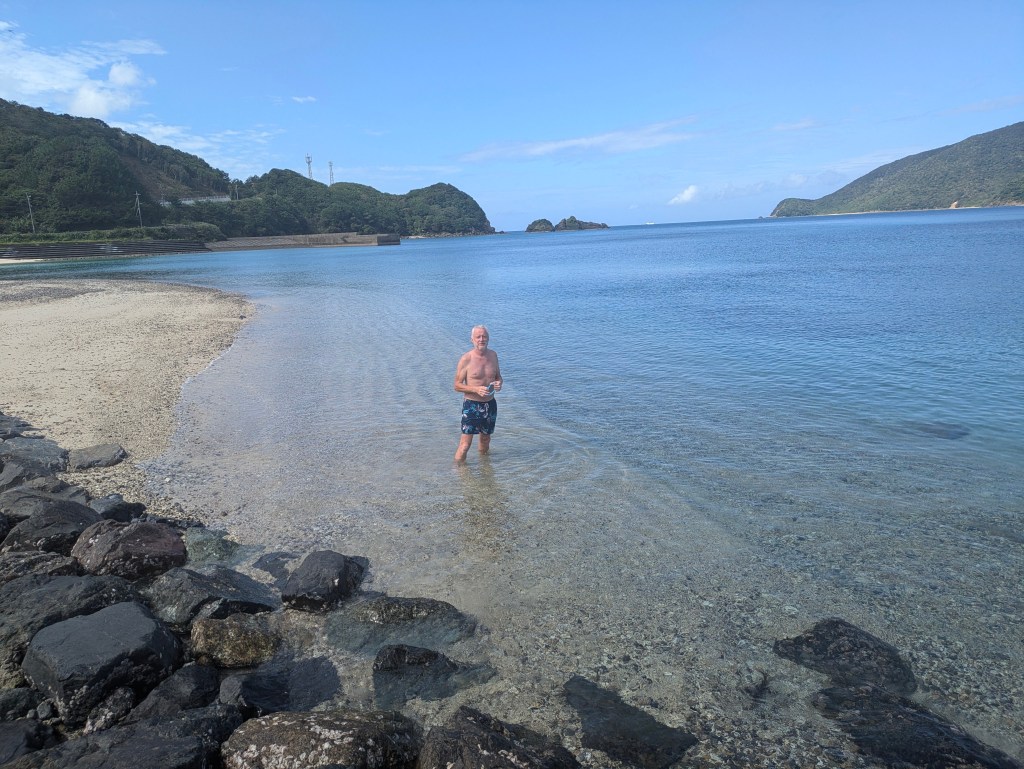
Glorious Beaches of Amami Amami Oshima is the largest of the Amami Island Group, a sub- tropical, nature-lovers’ paradise in the East China Sea, halfway between Okinawa and mainland Japan. Camping by the white-sand beaches here was truly wonderful, topped only by swimming in the clear turquoise water with lots of colourful, flickering fish.

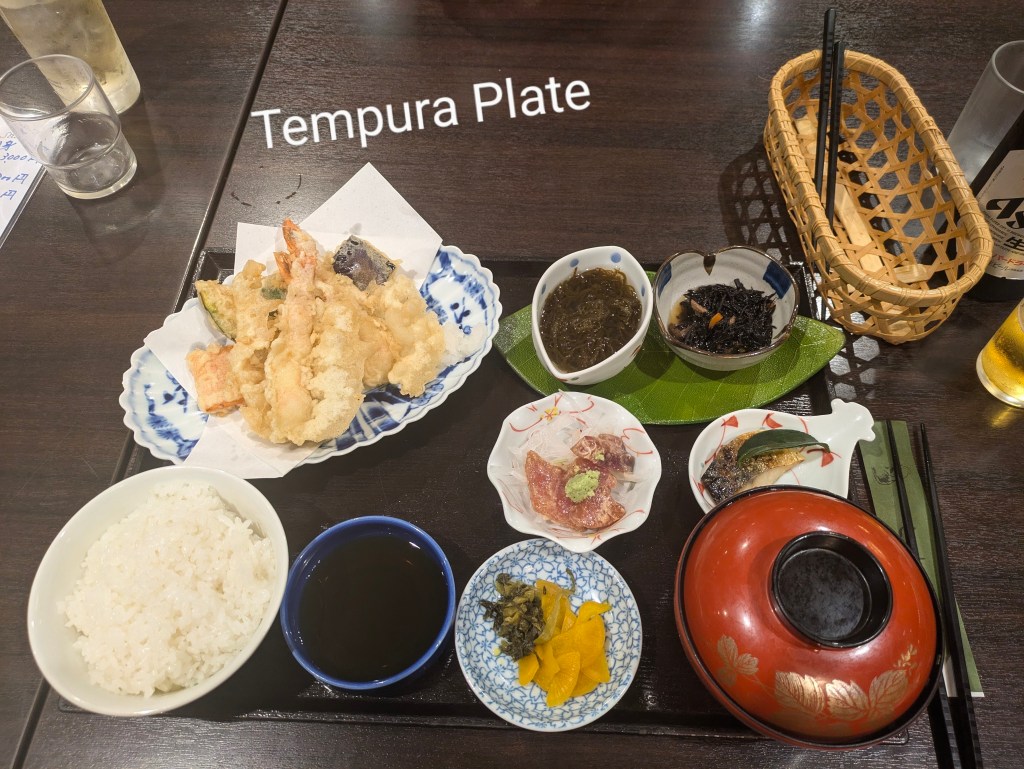
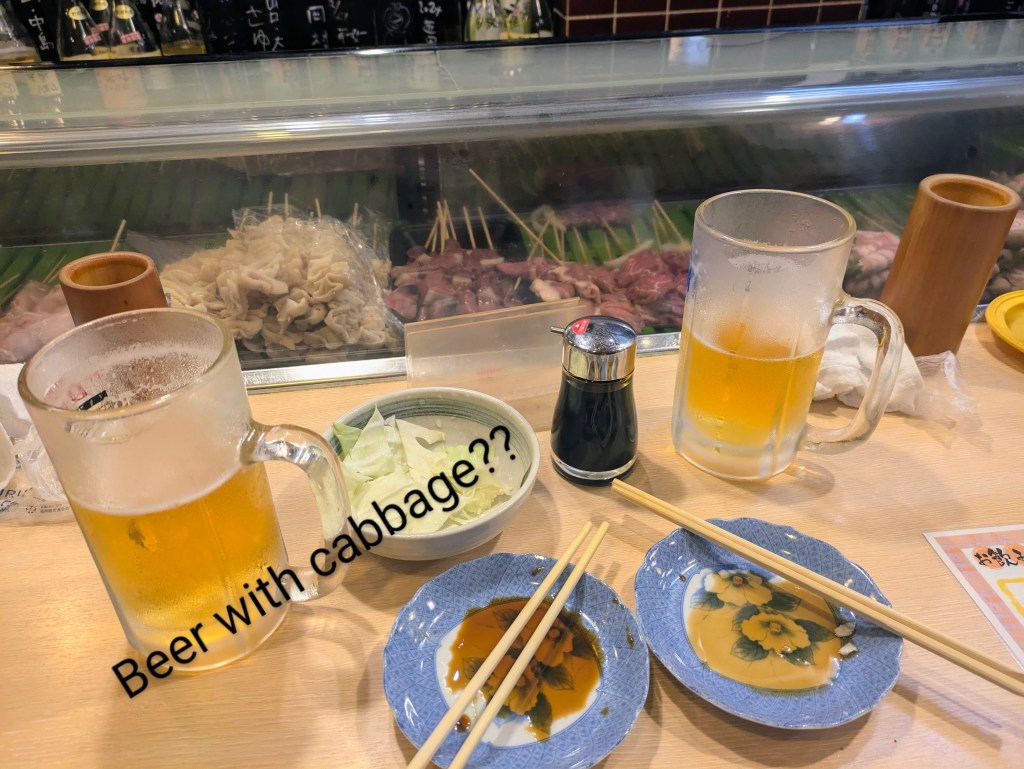
Food, Glorious Food– the food in Japan was a pleasure, a delight and a taste sensation. We had so many gorgeous meals from simple bowls of noodle soup to trays of tempura with a multitude of side garnishes. Good quality ingredients coupled with attention to detail made it special. The Japanese were very proud and fond of their ice-cream which was delicious. However, we were served raw cabbage and soy sauce to go with own beer 😁. It wasn’t as bad as it sounds but it may be an acquired taste.

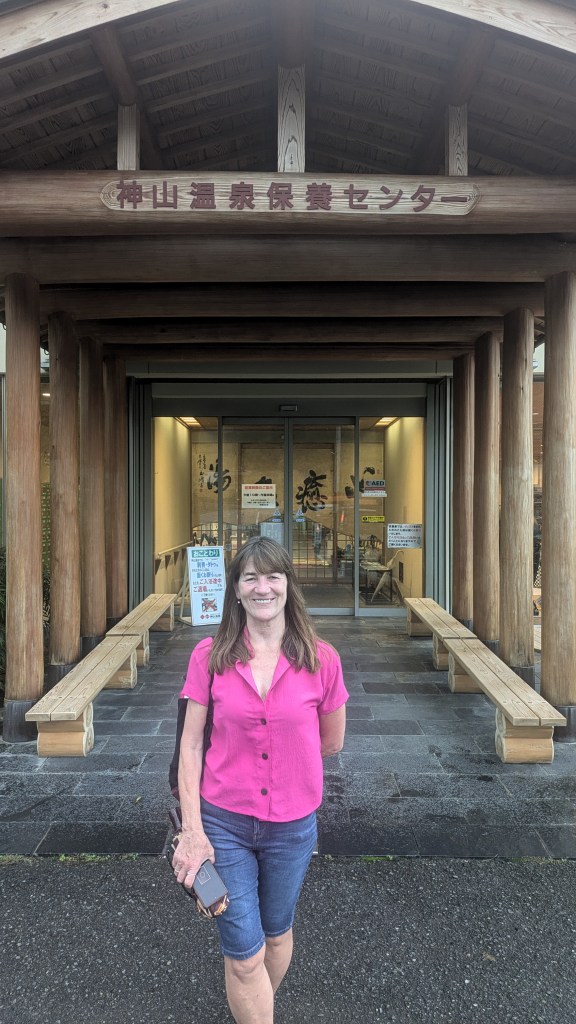
Relaxing Baths Onsens are public thermal baths, which are part of daily life in Japan, a place to cleanse and destress, to socialise and relax. The idea of stripping off and sharing a bath with naked strangers was an intimidating prospect at the beginning but we grew to love our immersions and appreciated their therapeutic power. Our favourite onsen was high in the hills outside Nagasaki with an outside section and gorgeous views over the city. It was so relaxing lying up to my chin in hot water, fanned by a cool breeze, watching leaves drifting down from the trees and trying to process all that we had seen in that lovely, vibrant city which has witnessed so much sorrow. (no cameras allowed inside the onsens for obvious reasons)

Path of Philosophy….Kyoto, the ancient city of history and dreams, was full of national treasures, World Heritage Sites, countless shrines and temples ….. and visitors, lots and lots of visitors. We shuffled along in crowds at most of the attractions except one. The Path of Philosophy in the Northern Higashiyama neighbourhood was tranquil and meditative. The path meanders along by a canal carrying murmuring water from Biwa Lake with the occasional family of paddling ducks and temples peeking through the foliage that borders the path. It’s very popular in spring when the overhanging cherry trees are in blossom but for us, it was blissfully quiet on a chilly November morning. Along the way, we chatted with a lovely Australian couple who enquired if they were actually on the path….none of us knew for sure where the path began or ended but maybe that was the true philosophical question.

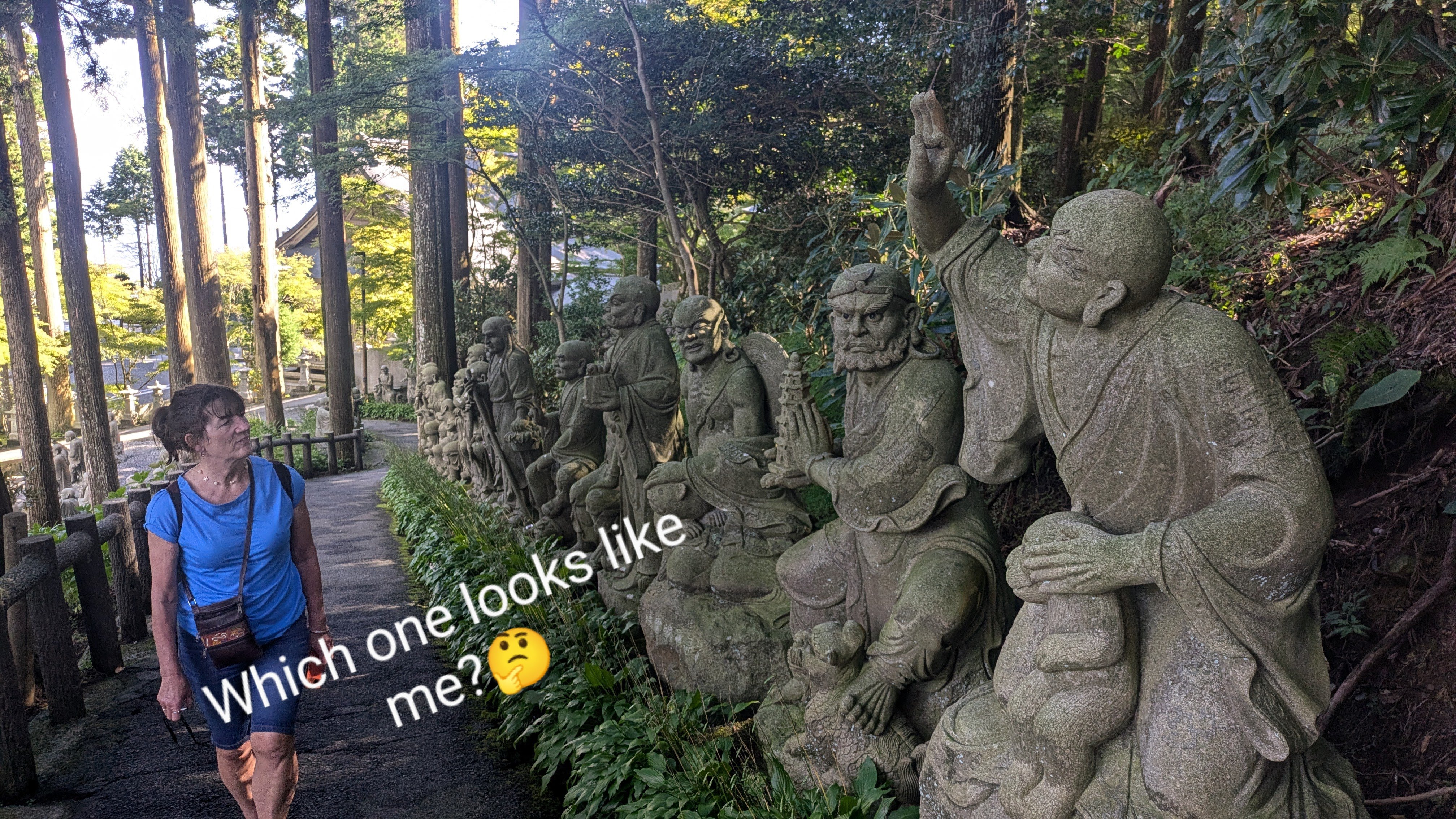
Temple in the Clouds  All over Shikoku, we saw pilgrims on the Pilgrimage Trail of the 88 Buddhist Temples. This is a long route, over twelve hundred kilometres, which circumnavigates the entire island of Shikoku. Most pilgrims do it in sections but we met a few who were devoting six to eight weeks to completing the entire pilgrimage in one go. Many had sore feet as the majority of the route is on hard road surfaces. Although we didn’t do the pilgrim’s trail, we visited several of the temples. Our favourite was Unpen-ji, the highest of the 88 temples and often called The Temple in the Clouds. Hundreds of life-sized statues of Buddha’s disciplines lined the walkways among the cedars. It’s said that if you look hard enough, you will find your likeness among them. Although I searched and searched, I couldn’t find mine

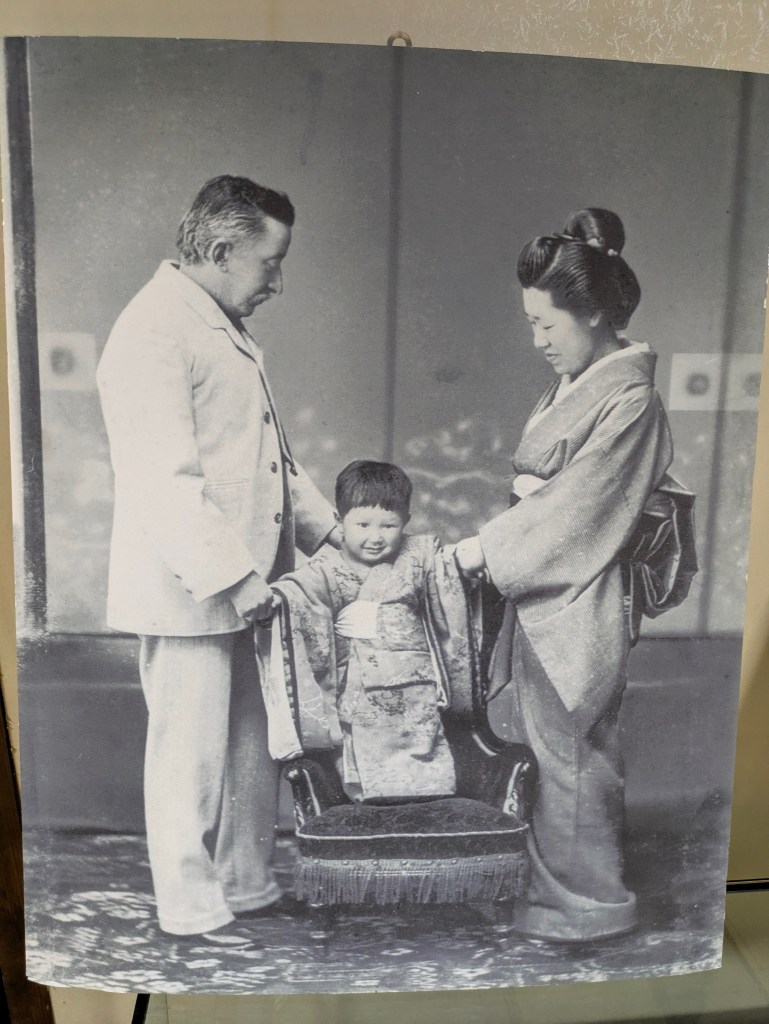
Making Connections  ……No matter where you go in the world there are always connections to home. We visited the Lafcadio Hearn Museum in the city of Kumamoto. In the mid 1800’s having an Irish father and a Greek mother,  Lafcadio spent many boyhood summers in Tramore, Co Waterford just a few miles from our home. The gorgeous Lafcadio Japanese Gardens in Tramore were established in his memory.  He was enthralled by Japan, setting up home there and he is still reversed in his adopted country because of his writings and translations.

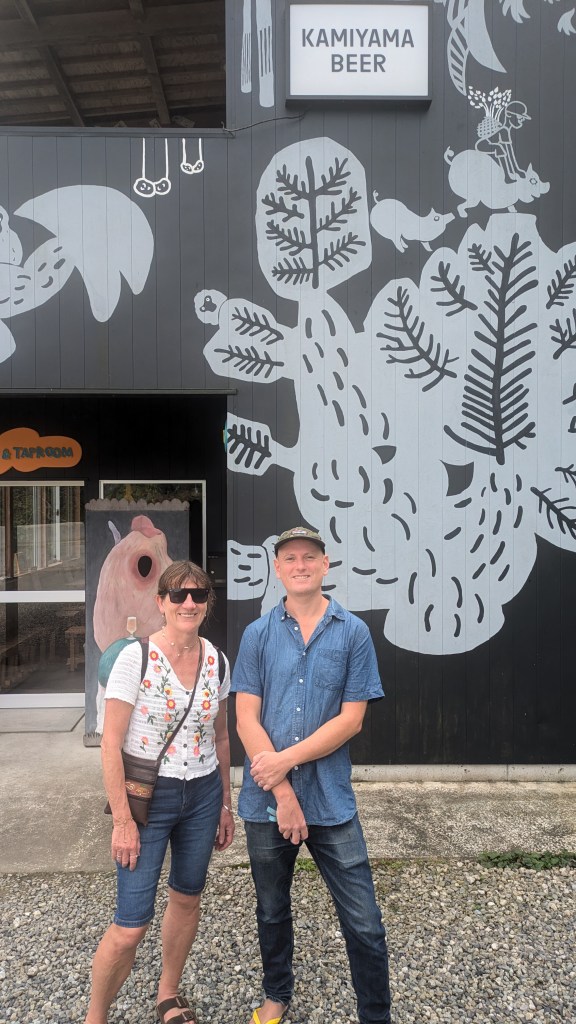
We met another man from Tramore, who has also made Japan his home, making fine craft beer in the beautiful Kamiyama area. We can certainly vouch for the quality of his produce. Manus and his Japanese wife, Sayaka, welcomed us, introduced us to some locals and gave us lots of tips, particularly about the etiquette of using the onsens. Strip completely, wash thoroughly before soaking in a bath, no splashing, no swimming, hair tied up, no tattoos.

LOWS

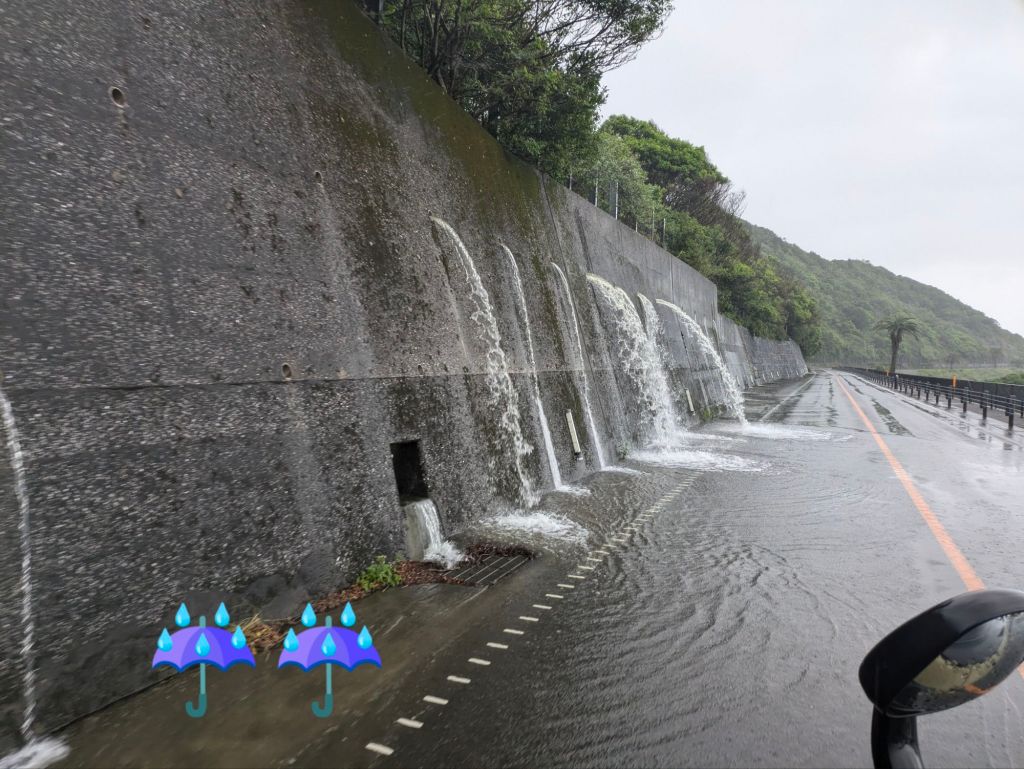
Dramatic Weather –We endured several bouts of torrential rain for days on end each time although it wasn’t the rainy season. Japan is green and gets a lot of rain but this level of rainfall in October and November was unusual. We had numerous phone alerts warning of typhoons, mudslides and flooding.

Packaging The amount of plastic packaging on everything but particularly on food items made us weep. Carrots were individually wrapped in plastic. I know that in Ireland we are guilty of using too much plastic as well but this was a totally different level. All food bought in a convenience store/supermarket/restaurant came with a wet wipe wrapped in plastic and some disposable chopsticks and that’s just for starters.

Disposing of Garbage….The contradiction is that the streets are super-clean with rarely even a scrap of paper on the ground and all this without a trash bin in sight.  Getting rid of our rubbish was certainly an issue until we started discarding it in pieces. When we shopped in supermarkets, we disposed of excess packaging before we left the shop. Convenience stores (konbinnis) had some segregated bins (meant for items bought in the shops) which we used. Motorway stops also had some segregated bins.

Campervan Sulks…. Our van wouldn’t start when we were in the queue to board the ferry to leave Amami. The rain was torrential and we didn’t even know how to open the bonnet. After trying several times, we were getting desperate. One last try and the engine turned over and we got on the overnight ferry. We didn’t have any more trouble.

Parking in Kyoto…..Mainly we availed of free wild camping in scenic spots in the countryside but  in the cities we parked in city centre carparks which usually cost about €5 to €10 for overnight parking. In Kyoto, we misread the tariff board , and  discovered that we could easily have stayed in a nice hotel for the price of the parking charges😲

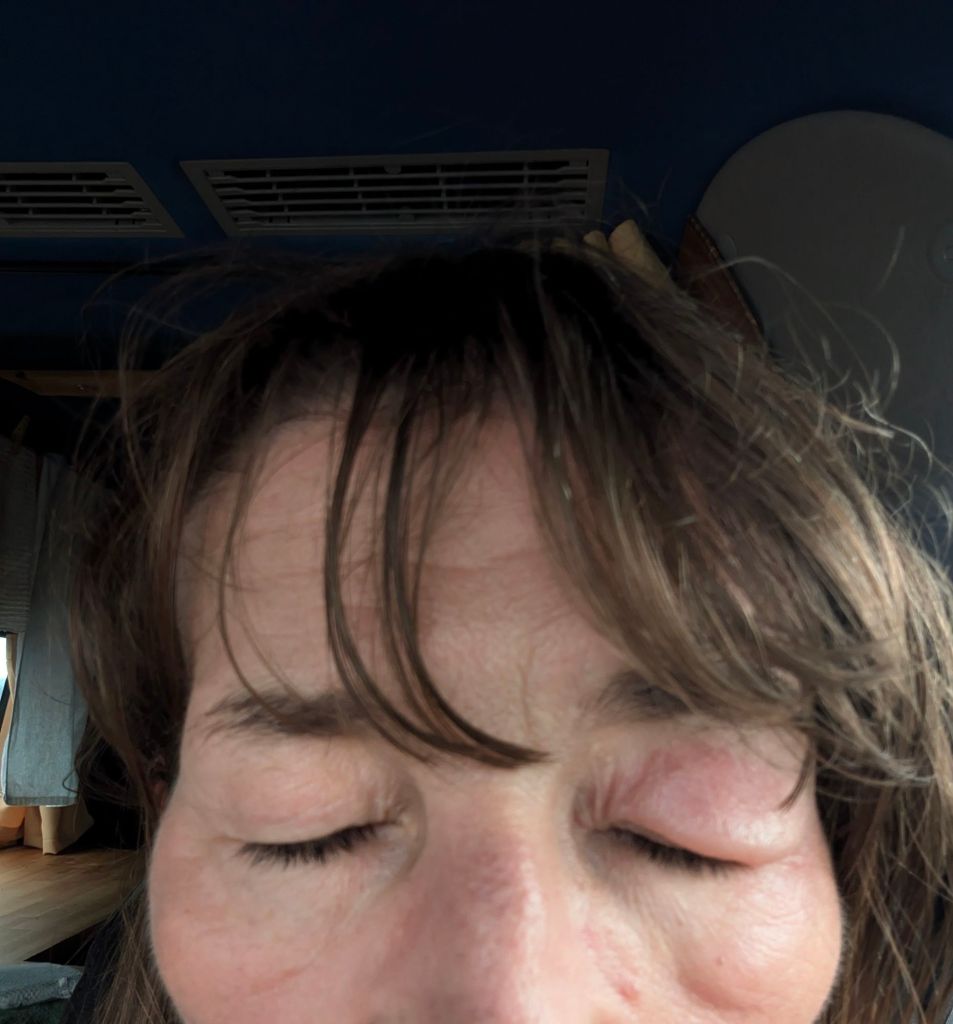
Encounters of a Small Kind Japan is an extremely hygienic place with a huge emphasis on cleanliness , partial to the liberal use of disinfectants and  wearing face masks. Neither of us had any issue with tummy upsets or health concerns. One morning, I woke up in the van feeling like I had a brick over my partially closed left eye. I expected Caoimhin to say it didn’t look too bad but his reaction was one of horror. It took two days to subside. I’m still not sure what caused the spectacular inflammatory reaction but suspect a mosquito.

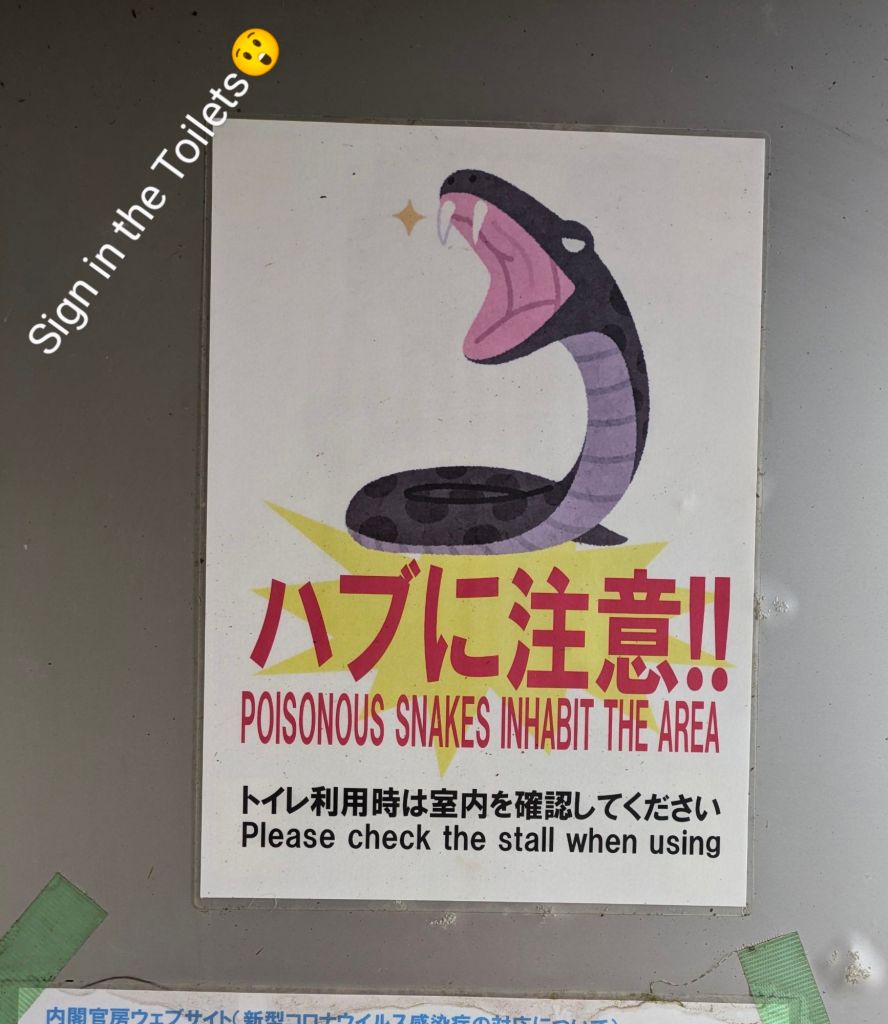
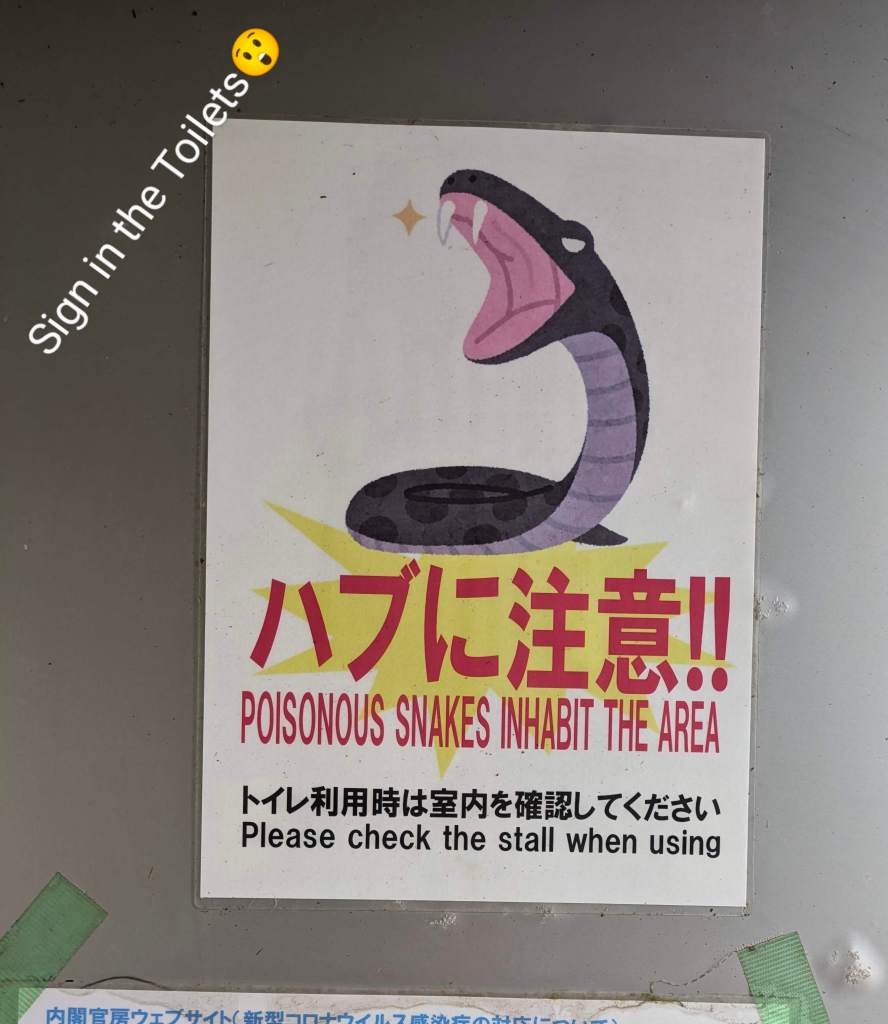
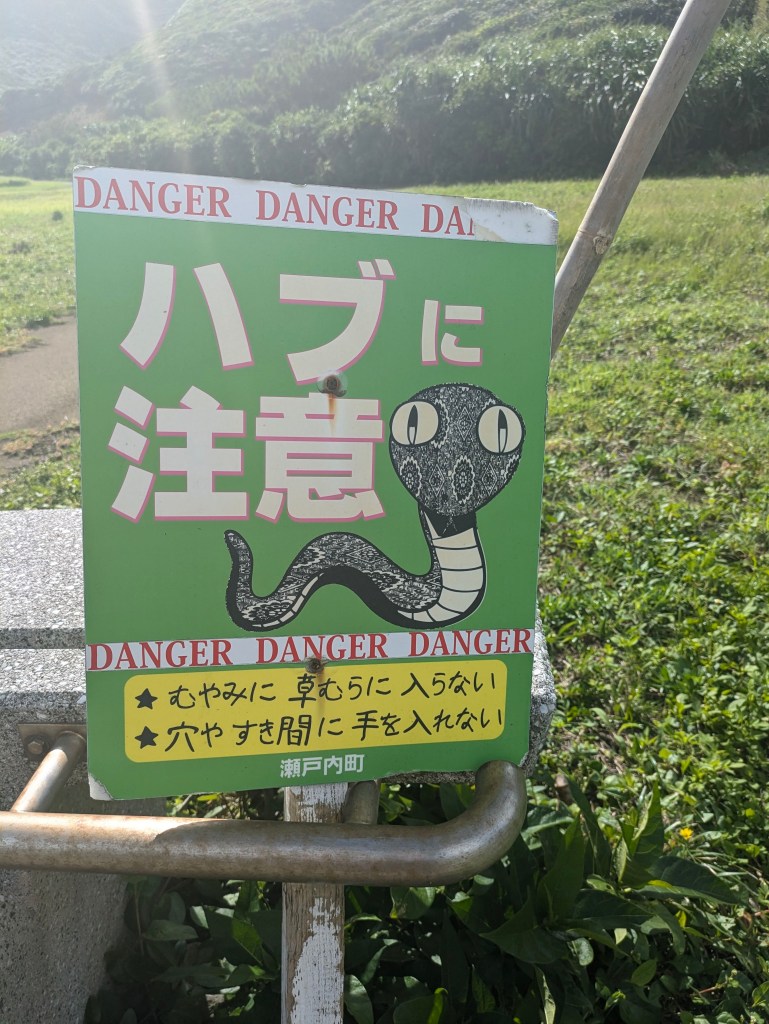
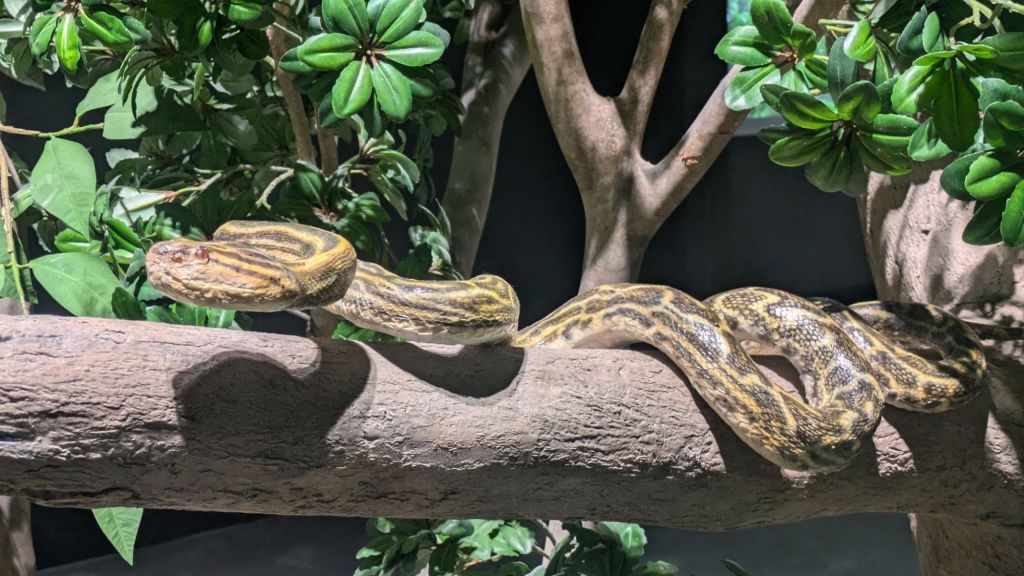
On Amami Island, we were warned about the viper snakes everywhere we went…..by the locals and by the many warning signs. Thankfully we never saw one or heard a slithering sound of one.

So many things surprised us about Japan from practical things like the abundance of public toilets and the people of all ages who use bicycles as a means of getting around to the greenness of the countryside and the enormous number of trees. Most people profess to have no religion but mark key life events with Shinto rituals and visits to Buddhist temples. The people are polite and reserved but welcoming and love to laugh, especially the women, and we gave them plenty of opportunity for amusement.

We covered less than a third of the country, we didn’t go anywhere near the big-ticket tourist items like Tokyo or Mt Fuji and barely scratched the surface of the places we did visit. We came anyway, changed in some indefinable way, fascinated by the blend of traditional and modern, mesmerised by the natural beauty of the country and perplexed by the contradictions. Japan still remains an enigma. We may have to return for a deeper dive, to breathe in the mystery of this fascinating country.

Japan: Highs and Lows

Japan: Chasing the Dream (aka Running from the Rain)

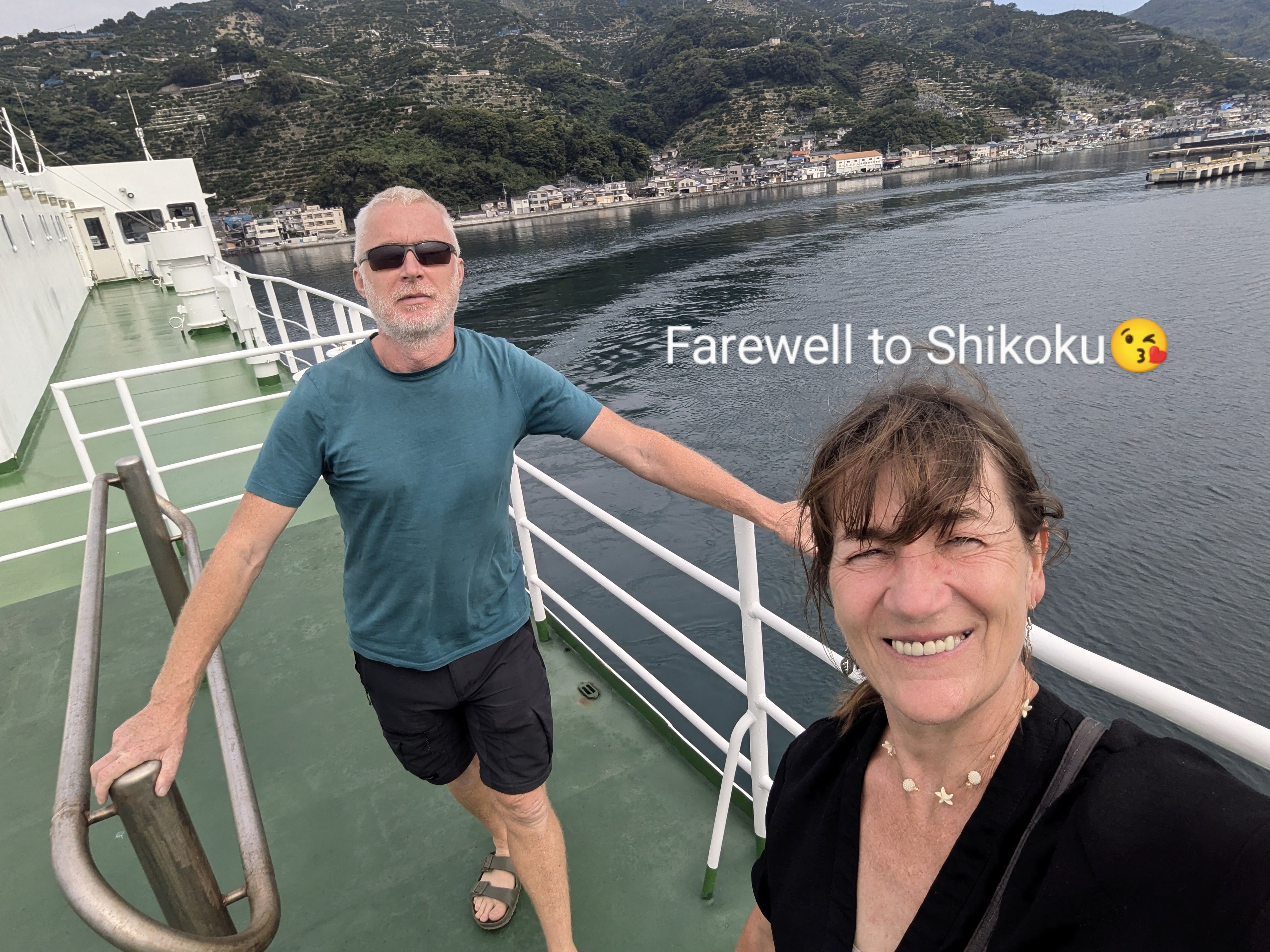
We are in the terminal building standing in a queue to buy tickets  for the ferry to Beppu in Kyushu when several phones, including Caoimhin’s, start making strange sounds simultaneously. It’s an emergency alert but it doesn’t say what for …more information coming is the ominous text.  The noise echoes around the high ceilings of the building.  People glance at their phones but nobody seems too bothered and the queue shuffles on as if such alerts are frequent.  It’s a reminder that we are in a country where natural disasters are common with a history of typhoons, tsunamis,  volcanic eruptions and earthquakes.

Ferries run several times a day between the two islands (Shikoku and Kyushu). We hadn’t booked a ticket but there wasn’t any problem about buying a fare on the day. The cost for two passengers and the van was €100 for the three hour crossing. There was more alarming phones on the ferry but again nobody took any notice. The ferry was quiet and extremely comfortable…. so comfortable that we were disappointed to arrive early.

Kyushu seemed green and mountainous and a lot like Shikoku with perhaps a little more rice cultivation. It has been a bad year for rice due to the unseasonably high temperatures. Most of the rice cultivation is on small holdings managed by elderly farmers. The average age of an agricultural worker in Japan is 69 years old. Most older people in Japan continue working. At the launderette where we were doing our weekly wash (we pack very lightly), the manager was a sprightly eighty something year old. He was a very chatty man, eager to give us tips about all the places we should visit in the locality. Unfortunately we missed a lot of it as Google Translate couldn’t keep up with him, he talked both too much and too fast for Google.

Our first stop in Kyushu was Beppu, a town known for its many onsens (thermal baths). It’s a very seismically active area which explains the many baths.  The nearby region of Oita has had nine earthquakes, greater than magnitude seven, since 1900. Beppu is built on a flat plane  hemmed in on three sides with mountains. As we approached on a grey, humid 30 degrees afternoon,  the plumes of steam rising from the many hot springs and the clouds descending down the mountains intermingled to give an eerie darkness. Maybe it was that our minds were filled with those emergency alerts (that everyone ignored) but we  felt a sense of foreboding. It became darker and huge, fat drops of rain splattered the van.

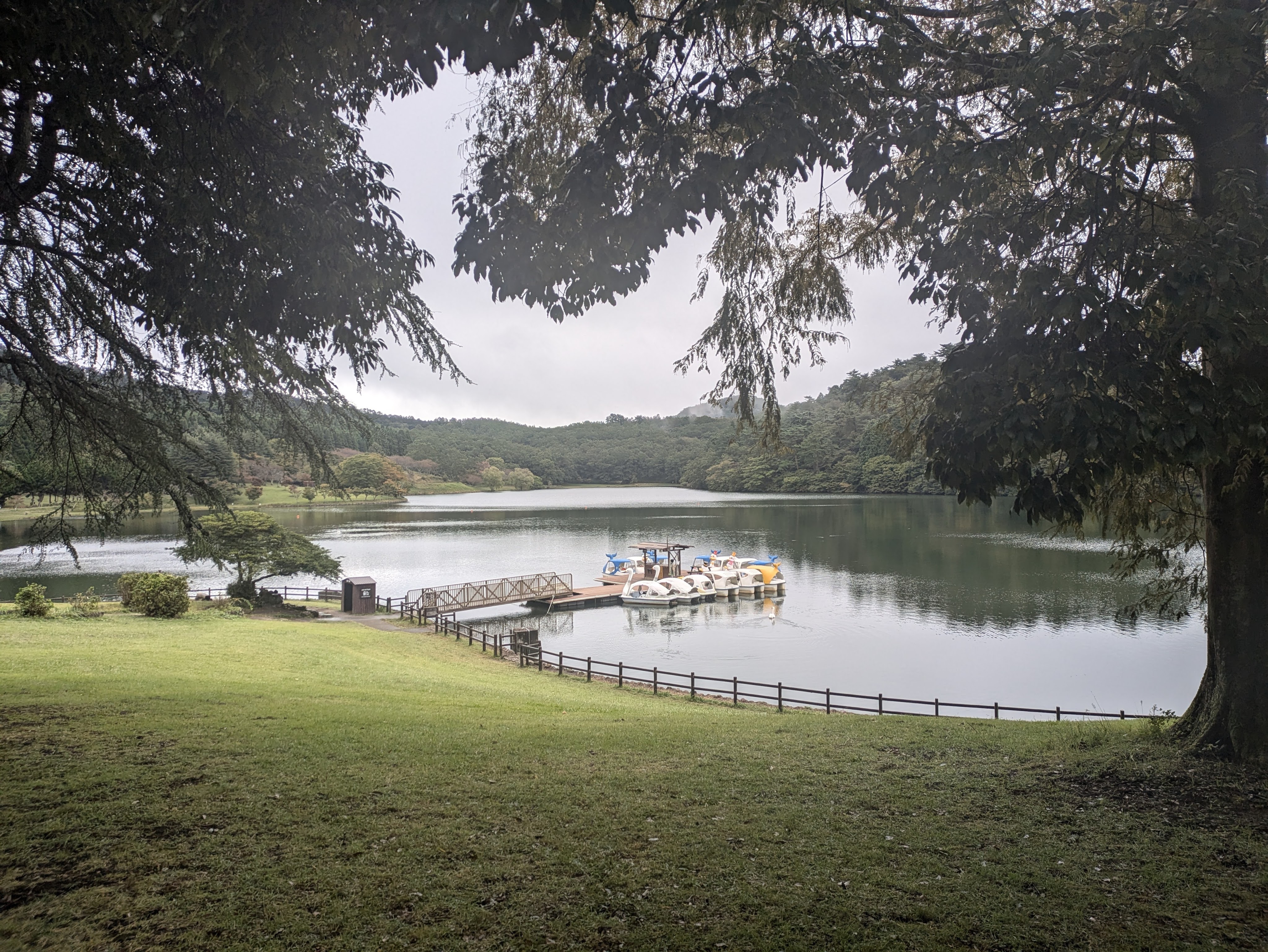
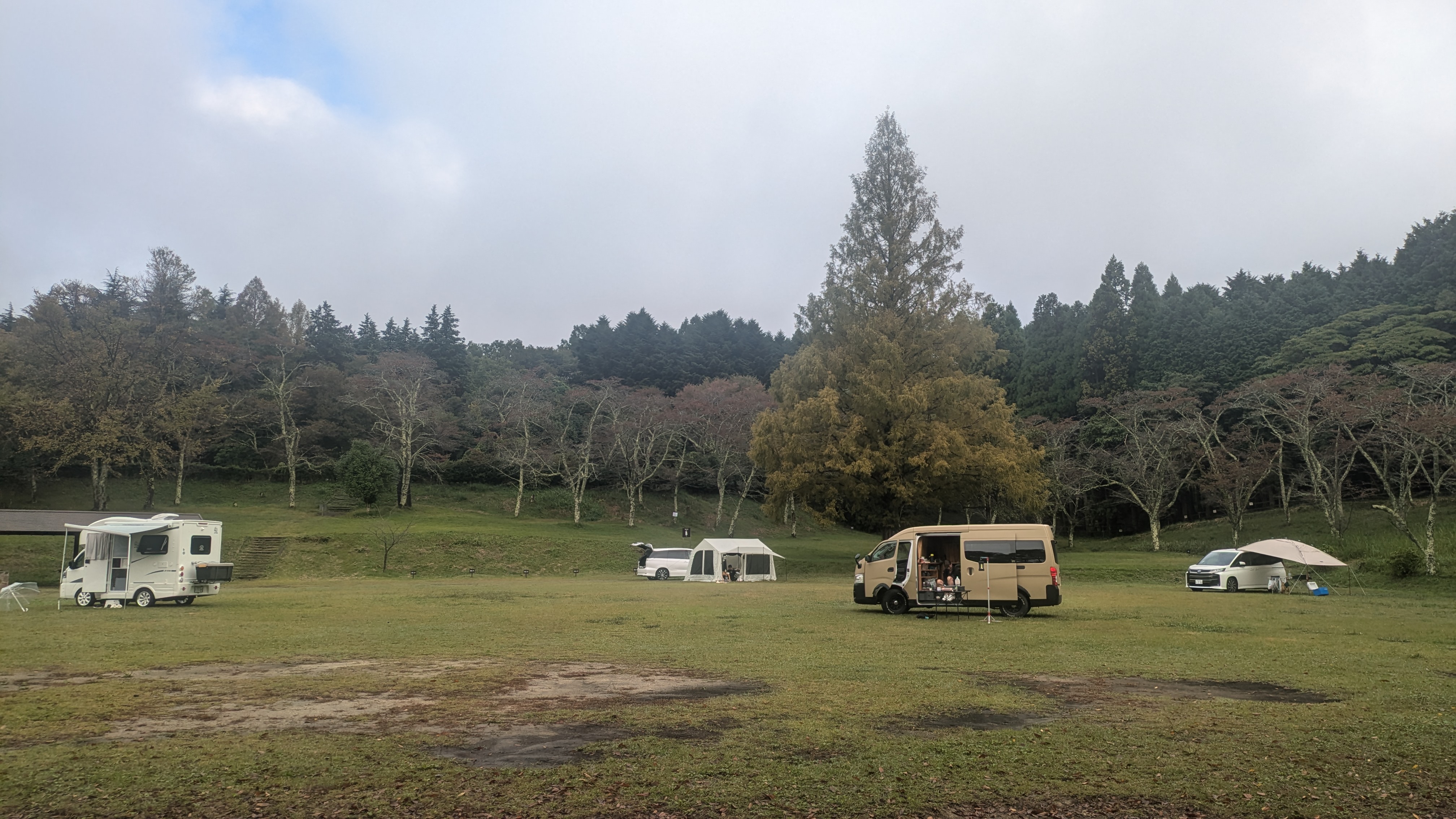
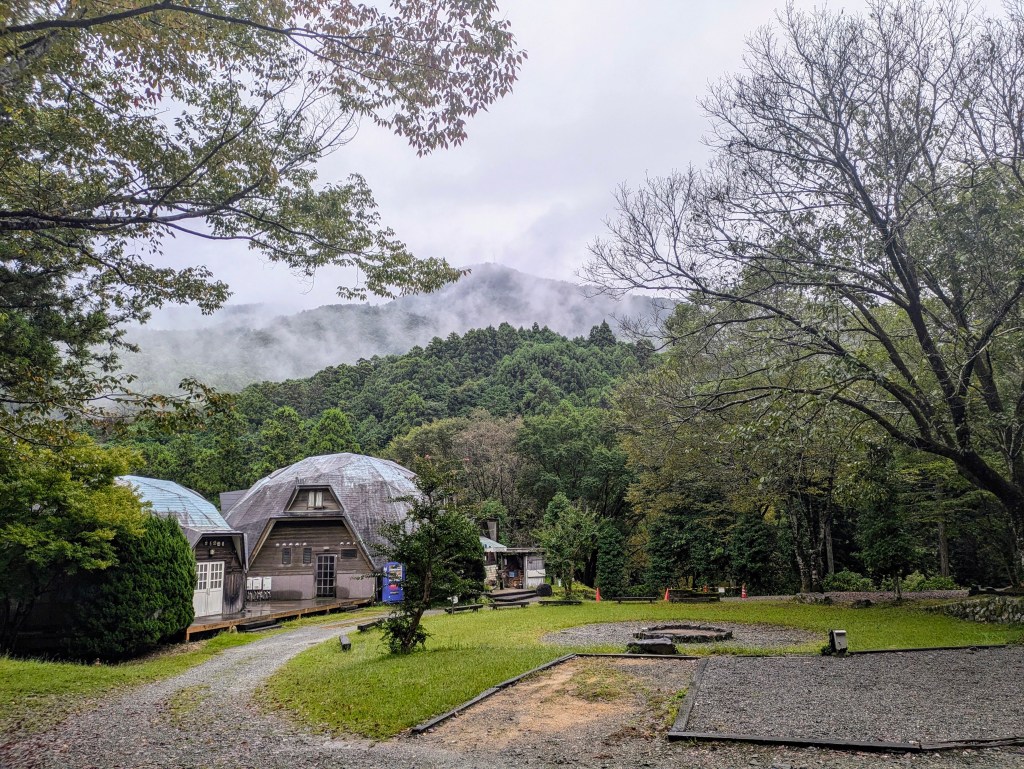
We tried to stay in an RV park in the centre of Beppu but it was closed so we tried a campsite in the hills buts that was boarded up. Our third option was a campsite high above the town in a nature reserve near a lake,. This was open and the rain stopped.  Although there were loos, there weren’t any showers and it was prohibited to swim in the lake. Lake Shidaka is supposed to have been made from the accumulated tears of the broken hearted. Nevertheless it was a serene plane where swans floated by and the trees were beautiful. There were only 5 campers/tents in the huge park. There was some damage from a typhoon that had swept through a few months before.

A Lake made from Tears
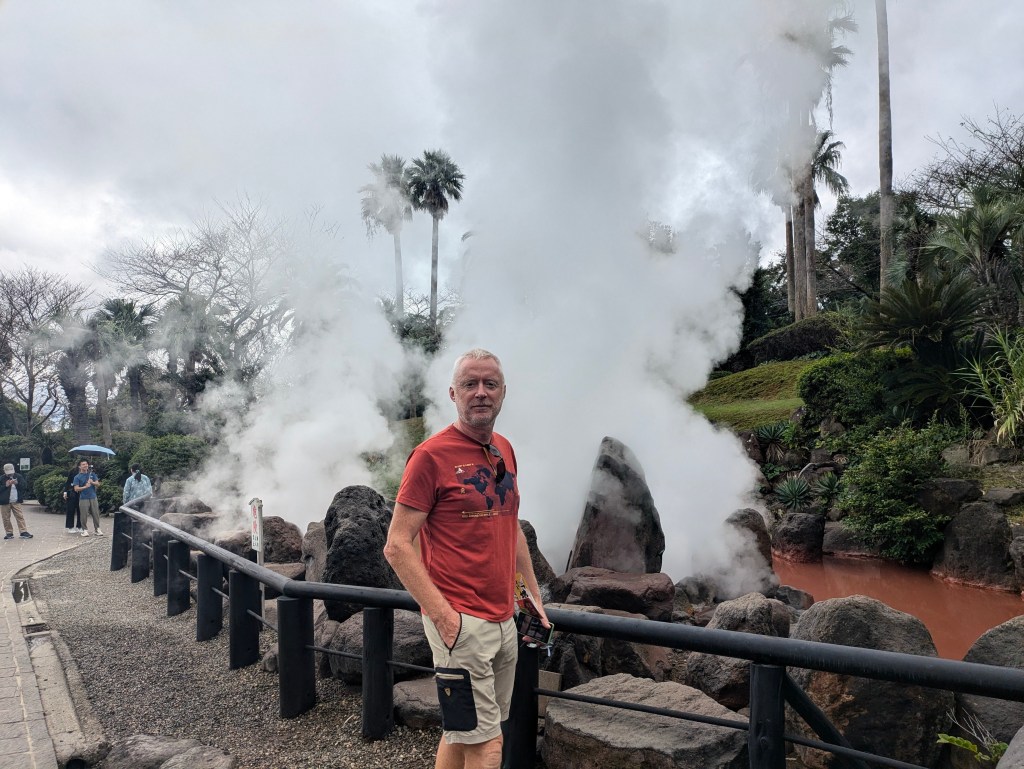
Don’t get TOO Close

 In desperate need of a shower and some Wi-Fi, we searched for a guesthouse in Beppu and found J.Hoppers in the centre of town with parking,  Japanese futon beds,  our own ensuite bathroom  for less than €40 a night. It was fantastic, comfortable and reasonably priced. The luxury of having our own bathroom cannot be underestimated. The owner spoke English with great recommendations for onsens and restaurants. There was also a common area for chatting with other guests, a couple who were cycling to Bhutan, a Kuwaiti guy who described Kuwait as a ‘dreamless sleep’ where people have nothing to do and more money than is good for anyone. If you ever find yourself in Beppu, I’d recommend you stay at Hoppers.

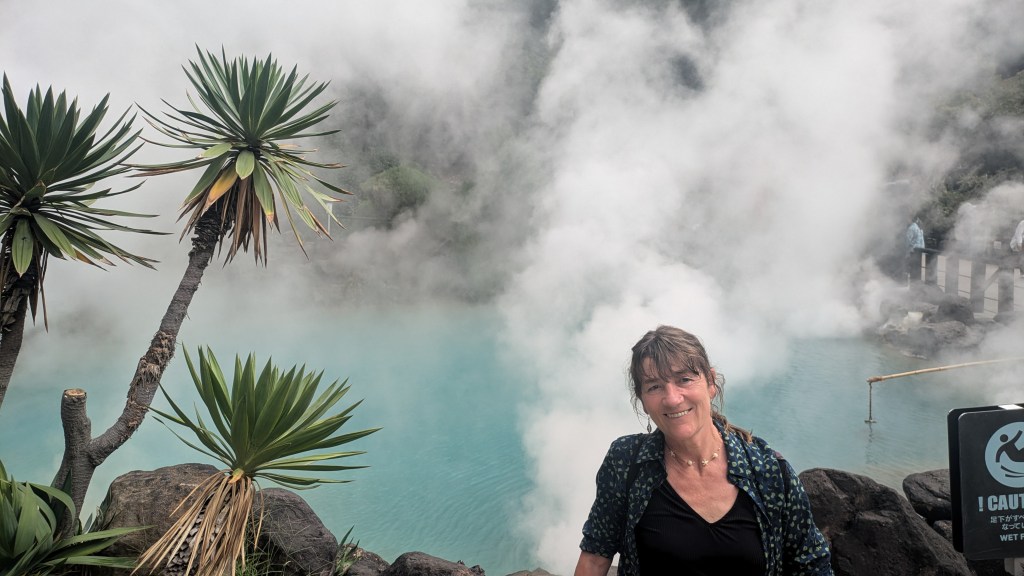
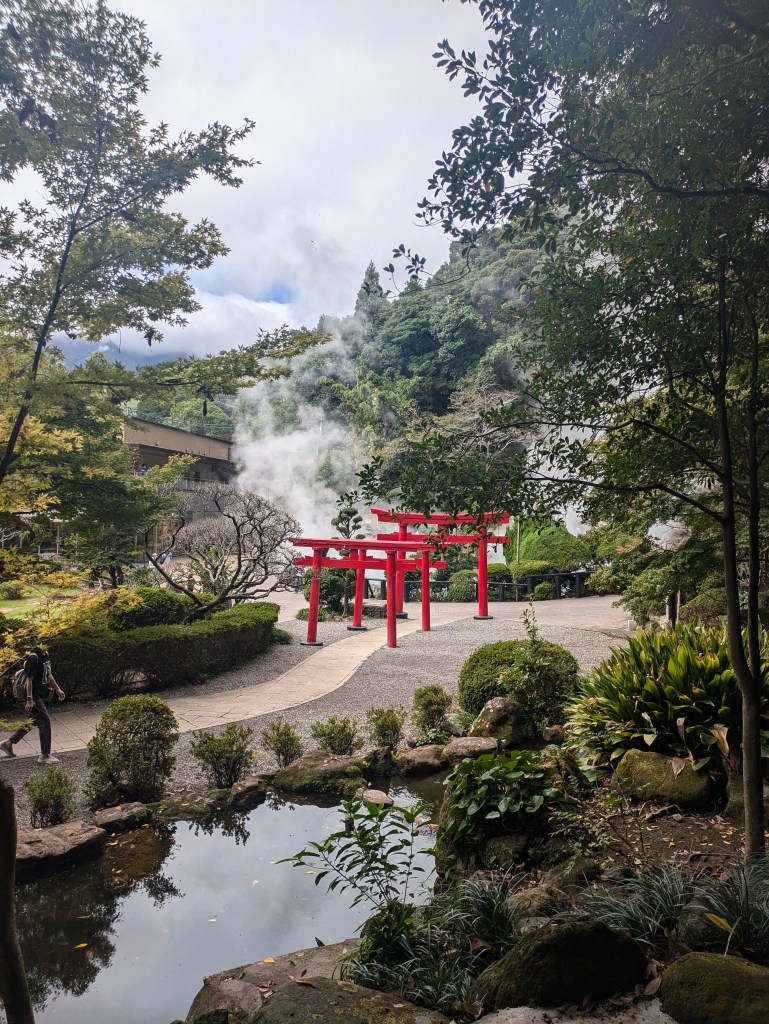
The Hells of Beppu is a series of seven bubbling pools of water and mud with various colours from deep turquoise to flaming red. They are dotted at separate locations around the town. The pools are strictly for viewing and not for bathing (unless you have a wish to be scalded) although there were footbaths at many of the sites to soak your feet.  It was probably the most touristy thing that we have done and our first exposure of coachloads of Japanese tourists. The noise, the crowds, the bell-ringing of the tour guide was totally overwhelming especially as the day was hot and the parks were steamy. It truly was ‘hell’.

After our enjoyable stay in Beppu, we headed down the east coast of Kyushu on non-toll roads but even these were very good. There were numerous tunnels cut through the mountains. Sometimes we there were only a couple of hundred metres from the end of one tunnel and the beginning of the next. It was about 20 degrees, a drop of 10 degrees in a couple of days. There were deserted beaches and closed campsites where we parked for the night anyway.

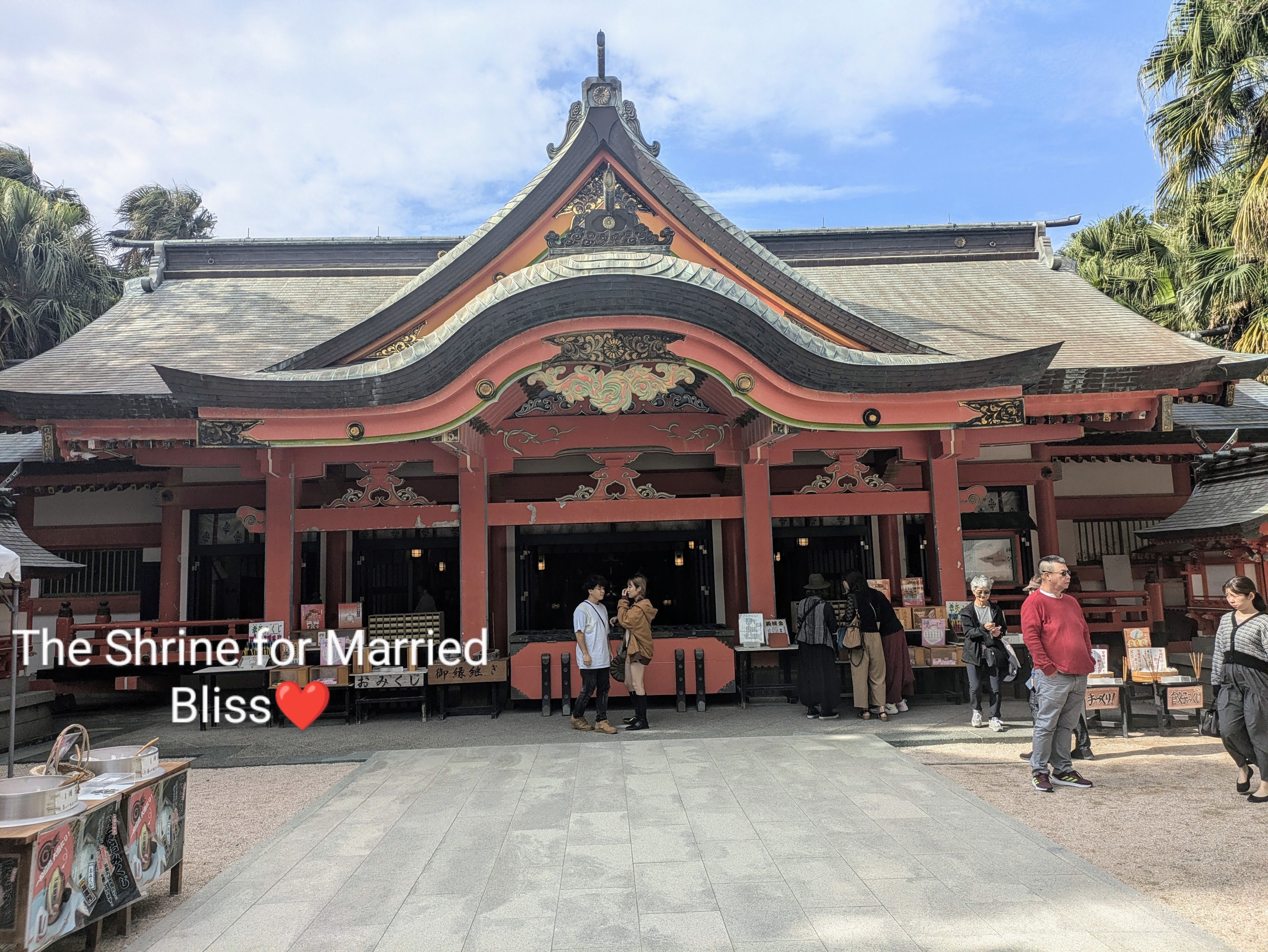
The Nichinan Coast on the eastern side of Kyushu is regarded as one of the most beautiful coastal drives in Japan with many offshore islands, strange rock formation and thundering surf. Down the coast, we visited a shrine for couples, a place that was very popular as a wedding venue. It was quite busy with both the hopeful, the grateful and the desperate.

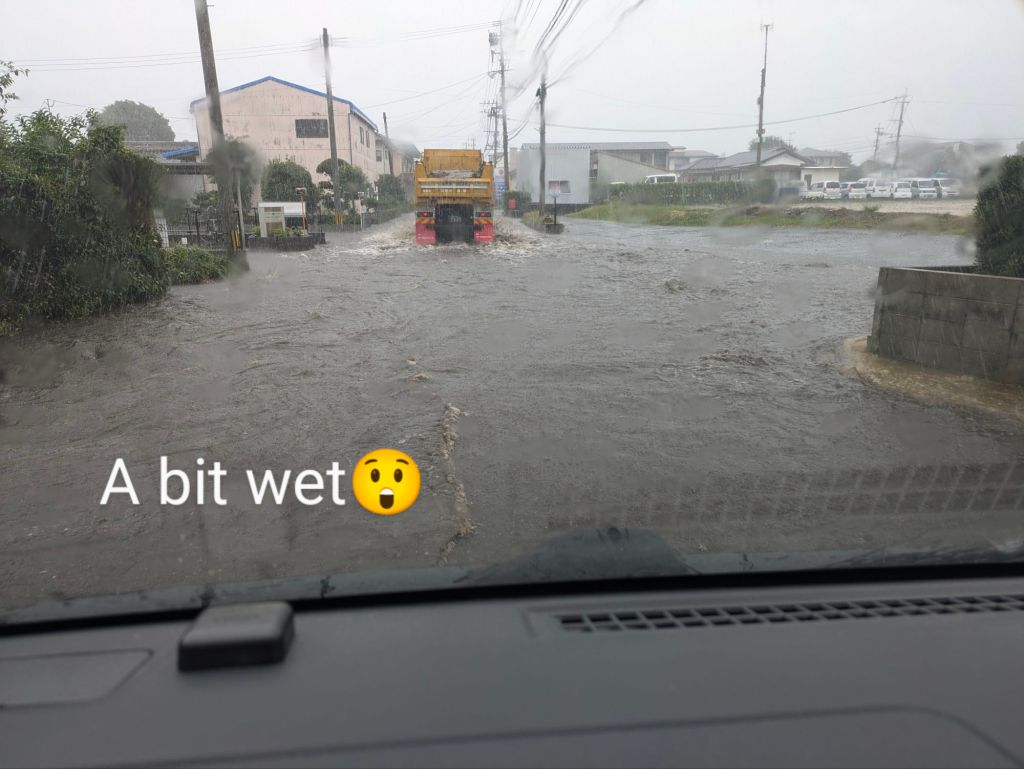
We pulled in for the night at a scenic spot along the coast overlooking the Pacific. It was sunny and blustery but it began to rain during the night and it didn’t stop. Hours later, we were marooned in the van, there was water leaking in the window onto one of our pillows. The carpark was almost a lake and a trip to the loo was a major expedition. It rains a lot in Japan (evident from the trees and green moss) but the area we were in was regarded as the wettest in the country. We sat in the van, checking weather forecasts and wondering where to go. Although we hadn’t seen the most impressive part of the stunning coast, we decided to abandon that plan. The lure of tropical islands was strong. We investigated ferries and flights to Okinawa and other islands in the East China Sea as rain hammered against the van. We made some coffee which streamed the windows even more and decided to head to Kagoshima Ferry Terminal and investigate ferries to any island. After driving on flooded roads when we feared the van would stall or a river might burst its banks, we diverted to the tolled roads. Hang the expense!

The woman in the ferry terminal office had the patience of a saint as we changed our minds about what we wanted to do, There was no availability for the overnight ferry that evening for a van, mainly because the army were travelling with lots of jeeps and trucks. We decided to go as foot passengers but then changed our mind again when we heard the price of parking the van at the ferry terminal. When we found out the price to travel with the van, we almost called the whole thing off.  I’m sure that the woman was inwardly cursing us but she was so helpful, as we debated, dithered and communicated with her by Google Translate.  Eventually we came to a decision. We would travel the following day with the van and we would return in eight days. There was some discount for getting a return fare. So we left Kagoshima in the rain but thankfully there was little wind and sailed four hundred kilometres overnight on the East China Sea.

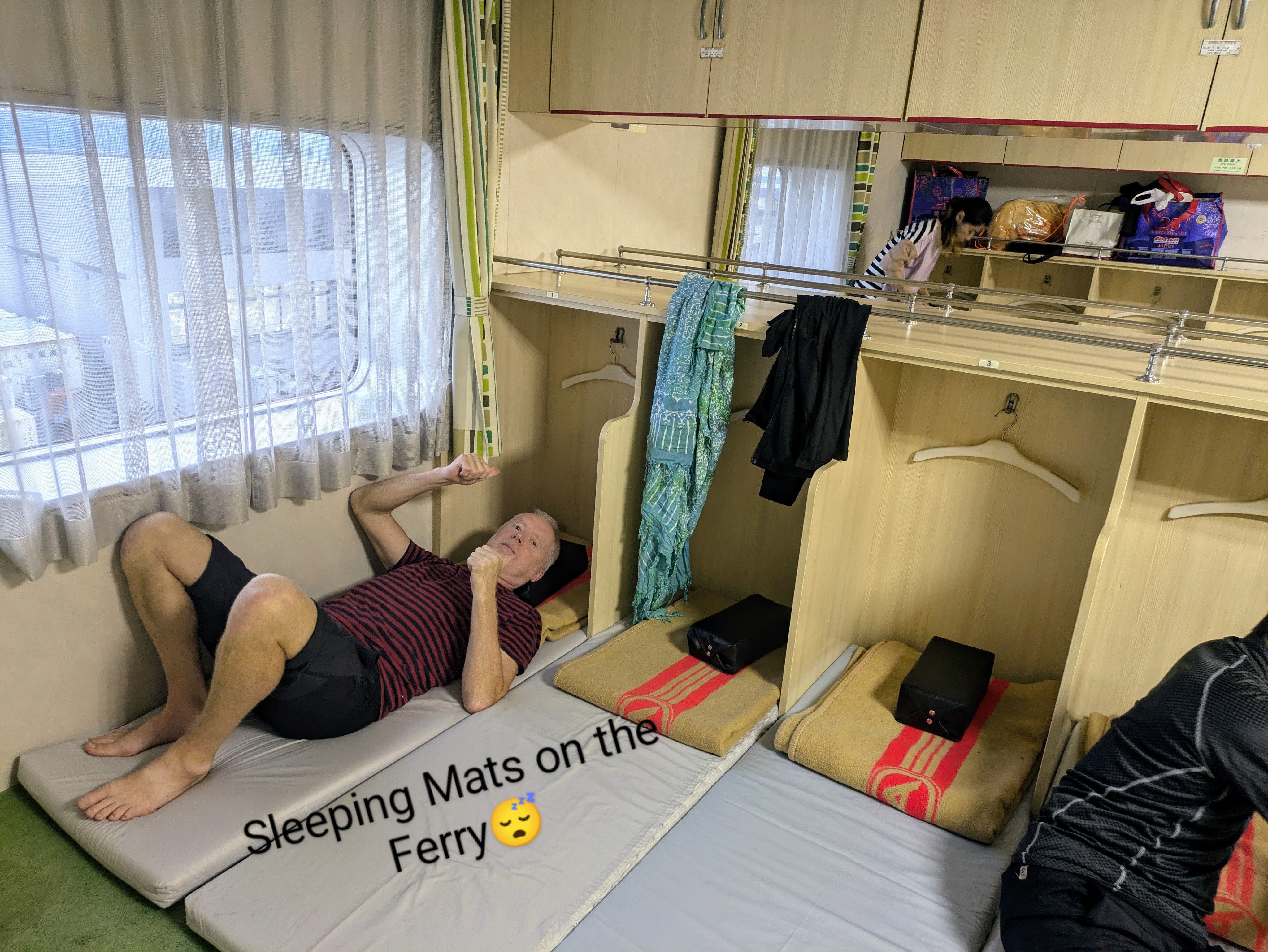
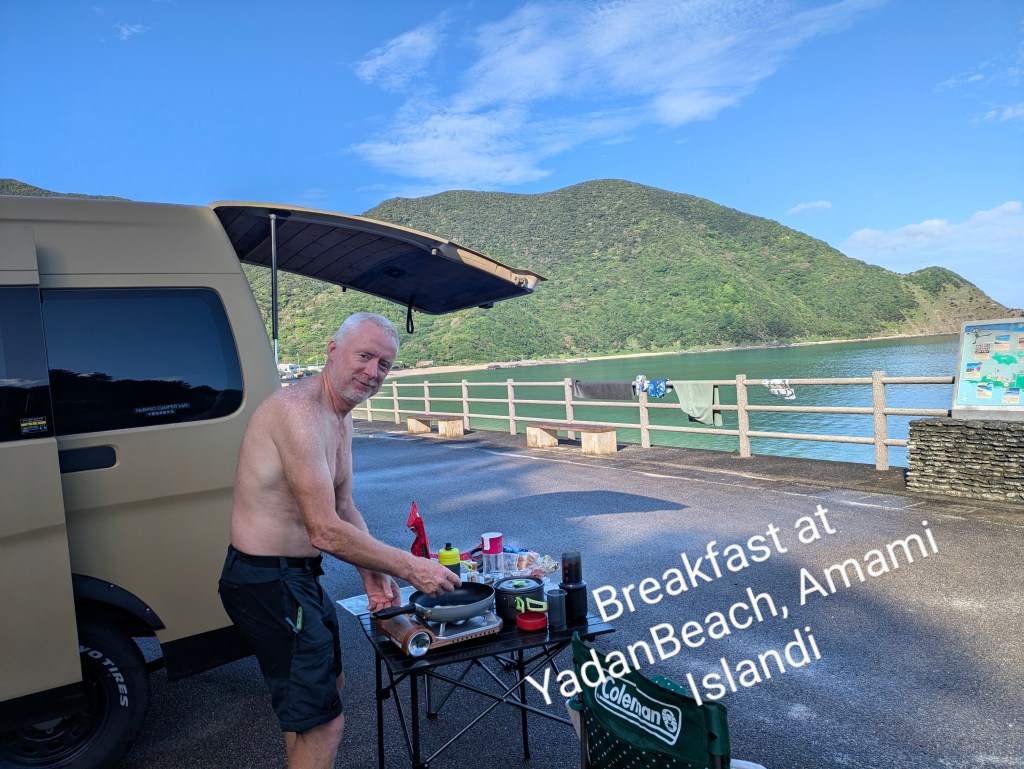
After a night on hard mats in the third class quarters, the ferry arrived in the early morning to a sleeping Amami Island. We parked near the sea, boiled some water on the stove for tea and coffee and waited for the island to wake it while we admired the dawn tranquillity . There was more birdsong than we had heard up to now and the loudest cicadas that we have ever heard.

Mainly there were green, forested hills, rising behind small fishing villages nestled on the shore. With the topography of steep hills coming down to meet the sea, we saw that it was a constant battle to prevent the land sliding into the sea from mudslides and the sea overtaking the land, a constant pull and tug. Driving around the island we witnessed first hand the hills reinforced with concrete and the sea barriers, both requiring constant maintenance.

The Amami islands are halfway between mainland Japan and Okinawa island group and not that far from Taiwan.  Amami Oshima, the main island, is sparsely populated, smaller and less touristy than its more well known neighbour, Okinawa. It has a similar climate, warm with plentiful rain and a unique culture with worship of many gods of mountain, sea and forest. Many rituals take place around a lunar calendar and are overseen by an elder female.

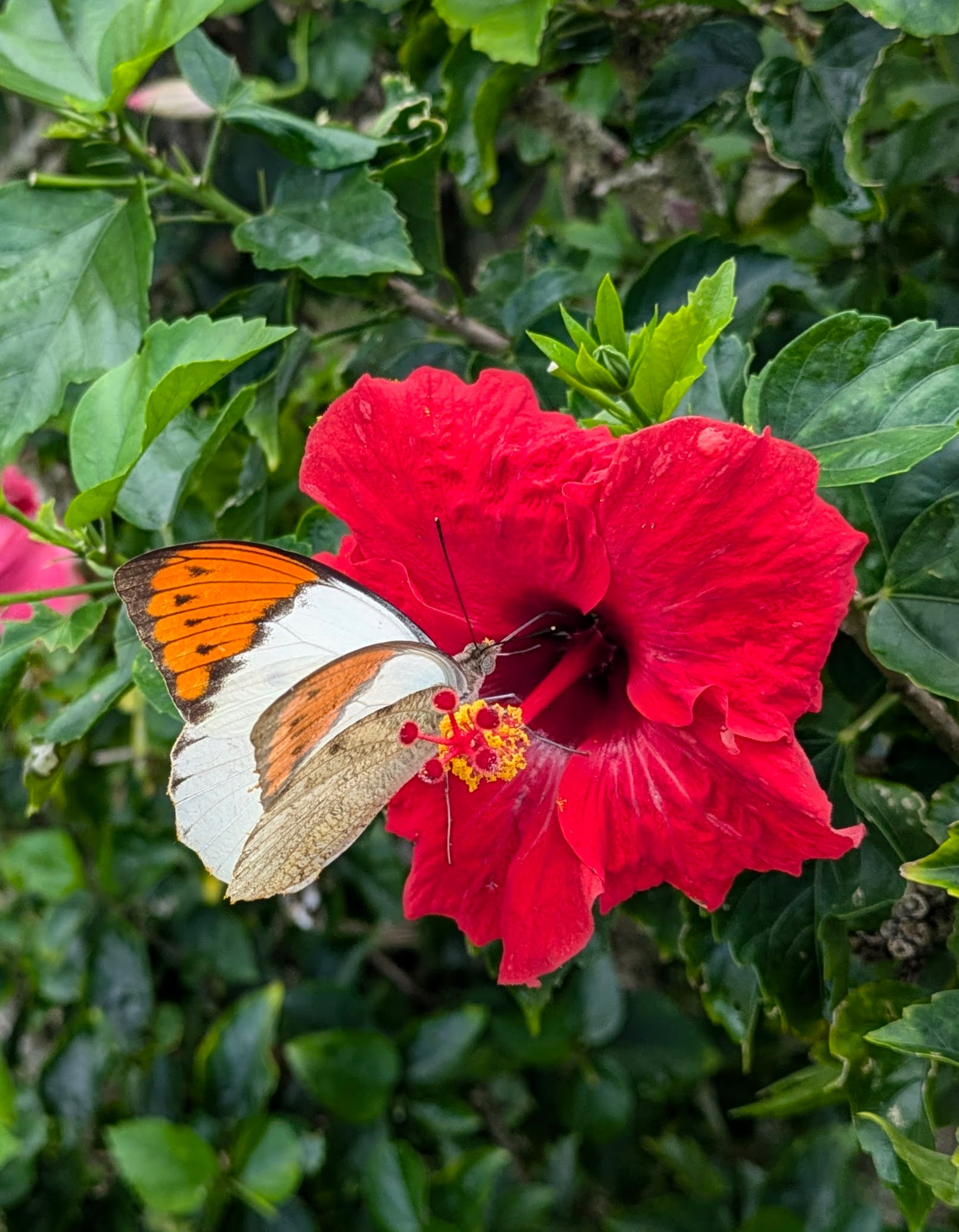
We soon found out how plentiful that rain could be. Although our first day on the island was warm and sunny (about 29C), it began to rain that night and didn’t stop at all for about thirty six hours. The rain wasn’t like rain at home, it  was warm but still drenching and it caused more leaky windows. The deluge gave us an opportunity to visit museums, an aquarium and the wildlife conservation centre. Conservation and nature is an important part of Amami with its unique eco-systems of mangroves, forests, seashore and pristine waters. It is a World Heritage Natural Site. There are rare species of plants and animals, unique to the island. Sea turtles come ashore and lay their eggs on many of the beaches between May and July. There were so many butterflies that sometimes it was almost like a blizzard. There are huge efforts in progress to eradicate the mongoose which was  introduced to help reduce the number of snakes and rats.  The problem was that the mongoose ignored the snakes and rats who were sleeping during the day and found easier prey in the rare species of rabbit and woodcock which have both become endangered as a result.  Everywhere we go, there are warnings about the snakes, particularly vipers. So far, we haven’t seen any…..fingers crossed, it stays that way.

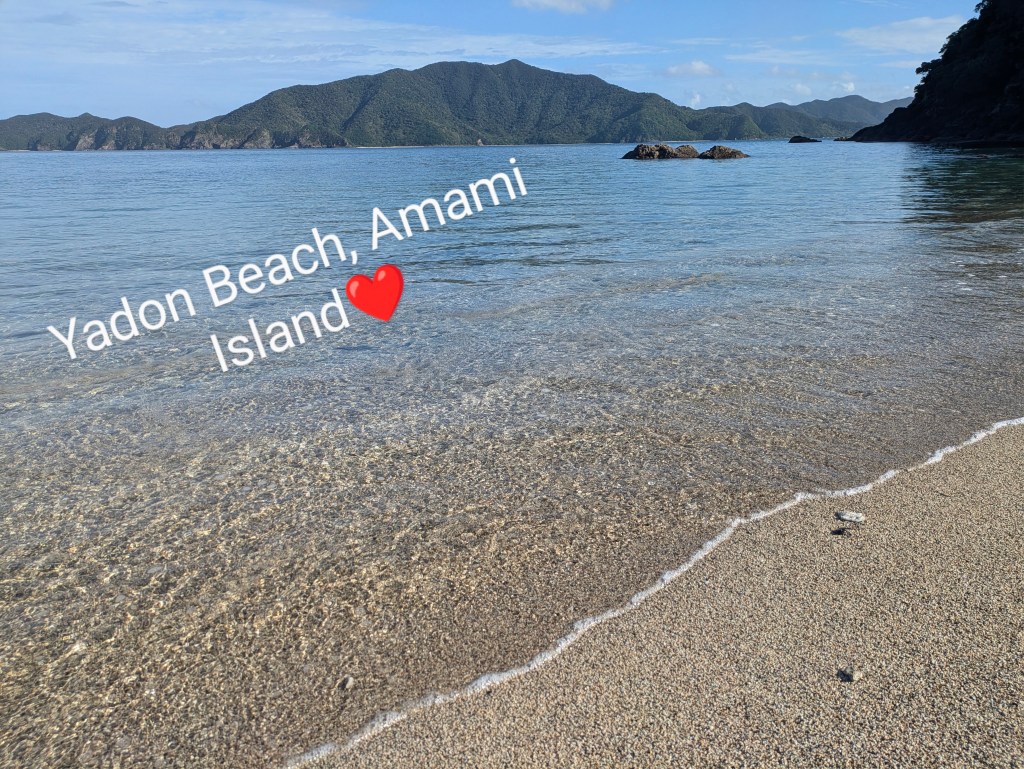
Last night we are parked up by Yadori beach, an idyllic spot on the edge on the forest. The temperature in the soft darkness was about 25C, there was a light breeze and we were enjoying some wine (which is surprisingly cheap in Japan).  A man in a jeep stopped beside us to warn us about the danger of snakes in the region(all by Google Translate). That put a little damper on our evening, I even dreamt of snakes slithering in the van window that we had to keep open for some ventilation and I’m not even squeamish about snakes….usually.

We are so glad that we made the decision to bring the van to the island. It allows us the freedom to travel around as the bus service is not extensive. Amami is an island made for camper vanning with so many beautiful places to park, often with toilets, showers and picnic tables. At the southern end of the island we were spoilt for choice, parking beside gorgeous beaches with crystal clear water where we snorkelled  with colourful, flickering fish. Truly a paradise when the sun shines……except for the snakes.

But there’s a typhoon coming and it is predicted to be a strong one. We are going to try and change our ferry tickets so that we can leave a day early…..just in case

Till next time….hope your Bank Holiday weekend is going well

From a sunny, blue-skied Amami,

Mata Ne (またね)

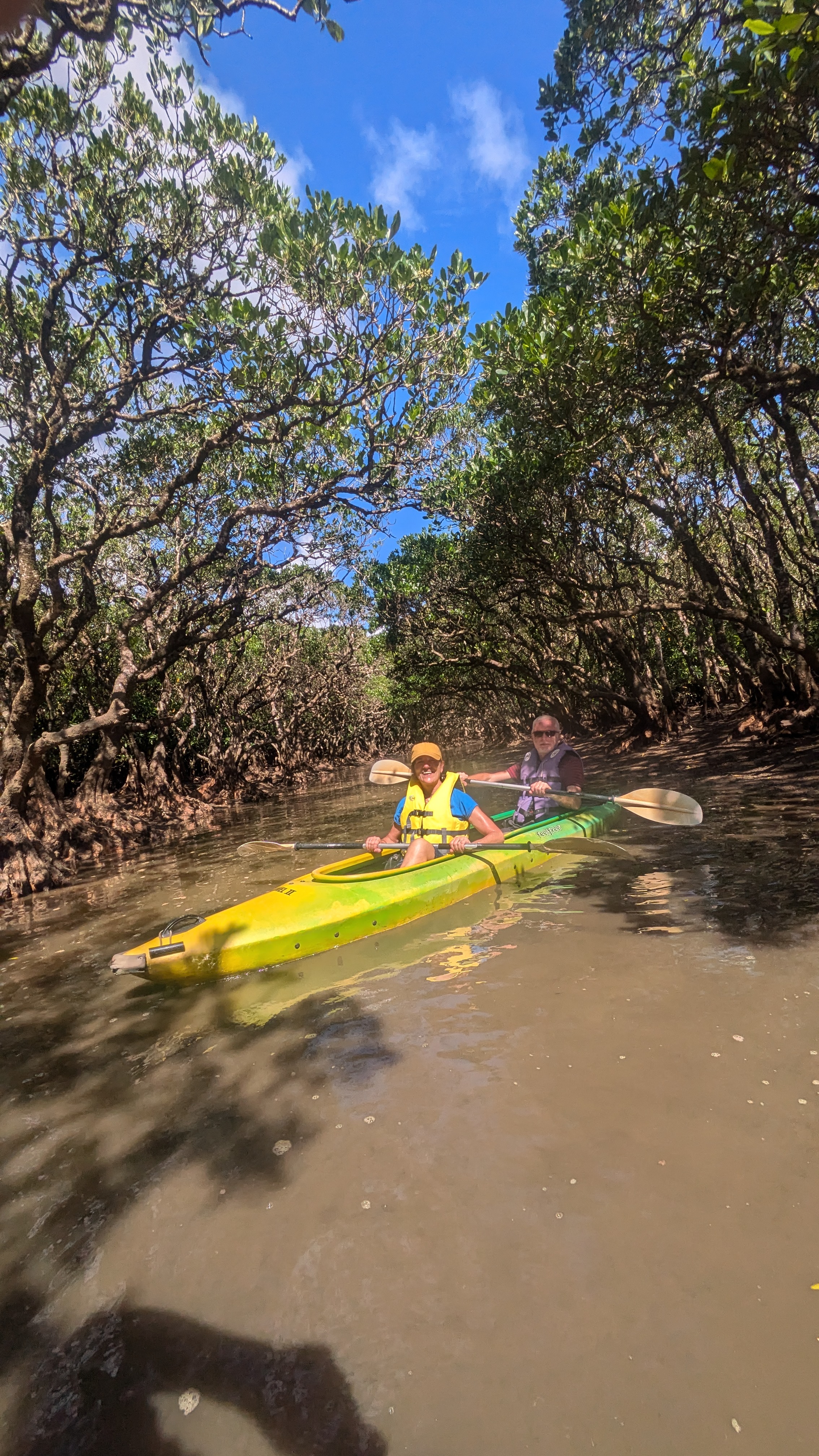
Kayaking among the Mangroves, Amami Island

Japan: Chasing the Dream (aka Running from the Rain)

Journey to Japan✈️✈️

Our journey was longer than expected. We flew Qatar Airlines from Dublin to Doha (Qatar) and onwards to Osaka in Japan but delays leaving Dublin meant that we missed our connecting flight in Doha.

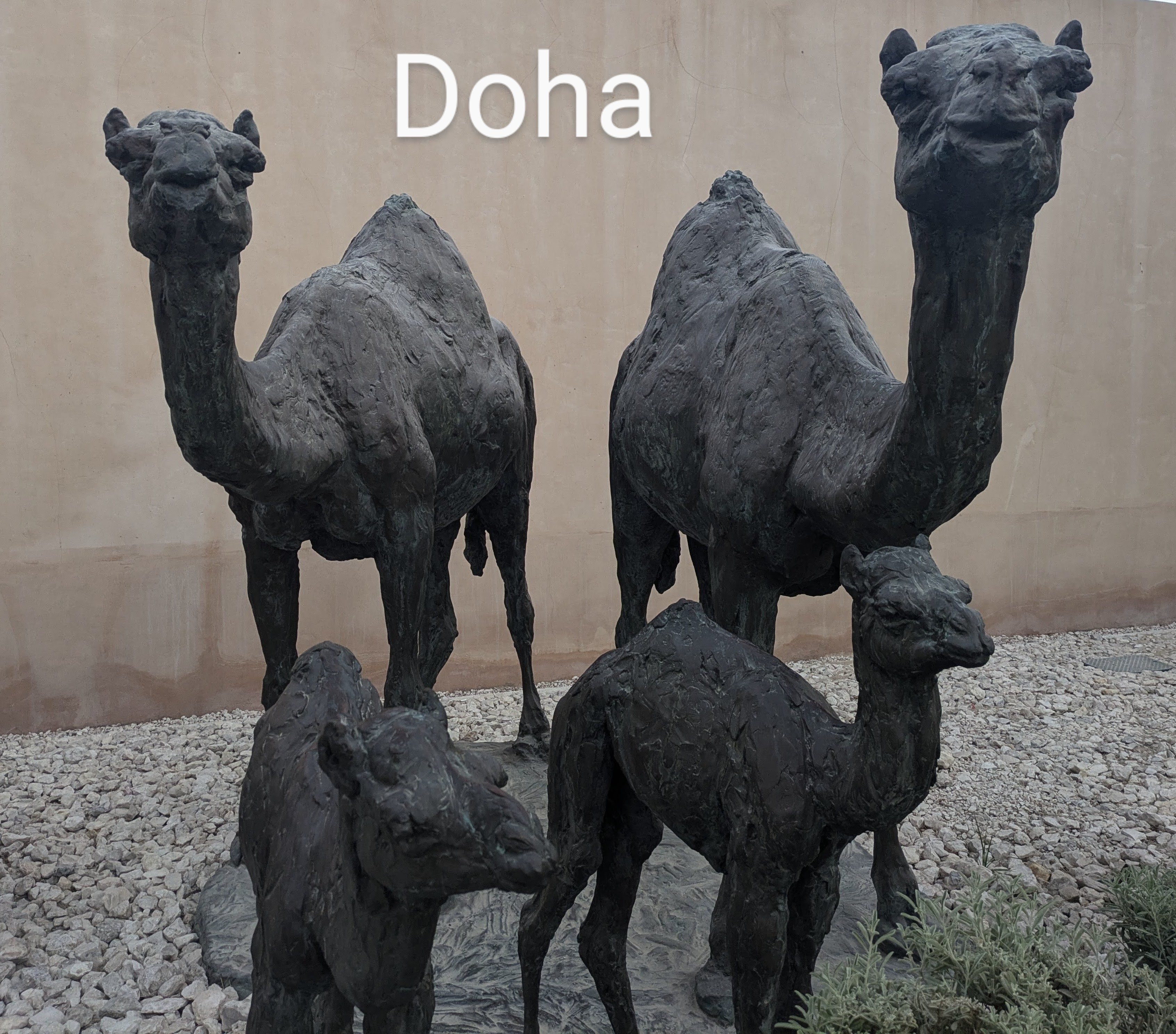
We weren’t the only ones with missed flight connections. The escalating situation and volatile skies over the Middle East meant that lots of flights were delayed, cancelled or diverted. Doha is a big international hub with connecting flights radiating in all directions and that night it was chaotic with hundreds (maybe thousands) of passengers milling around, all wanting to be somewhere else. After queueing for hours at one Transfer Desk, we were moved to another emergency Transfer Desk that was set up in a different part of the airport to cope with the huge numbers of displaced passengers.   Finally we were booked on the next available flight to Japan which was in 24 hours. The  bad news was that there were no hotels available as the allocation for delayed passengers was already filled. Others fared much worse – people going to Auckland were told that that next  available flight for them was in  three days.

Qatar Airline staff advised us to try again later for a hotel  when other passengers might have checked out and in the meantime we were given a meal voucher so that we could ‘rest and replenish’ in the words of the man at the Transfer Desk. There wasn’t much replenishing as the ‘meal’ voucher was valid for tea/coffee and little else. All sandwiches/rice meals were beyond the price range. The staff in the restaurant were very nice, advising us that the best  way to spend our vouchers was to get the ‘specials’ (falafels and soggy chips). They had plenty of experience as the situation had been even more chaotic the night before.

Doha airport is enormous.  The shuttle bus  from the plane took at least 35 minutes to reach the terminal building.  There were people curled up in every corner trying to sleep.  Segregated ‘quiet’ rooms were available with recliners.  Both of us were lucky enough to grab a recliner in our respective male and female rooms but they weren’t really ‘quiet’.  Phones were going off, people were coming and going, there were chatters, snorers, coughers and sneezers.  Plenty of smoking rooms were available for the smokers, segregated prayer rooms for the religious but not a bar in sight for the drinkers🥂

At around 6am, we made our bleary-eyed way to  join another queue for the service desk and after an hour, we were allocated a hotel room but…. we had to join another queue to get the voucher printed. Then more queues for immigration followed by hanging around for a bus to take us to our hotel where our room wasn’t ready for another two hours.

We were delighted to be out of the airport. There was a faint smell of spices, maybe turmeric, in the hot dry air. After the air-conditioned airport, the 39 degree heat was a shock, a solid, shimmering wall in a flat landscape.  Doha looked brand new, as if it was made yesterday with skyscrapers, minarets and new roads rising out of the desert sands.

Our hotel, Hotel Royal Riviera,  was much better than we expected, with a spacious bedroom, hot showers and plentiful tasty food, a buffet breakfast, lunch and dinner. There was an absolutely fabulous selection of dessert cakes at lunch and dinner….the most delicious syrupy orange cake that I have ever tasted and superb chocolate brownies topped with roasted pistachios –  it was so good that if we are delayed in Doha on the return journey home, I won’t mind.

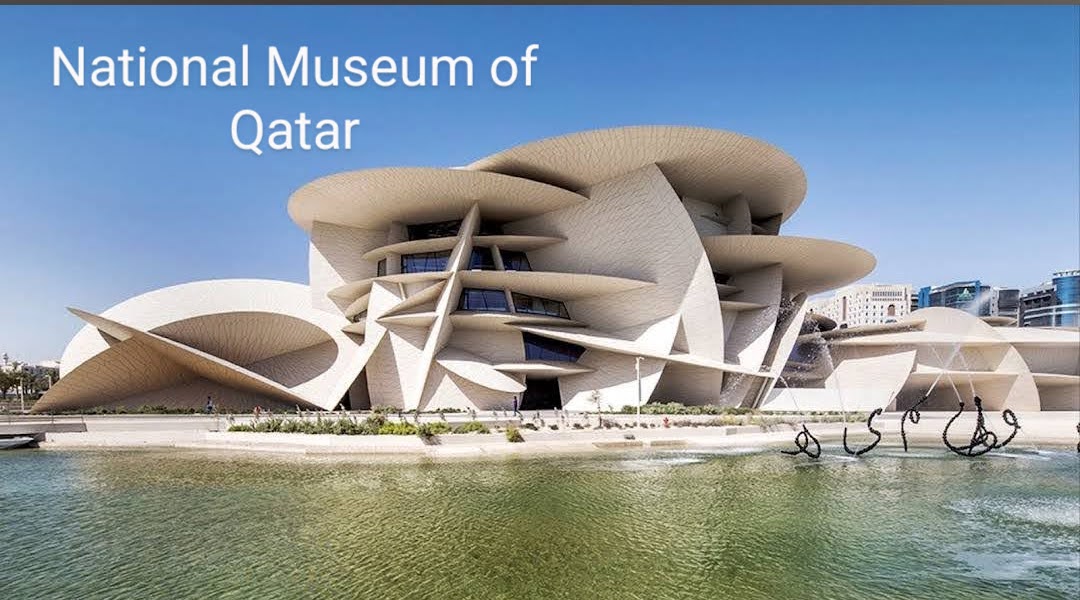
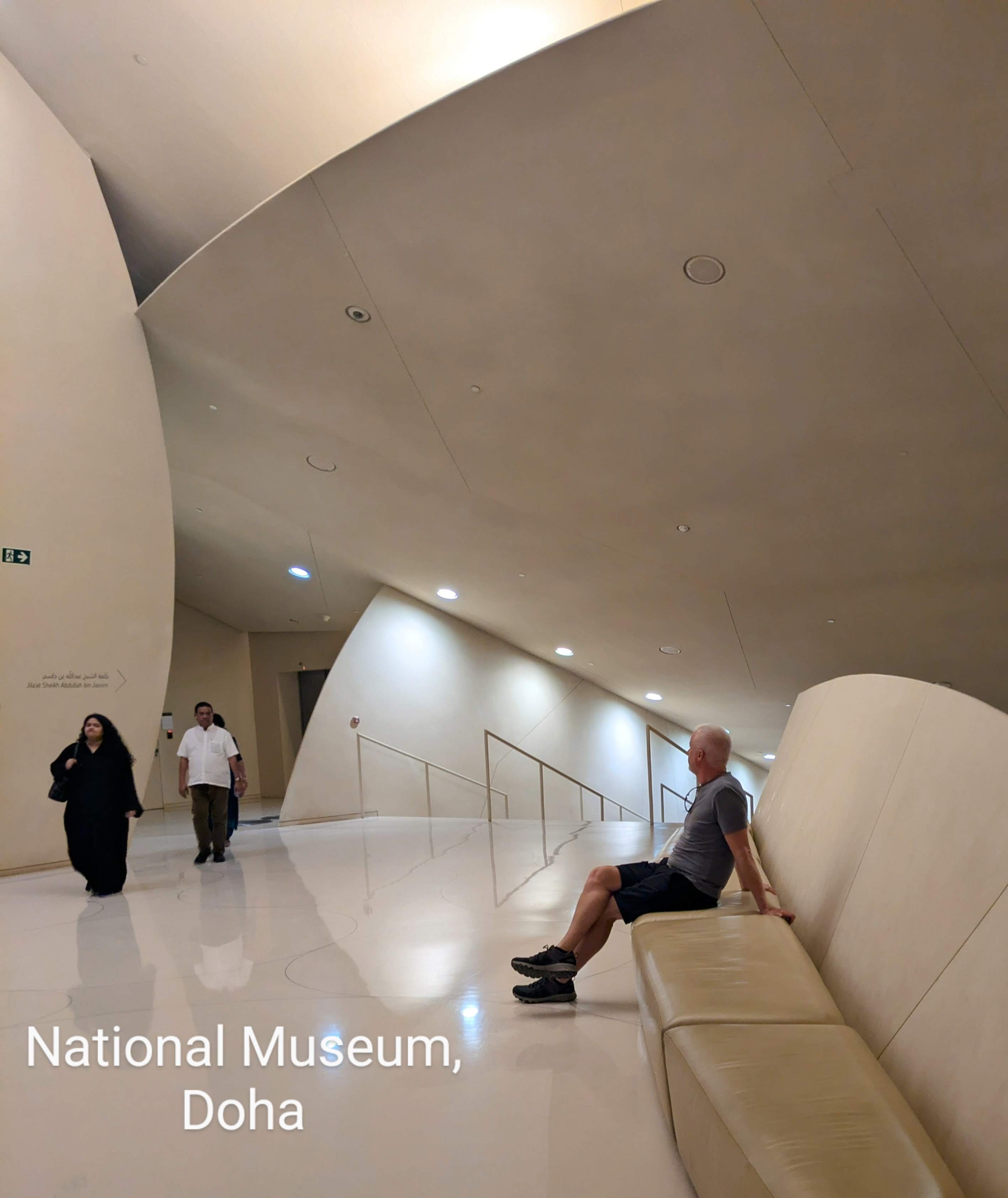
At about 10.30am, we  fell on the  hotel bed into a deep sleep for a few hours, waking in a jet lagged stupor to walk to the National Museum of Qatar.  White taxis kerb- crawled beside us wanting to take us on a city tour which we kept declining. The museum was a breath-taking building with interlocking disc inspired by the desert rose, a geological phenomenon formed by the deposition of minerals in a circular pattern around sand grains Built on the shores of the Arabian Gulf, the museum was as stunningly beautiful inside as it was outside and is well worth a visit…if you ever find yourself stranded in Doha.

Our flight to Japan departed Doha at the ungodly hour of 1.30am. With a nine-hour flight and a six-hour time difference, we arrived with addled body clocks at 5.30pm into a cloudy Osaka (23C). In contrast to Doha, the airport was calm with orderly queues and much bowing by the courteous staff. We were first fingerprinted, then given a 12 week visitor visa  at passport control. After two nights and almost three days, we had arrived.

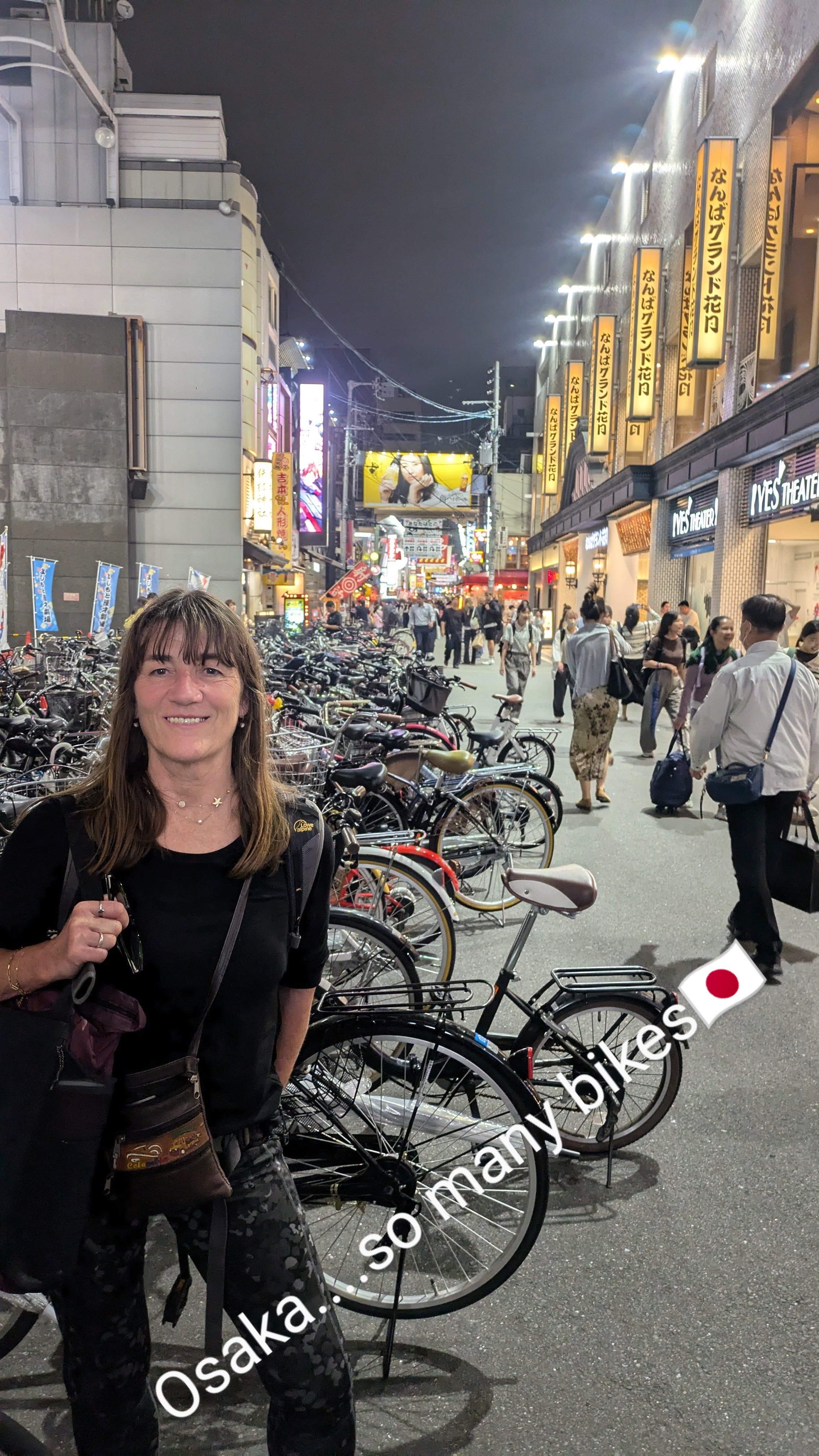
An efficient train brought us directly from the airport to Namba station in the city centre for about €6. Google maps guided us from there to our hotel, through narrow laneways, over humpbacked bridges crossing the canal and then onto wider streets which felt clean, safe and welcoming. We liked Osaka immediately.  The large number of cyclists  surprised us, most of them cycling on the footpath.  Many had small kids on the back carriers and shopping in the baskets on the front. All pedestrians and cyclists stopped on red lights even if nothing was coming from any direction. This adherence to rules was something that Caoimhin found quite a challenge and it’s entirely possible that we will find out what the sanctions for jaywalking are before we leave.

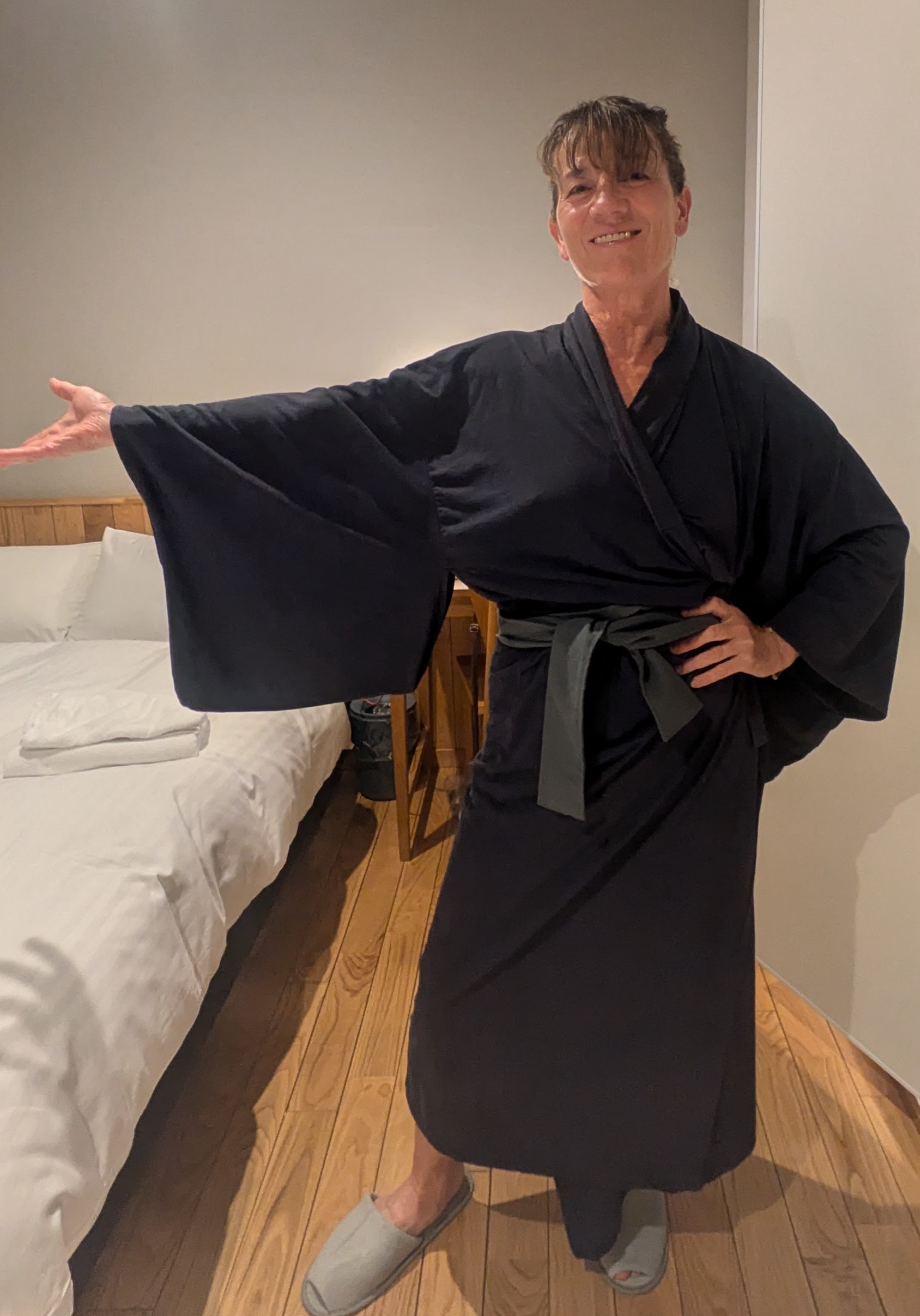
Our hotel, Be-zen Shimanouchi, was on a small, quiet street and had a big,comfortable futon-bed, both a shower and a bath and an incredible number of  complimentary beauty products (even a face mask which was not as rejuvenating as anticipated) all for €64. There was no extra charge for the change of date  from the night before which we really appreciated.  A guest who had come from Tokyo said that his hotel room here was double the size, twice as nice and half the price.

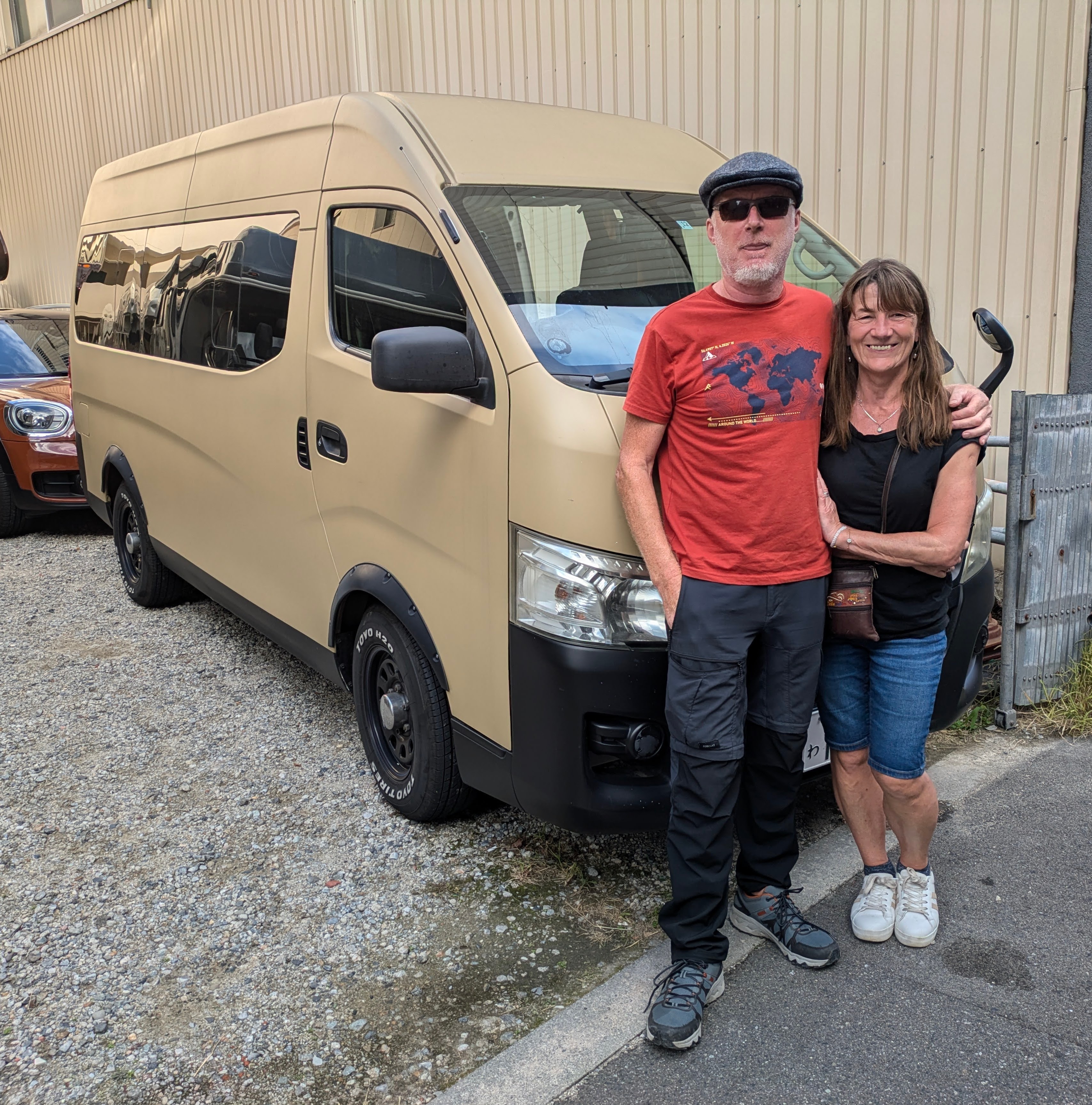
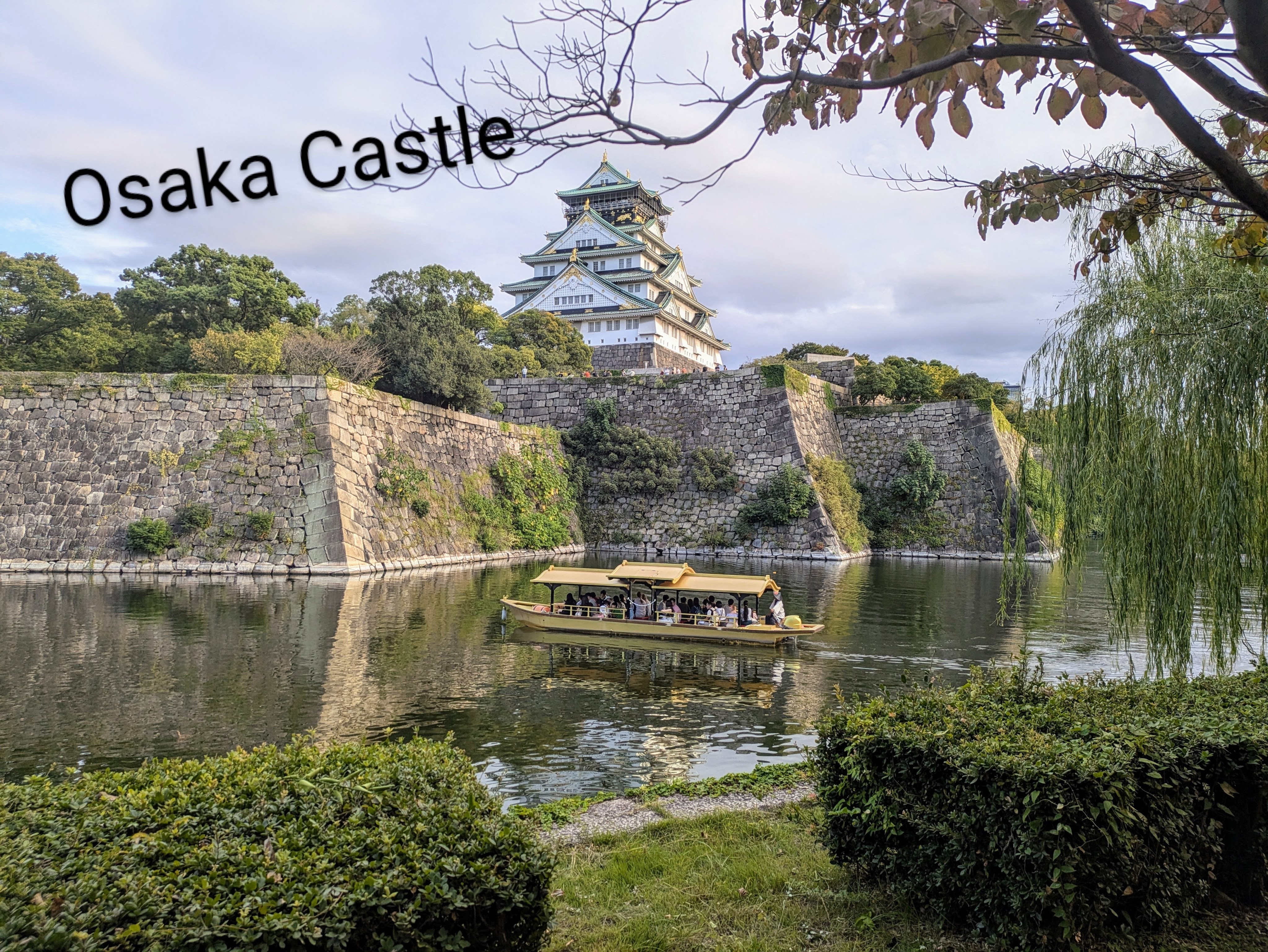
The following morning, it was time to pick up the campervan from Zen Campers. Our van was exactly as shown online, a beige, ‘no-frills’ van conversion which seemed perfectly adequate for us. Deciding to park it up for the night in the Zen office parking lot for free , we explored Osaka.  The city has two main tourist attractions which are very different. One is a crowded street full of towering neon signs and tourist shops,  the other is a spectacular five-story fairytale castle with almost 450 years of history.

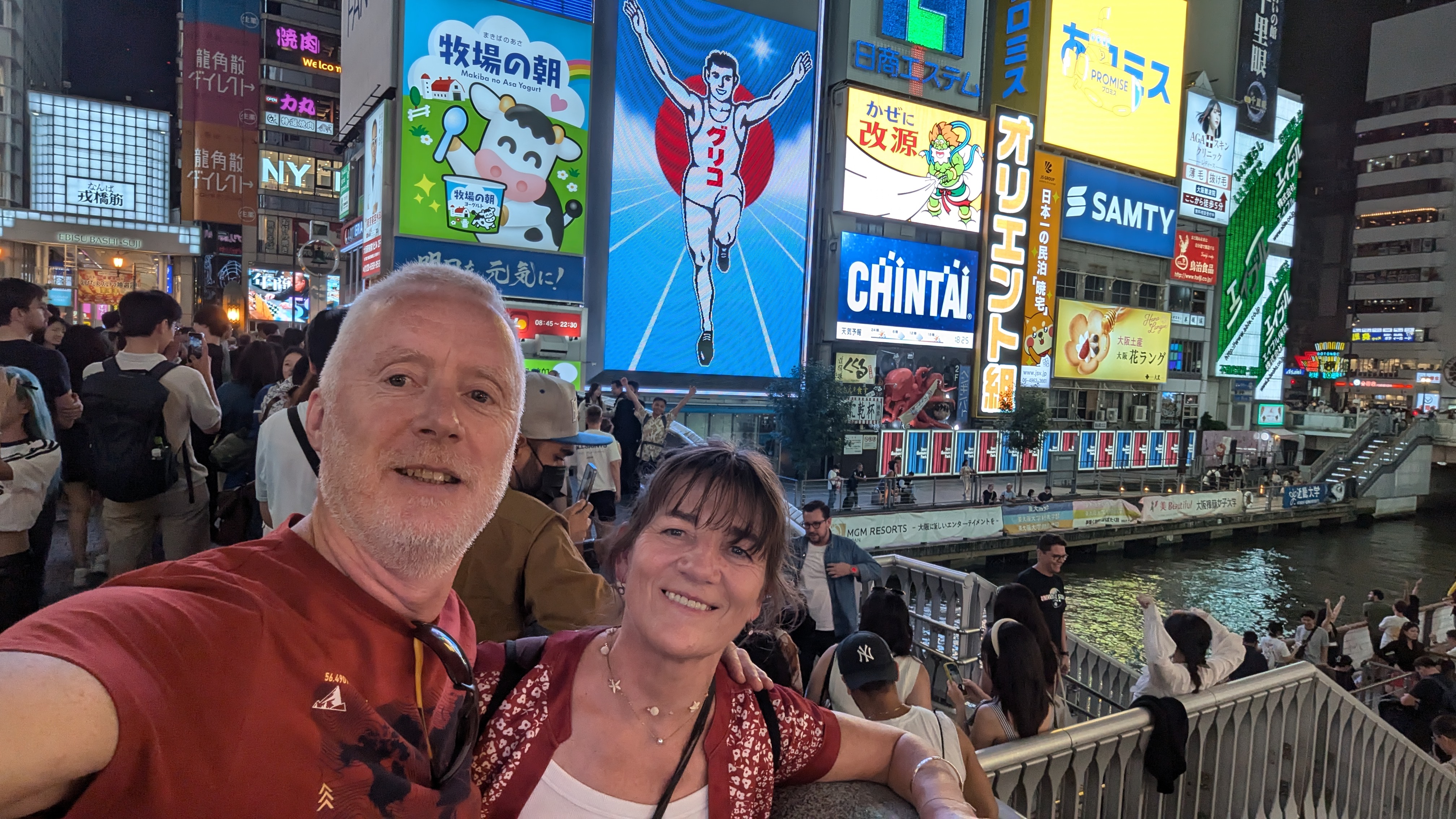
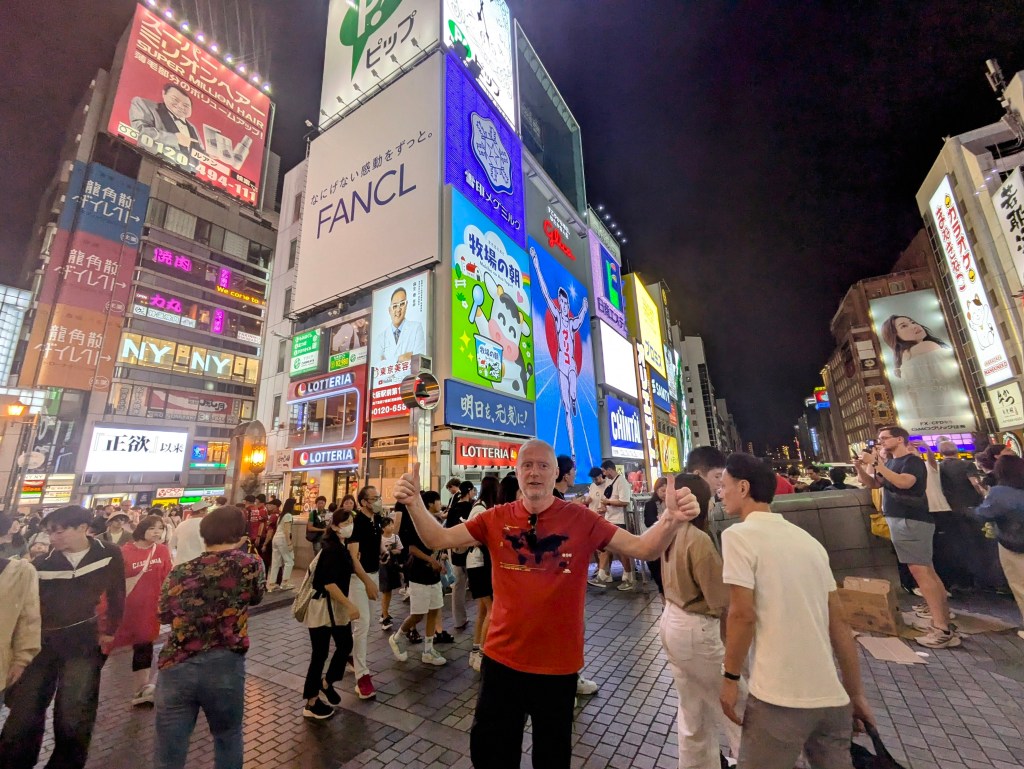
The atmosphere was tranquil as we strolled in sunshine  around the large castle park with gorgeous views of the thick castle walls.  There were  lots of meandering families, bicycles, stalls selling bonsai plants and a violinist playing near an old bridge over the moat. This was in complete contrast to the madness of Dotonbori. This area  was teeming with tourists trying to take photos of flashing billboards, the most famous of the Running Man which has glowed over the area for more than eighty years. We jostled along in the crowds before drinking an overpriced beer in a bar where half the people were smoking inside (that’s a blast from the past).

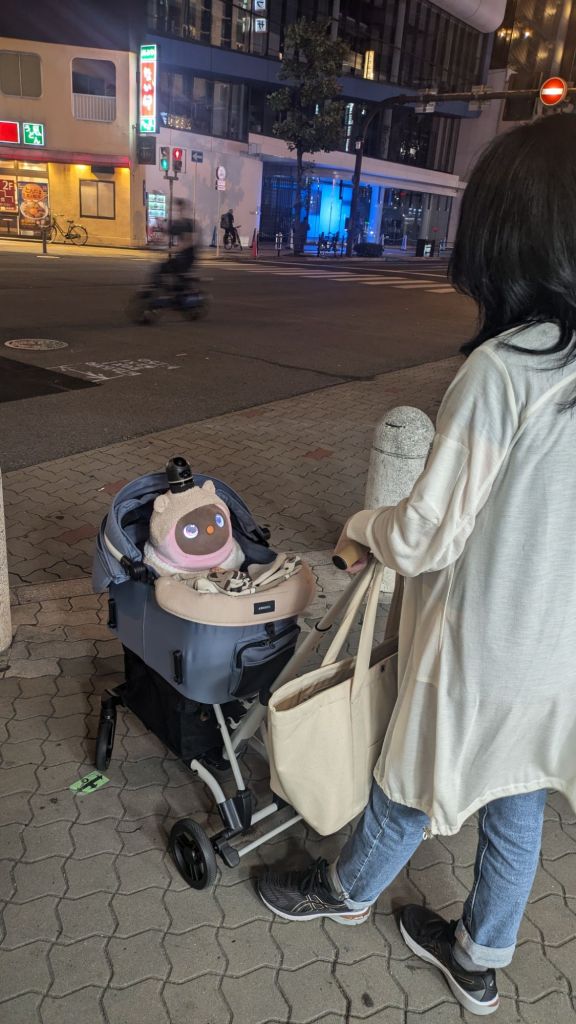
On the way back to our van we walked through quiet, clean streets. Walking past a woman pushing a stroller, we were surprised to see that there was a robot baby in the stroller. I googled the image from the photo we took and the robot is called a Lovot and can be taught to love you.

Lovot Robot
Dotonbori, Osaka

Sunday morning dawned bright, sunny and much warmer than we expected for early October with temperatures of  30C. We wanted to leave Osako but we weren’t sure where to go. On a whim we decided to head south towards the island of Shikoku, the smallest of the four main islands in Japan and to leave a visit to historic Kyoto  until the end of our trip.

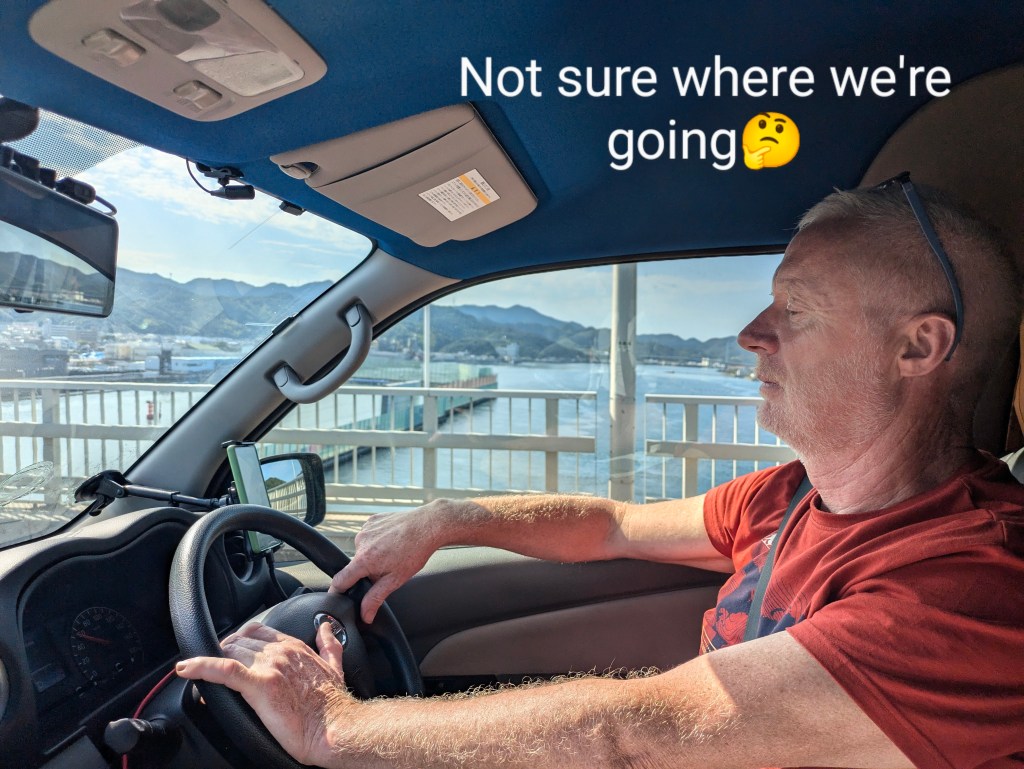
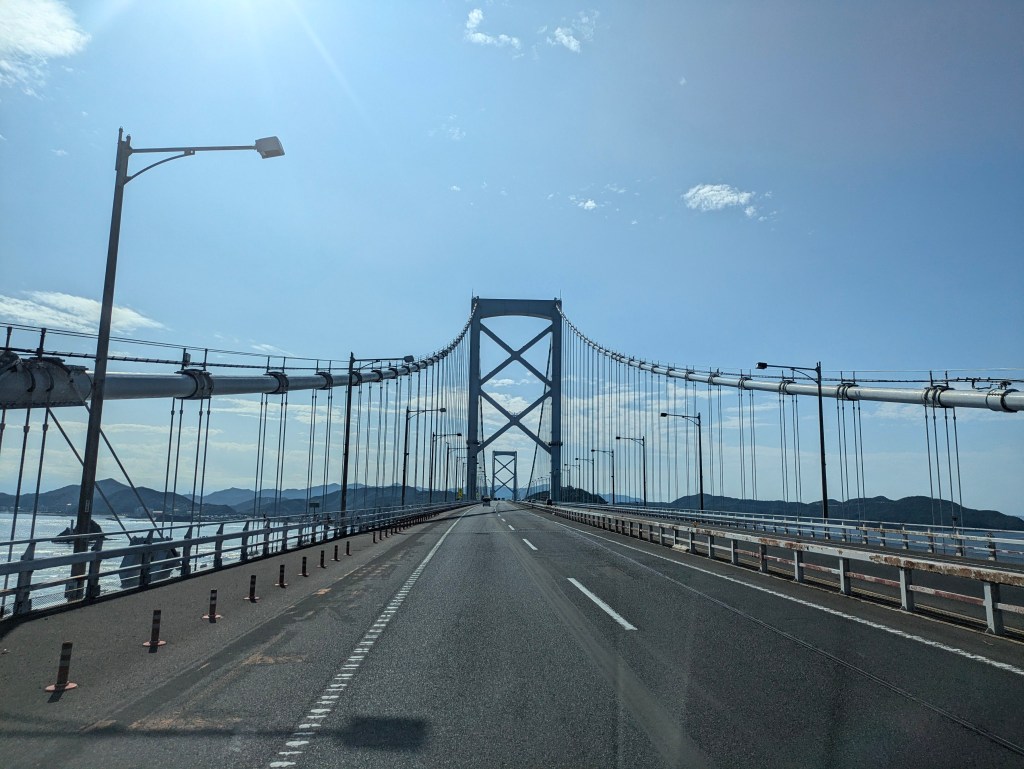
The roads were reasonably busy leaving Osaka but the drivers were courteous. The road signs were in both English lettering and Japanese symbols and best of all, the Japanese drive on the left side on the road, the same as at home. On the highway, one city blended into the next, almost without a pause. There were  some long suspension bridges linking  islands. Japan is a country of islands  and engineering. Although there are only four main islands in Japan, there are hundreds of smaller islands often used as stepping stones to join one with the other. The price for such fantastic infrastructure was pretty hefty tolls (eye-watering at times), some of which could only be paid for with cash or pre-registered toll-cards. It’s essential if you’re even slightly off the beaten track to have some hard cash in your pocket. ATMs are widely available for withdrawing yen  Many of the small family restaurants and even the bakery in Osaka only accepted cash.

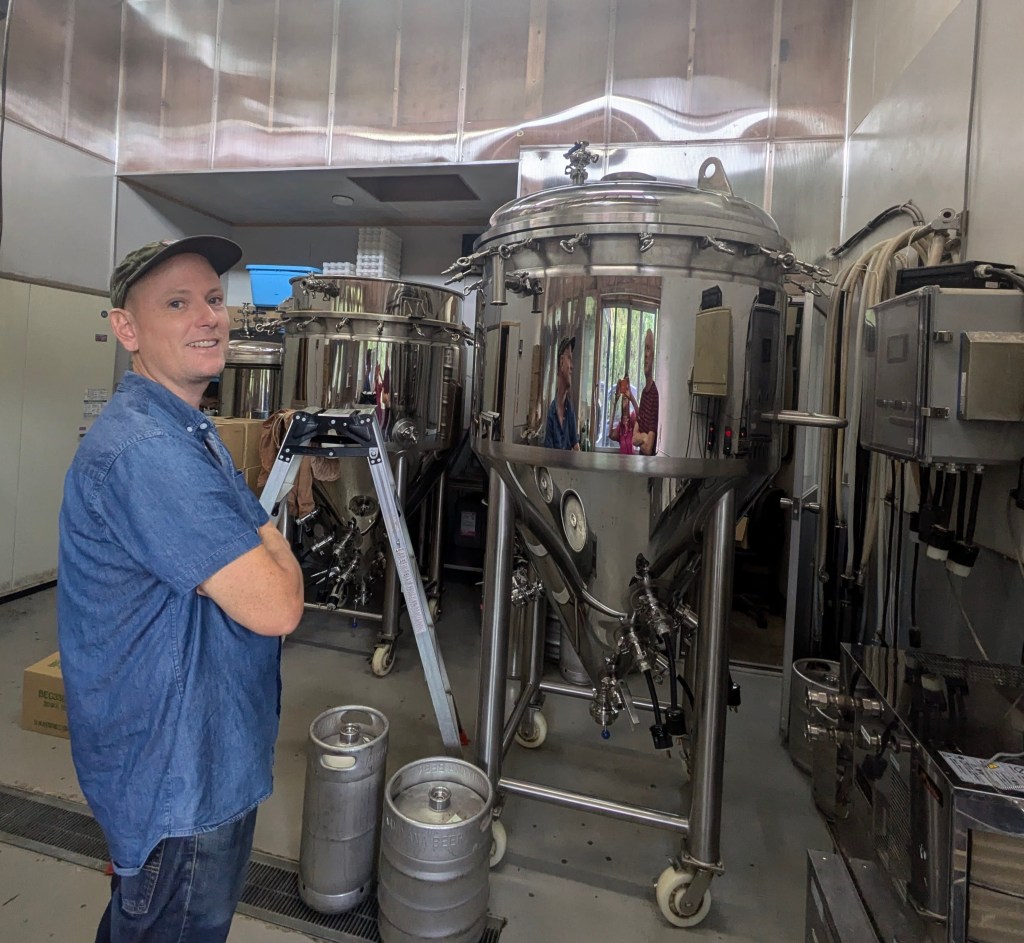
Soon the cities were behind us and we were looking at the green, tree-clad mountains of Shikoku Island. We headed to Kamiyama because we had heard that it was a rural idyll and because a man from Tramore lived there,  the son of a friend of Caoimhin’s and a fellow GiY enthusiast(Grow It Yourself). Manus had set up a small craft brewery in Kamiyama which had won awards and was open on Sundays…..a good enough reason to go in that direction. We found the brewery (Kamiyama Brewery) sampled some really great beers  and although Manus wasn’t there, there was a  campsite nearby in a glorious setting  among tall trees by a river.  We  parked our van, really delighted to be in Kamiyama.

 We met up with Manus the following day at his brewery. He and his wife, Sayaka, a Japanese artist, set up home with their two young children in Kamiyama, a small spread-out town in a valley surrounded by green,forested mountains. It also has an unexpected vibrancy, rural but not sleepily provincial. There was even a bakery selling sourdough baguettes. Manus and Sayaka came about ten years ago to participate in an artist’s hub that was being set up in the town. They were so charmed by the place that they stayed. We could certainly see the appeal.

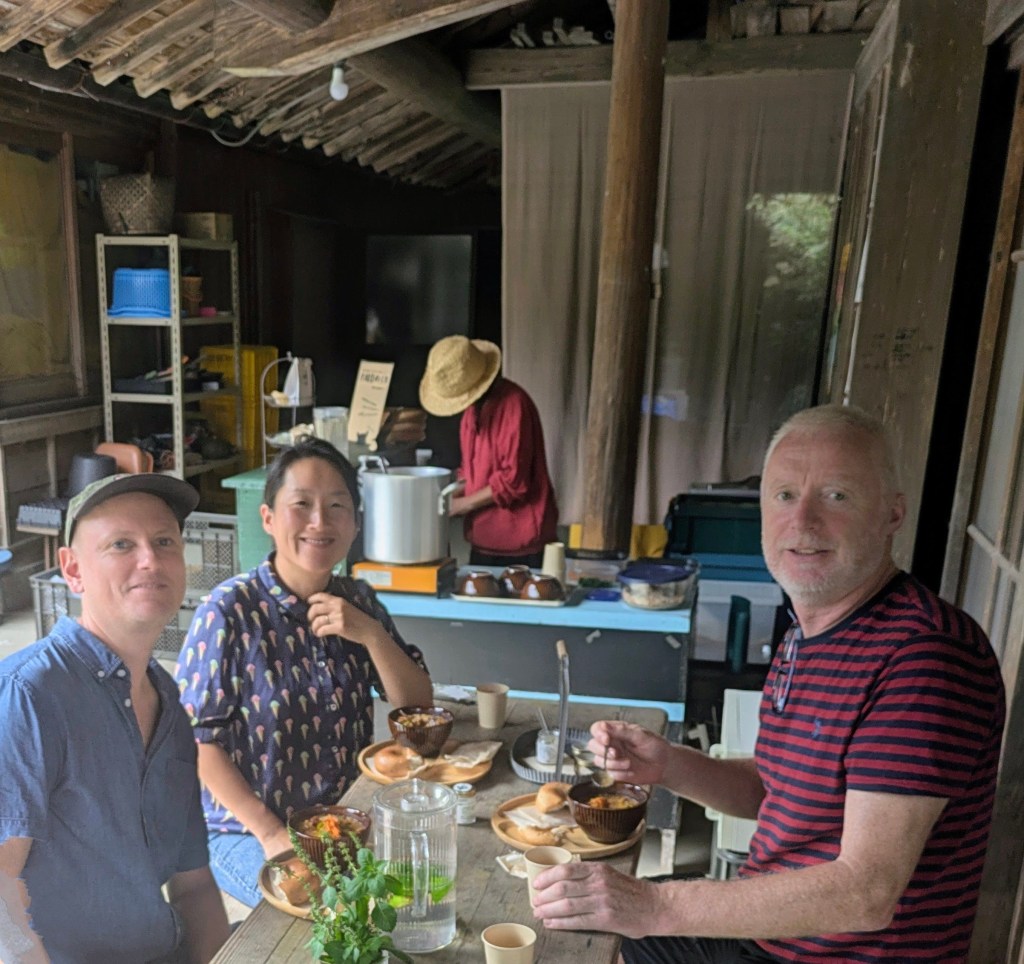
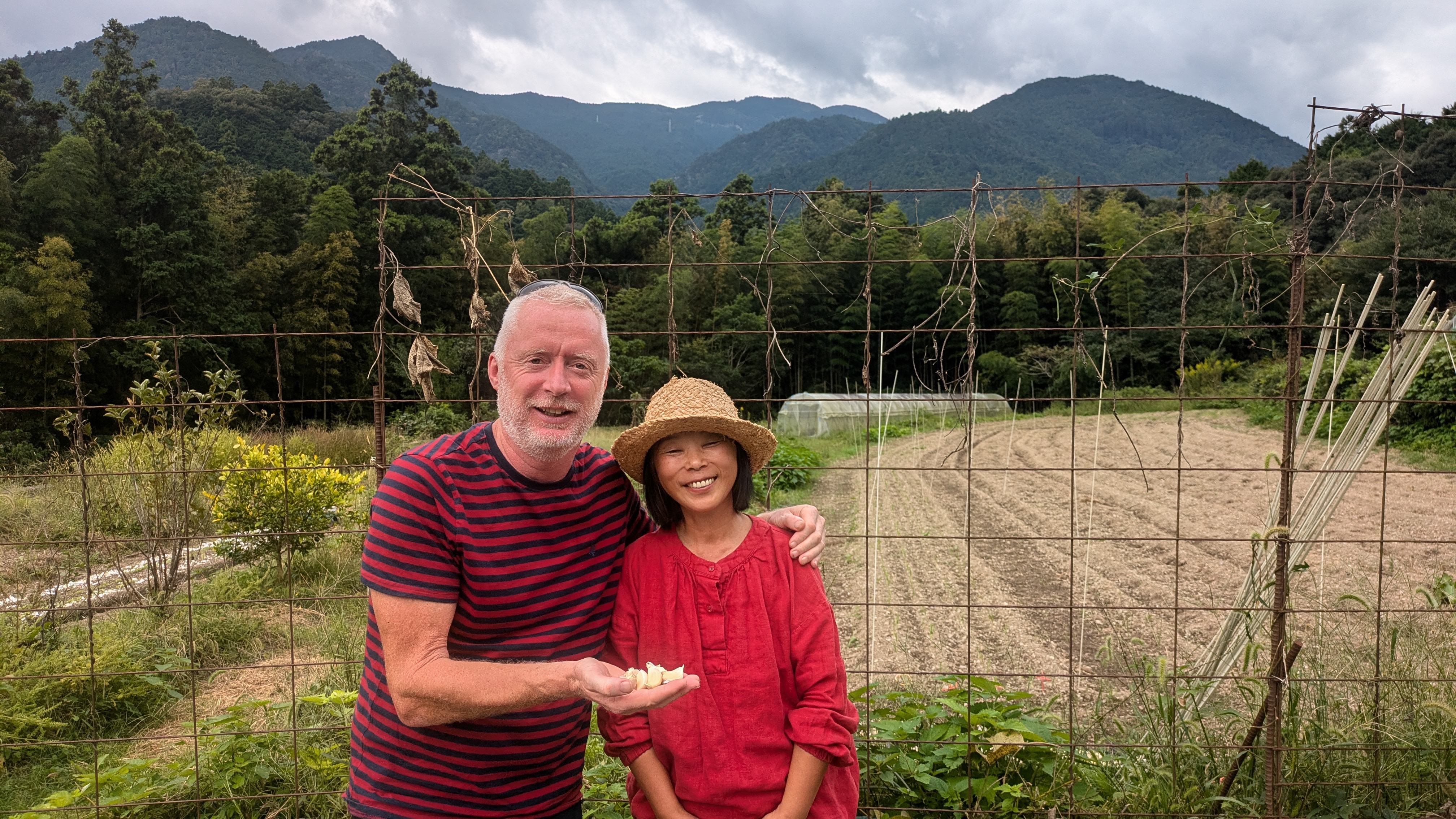
Manus and Sayaka were so lovely,  giving us lots of useful tips for our trip and treating us to lunch at a pop-up restaurant where every Monday, a local organic farmer makes a big pot of curry using her own produce, sets up a table or two outside her house and sells a delicious lunch. The farmer-cook was also funny and charming, and very proud of her home-grown garlic(like Caoimhin). So many Japanese rural towns are dying because of an aging population and a rapidly declining birth rate.  Kamiyama is bucking the trend with an influx of younger people looking for a better, more sustainable way of life.  Many companies based in Tokyo even have an outreach office in thriving Kamiyama, which has  just built a large Polytech school which should encourage more people come and stay in this beautiful area.

The Japanese love their Onsens, hot spring thermal baths which are found all over the country. These are much more than a place to have a good soak, they are  part of Japanese culture. There was an onsen down the road by the river from our campsite so we decided to visit. At the entrance, there were many signs in Japanese which we didn’t understand  but there was also a drawing of a tattooed torso with a big x through it, informing clients that anyone with tattoos wasn’t welcome. Leaving our shoes in a locker inside the door, we entered a large foyer with a  pale-green carpet and a long counter where we paid the entrance fee (about €3) and rented some tiny white towels. I walked through the red curtain for the women’s section while Caoimhin disappeared behind the blue curtain. It was quite intimidating. I wasn’t quite sure what to do although Manus had given us some instructions.  It was mid-afternoon, a quiet time at the baths,  I was by myself in the large changing room so I couldn’t follow the example of anyone else.

I stripped naked and holding  my little white towel (slightly bigger than a handkerchief) i pushed through the swing door into the onsen. The air was hot, humid and slightly steamy , there were two elderly nude women sitting on chairs inside the door, with the tiny white towels folded into a square on their heads. I knew that it was important to wash before going into the baths and that foreigners are often scrutinised to ensure that they give themselves a thorough soaping and that they rinse off the soap properly. A woman covered in soapy suds sat on a stool in front of a mirror and used a spray-hose to rinse her body. Then she filled a small blue plastic basin with water, stood up and threw the contents on the stool and floor a couple of times before waddling towards one of the bubbling baths with the little towel folded on her head.  I sat on another small stool and did likewise. The little towel is for wiping yourself down after the bath but etiquette demands that  it should never touch the bath water. That’s why it is folded on the head or left on the side of the bath.

The water was hotter than expected when I slid into the bath (no splashing allowed) and it took a while to get used to it  but soon I was relaxed…..and very shrivelled.

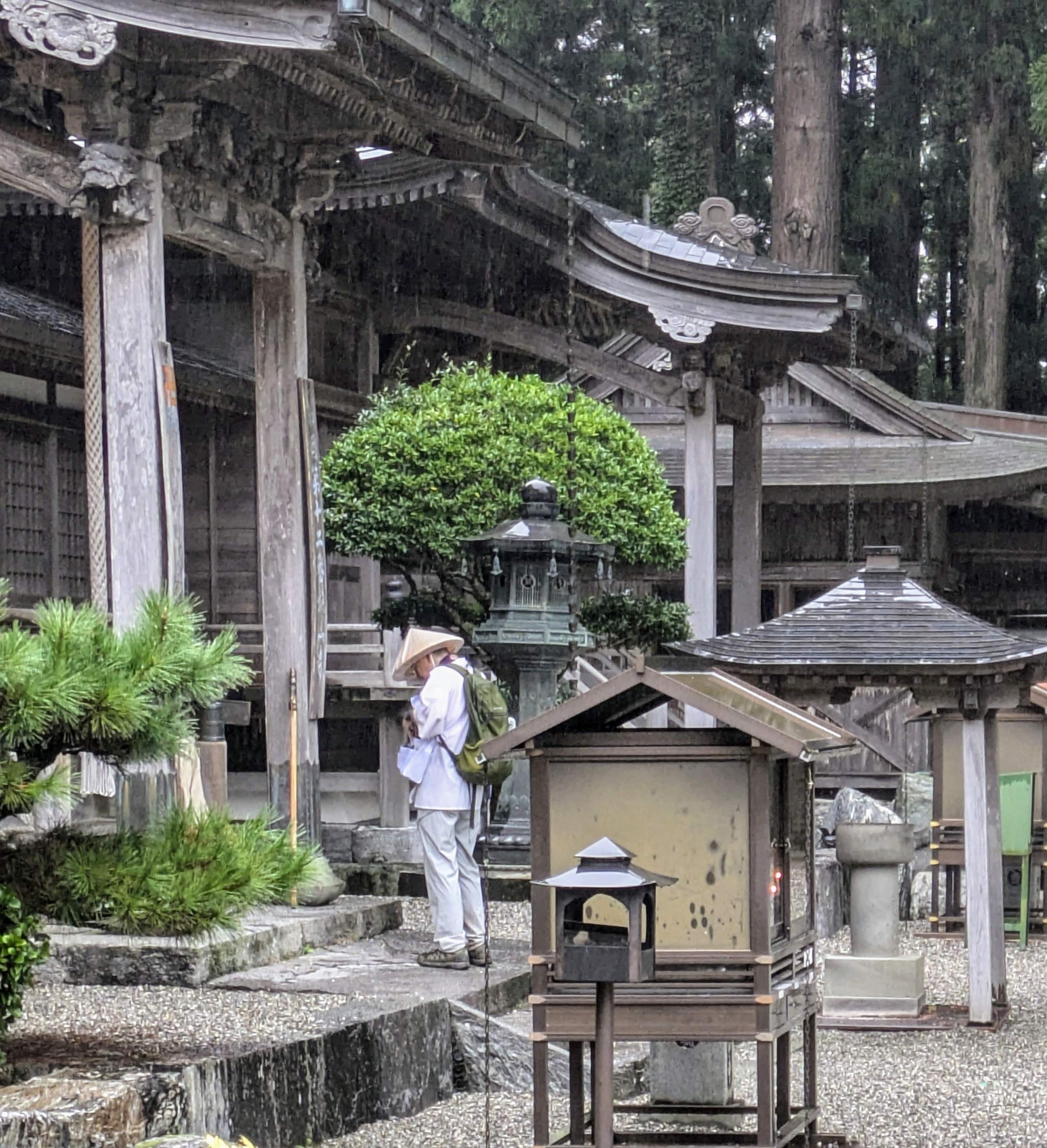
A Pilgrim Prays

Kamiyama also has another attraction. It is on the famous Shikoku pilgrimage of the 88 Buddhist temples. This is a circuitous route, about 1200kms long around the island of Shikoku. Pilgrims are very recognisable by their conical hats, white robes and wooden staffs. We had seen a few walking (and hobbling)  along  the roads. Hopefully in the next week or so, we will visit some of the eighty eight temples either by walking or by campervan and find out more about this ancient pilgrimage

Apologies for such a long post …if you reached this far, thanks for your stamina.

じゃあね。Jāne.

‘Till next time🥰

Journey to Japan✈️✈️