Electric Roadtrip: Blue Days in Morocco

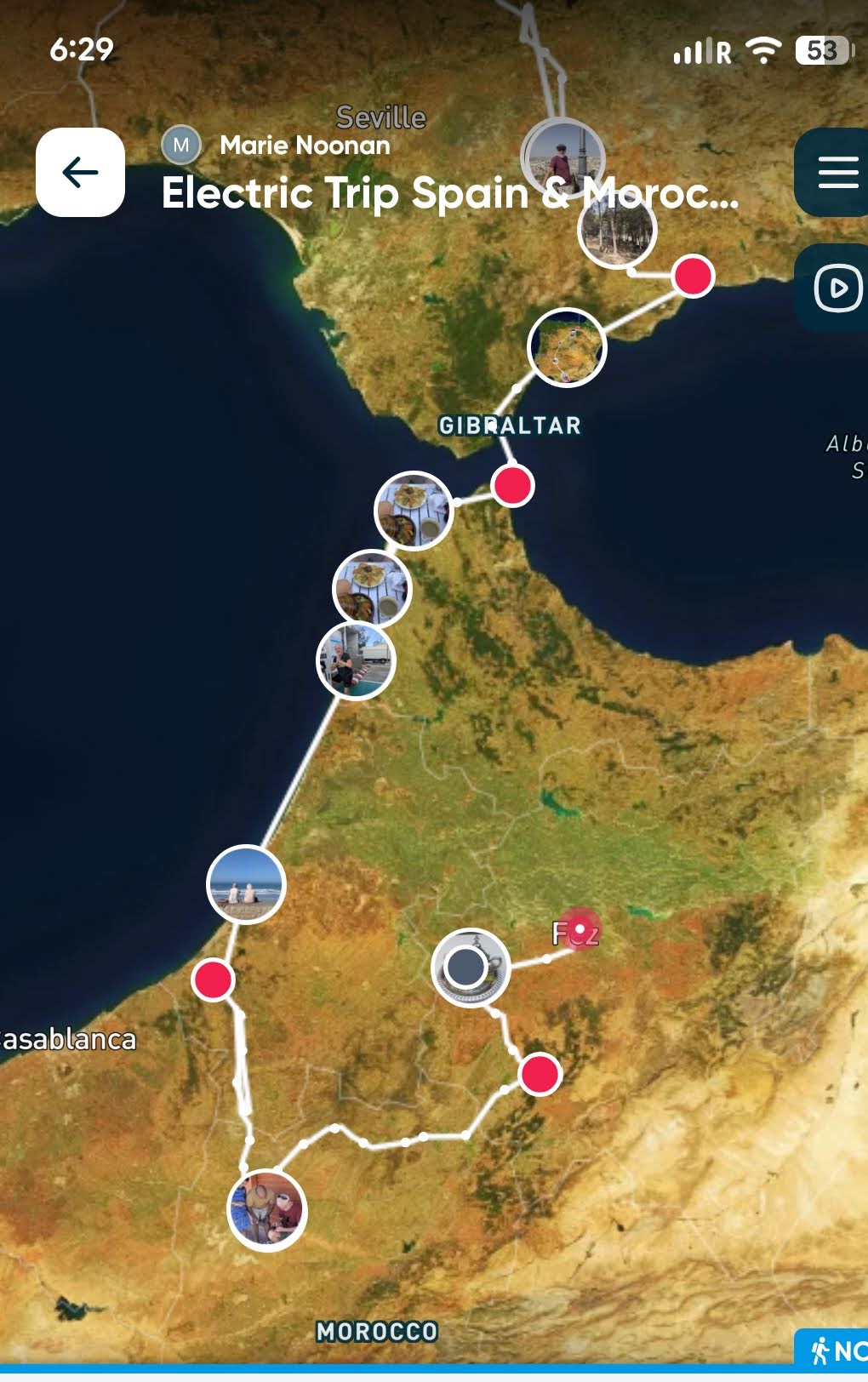
Fes was different,  As we drove into the imperial city in the heart of Morocco, our priority was to get the Buzz charged. Following the map directions for a Kilowatt EV charger, a man on a motorbike pulled up beside us in the traffic and, noticing the van’s registration, shouted in English ‘Are you from Ireland?’

We nodded,  replying  that we were making our way to charge the van. He raced ahead and directed us to the EV chargers on the side of a busy wide street. Unfortunately neither was functioning but our motorbike ‘friend’ was now bombarding us about talk of city and medina tours of the medina for a special price for the Irish. This was our first exposure to touts in Morocco….and he was persistent…but we finally managed to get rid of him.

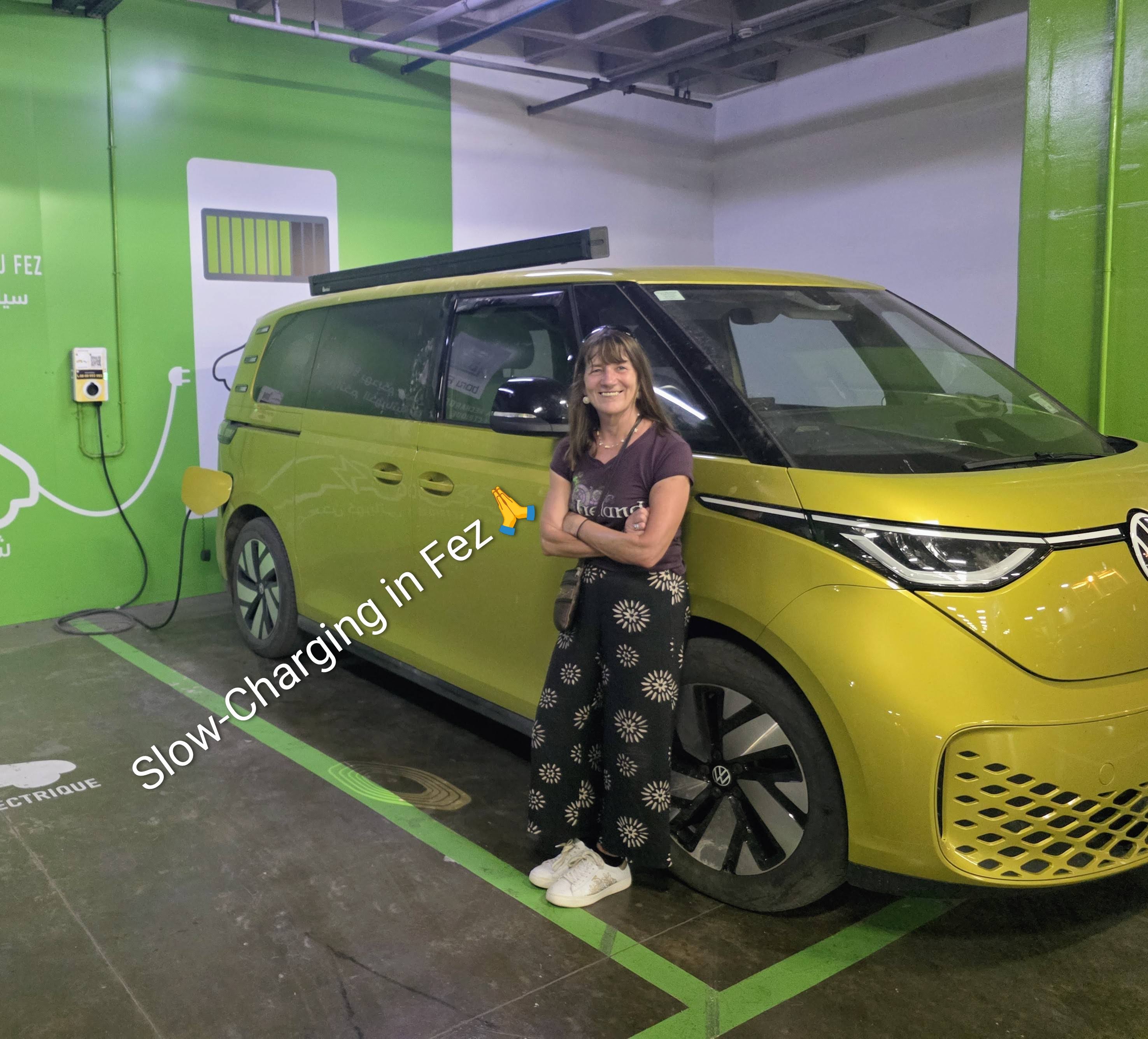
Our next and only option for charging the van in Fes, according to various maps, (Google, Electromaps, Kilowatt and Place to Plug) was a couple of kilometers away at a shopping centre. We located them in the underground carpark of a Carrefour Mall and, thankfully, they worked although they were again slow-chargers and free of charge. When we connected, the Buzz display told us that it would be over five hours before it was 100% charged. We booked a place to stay near the medina and walked the forty minutes there, deciding to return later for the van. Our tolerance for shopping malls, full of the usual designer shops and stuff we don’t need, was always low, but was now hovering below zero although we were grateful that the Buzz was charging.
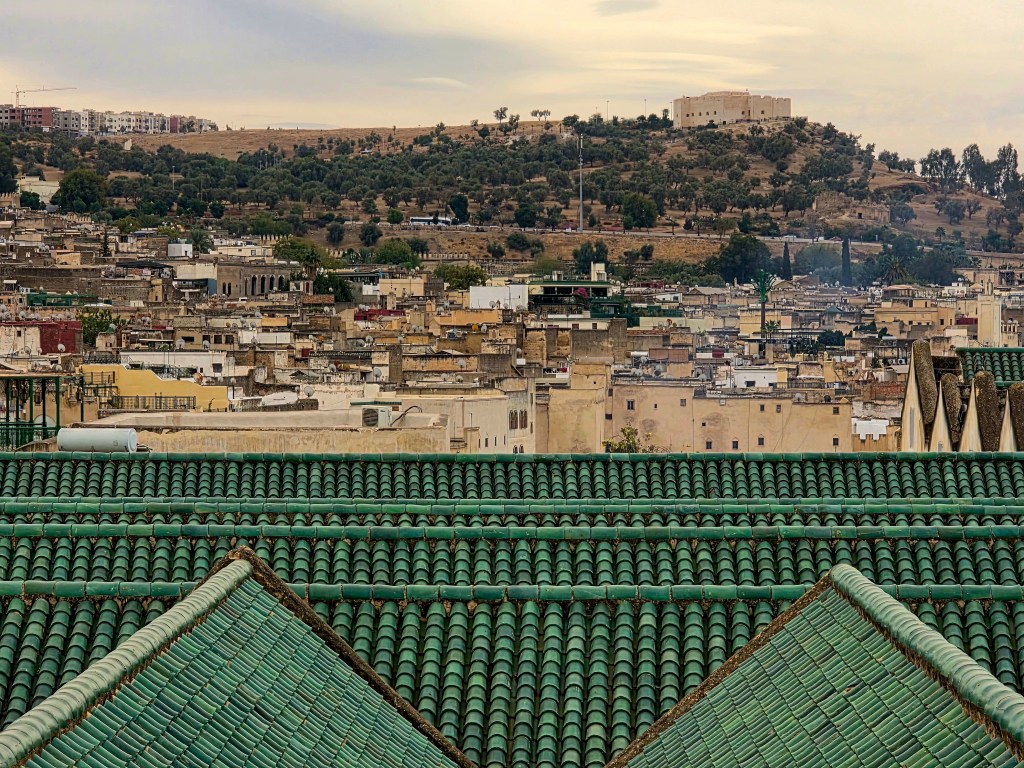
Fez, the oldest of the four Moroccan Imperial cities, was blessed with an abundance of water and surrounded by fertile hills which also supplied  defense.  It was an important trading post for centuries, strategically placed at the crossroads of major caravan routes (silk, gold, salt and slaves) between sub-Saharan Africa and the Mediterranean. Its wealth also came from its rich natural resources and skilled artisans.

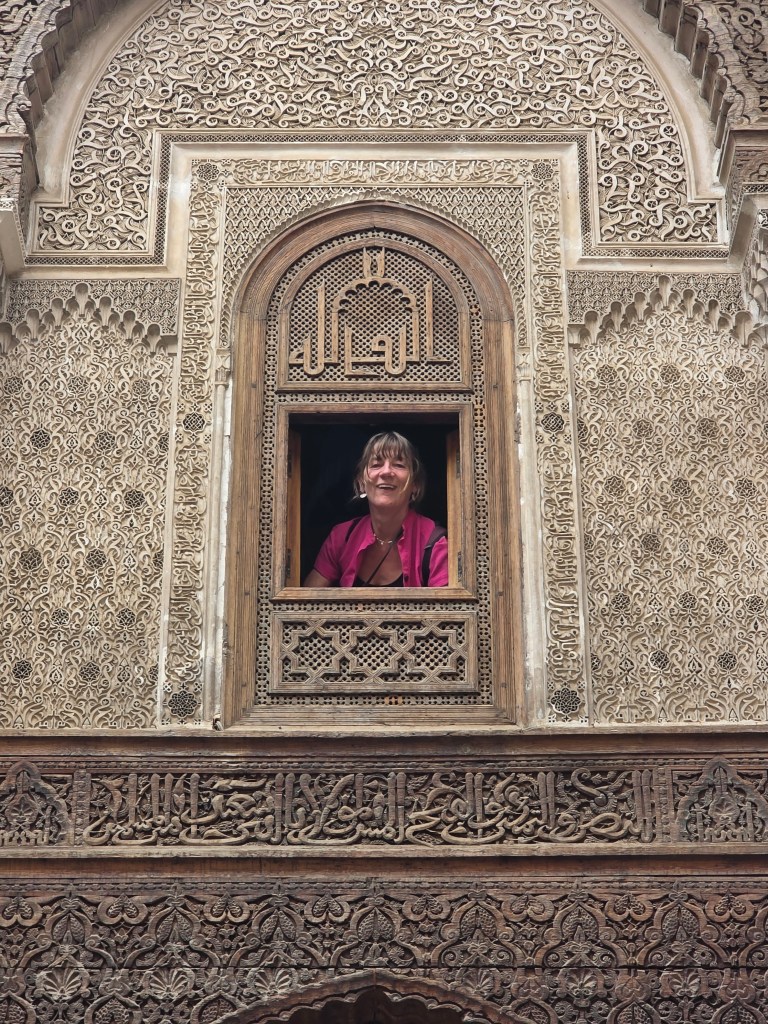
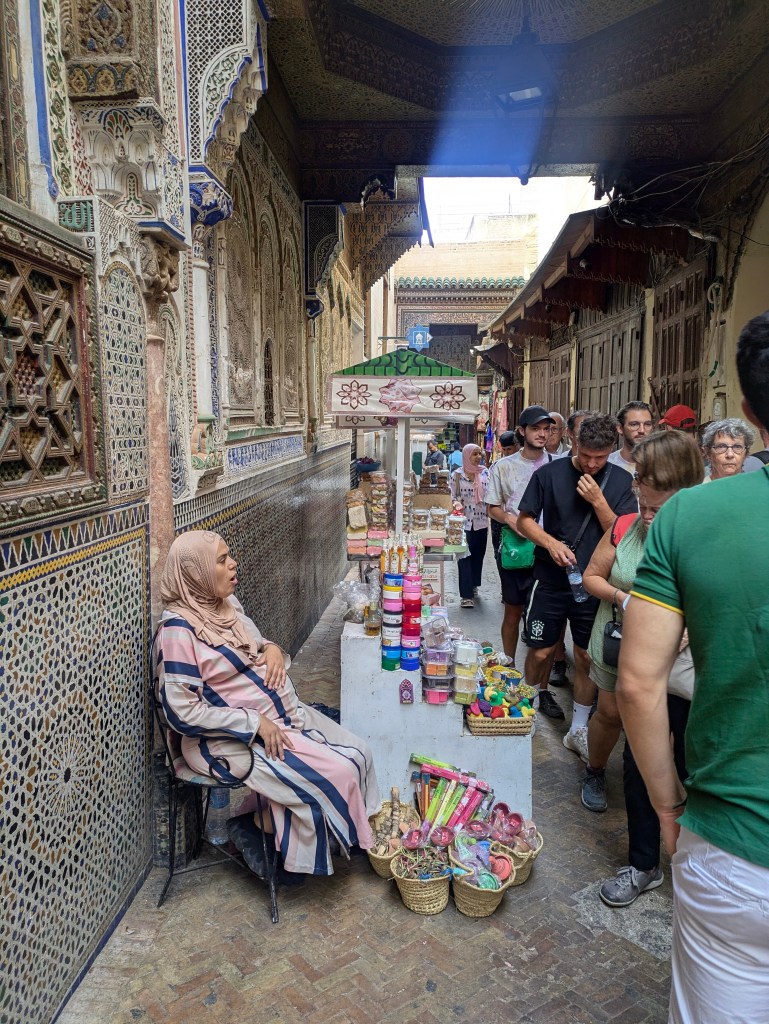
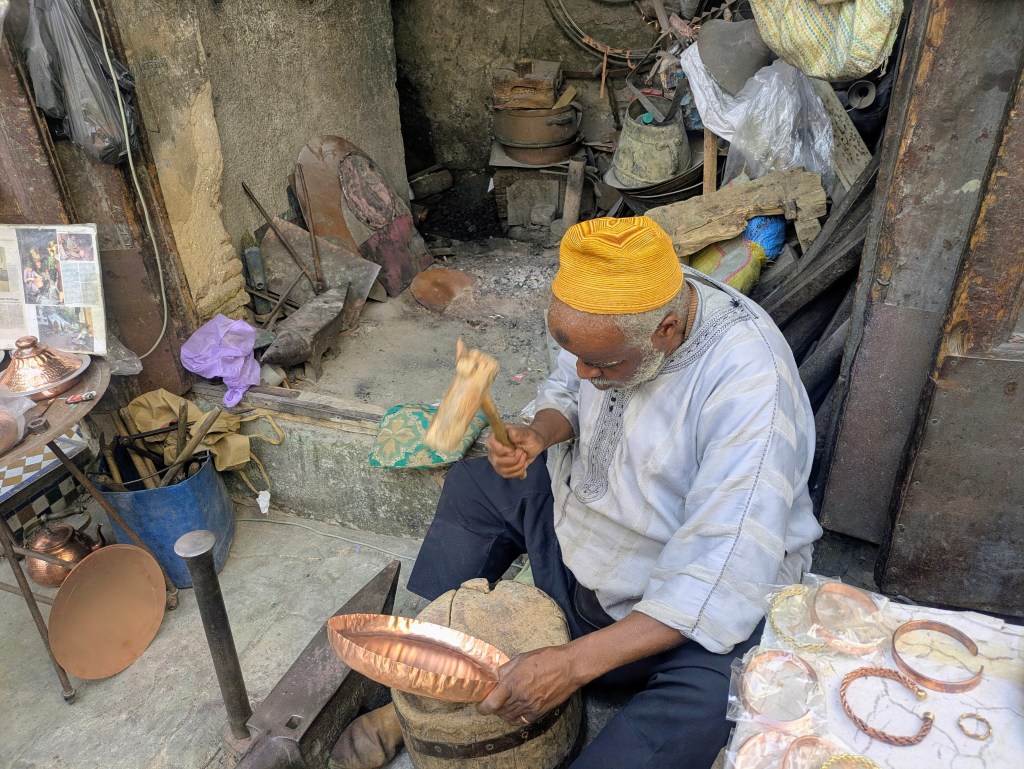
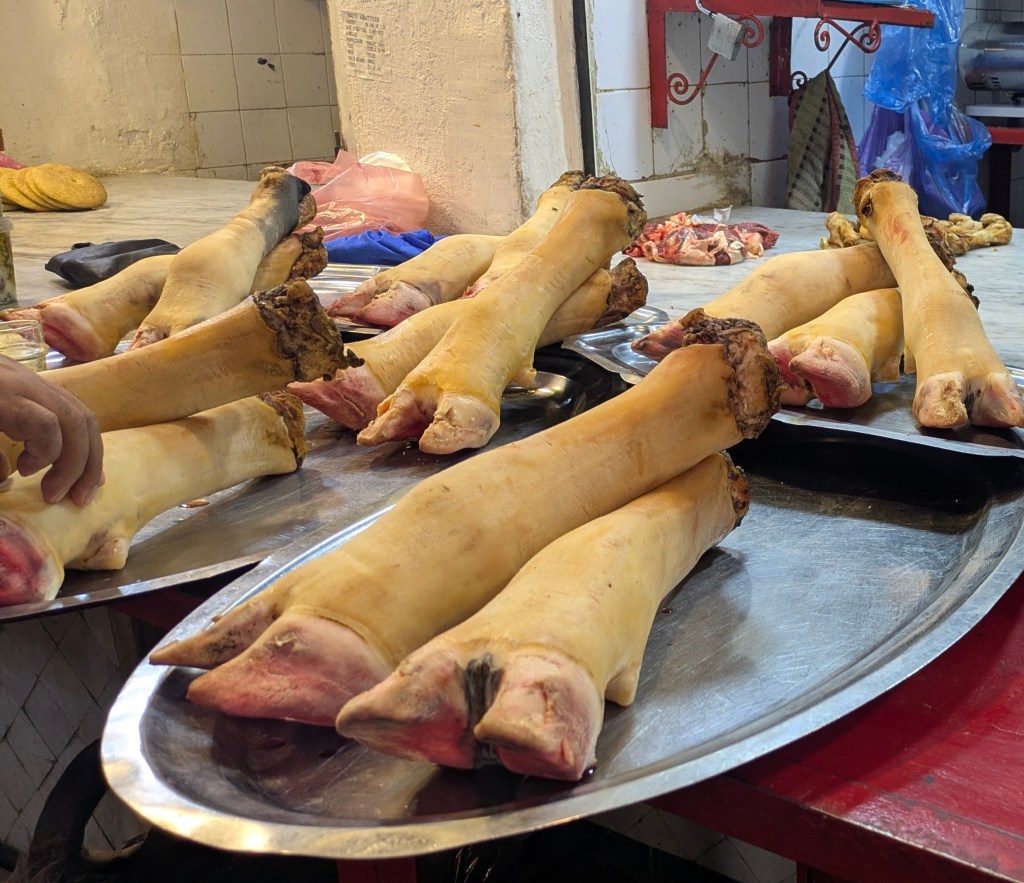
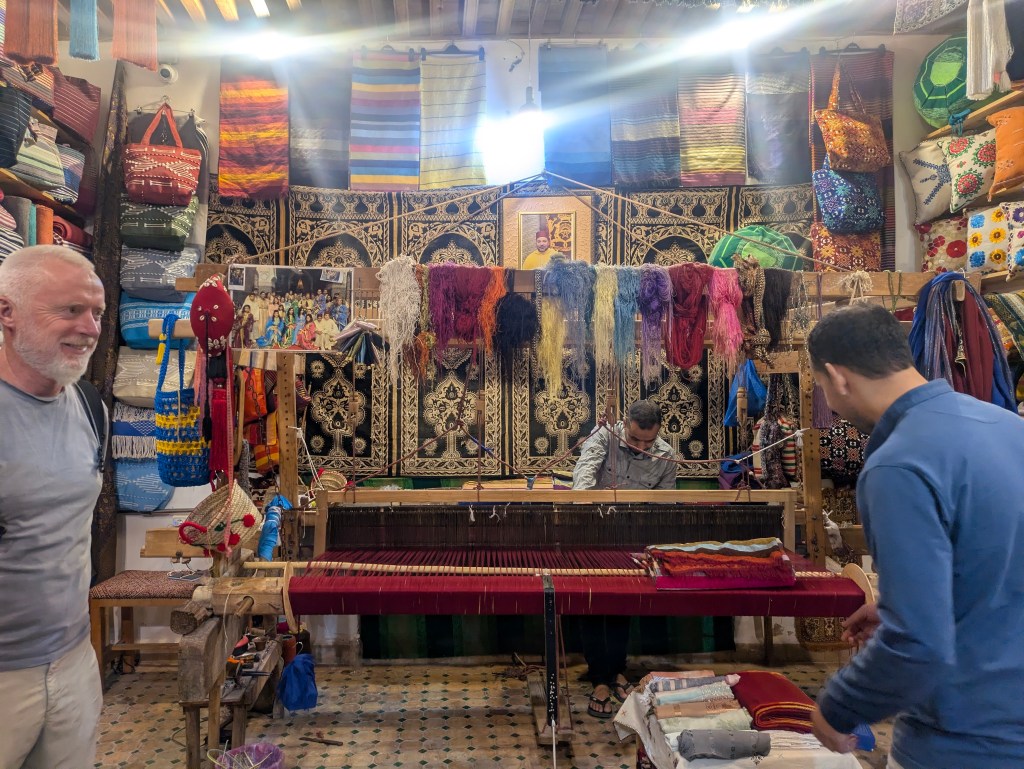
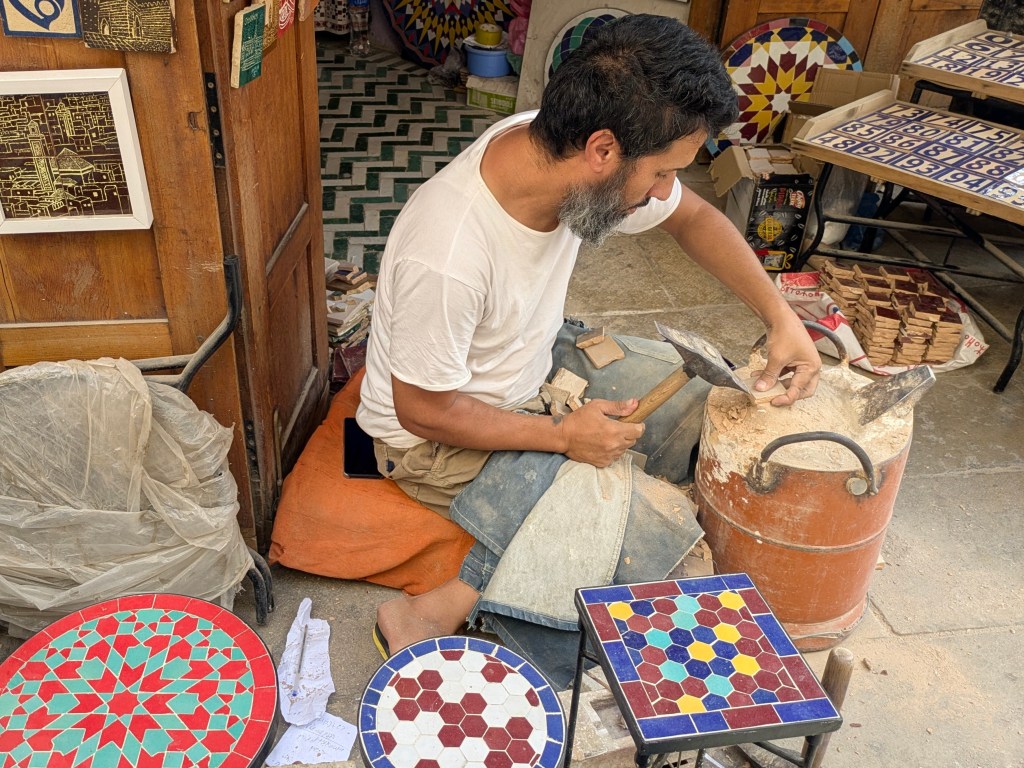
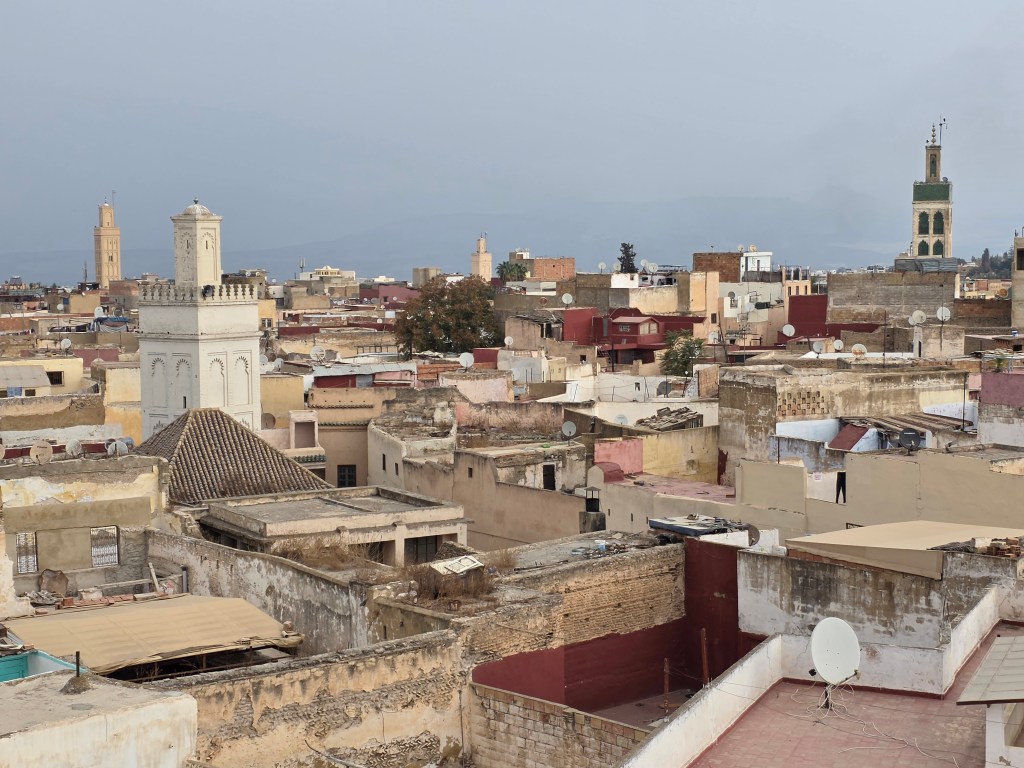
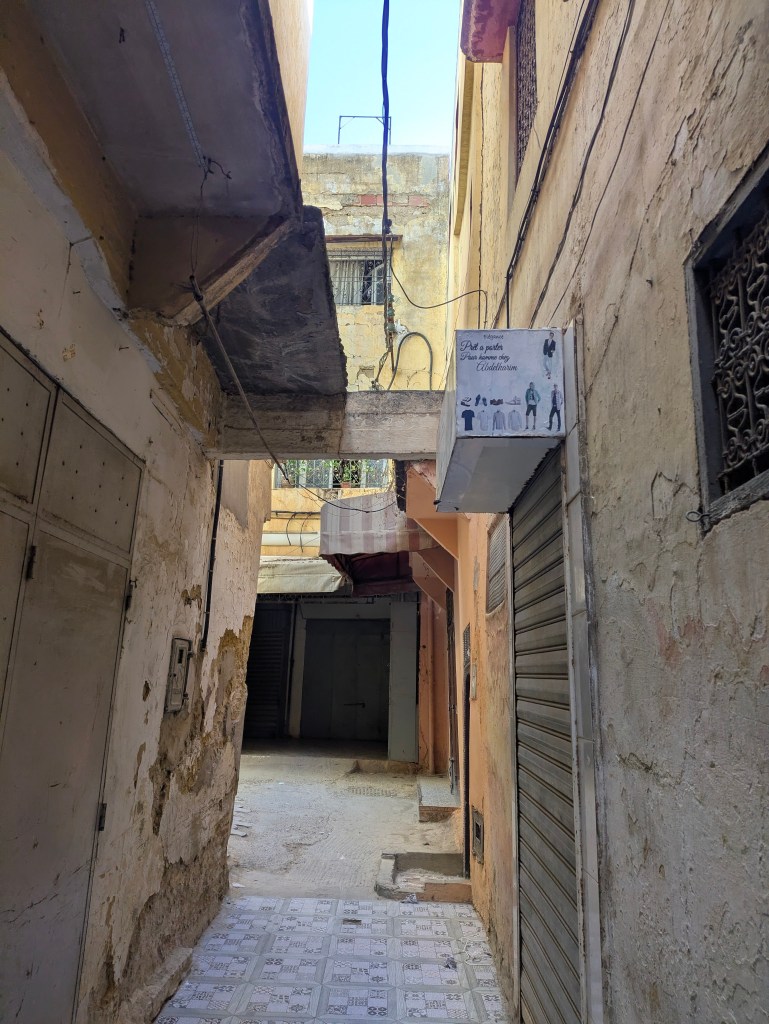
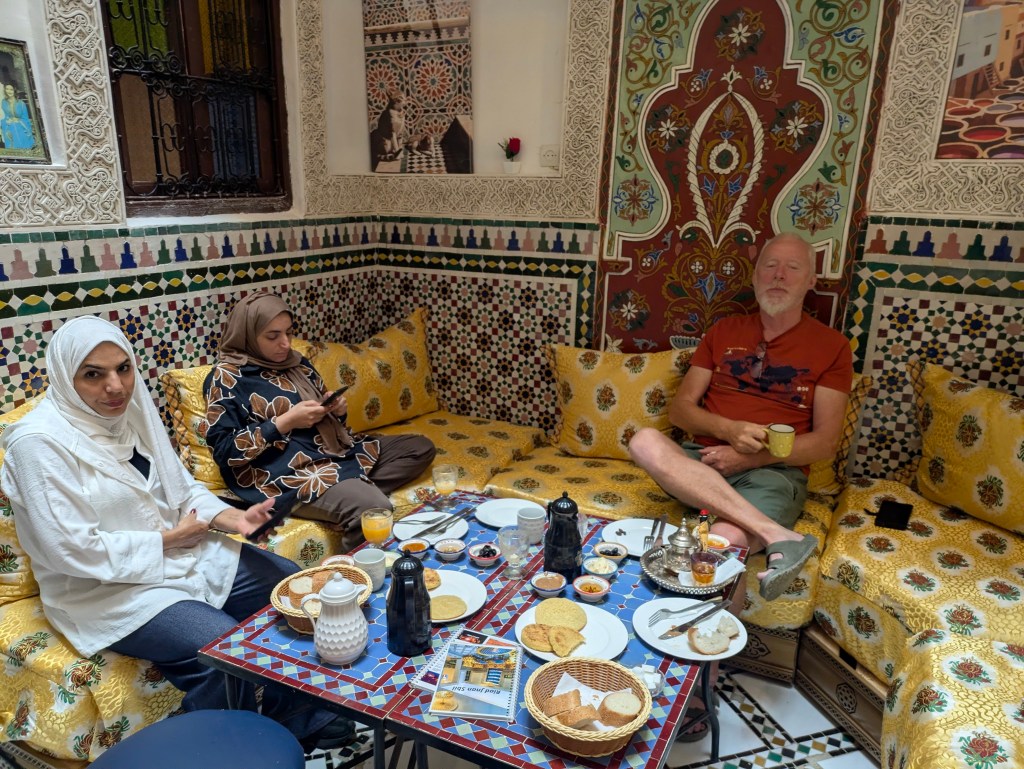
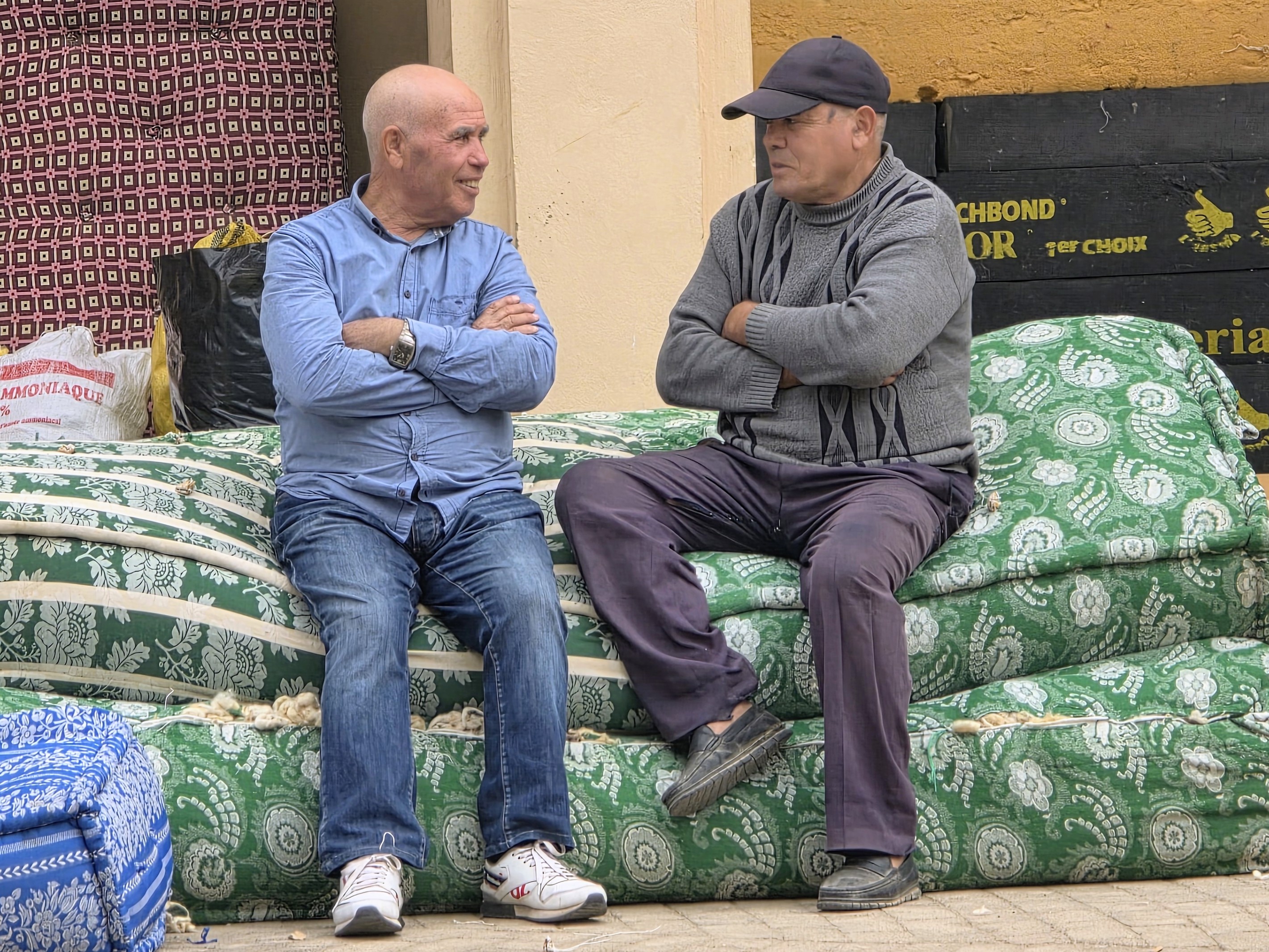
The following morning, wandering around the narrow streets of the medina on a walking tour, it seemed that little had changed. There was the clamor of commence and the rumble of wooden carts being pushed along the narrow ‘streets’, a maze of over nine thousand paths where Google maps didn’t work very well and which was reputed to be the largest pedestrianized area in the world. There was the banging of hammers on metal, the soft whoosh of looms, the silent concentration of calligraphy, the slosh of dyeing fabrics and much more. The scent of rosewater and orange blossom mixed with the smell of raw meat, fish, spices and fresh baking. In many ways, it was like stepping back in time, we ate warm flatbreads directly from the ovens in a family bakery, tasted honey cakes from an old recipe and visited the tannery at the edge of the medina.
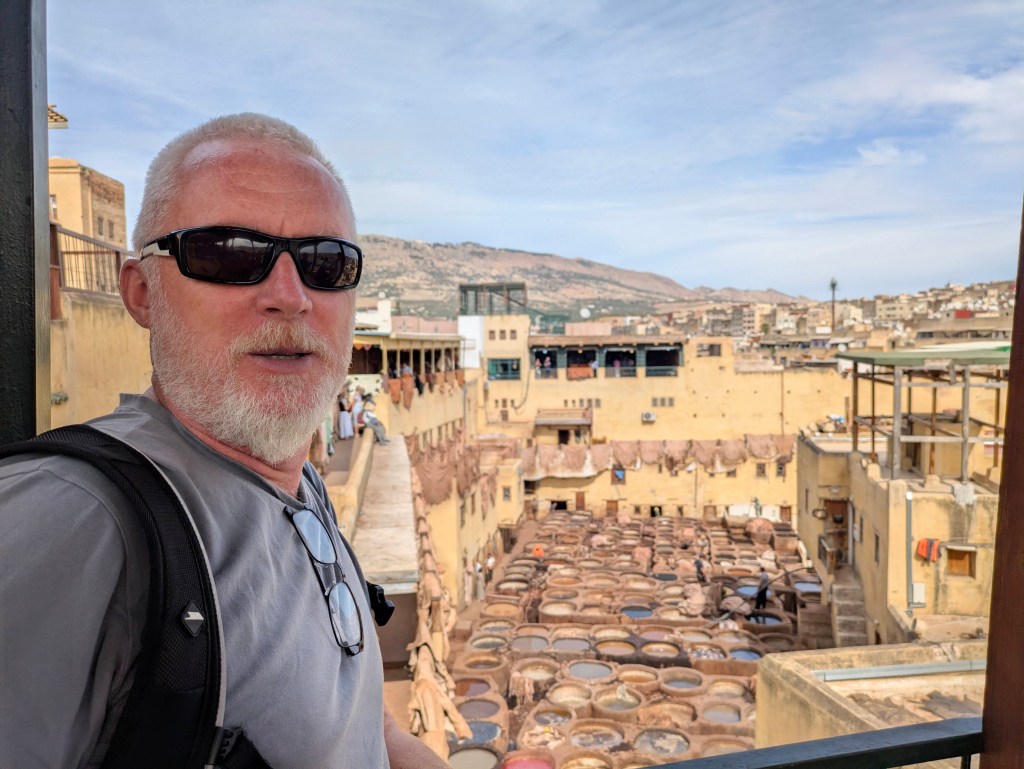
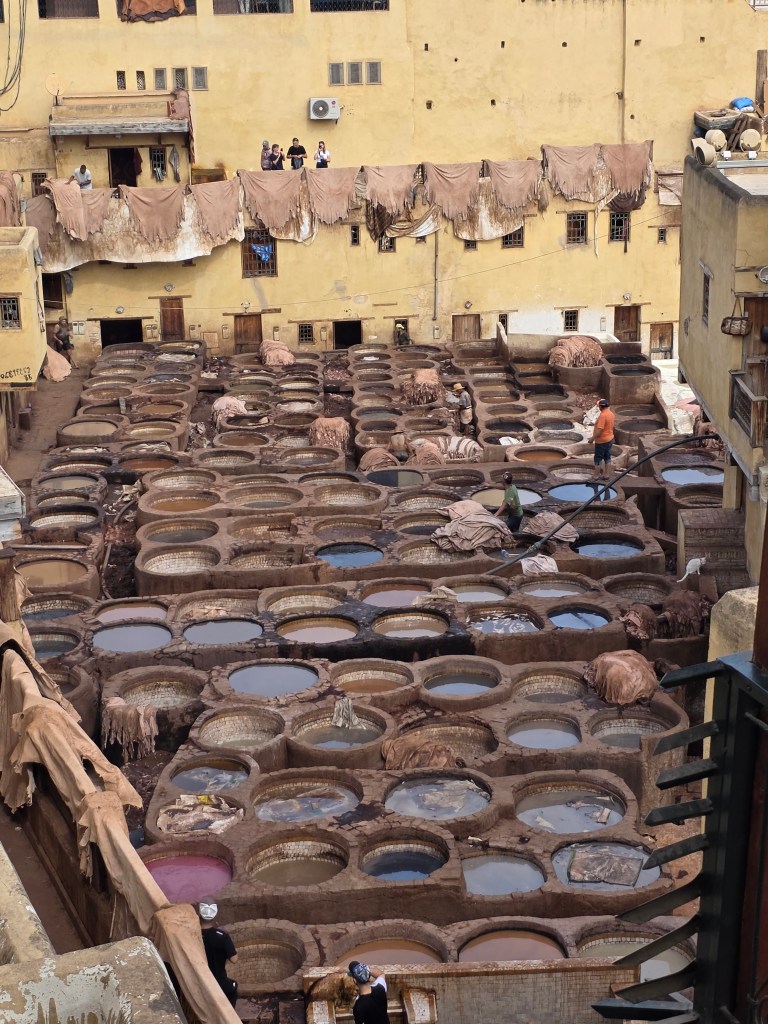
            At the door leading into the tannery, a small man with a face like wrinkled leather pressed a few mint leaves into my palm and gestured that I should hold it to my nose. It didn’t help much. A whole mint bush wouldn’t have disguised the pervasive pungent smell that hung in the air, the smell of blood and chemicals although the tanning was done using old natural methods, many unchanged for a thousand years. The ammonia needed in the process was supplied by pigeon poop, gathered from the town’s buildings and from pigeon fanciers and the red dye came from pomegranate seeds. The recently eaten honey cakes were leaping into my throat as we looked down at a ‘clothes line’ of drying skins, a mixture of goat, cow and camel  and the much-photographed ‘honeycomb’ vats of coloured liquid used in the dying process. A worker at a tap tried to wash dye from his bare legs, stained a deep burgundy from immersion in one of the vats. The work was intense, the noise unrelenting, the conditions brutal… no wonder the number of workers had dropped dramatically during the last decades. In the heat of summer, the conditions would be even more hellish. The idea of buying a leather bag lost its appeal.
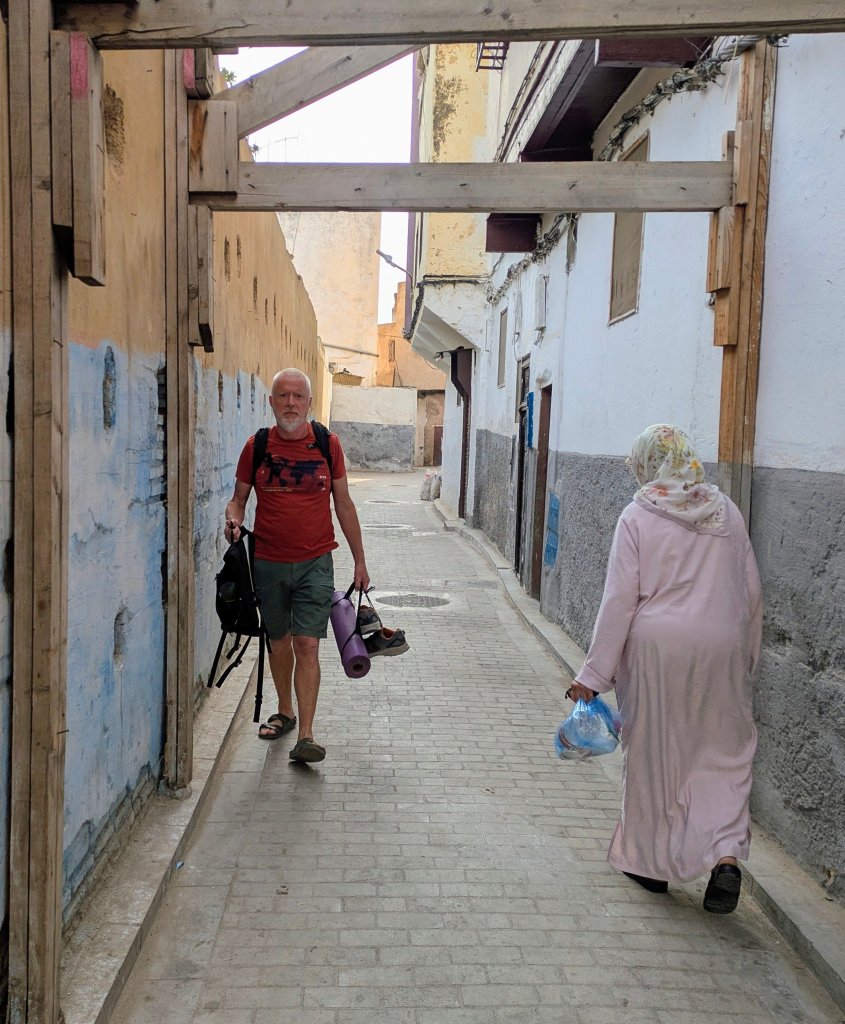
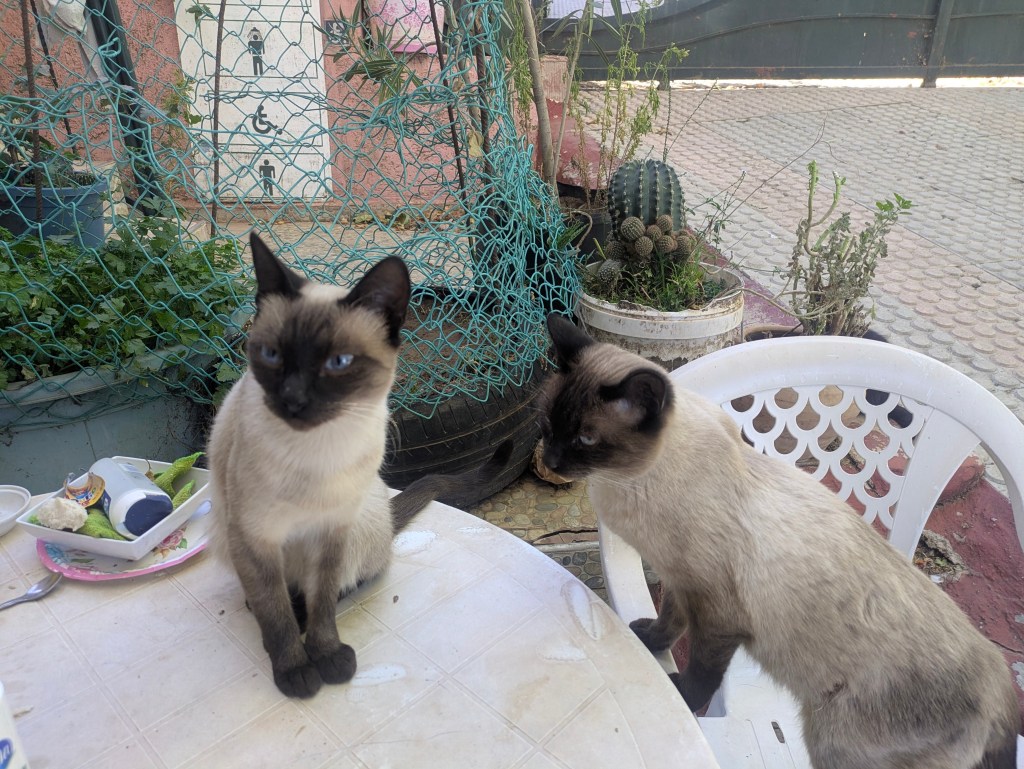
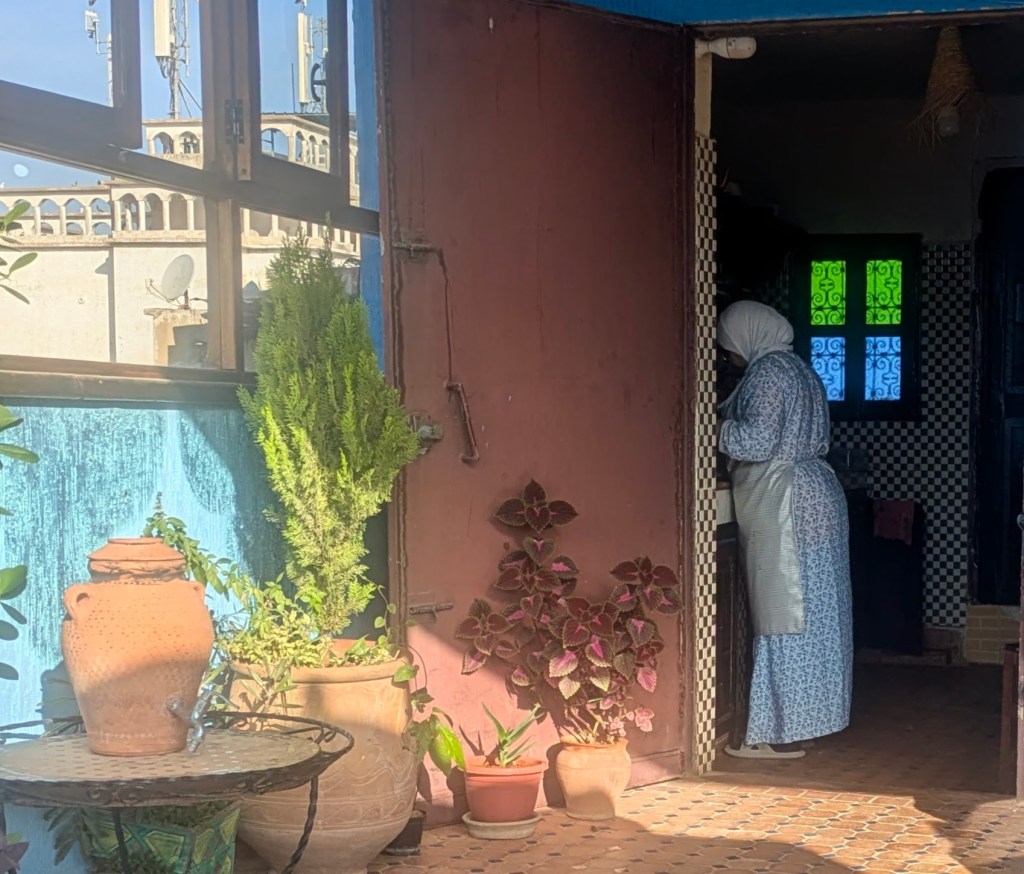
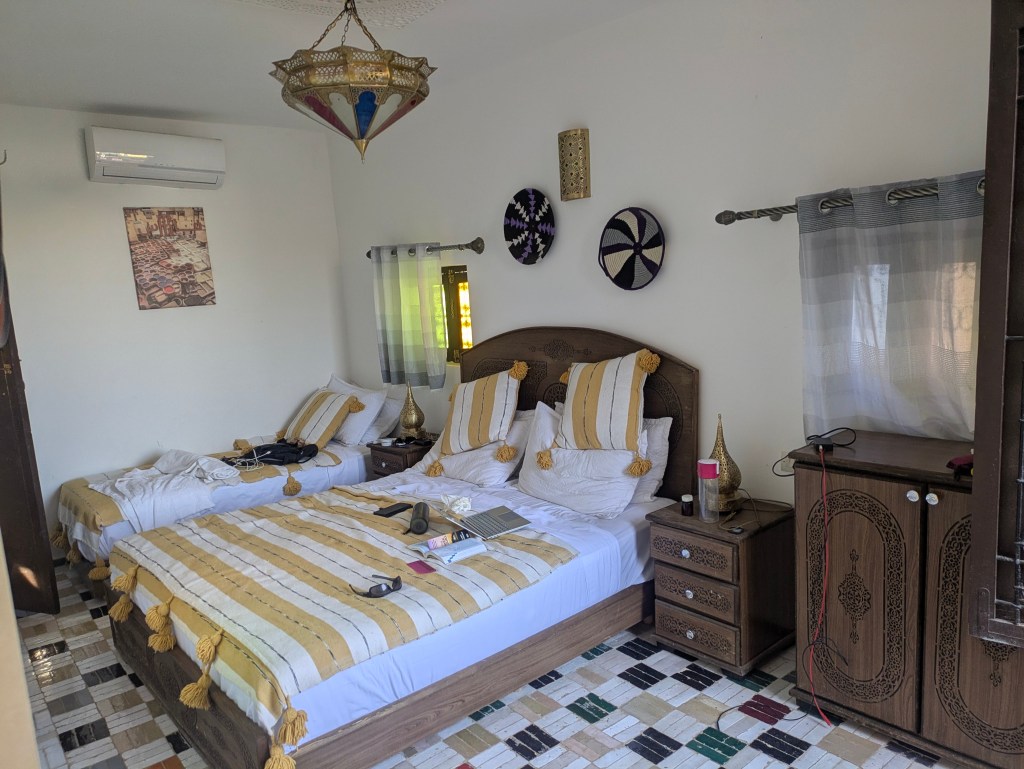
Although our accommodation in Fes was in a narrow laneway, outside the medina, it was an area full of life with playing children, barking dogs and  the usual slinking cats, a guy fixed a motorbike puncture in a narrow doorway, another was welding without a mask in a tiny workshop. People lived in very close proximity with their neighbors, the shabby closed doors giving no indication of the beauty inside many of the houses….not everyone here was poor despite external appearances. Washing was always billowing on the flat rooftops, the day punctuated by the call to prayer from the mosques.
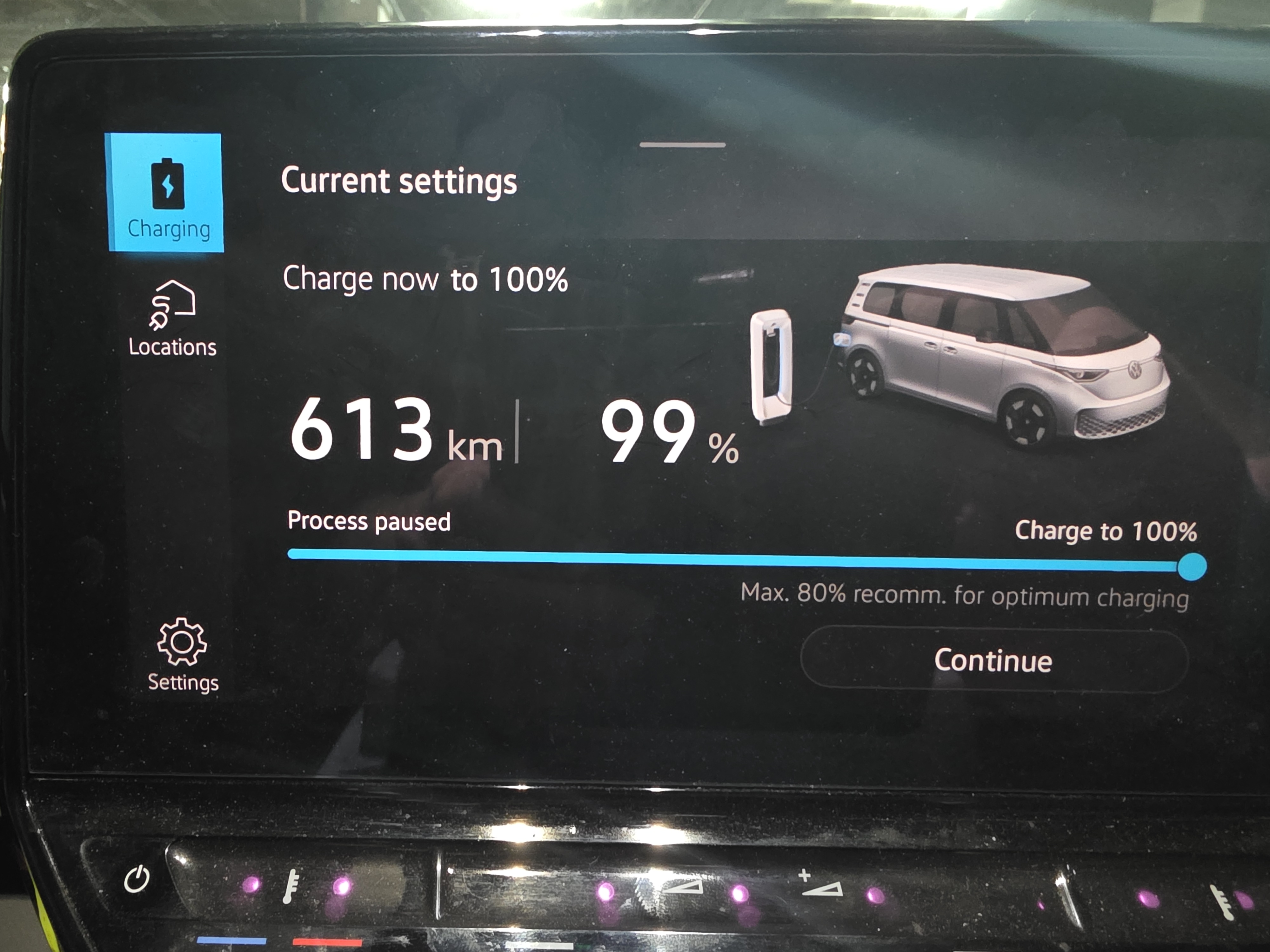
We left Fez with the Buzz 100% charged, thanks to the free (but slowish) charging in Carrefour Shopping Mall. Our kilometer range had reached a new ‘high’ of over 600kms, a consequence of our very ‘conservative driving style.’ At home, a full charge usually gives a range of about 450kms.  Of course, fuel consumption in a diesel/petrol car also has direct correlation with how the car is driven but it isn’t as apparent…or as critical when you have numerous options for filling the tank.
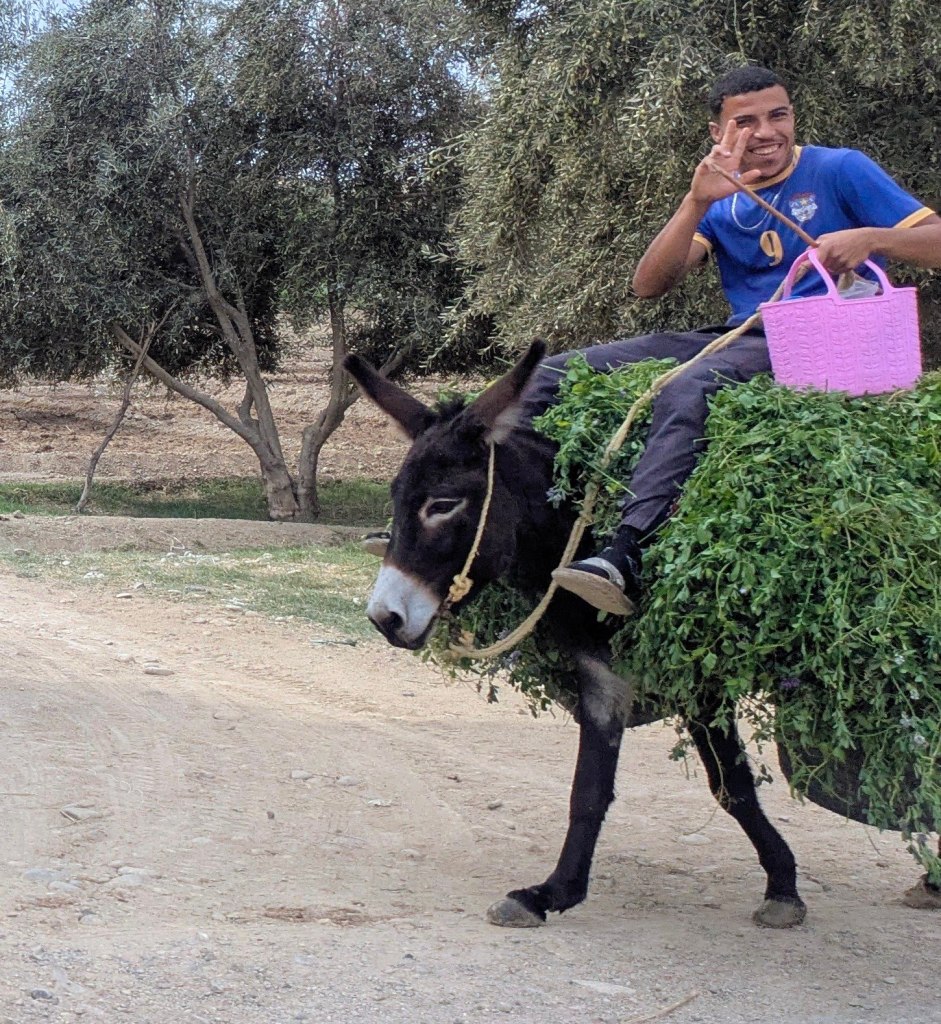
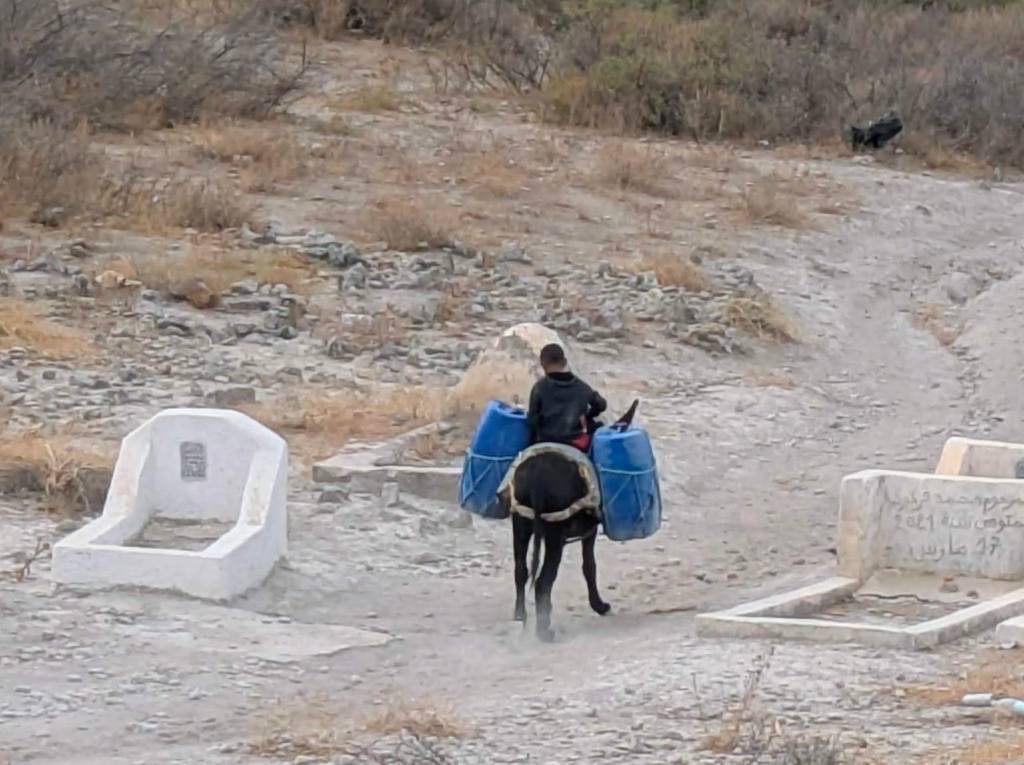
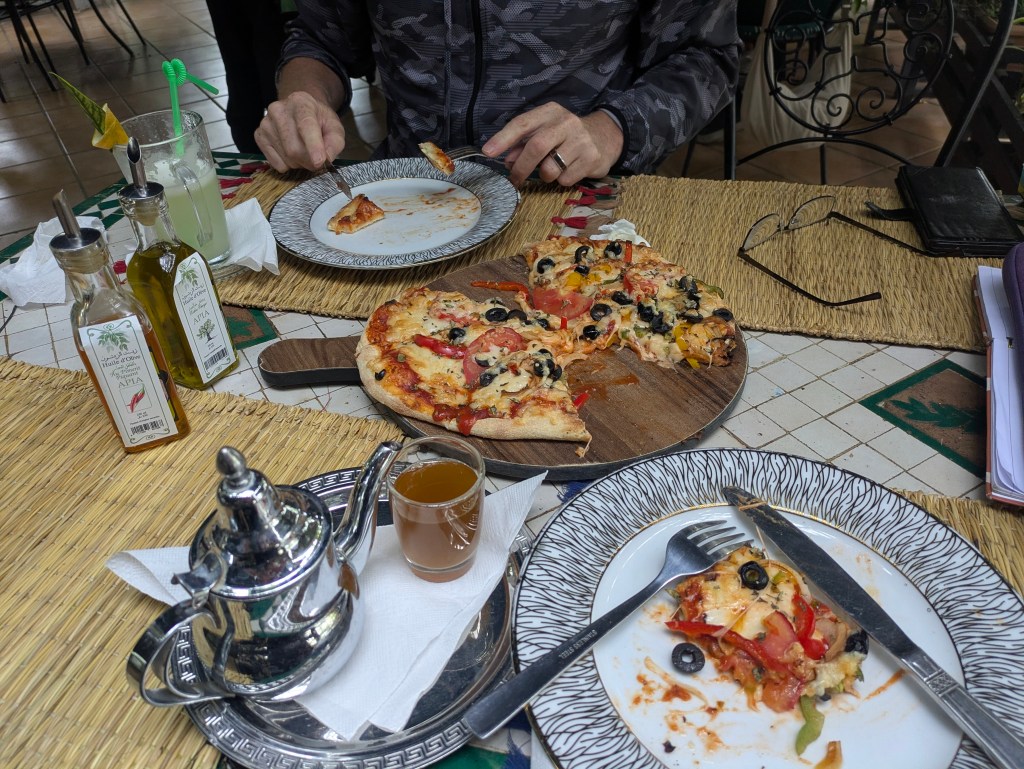
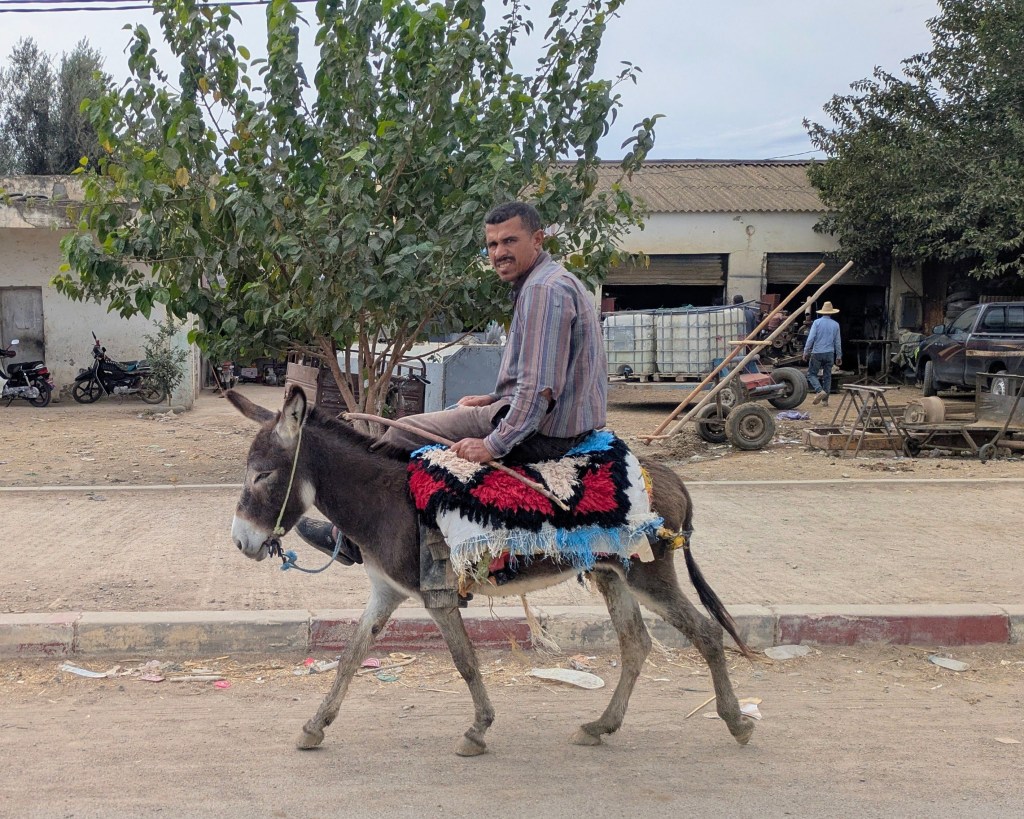
 Our next stop was Chefchaouen, supposed to be the ‘prettiest town’ in all of Morocco, a little under 200 kms north and about three and half hours away (depending on driving style).  Leaving the fertile plains of Fes, the land got drier and dustier, children waved to us as we passed. At this stage, we had seen so many donkeys that we (almost) no longer reached for our camera. Our maps told us that there was a restaurant with an EV charger about two hours into our journey so we decided to stop there, with no real expectation that the charger would exist or that it would work but, for a change, this was a good charging story. While we were eating delicious pizza with mint tea, (is that Moroccan-Italian fusion?), the Buzz charged to 100% for free.
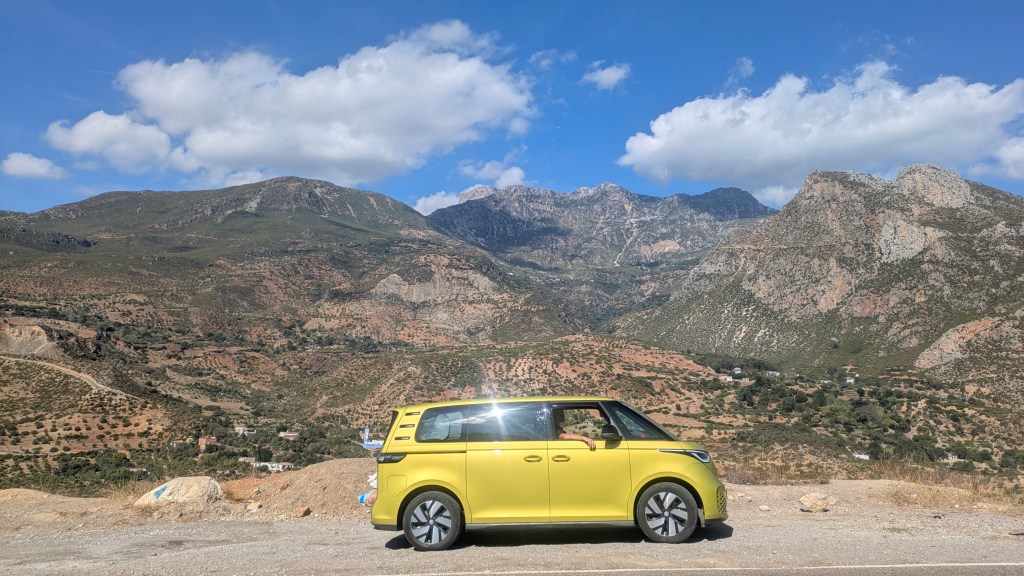
The terrain became greener as we continued on our journey and the temperature dropped from 26C in Fez to  about15C.  Ominous clouds scudded across a darkening of sky as we headed towards the Rif Mountains. By the time we reached our campsite in the hills above Chefchaouen, the wipers were working at full tilt and the gulleys at the side of the road were overflowing with brown sludgy water. A gusty wind blew the rain sideways but we were thankful that we were sleeping in the van. The canvas on several tents belonging to an Africa Overland Tour were bulging with water in the early evening The tour was only on Day 3 of a forty-five week trip down the west coast of Africa and up the east coast, finishing in Cairo. The biggest surprise was the age profile of participants. Many were in the fifties and quite a few looked a couple of decades older.

It rained all night. The wind blew off our awning, sent it sailing over the van but at least it didn’t collide with a person, tent or camper. The morning was grey and drizzly, the sodden Africa Overlanders, still in good spirits, were up and gone before 8am but many claimed they hadn’t slept at all.

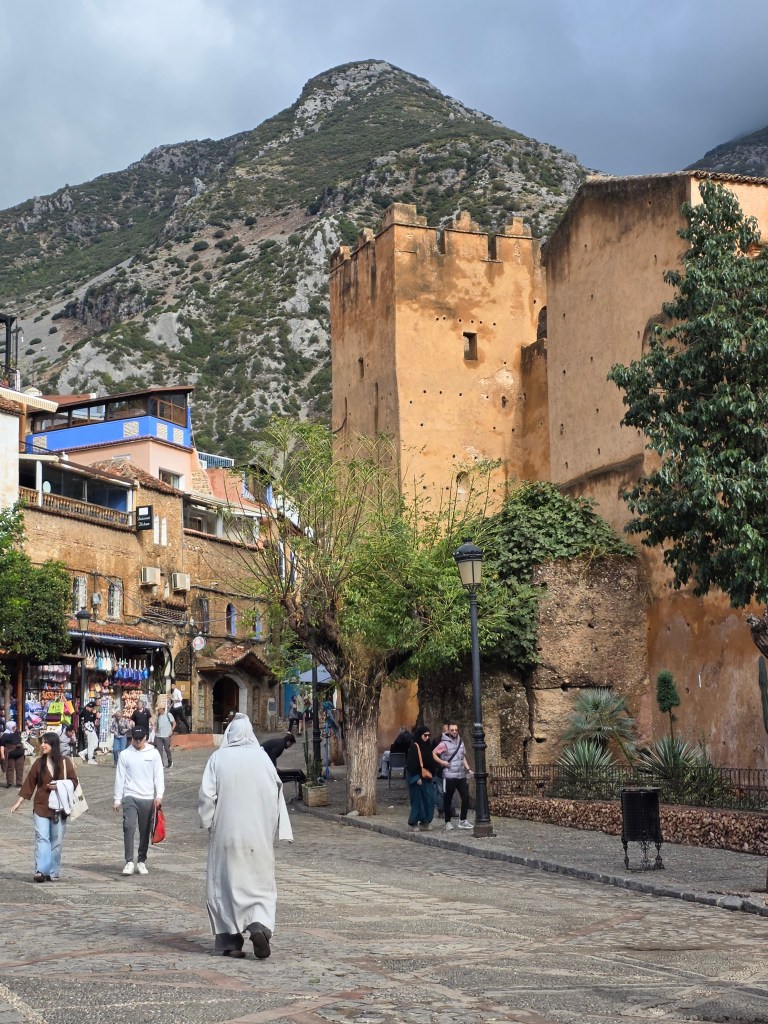
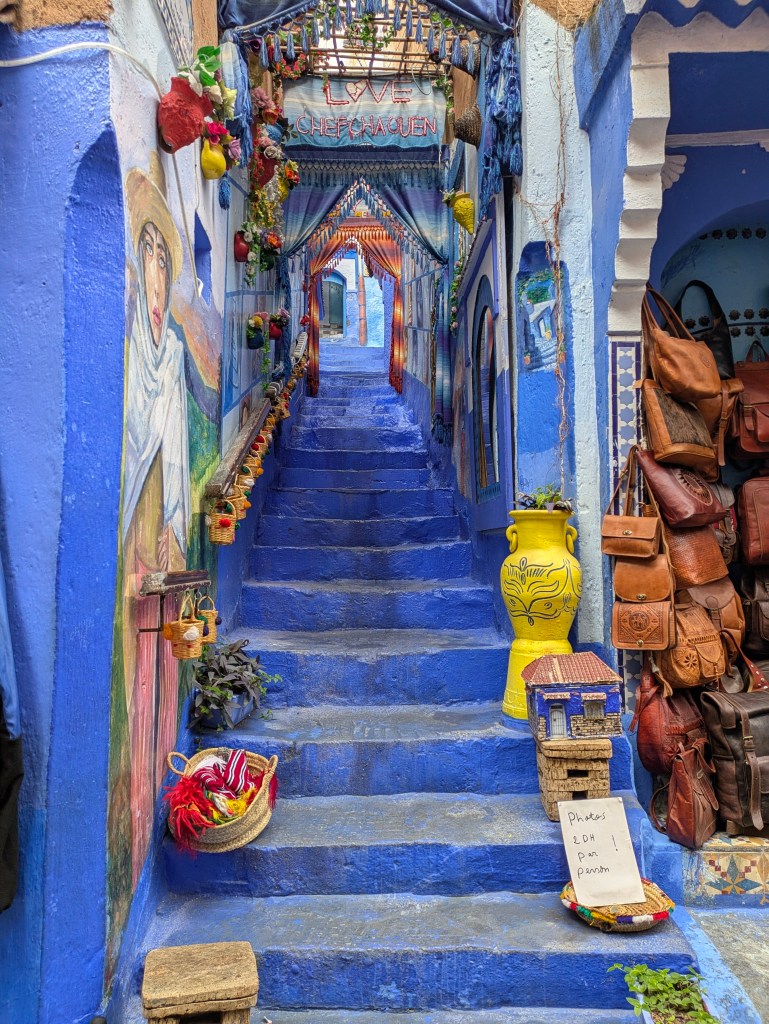
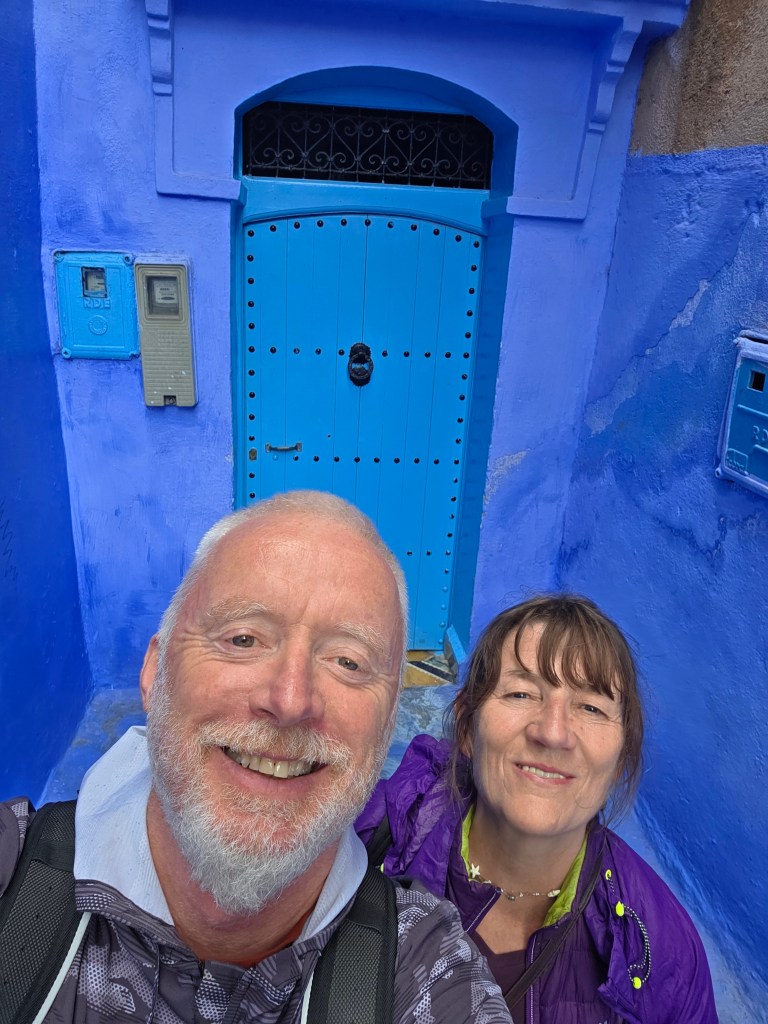
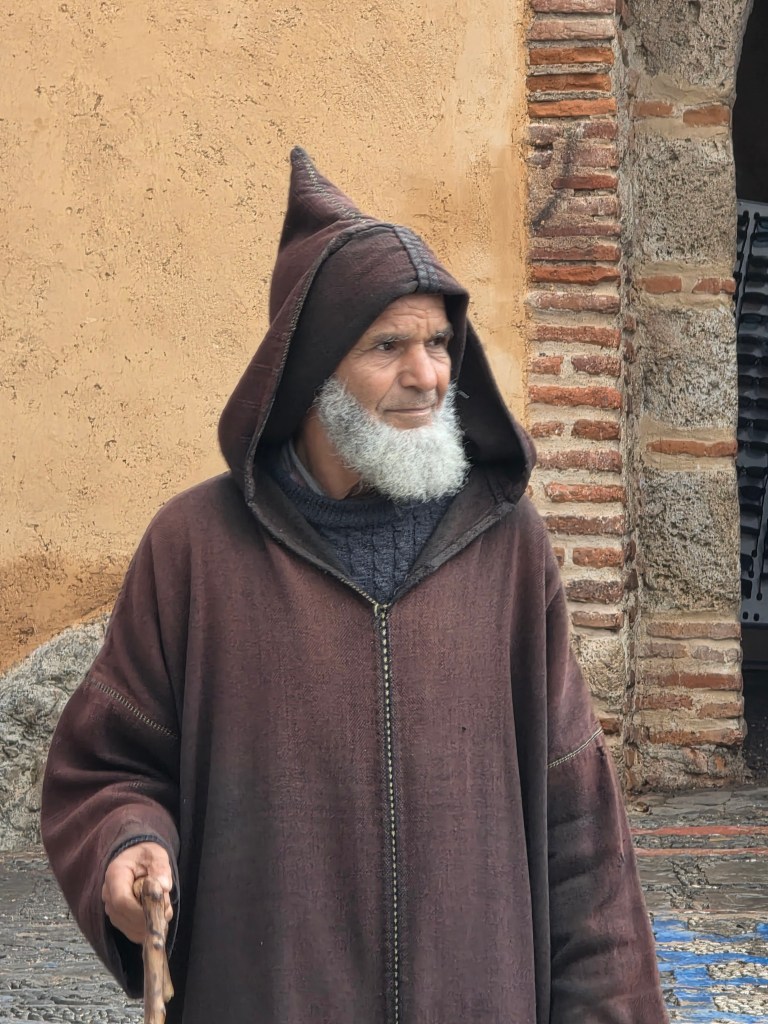
Chefchaouen, famous for its narrow streets with facades painted in different shades of blue, was not looking it’s best under the grey skies.  Men walked around with the pointed hoods of their djellabas (long tunics) covering their heads, giving them an old medieval monkish look.  Nobody was entirely sure why the town was painted blue but there were several theories.  Some said that the colour blue symbolised the sky and spirituality, that it came from the Sephardic Jews who settled here in the 15th century, others said that blue was a good insect repellent. Whatever the reason, the result is stunning and Instagram-able and a tourist magnet. Thankfully, the skies cleared for us and the temperature rose…..just as we were beginning to think we had been hasty in leaving the heat of the desert.
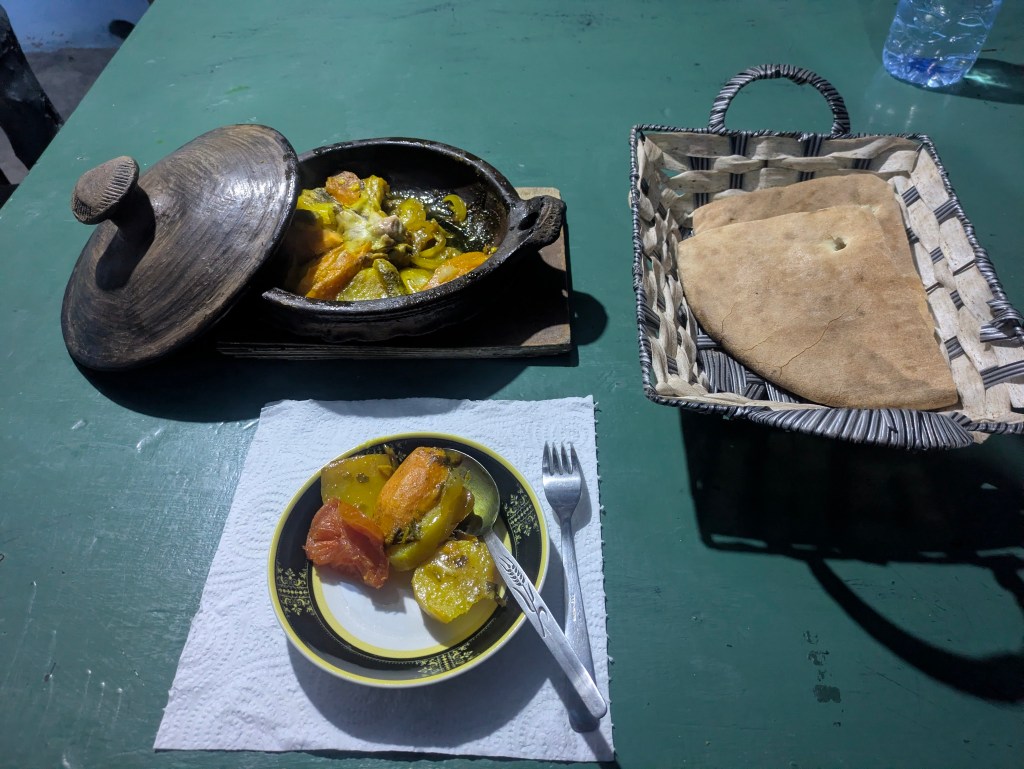
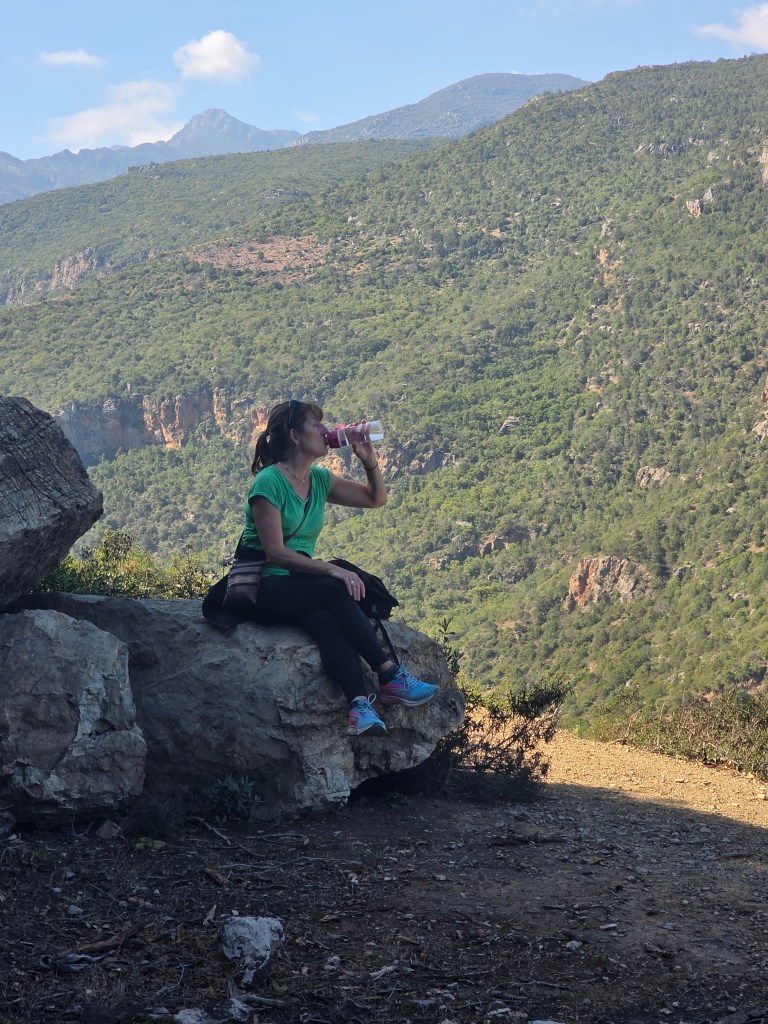
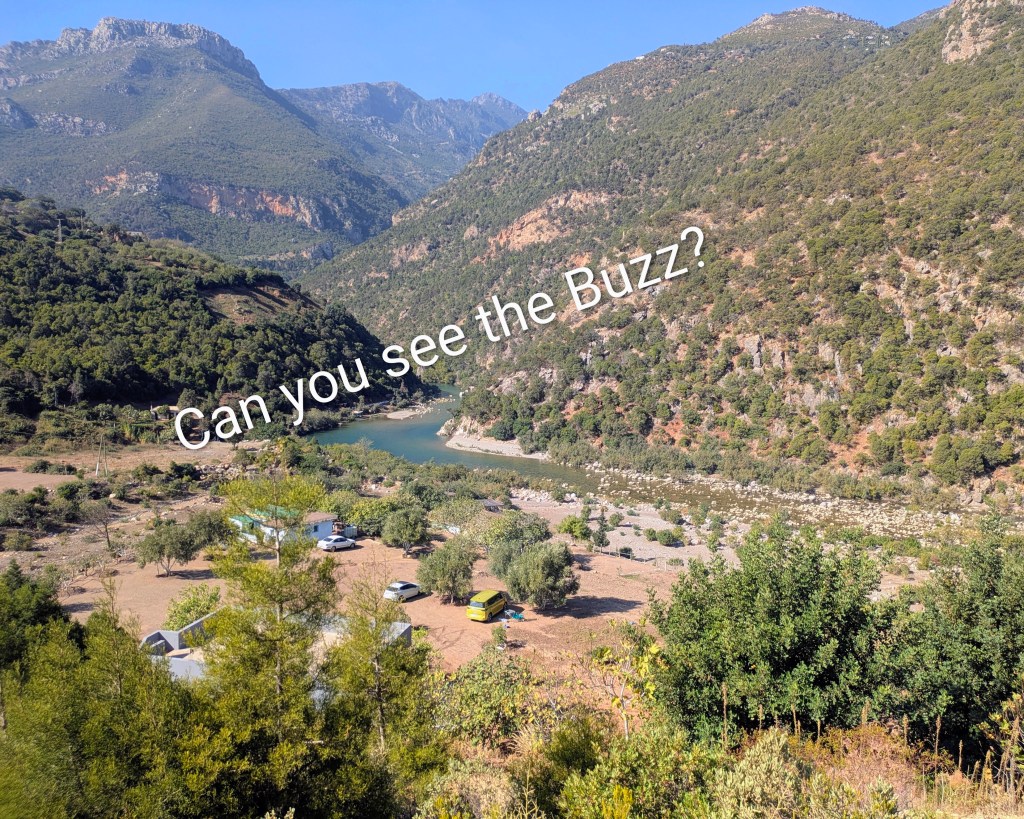
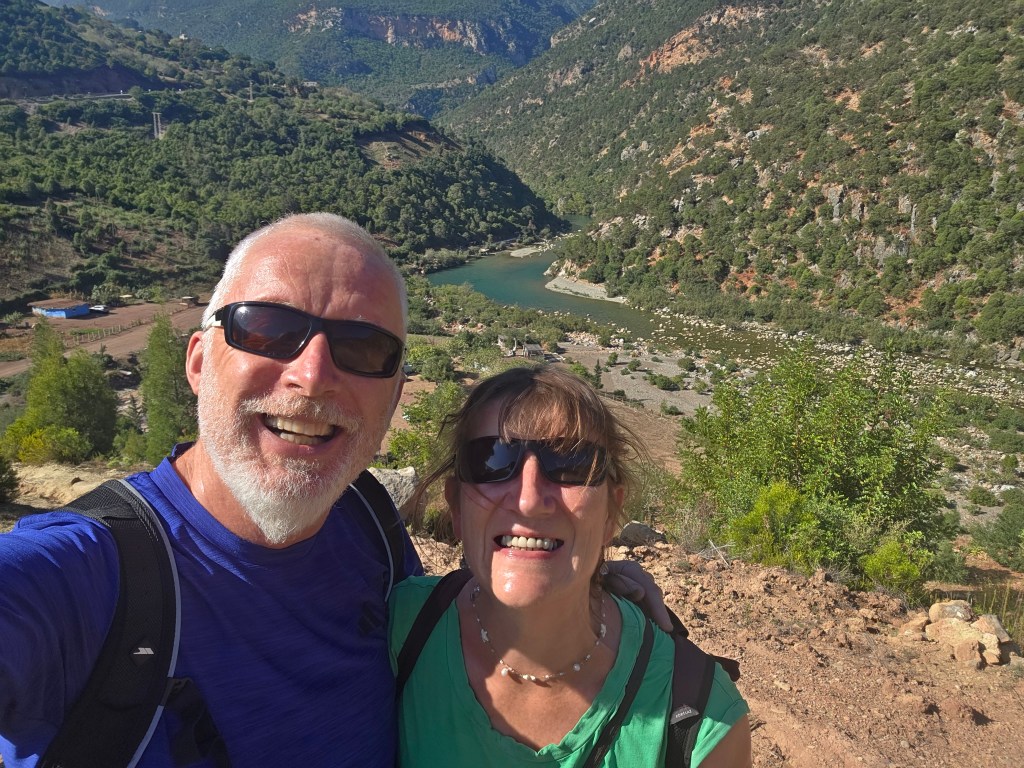
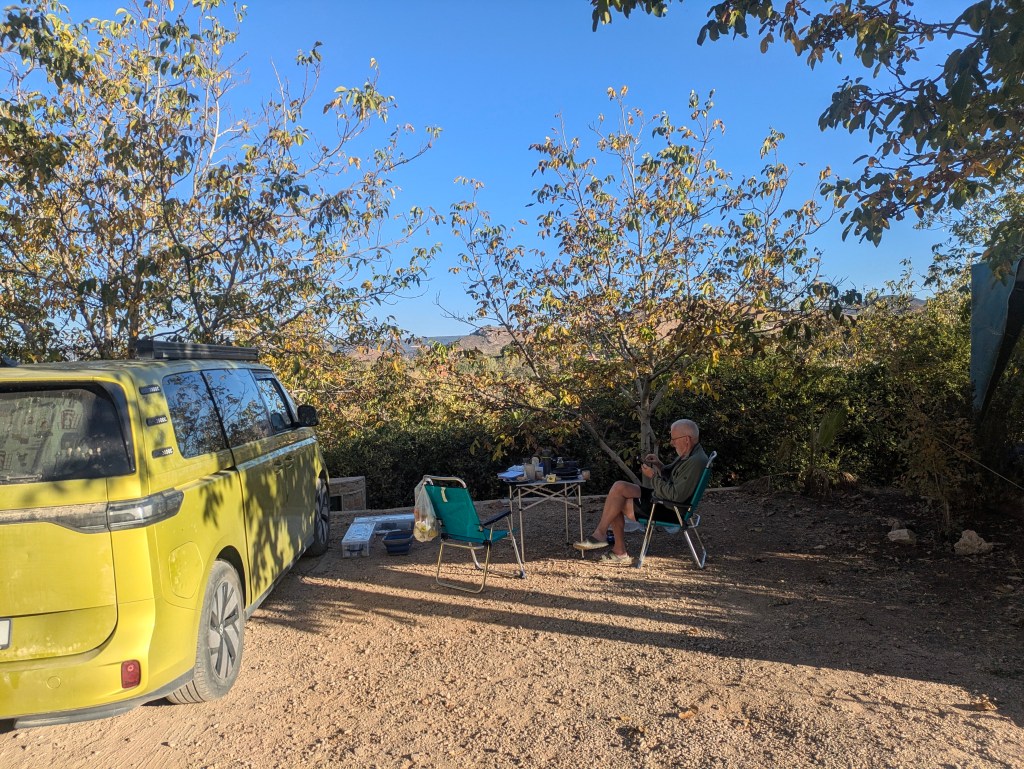
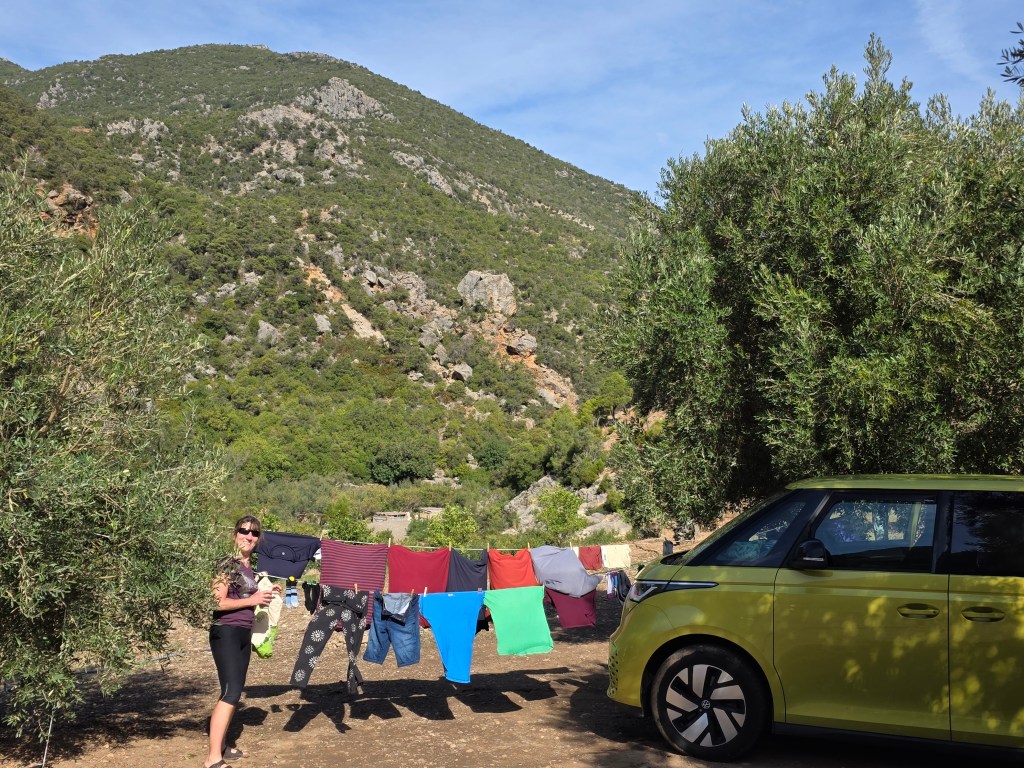
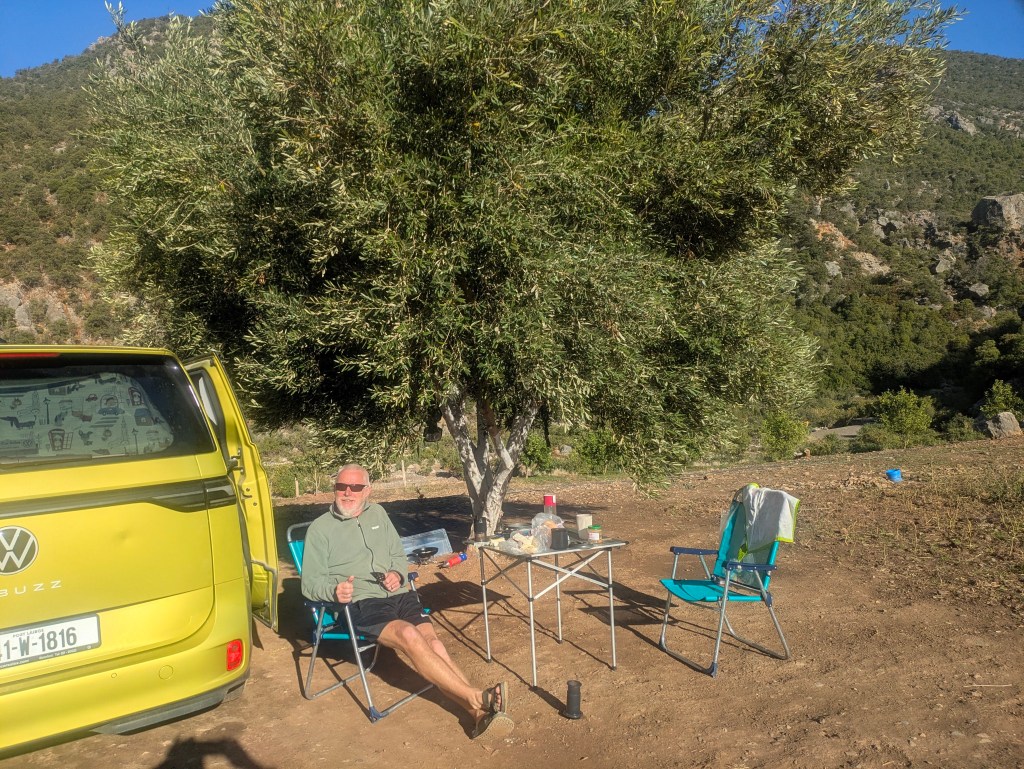
 I’m writing this under an olive tree, the sunlight turning the white bark silver. Theres the babble of a small river, a soft wind in the bushes and the bleating of a few goats. We came here after Chefchaouen. The days are warm, perfect for hikes, the nights and early morning are cool (about 10C, perfect for sleeping.  This little unpretentious campsite in the Rif mountains is a slice of heaven, run by a lovely family who bake bread in an outside oven and make the tastiest tagines we have eaten. We might never leave.
Thanks for reading,

‘Till next time..
Electric Roadtrip: Blue Days in Morocco

Electric Roadtrip: The Charging Saga

Leaving our camping cocoon in Tangier was hard but it had to be done. Waving goodbye to Said, the manager, we headed off in search of EV chargers, making a minor detour to Carrefour Supermarket (Socco Alto branch) to stock up on a few beers and a bottle of wine. Alcohol is not widely available in Morocco, but you can find it…. if you know where to look or have inside information from a walking tour guide.  It’s relatively expensive, especially compared to Spain.
We stop at a fuel station which has Fast Volt Chargers, which again look well maintained. Caoimhin had contacted the company for help about our inability to download the app (essential for charging as there was no option to pay directly using a bank card) but we were still unable to download it despite following their instructions of using a VPN and selecting France.

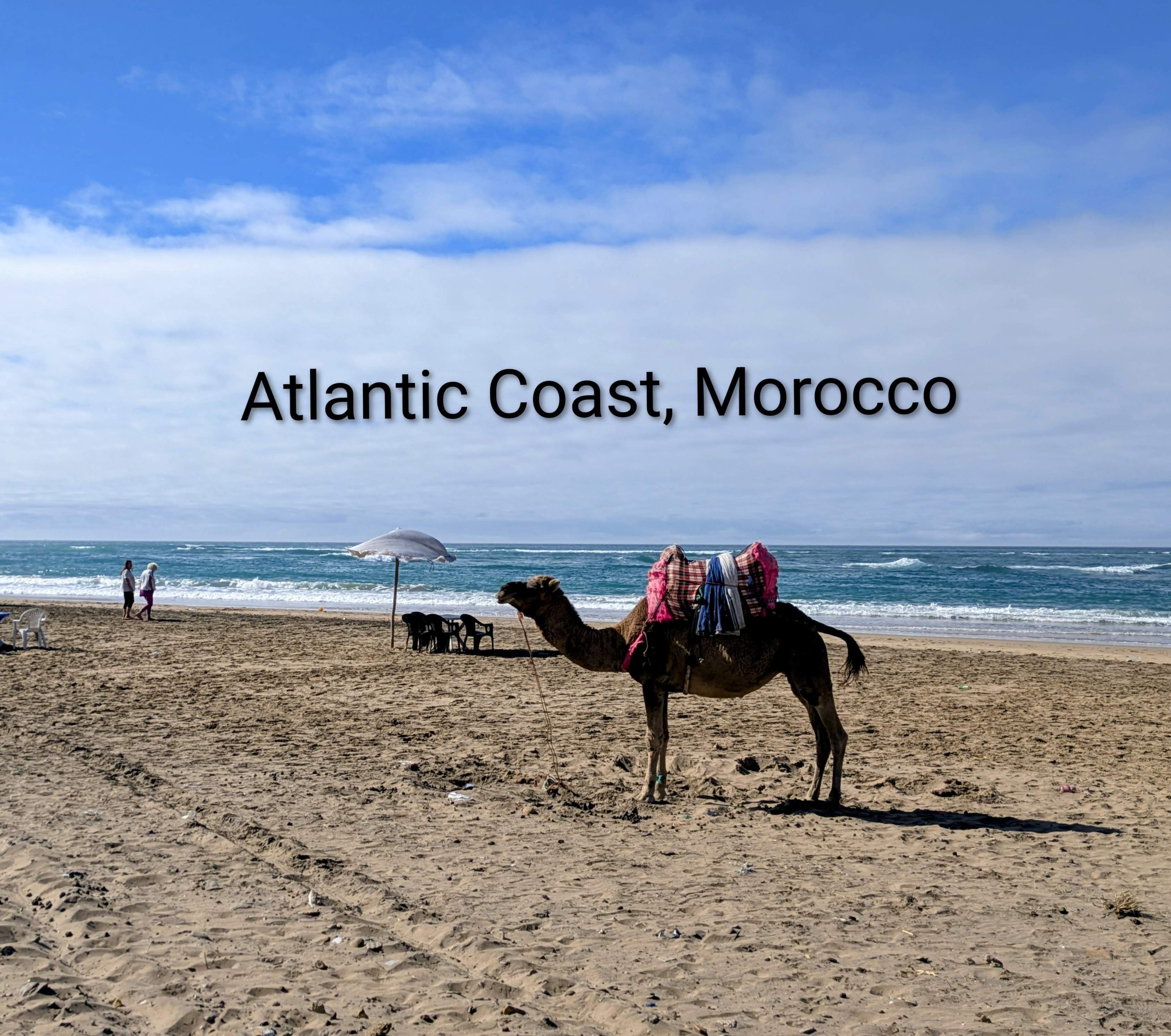
Google maps (but not Electro-maps) tells us that there’s an EV charger about 3 minutes away so we go in search but they aren’t there, and never were, according to a security guard who directs us back  to the Fast Volt chargers. We continue down the coast towards some Tesla Super chargers which appear to be in the middle of nowhere,. When we get there, we discover that they are part of the high-end Hilton Golf Resort. The guys on the gates were friendly and helpful but the Tesla chargers were only compatible with Tesla cars. The guys were offering us cables to slow-charge off a wall socket but that would have taken hours so we pushed on down the coast where the sight of camels relaxing on the beach made us smile.

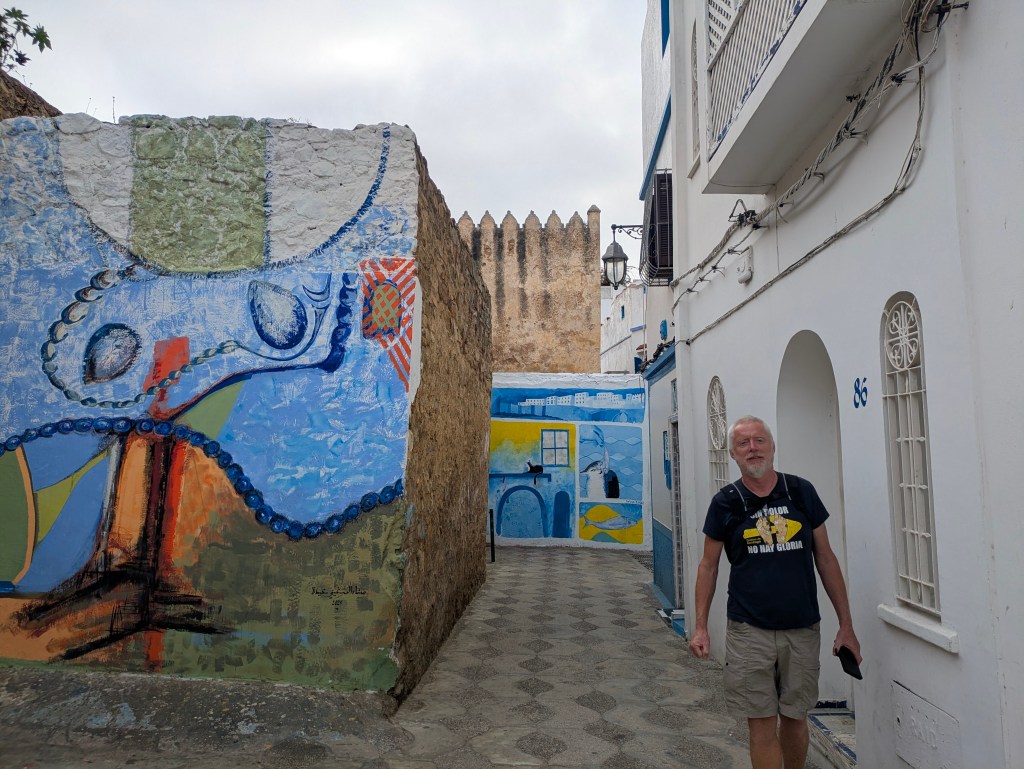
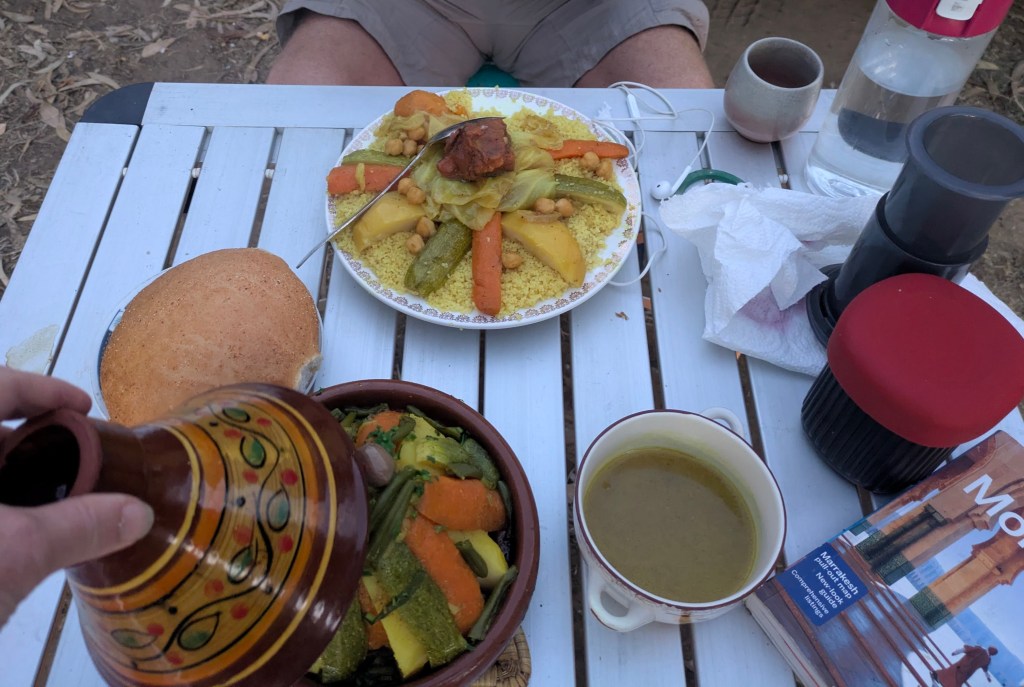
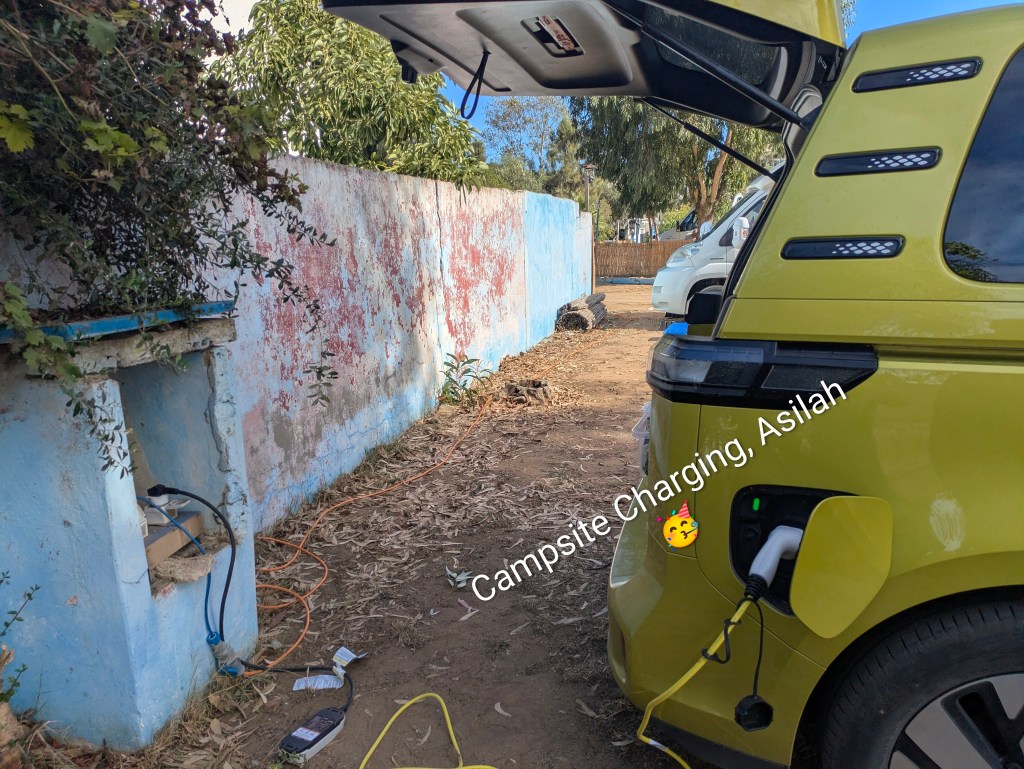
 We continued to a dusty, dishevelled campsite in Asilah, a windy town of murals, artists with a long promenade by the Atlantic and an interesting walled medina.  After checking in, we plugged into a socket with the blessing of the campsite owner who was saying Inshallah, and lo and behold, the charging light turned green and the Buzz slow-charged all night until it reached 100% by mid- morning the following day. Maybe it was the blessing – or the lack of safety features and circuit breakers – but we now had 450 kms to play around with. As well as that, the wife of the campsite owner made us a dinner of tagine and couscous/veg and delivered it to our van in the evening. Delicious. It rained heavily during the night, the first real rain that we have had since we left home on Oct 1,  but there was little evidence the next morning as the thirsty ground had soaked it up.

On down the Atlantic Coast, stopping at a Total Energies gas station in Lareche, we found  two working chargers, that were also free to use. We didn’t really need to recharge but we couldn’t pass up the free offer. Things were definitely looking up.  

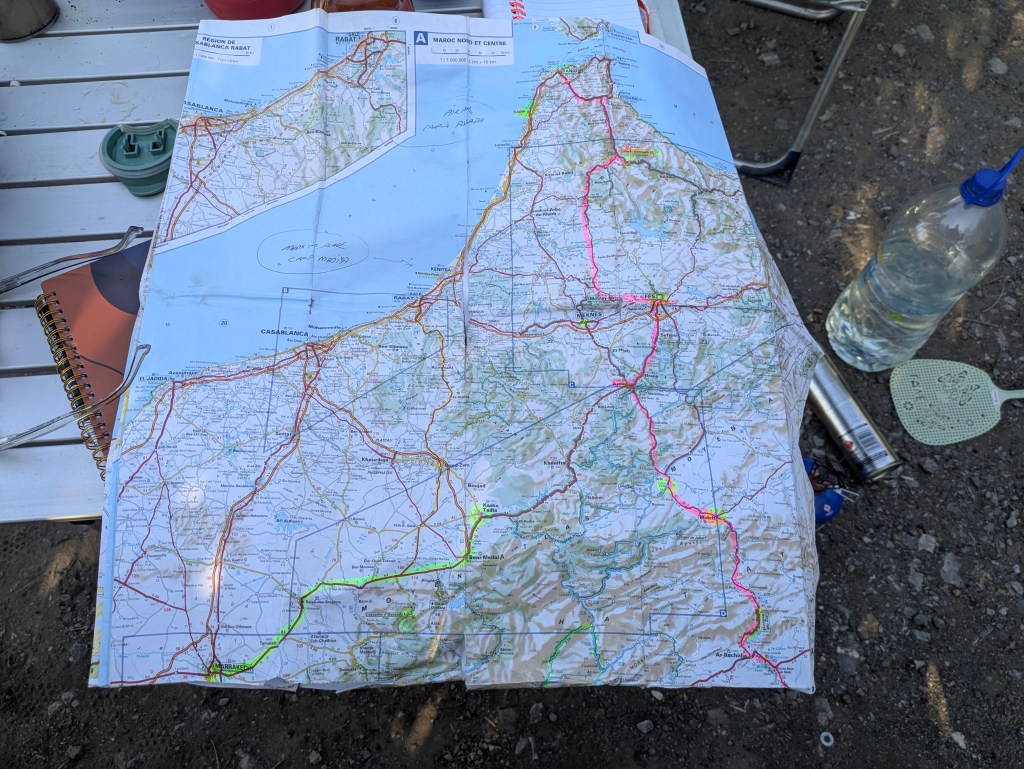
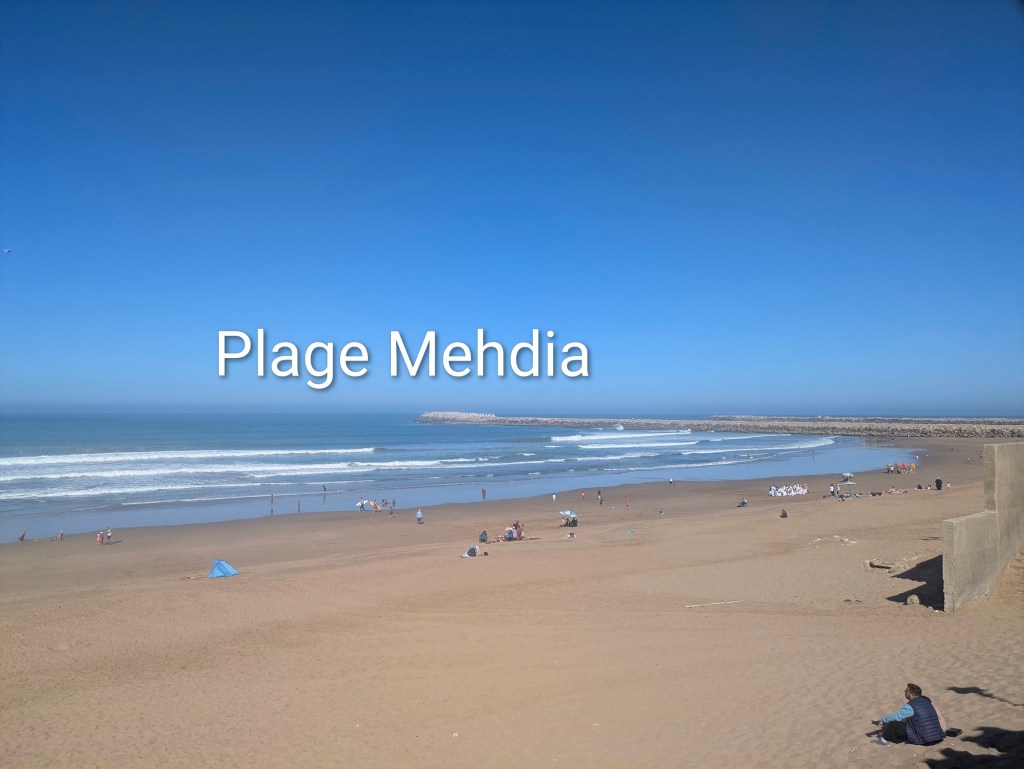
We continued  past acres of polytunnels gleaming silver in the sunshine, roadsides strewn with rubbish and towns that slide into each other until we reached Mehdia Campsite, a large campsite near an impressively long beach. It also had a large swimming pool, much favoured by seagulls who used it as a playground and a toilet. Two British bikers pitched a tent beside us and through the hedge, we heard them mention their longing for a cold beer. As we had a couple of cans in our little fridge, we passed them through the hedge to our grateful neighbours. They were heading north towards Tangier on their way home after two weeks in Morocco and told us of their favourite scenic rides. One of them produced a paper map with highlighted lines, marking their trip. This made me realize how much I miss the feel of paper maps, grubby from use, creased from folding ‘the wrong way’ but so easy to get a proper overview.  One of their routes looked suitable for us, provided we could charge (we were unable to charge at the seaside campsite although we tried).

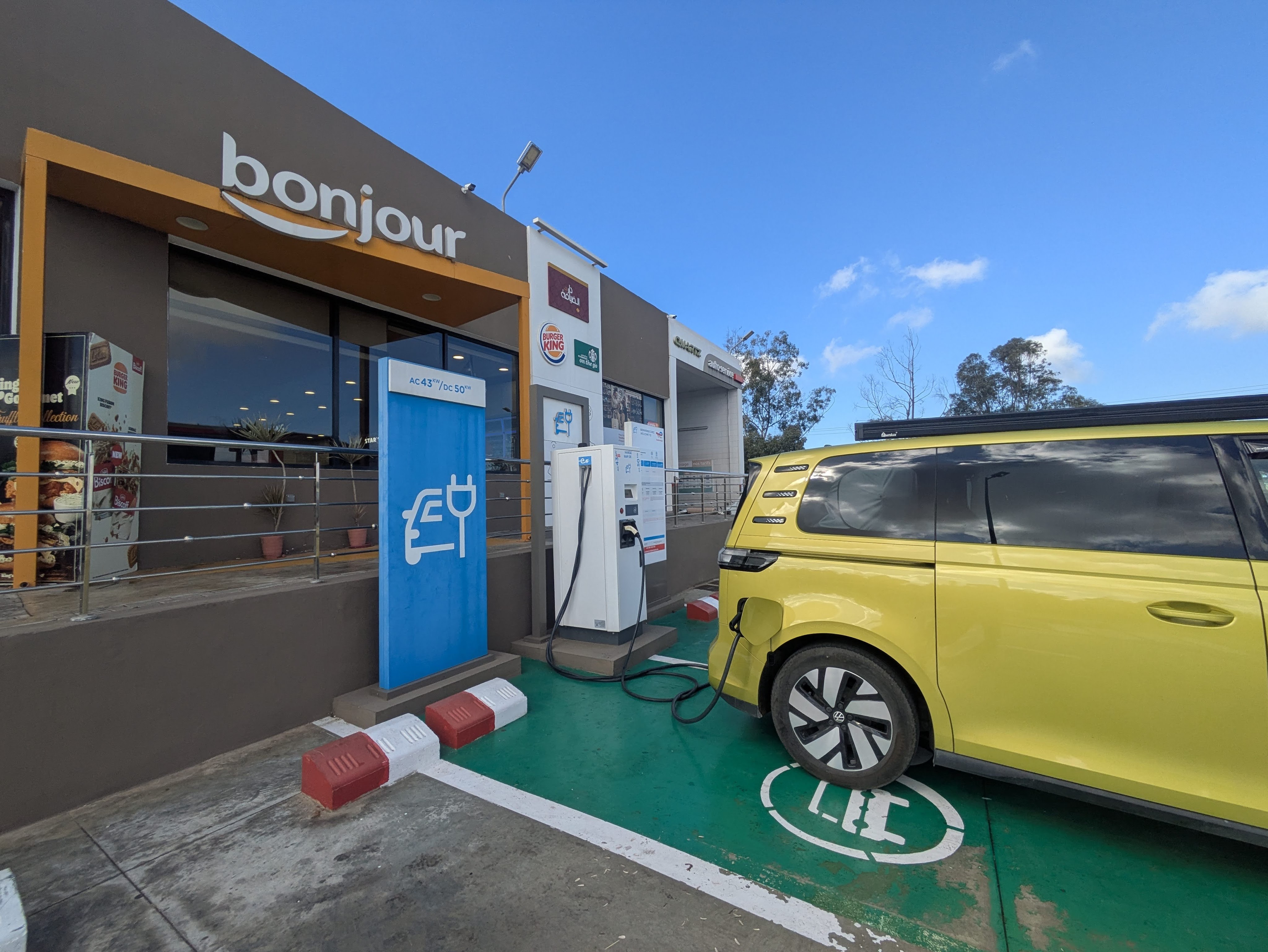
So we changed direction, abandoned the coast which was mostly dismal and dirty and ditched our plan of heading to Casablanca – it sounded alluring but many people told us that it was bustling, modern and quite miss-able. We managed to charge fully (for free) at another Total Energies fuel station on the motorway outside Rabat. These motorway stations were similar to home with Burger King, and shops that sell pastries/sandwiches and Pringles – generic places that could be anywhere on the planet. We chatted to two Norwegians who were driving to Gambia from Norway and who thought we were very brave (and quite mad) to be driving an electric van in Morocco. They actually went in search of us, curious about who could be driving the all-electric van with an Irish registration in the charging bay.

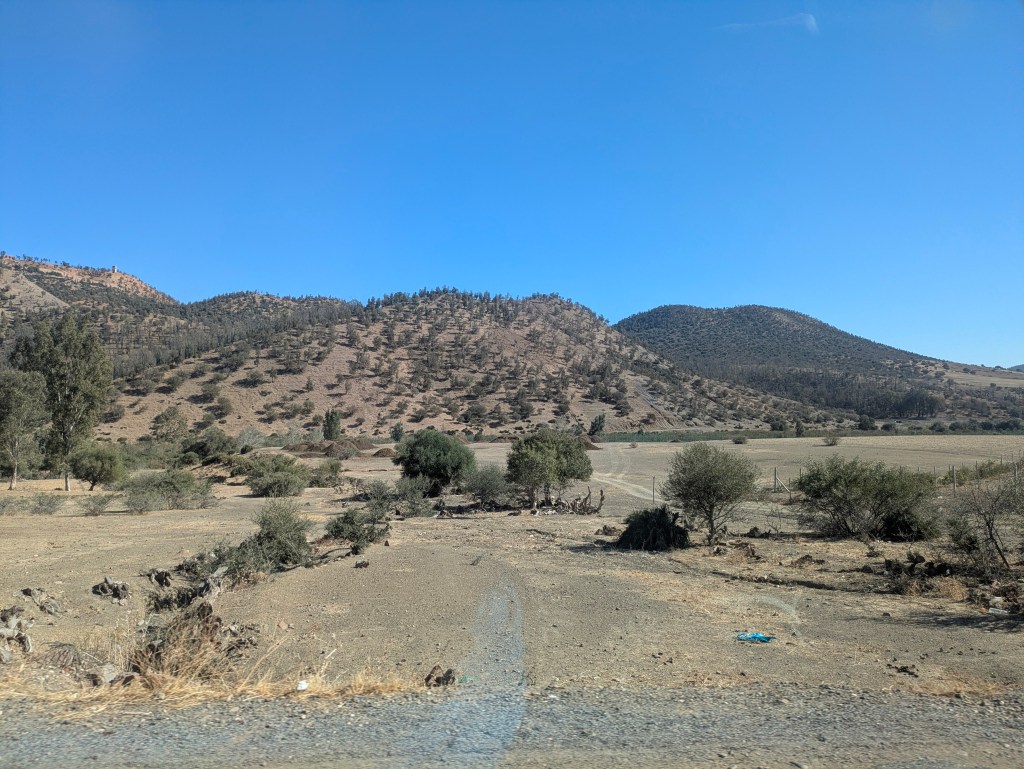
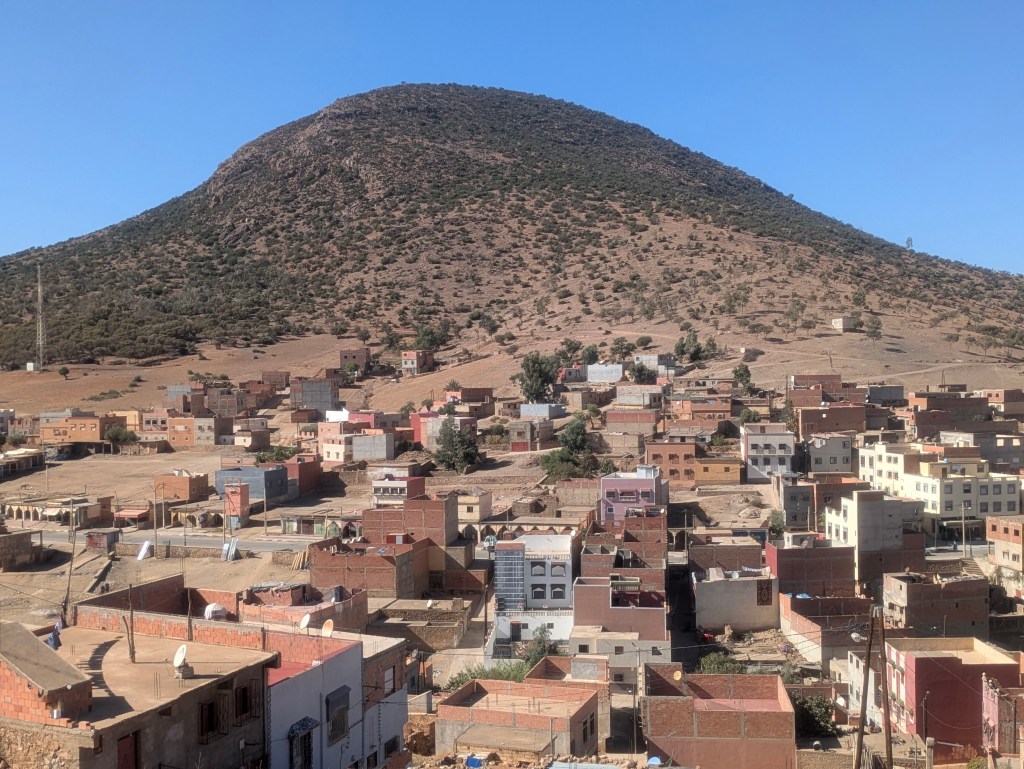
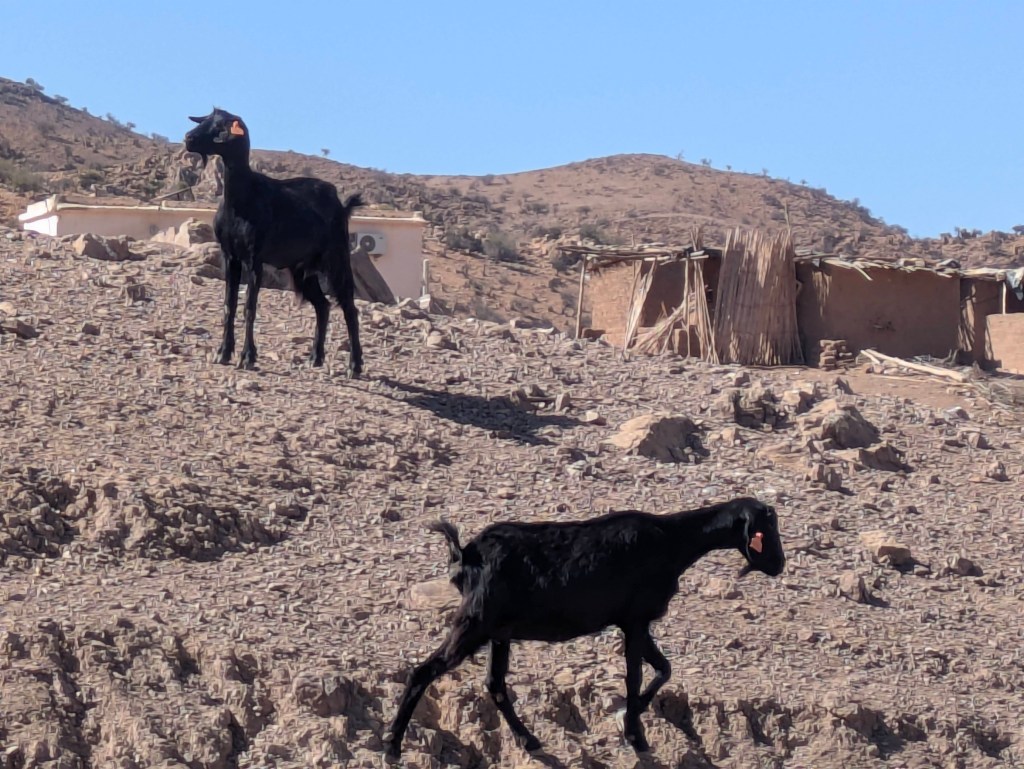
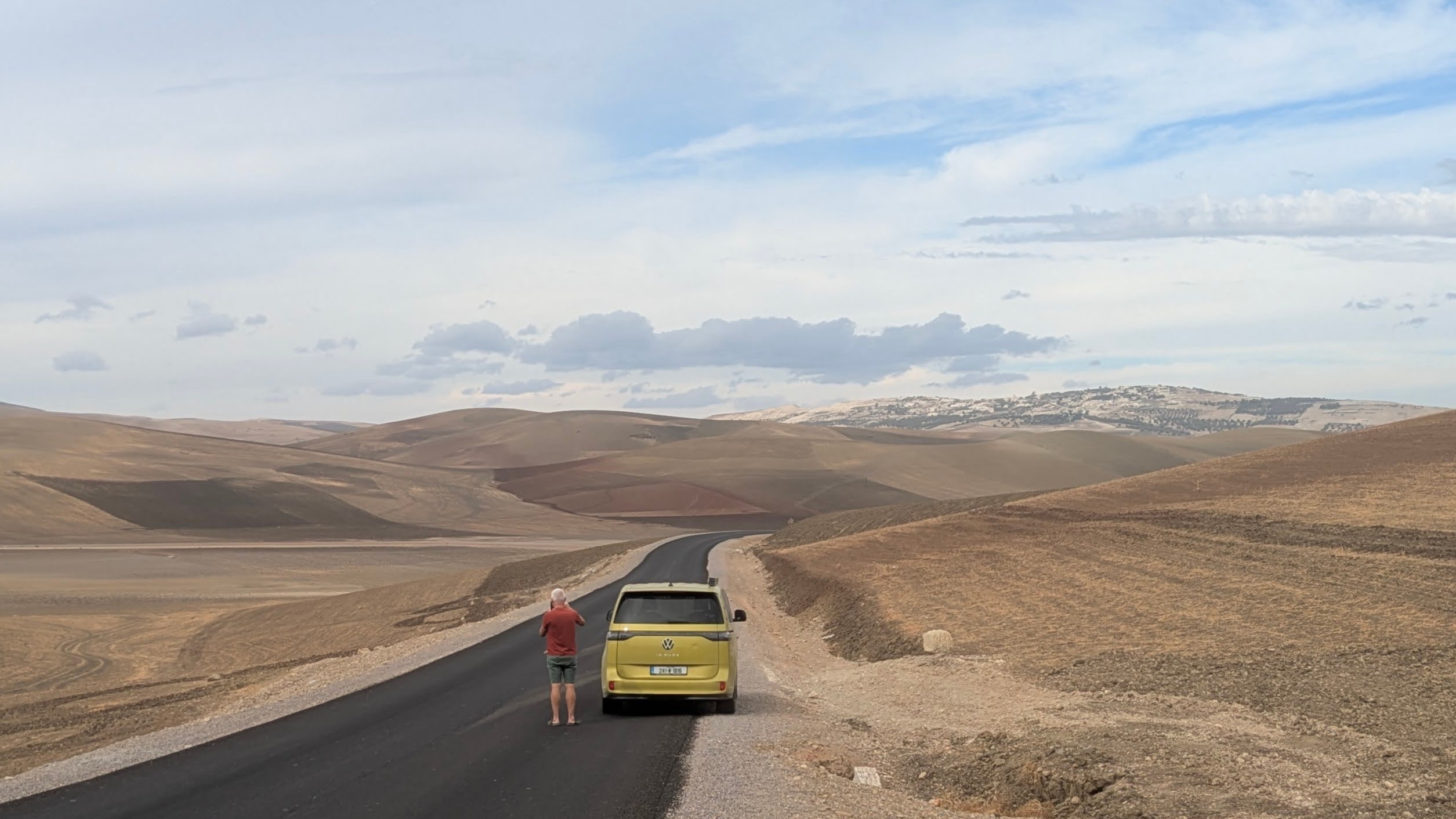
The inland journey was breathtaking, undulating and twisty, the countryside a palette of browns with the occasional green scrub, villages like mirages clung to hillsides and everywhere there were goats, mainly jet-black, like shadows. The temperature rose steadily until we hit 34 degrees. There was the bleating of the goats and the ‘call to prayer; from the village mosques but often there was miles of emptiness. We were in search of a farm campsite on Google maps which sounded like a place we might be able to charge the Buzz, plug it into a socket…..if there was a socket or even electricity. The trouble was that we couldn’t find the campsite. We left the tarmac and followed dusty tracks…. to nowhere. Eventually we turned around and  tried to retrace our tyre tracks back to the ‘main’ road which was not an easy feat.  A ragged boy appeared at our car window, offering us the bunch of grapes he held in his hand. He didn’t know anything about a campsite but knew the word for ‘money’ in several languages …and probably in a few more that we didn’t recognize. He wasn’t in the least bit aggressive but had a lovely charm about him.

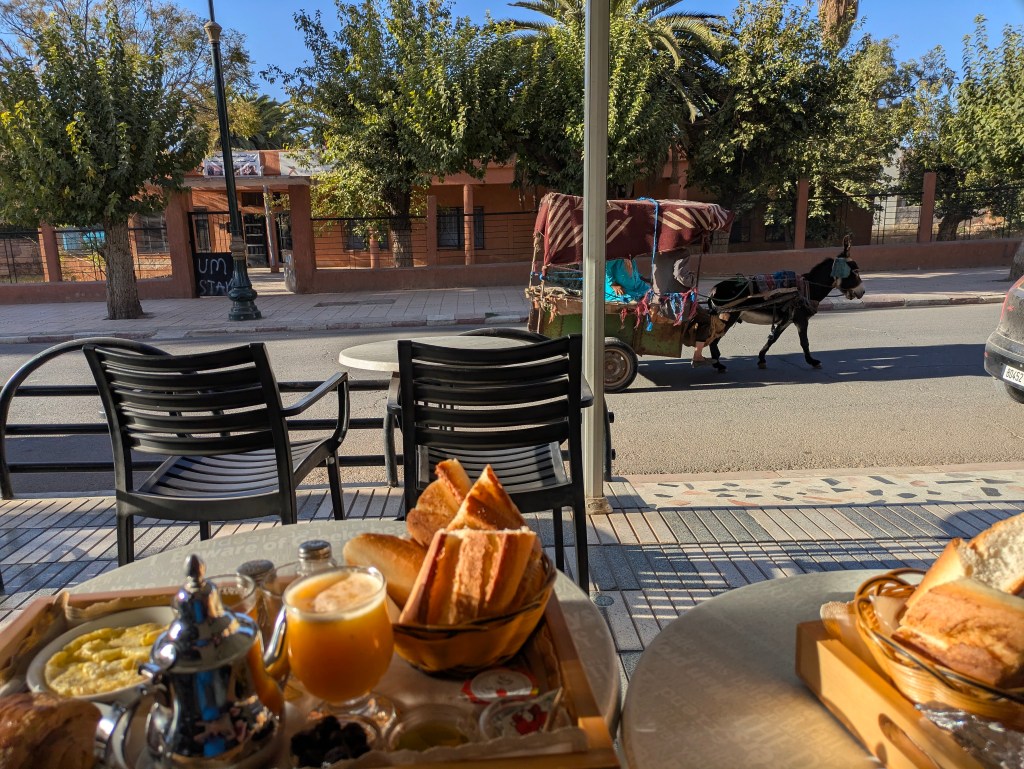
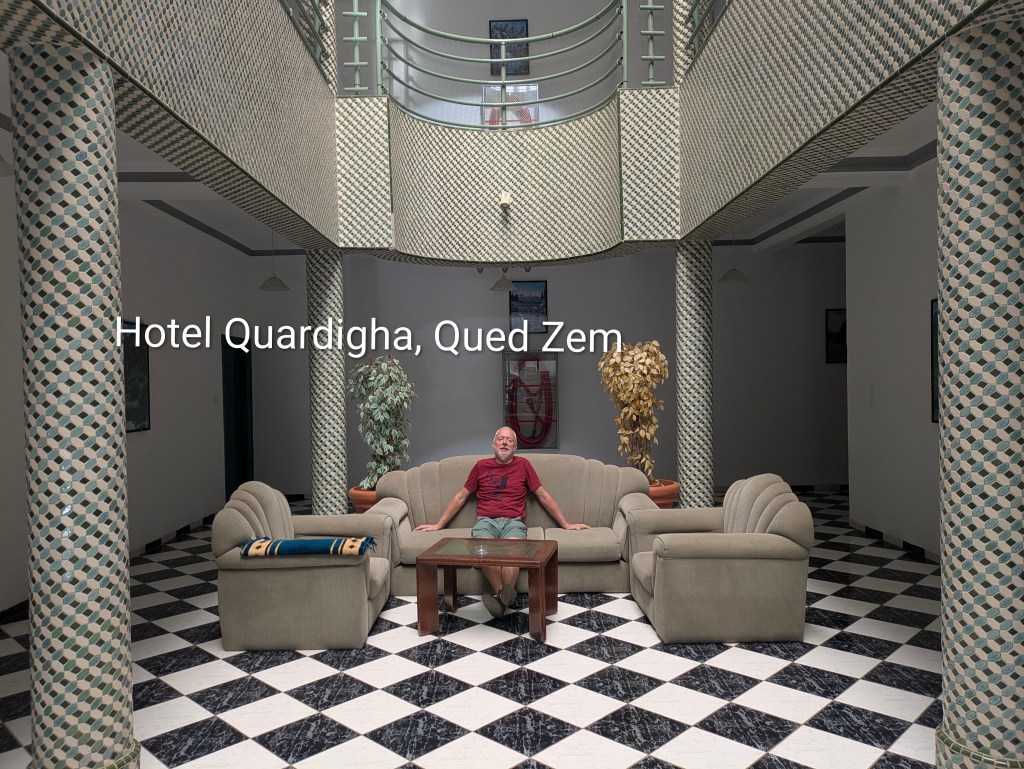
We pushed on to Qued Zem, a substantial town, which was once called ‘Little Paris,’ a title which left us scratching our heads. It was after six in the evening and still almost 30C so we went in search of a hotel. There weren’t many choices, the review for one read ‘don’t expect clean sheets’ so we went for the other, a fairly pricey option in a grand old mansion. This looked impressive but the bedroom aircon refused to go below 26C and the blocked shower tray flooded the bathroom but the sheets was clean and the breakfast on the veranda facing the street was delicious.  The quality of bread and pastries in Morocco was surprisingly superb, probably the French legacy, and juices were almost always freshly squeezed.  

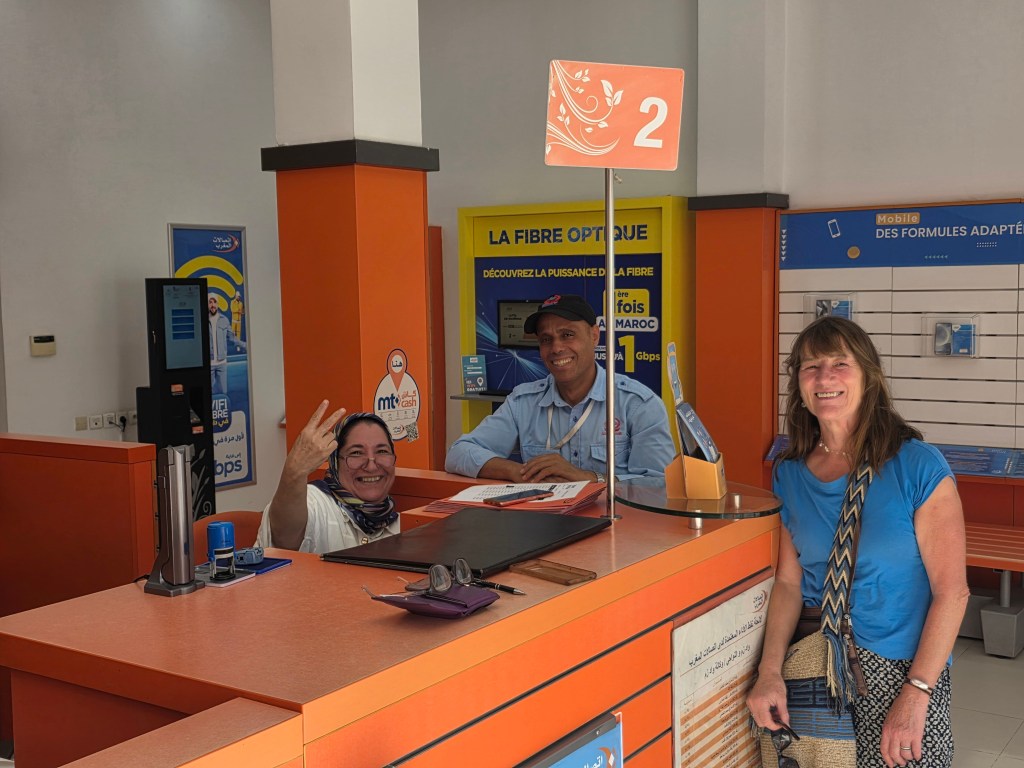
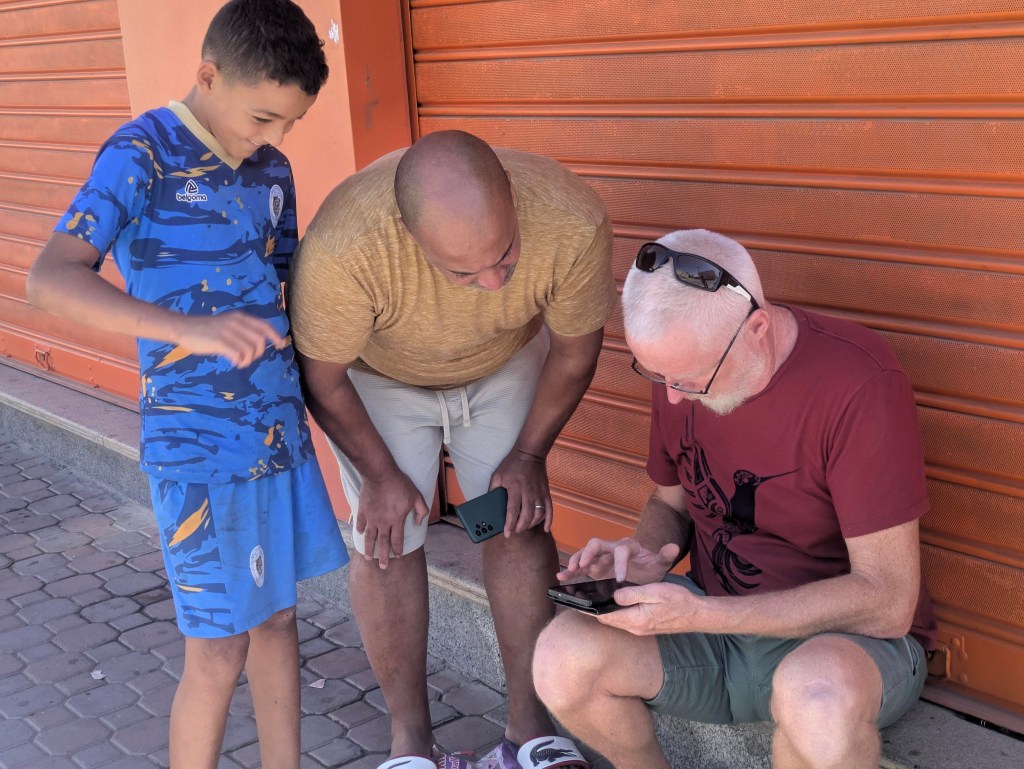
Although I had an e-sim from Revolut, I wanted to buy a Moroccan phone sim so we paid a visit to the Maroc Telecom office in the town where the lady behind the counter was extremely helpful but couldn’t understand why my Maroc Telecom sim in my phone worked for calls but not for mobile data. She eventually asked the doorman to take us to Hashim around the corner who was good at fixing things. Hashim was determined to find a solution but eventually had to give up….mainly because we wanted to get on the road. The Moroccan desire to help was truly amazing.

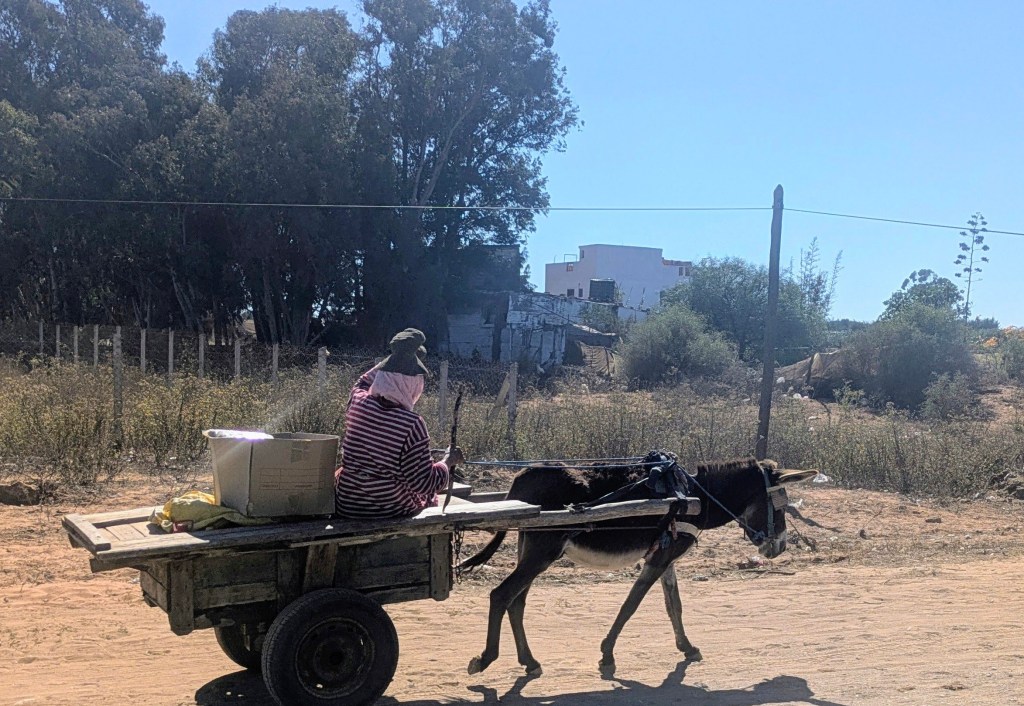
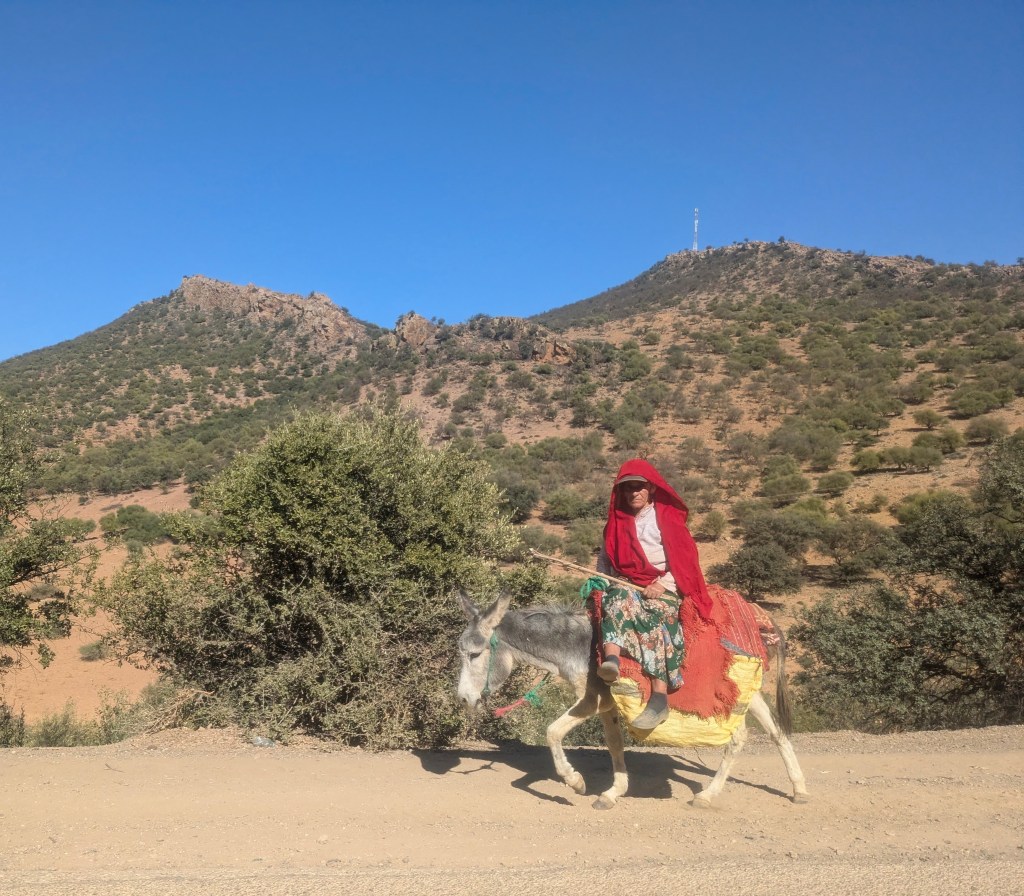
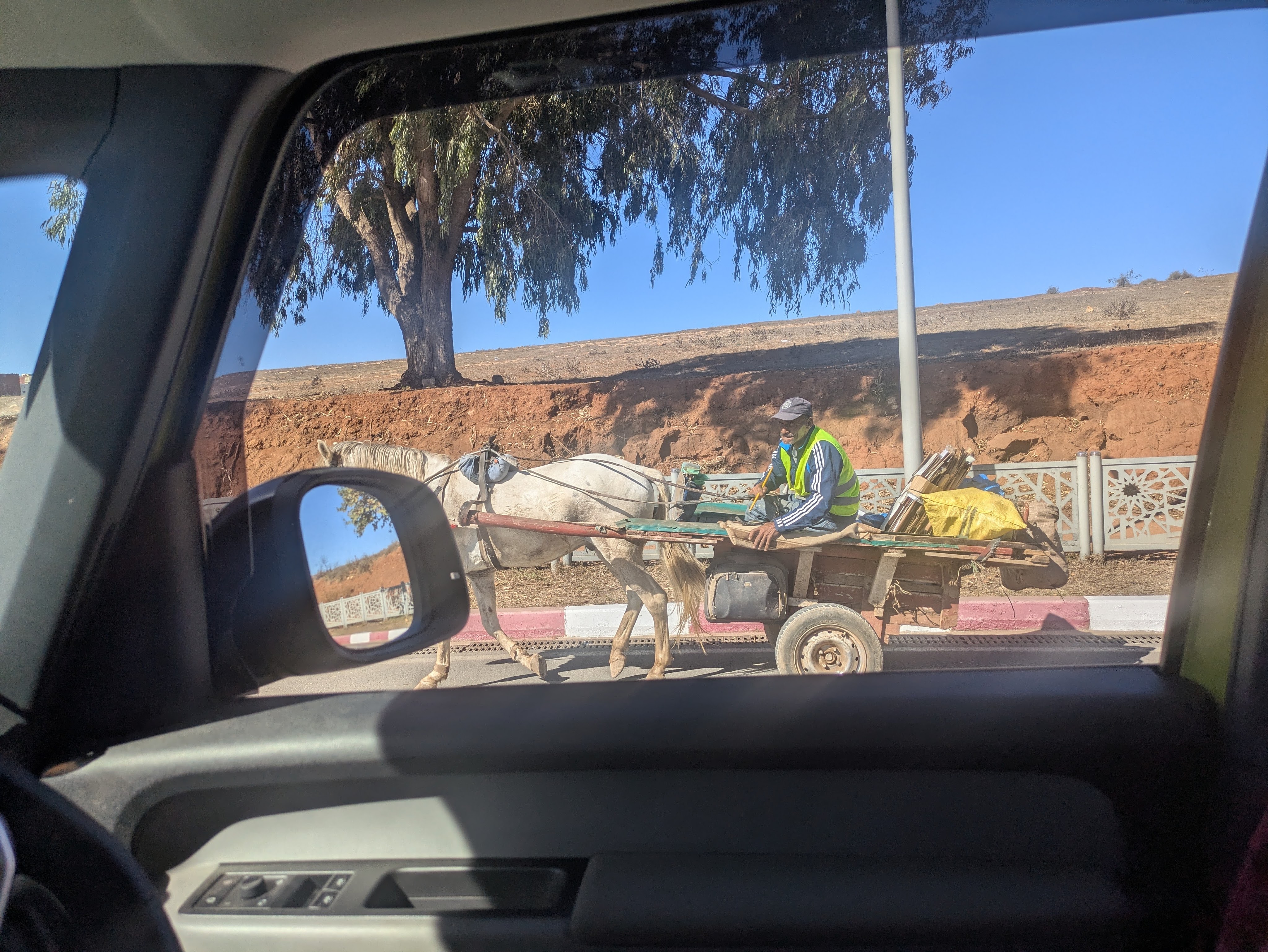
Although there were plenty of petrol stations in Qued Zem, there weren’t any EV-chargers  -most people didn’t know what we were talking about. Although we would have preferred to continue south to the High Atlas, the difficulty with charging made us head north although in reality, chargers were scarce in every direction. The drive north through the Middle Atlas to Azrou was again spectacular with a timeless, almost biblical feel.  It was Friday and in many of the villages, our passing coincided with people spilling out of the mosques and hopping on donkeys carts or bicycles. In many cases, the only evidence of modern living was that the man on the donkey had a mobile phone in his hand.

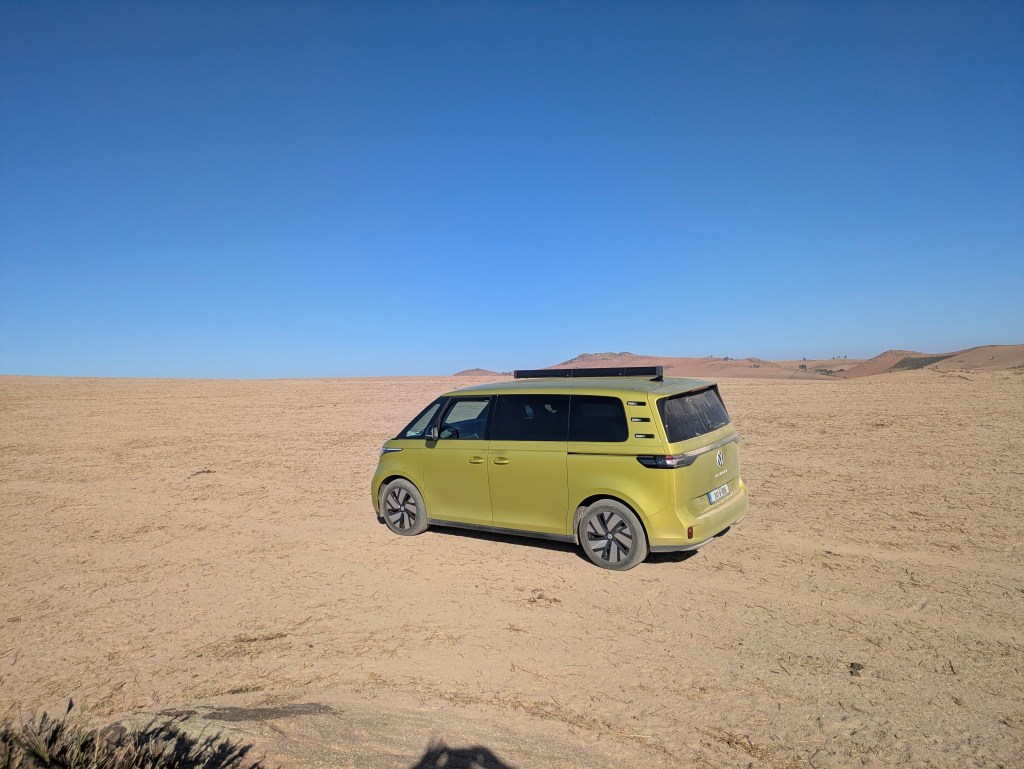
Surprisingly, there were lots of speed checks with police hiding behind bushes with speed guns. The advantage of trying to conserve fuel was that we were always within the limit and were waved on. Our charging issue was becoming critical, the kilometres ticked down and we mentally calculated how many we have left versus how many we needed to get to our destination. Morocco is a big country, more than ten times the size of Ireland. There were supposed to be EV-chargers in Azrou but we couldn’t find them and nobody knew anything about them. By the time we reached the Azrou campsite, Euro Camping Emerites (at least that existed), we had 62 kms left and we desperately hoped that we would be able to charge using a granny cable in a socket.

Azrou was charming, a Berber town surrounded by cedar and pine forests with many walking trails and home to troupes of monkeys in the woods. At about 1300 m, the days were warm and the nights were cool. The campsite was also lovely with lots of trees, a place where Khalid, the friendly manager, delivered free baguettes to everyone in the morning. It was exactly the type of tranquil place we liked, surrounded by nature BUT we had a big problem, we couldn’t charge the Buzz, We tried several sockets, Khalid allowed us to plug into the kitchen, he called a friend, brought us to a garage but the Buzz wasn’t buzzing.

 According to various (unreliable) maps, we thought there were chargers in Fez, which we had intended visiting, or Meknes, which we had never heard of before. Fez was 89kms but Meknes was closer at 65kms but we had a mere 62 kms in the tank.  Would either of them have chargers that worked……even if we got there? Our hope was that as we were in the Middle Atlas mountains, it should be all downhill to either destination. We decided on Meknes and drove slowly….Khalid gave us his phone number in case we got stuck and said that he would come and rescue us.

A wonderful thing happened.   A few kms outside the town, our available kilometres rose to 90 with 60kms to go. I began to breathe again, my stomach unclenched. The Buzz kilometres changed according to the terrain – going downhill, they zoomed up, any uphill, they went decreased but by the time we arrived in Meknes, we had an unbelievable 109 kilometres to spare. We headed to Carrefour Shopping Mall where there were supposed to be Kilowatt chargers and we had already downloaded the Kilowatt app. The good news was that the two chargers were working but the bad news was that they were in use. The friendly doorman suggested that we go for coffee and he would call us…which he did after about thirty minutes. Thankfully, the Buzz charging light turned green. As it was only a medium charger, we were only 50% charged after about three hours but we hated shopping centres and couldn’t bear to spend any more time there.

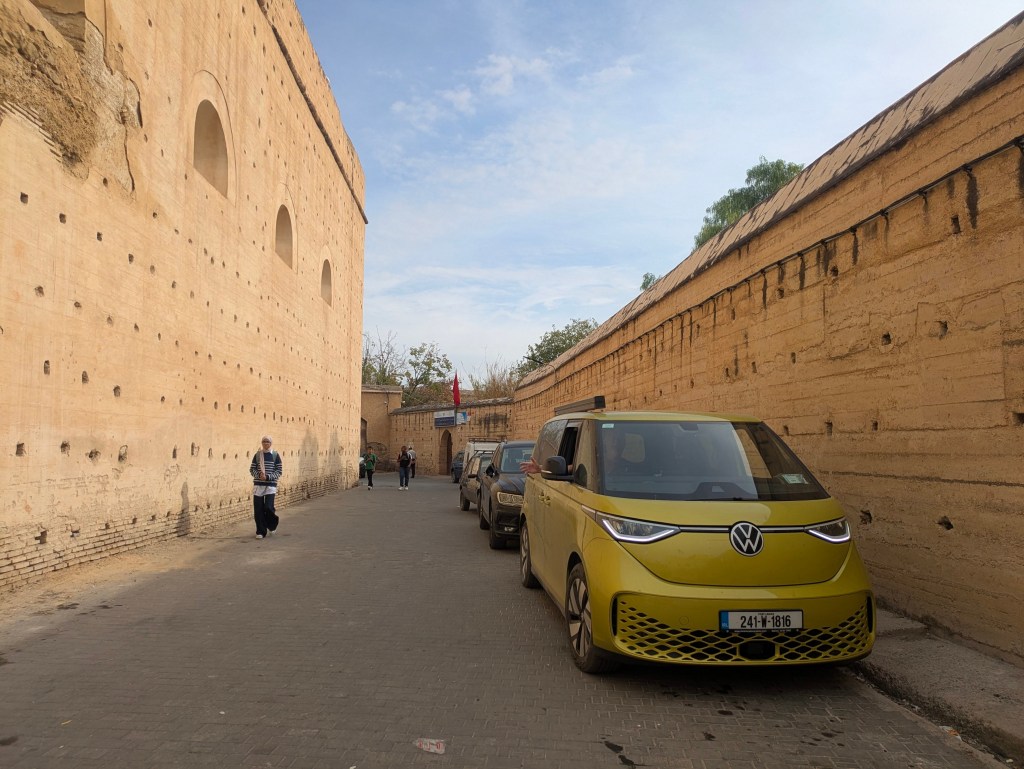
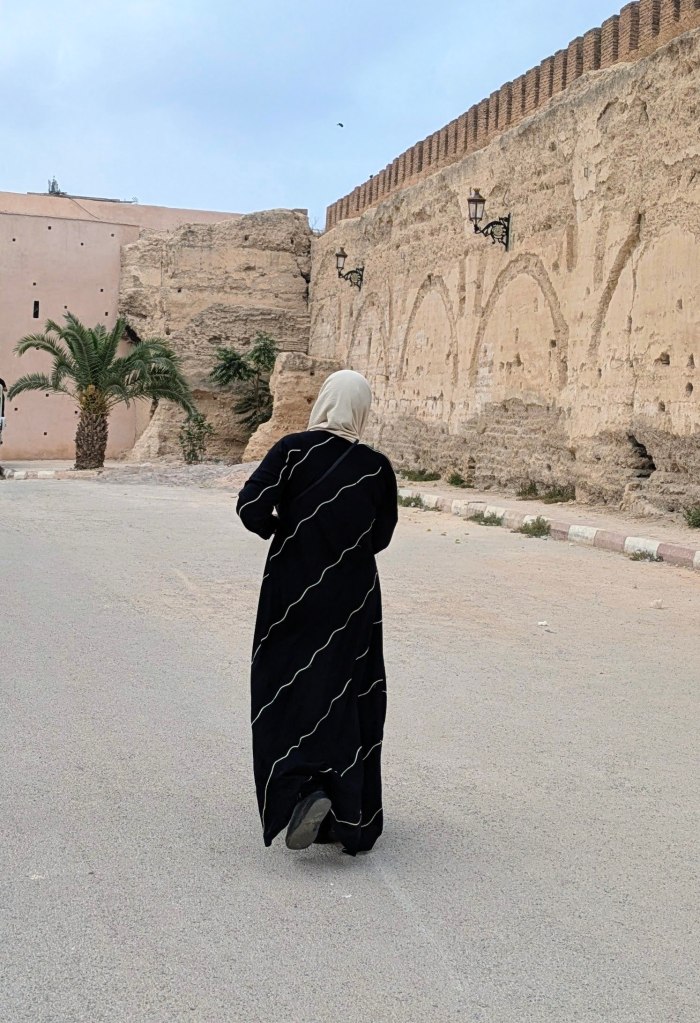
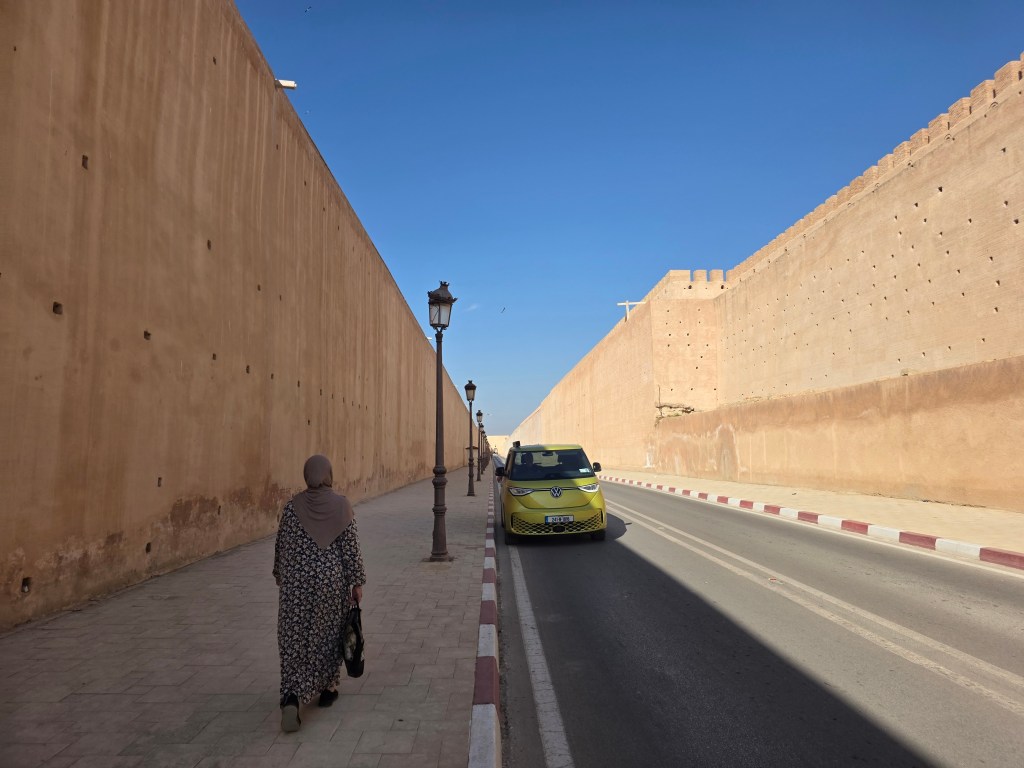
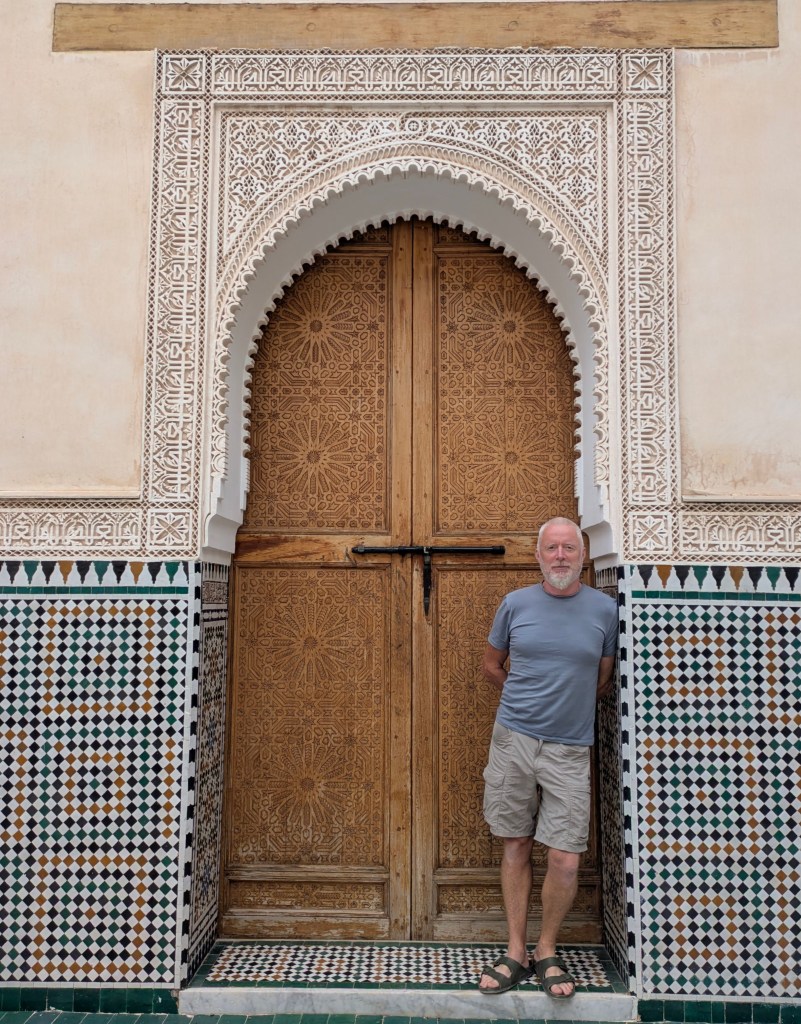
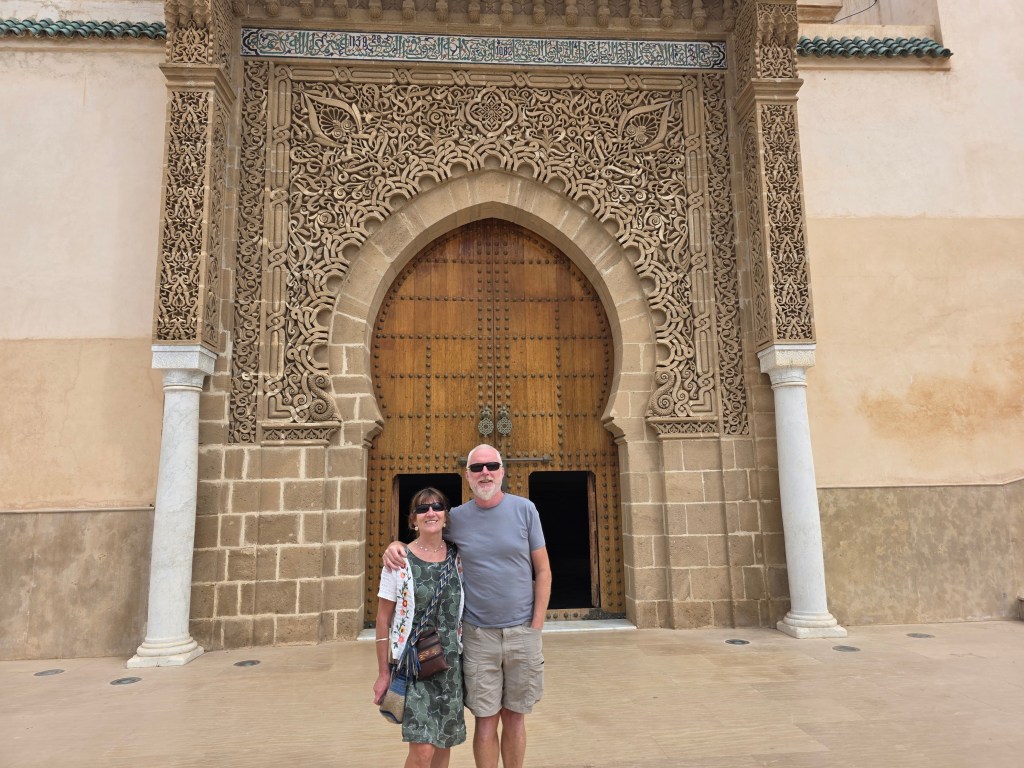
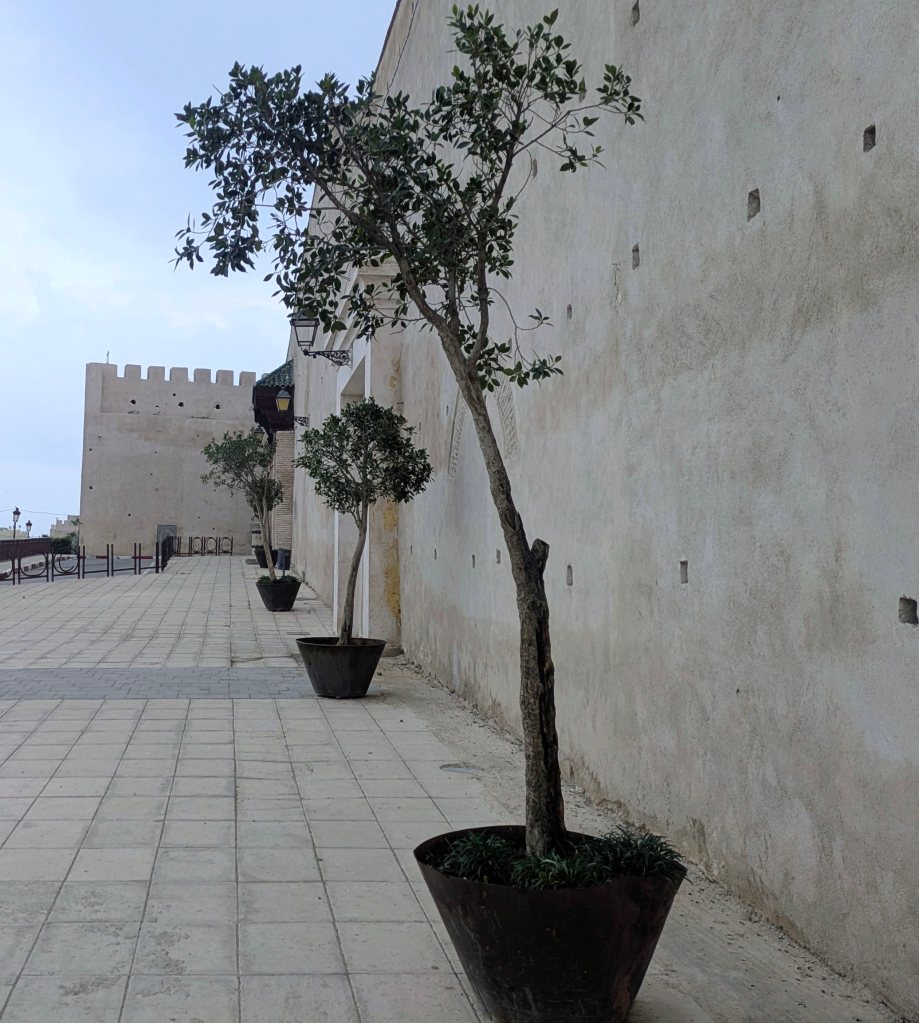
 Maybe our diversion to Meknes was meant to happen. It was a lovely city with impressive architecture, and although it was one of the four imperial cities of Morocco (the others are Fez, Marrakesh and Rabat), it wasn’t very touristy. Driving from the Carrefour Mall, we were wowed by the beauty of the old walls, built by Sultan Moulay Ismail in the mid seventeenth century. These impressive mud walls encircled the palace and old town and were home to hundreds of stocks nesting in the turrets. Sultan Moulay Ismail began the first day of his reign by murdering any of his 83 brothers and half-brothers who refused to bow to him. Despite that – or maybe because of it, he is much revered even to the present day. We visited his lavish mausoleum with a stunning mix of exquisite tiling and simple design.

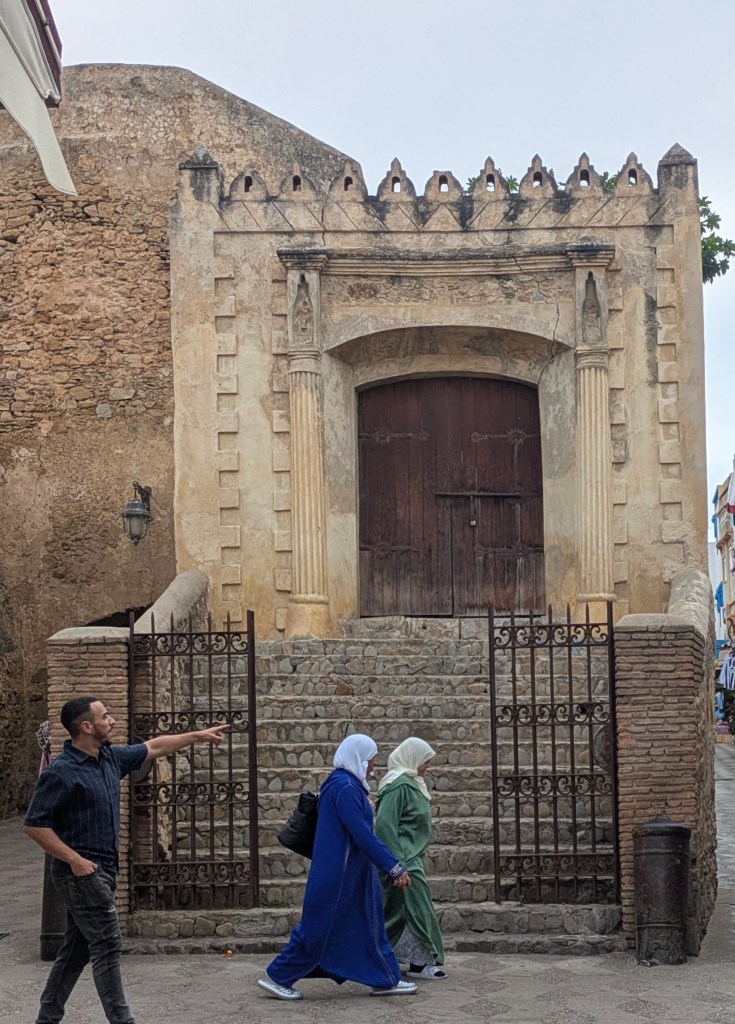
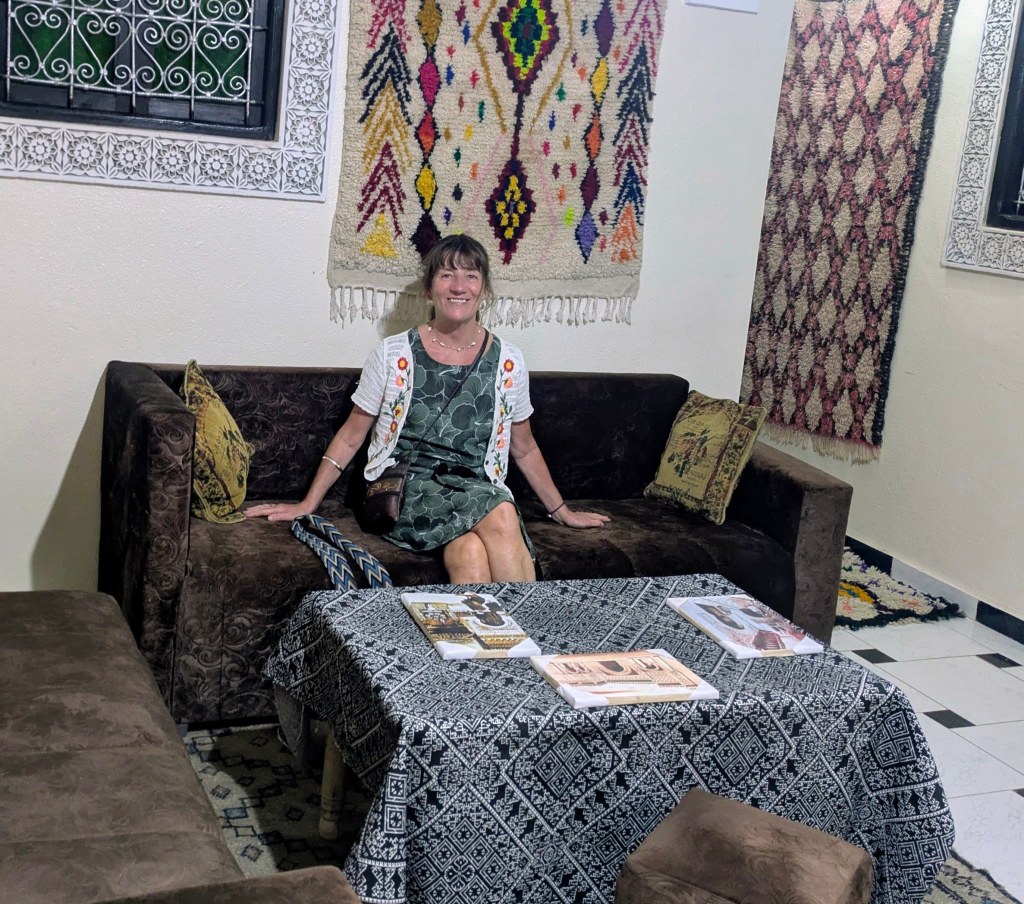
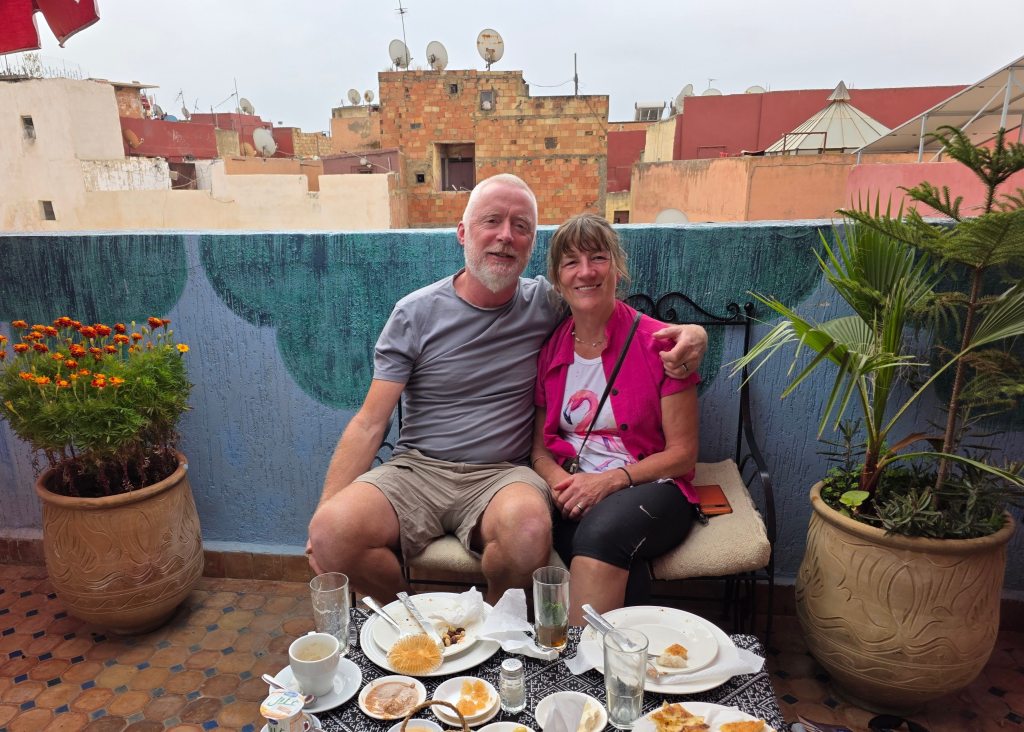
We stayed in a fabulous riad (Riad Andalous), hidden away in one of the alleys of the medina warren for two nights. Finding it was difficult, we walked  in baffling circles through stalls selling shoes, scarfs and food. Riads are traditional Moroccan houses and what a revelation when we climbed the stairs to enter Riad Andalous after a maze of dirty alleys. Secreted away high above the clamour of the medina stalls, it was an oasis of calm with tapestries on the walls, ornate ceilings, rug-strewn floors and a sunny rooftop terrace for relaxing breakfasts. It even had a little resident tortoise, who slowly followed the sun around the terrace.

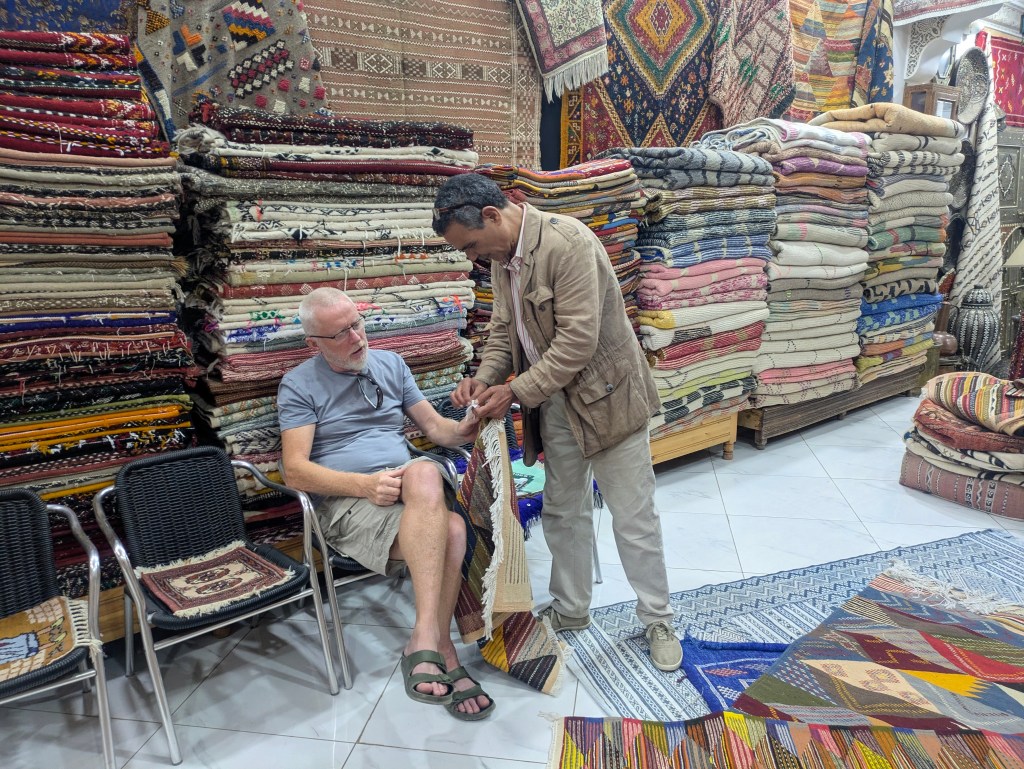
We visited a few carpet shops where eager salesmen pulled out rugs until the floor was strewn with them and our heads were swimming, so overwhelmed that we no longer knew what we liked. On the last morning, leaving our gorgeous accommodation, we turned into the alleyway to have one final look and this time we purchased after some hard bargaining.

It was time to head to Fes but as the Buzz tank was at 50%, we diverted by a motorway fuel station on the outskirts of Meknes that according to our maps had fast EV chargers but we were again disappointed. It will be absolutely essential that we charge in Fes which according to our (unreliable) maps has three chargers, one of which is a Tesla and so wont work for us (In Morocco, Tesla superchargers are only compatible with Tesla cars), so that leaves two medium chargers. Yikes!!!

On the bright side, we have really enjoyed our visit to Meknes, a city we would never have visited without charging issues.

Thanks for reading.

Till next time

Electric Roadtrip: The Charging Saga