Mexico: Then and Now

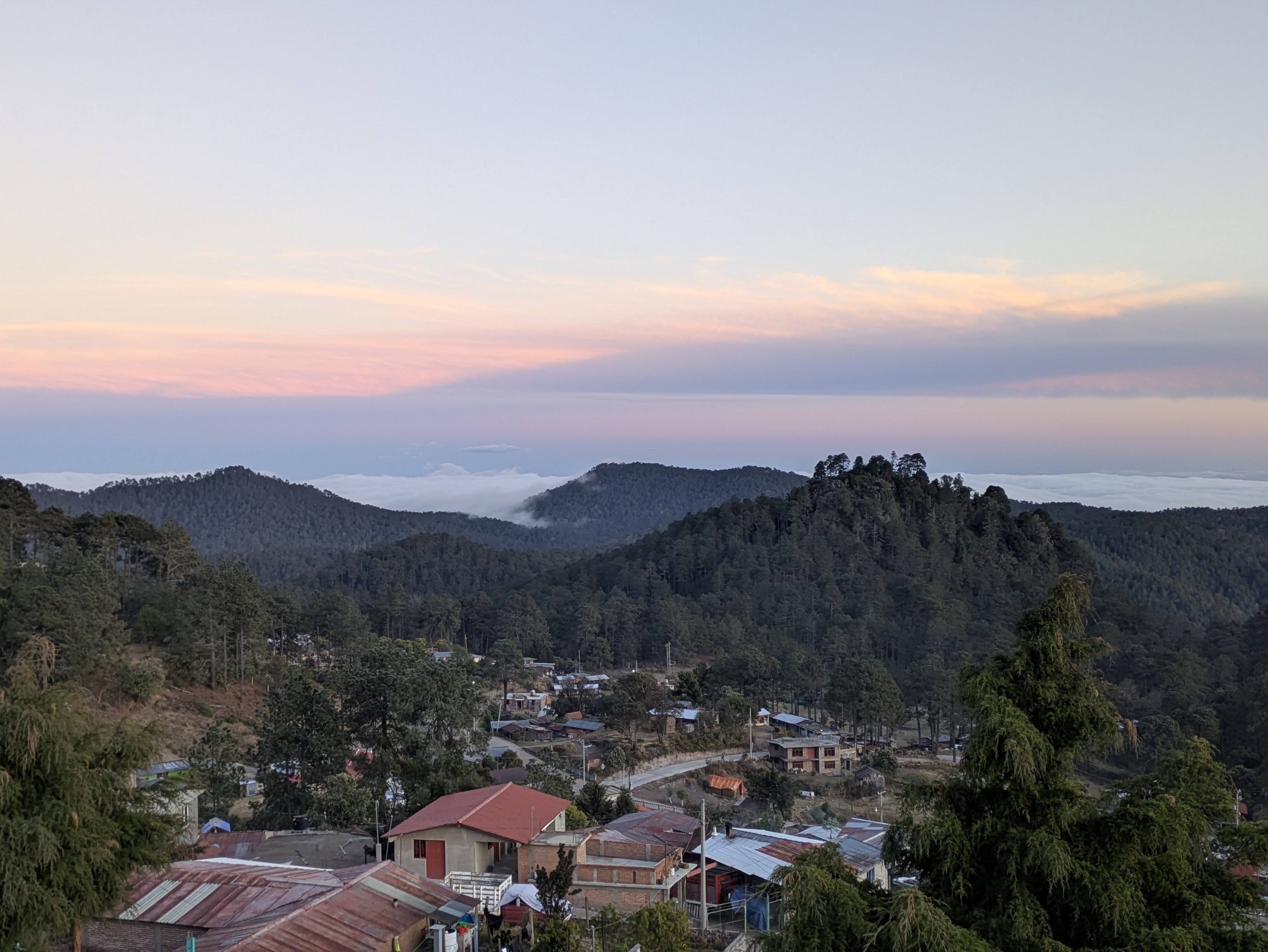
Village of Cuajimoloyas, Sierra Norte @ 3200m

Inhaling clear air, we felt slightly dizzy from the altitude at 3100m and the breathtaking scenery of pine-clad forests. The distant tinkling of bells, worn around the necks of goats and sheep, drifted upwards on a light breeze. We could have been in some Alpine town in Switzerland but this wasn’t Europe, it was the Sierre Norte, a mountain range in the Oaxaca region of Southern Mexico. The idea to visit this remote village was planted in our minds only two days before when we visited Mount Alban, an impressive archaeological site which overlooked the colonial city of  Oaxaca.

Mexico is full of history. There are archeological sites everywhere especially in the southern part of the country in the states of Oaxaca, Chiapas and the Yucatan. Most of these went through the same cycle of growth, decline and abandonment, many  becoming ‘lost’ for centuries.

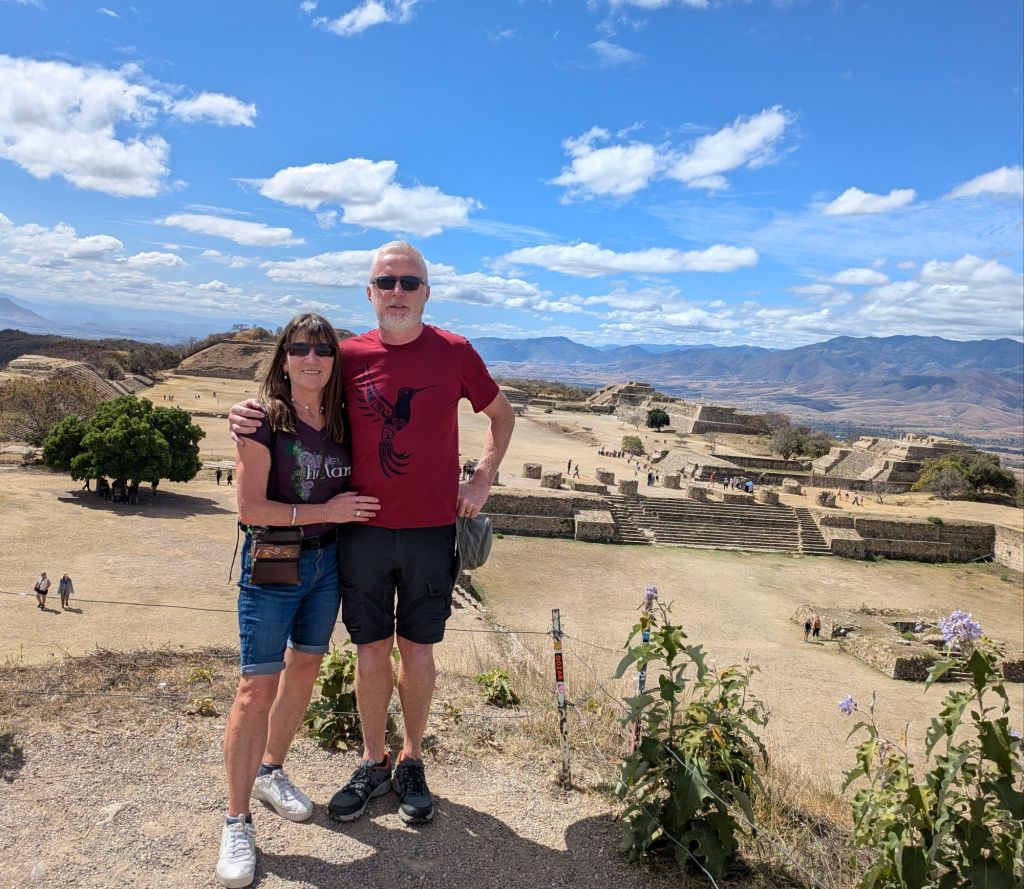
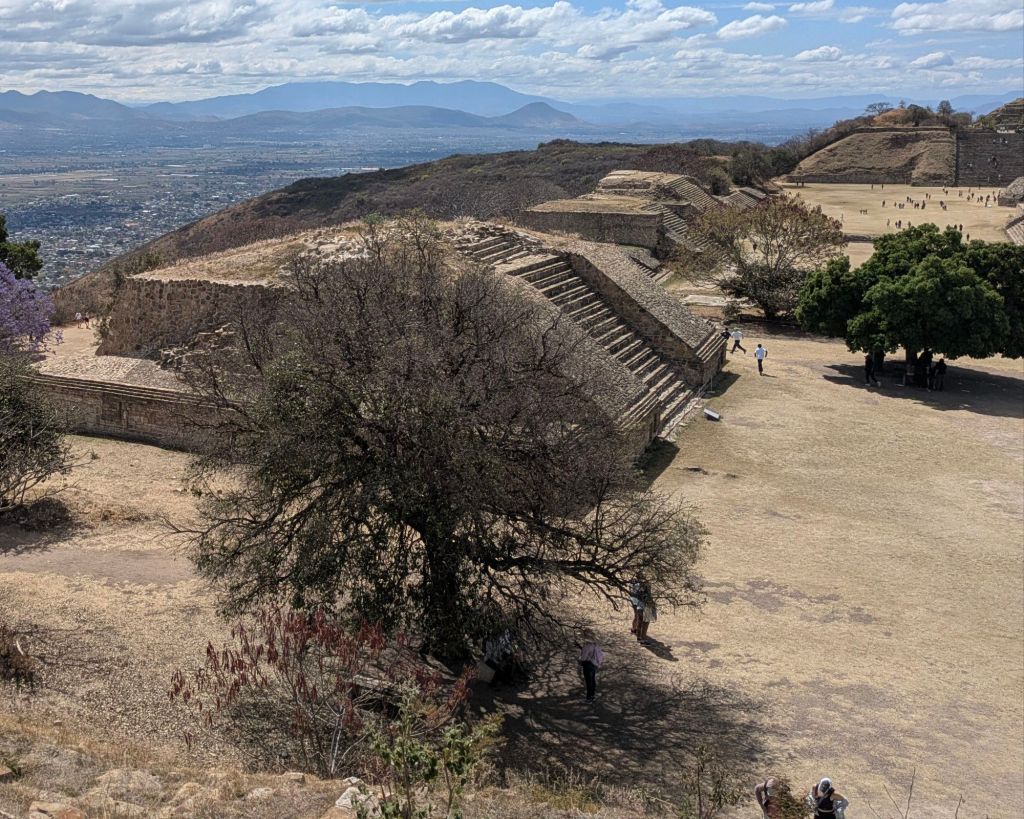
We wondered what happened to the people who built these fabulous monuments as we strolled around the sunbaked ruins of the Zapotec capital at Mount Alban. These were built on the Hill of the Jaguar, a mountaintop that was deliberately flattened to create room for the vast site which kept unfolding and becoming more impressive as we walked.  The temple complexes, the enormous Gran Plaza, the mysterious carvings and the extraordinary astronomical observatory told of great wealth, prestige and domination over a huge area but it was abandoned in about 800AD after about 1300 years of occupation.
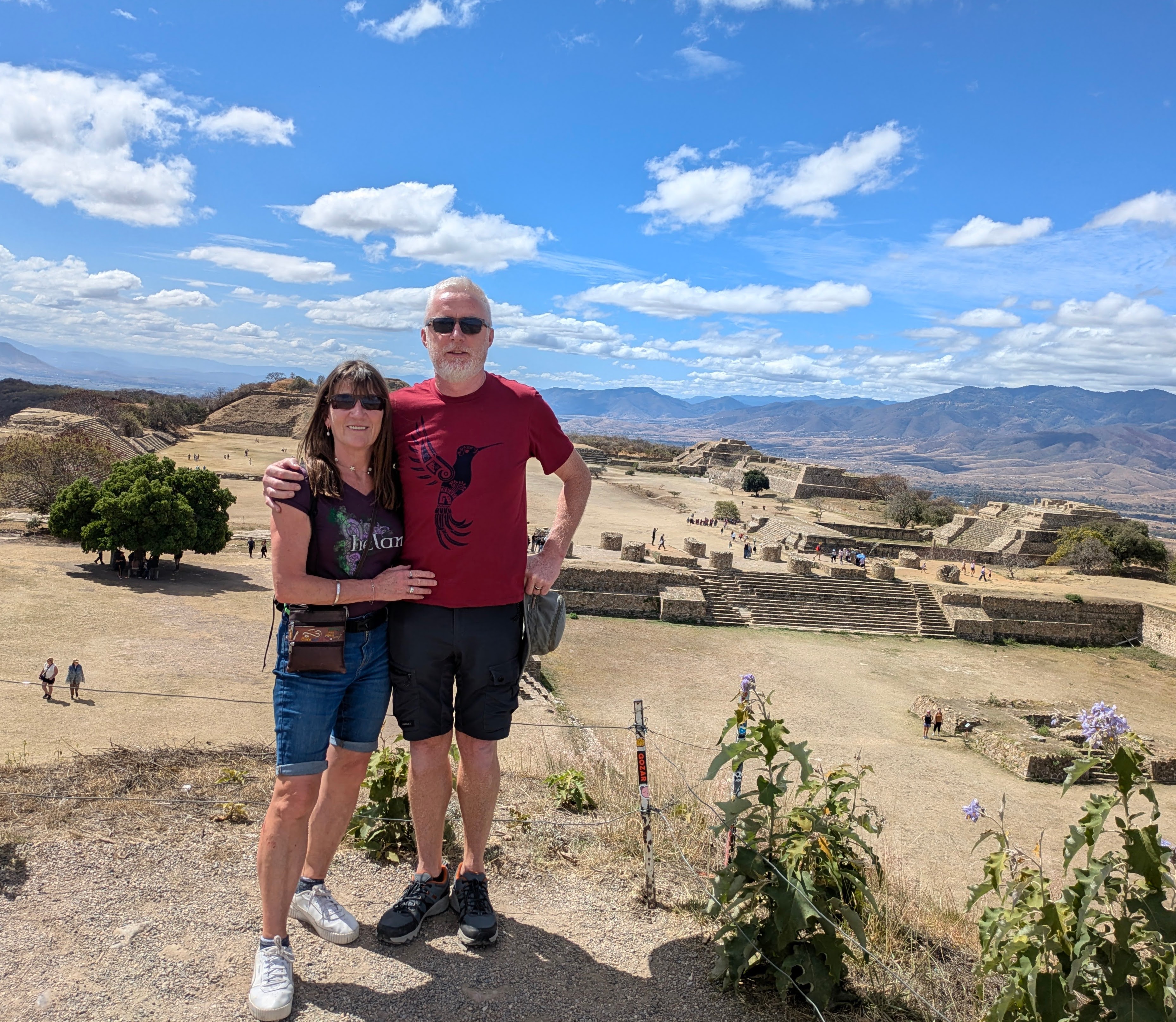
Mount Alban, Oaxaca

The Zapotec people hadn’t completely disappeared. The descendants of those who built the metropolis of Mount Alban were living in mountain villages, less than a two hour drive from Oaxaca and so we decided to visit.  Travelling into the cloud-forested mountains of the Sierra Norte on a bright sunny morning, we reached the high altitude pueblo of Cuajimoloyas (I still have difficulty pronouncing it) where we were supposed to pick up a guide for a hike in the mountains.

 ‘You have arrived’ said Goggle. Looking around, we got that sinking feeling. We were outside a boarded up house with no sign of a guide or anyone else and no phone signal to make contact with anyone. The village was larger than expected, sprawling up a hillside with well-kept houses, trimmed verges, flowers and virtually no rubbish . We drove in circles until we spotted an elderly man, leaning on a walking stick who pointed his stick towards the office of  Expediciones Sierra Norte, an eco-tourism company which is entirely Zapotec owned and operated. A smiling Andres, a thirty year old who has lived in the village all his life,  was sitting on a bench outside the office, not in the least perturbed by our late arrival.

Arrangements for our 2 day hike were made in Oaxaca in the city-centre office of Expediciones Sierra Norte, housed in a shady colonial building. The office was manned by four young women, all charming but there was little bargaining in terms of price. When we discovered that having an English speaking guide doubled the cost of the two day/ one night trip from roughly €230 to over €400, Caoimhin joked with Janet, who was an English speaking guide that he wanted her job. She protested, saying that she didn’t earn that much but only received a amall portion. There weren’t any English speaking guides available anyway for the days we wanted,  so we opted for a Spanish -speaking guide.

To our surprise Andres greeted us in English and welcomed us to the village but we soon discovered that that was almost the extent of his English. The village was remote but certainly not primitive. The toilet block opposite the Expediciones Office was new and had a  turnstile to get it that required a five peso coin.
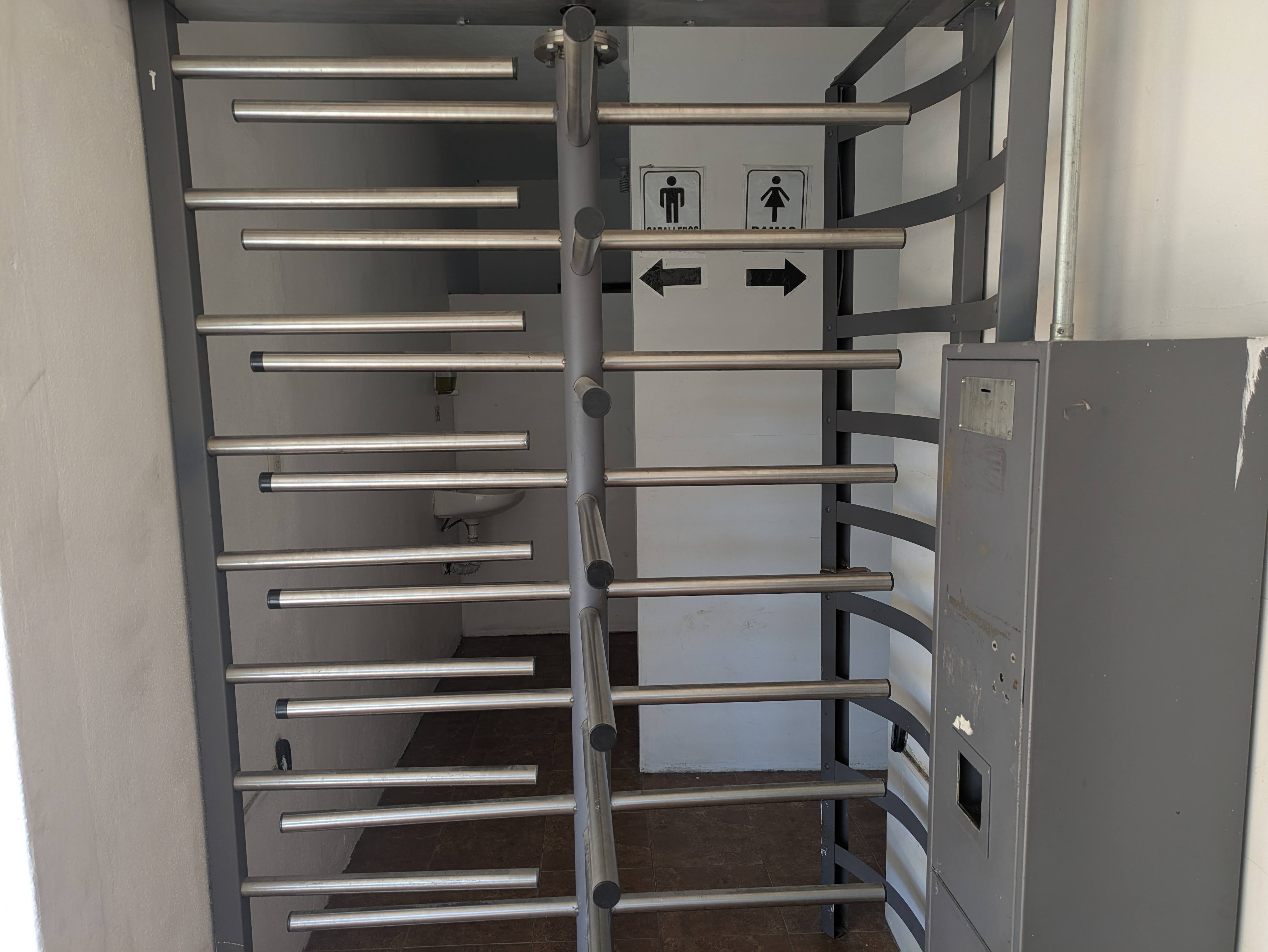
Paying for a Pee at 3200m

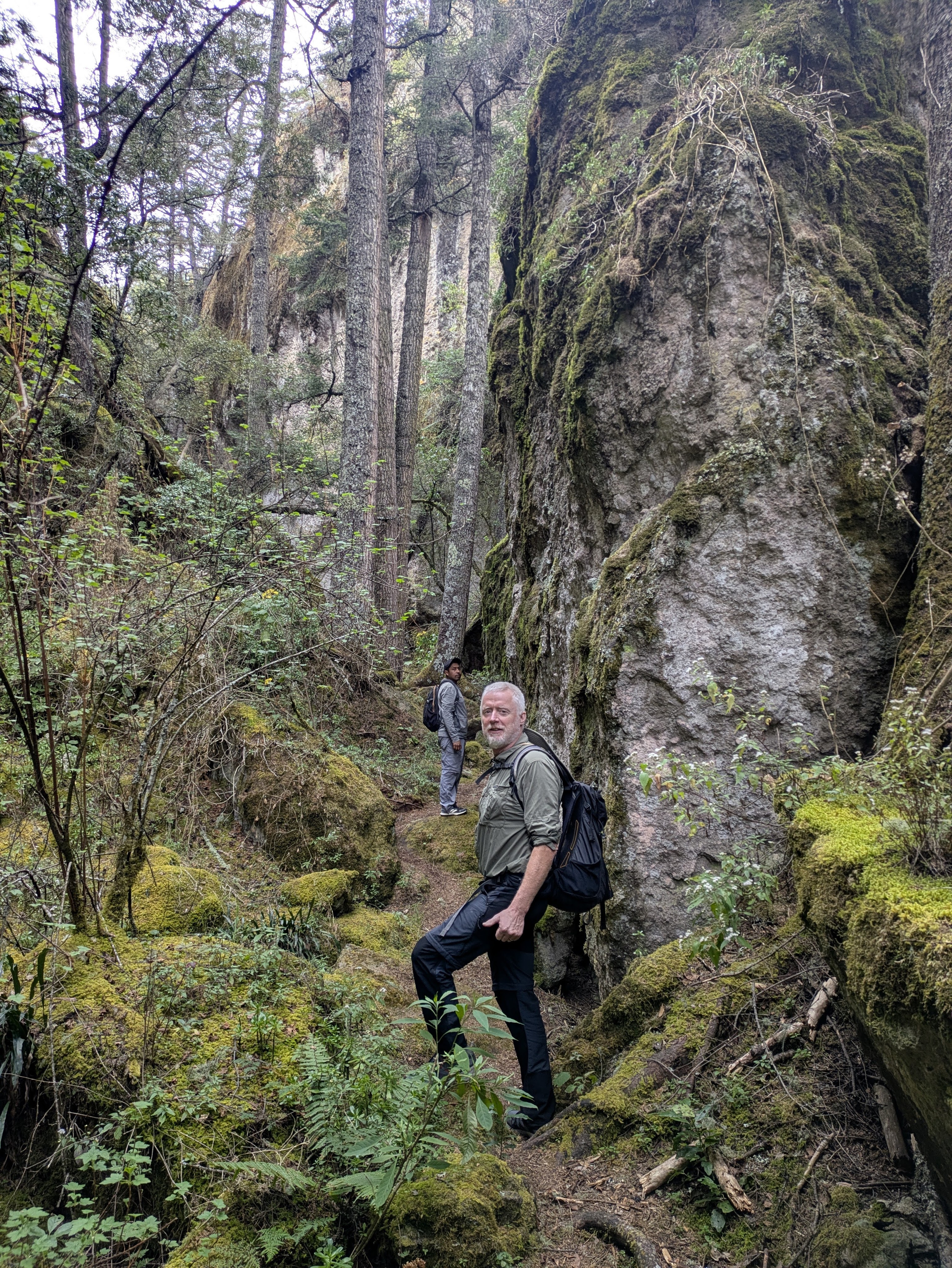
Our hike started in the village of Llanes Grande famous for its flowers, especially an abundance of Red Hot Poker flowers. Andres picked up enormous sandwiches stuffed with cheese, tomatoes, cucumbers and black bean paste at one of the little comedors (restaurants) in the village for a picnic on the way. At the beginning we strolled on a soft carpet of pine needles through forests of towering pines, bordered by huge agave plants. Cattle grazed in open meadows  and a couple of lakes were full of flickering  trout. Andres stopped to explain the medicinal and culinary uses of many of the plants.
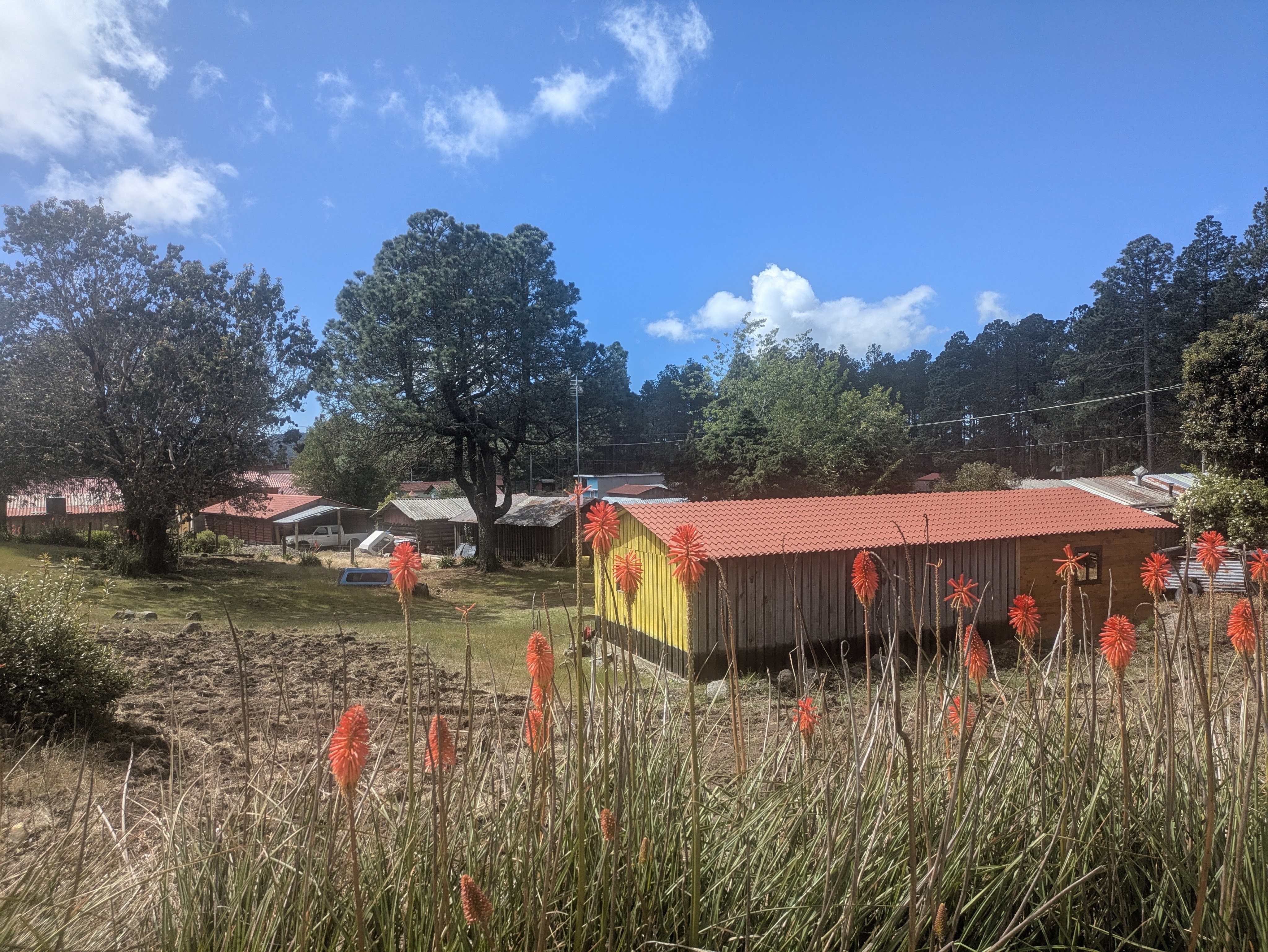
Lianes Grande
La Cuvee de La Iglesia

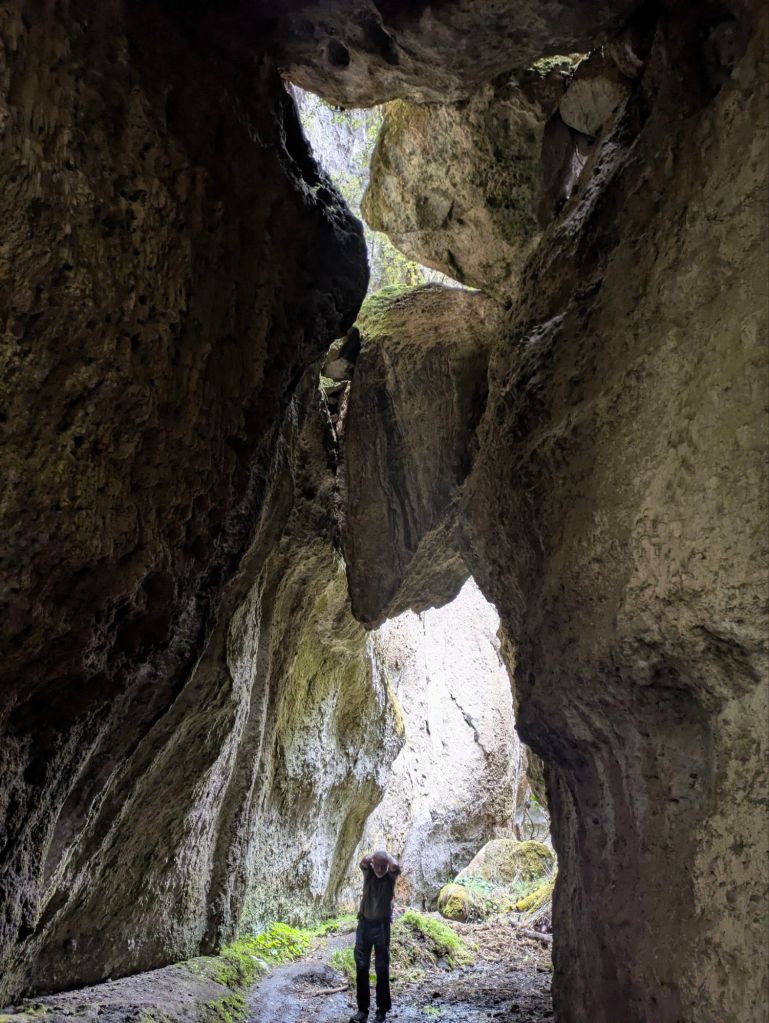
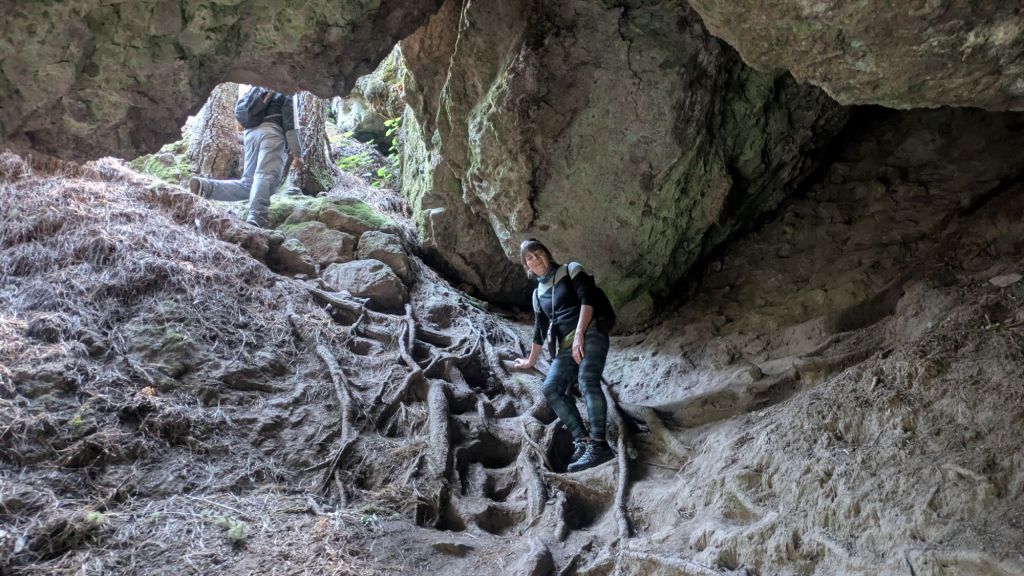
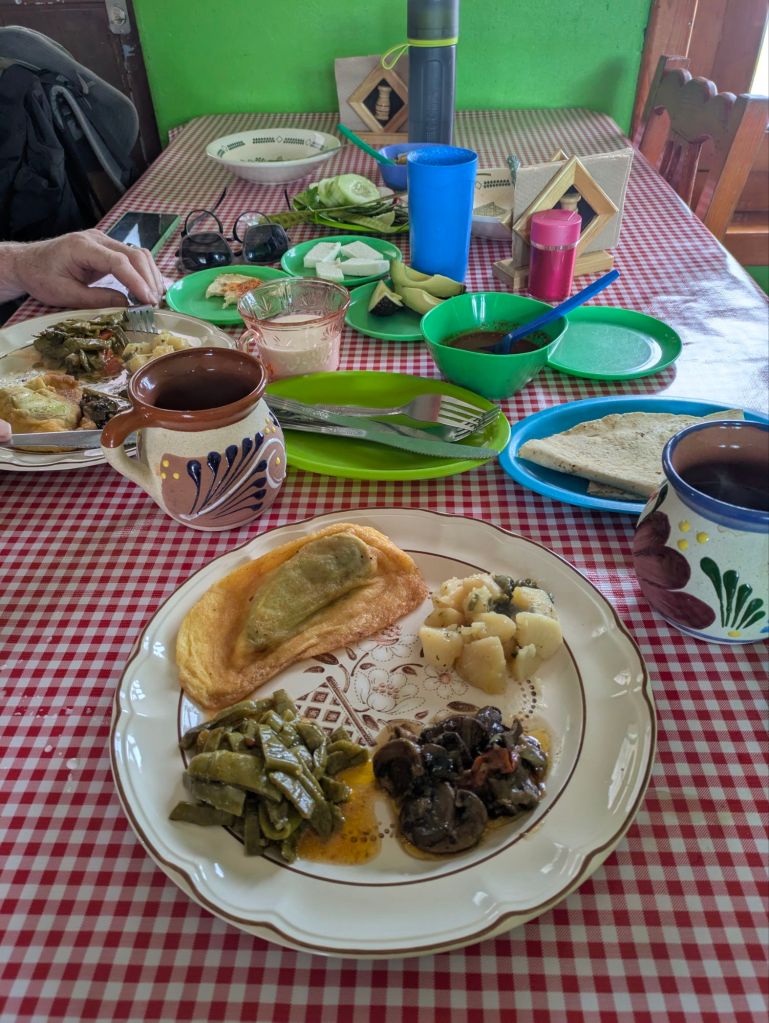
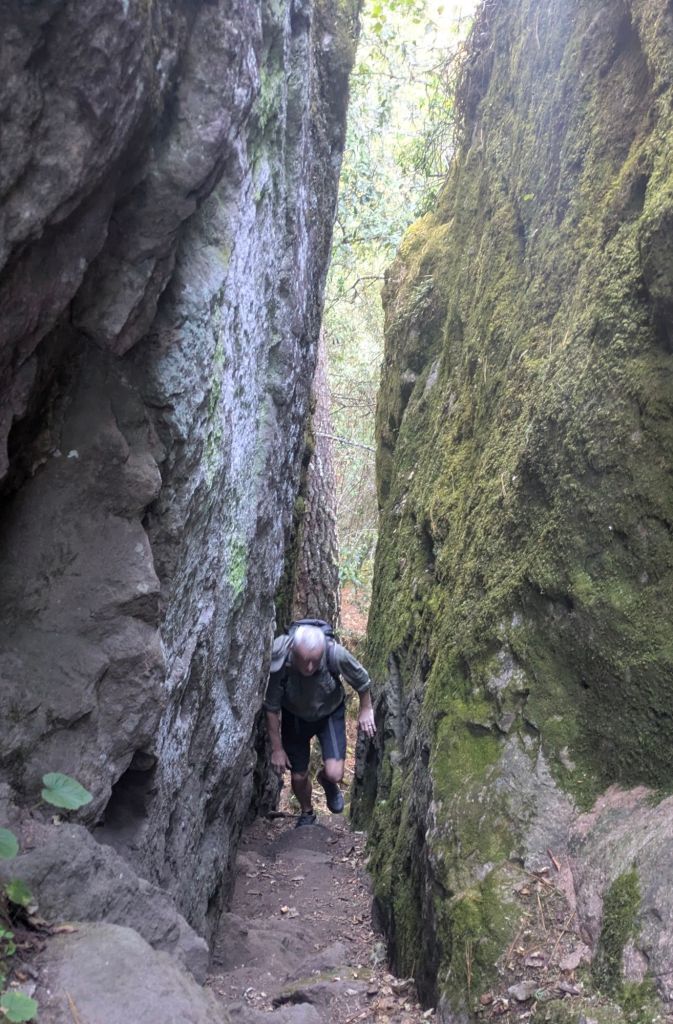
Climbing down into a steep gorge, we were dwarfed by walls of rock until we reached the cave known as the La Cuvee de la Iglesia, a mystical place of legends and phantom horses. Andres led us onwards to Cuajimoloyas where Senora Marlen plied us with so much food that we could hardly walk. We devoured fresh vegetable soup, quesadillas (cheese sandwiches), plates of fried potatoes, chilli mushrooms, green beans, frigoles, and tortillas  garnished with limes, sliced avocados and picante sauces. The kitchen was lovely with a range of saucepans that were so colourful, I had kitchen utensil envy.

Brightly coloured pans on a wood  burner stove
A feast of food

We bumped into Janet, the women from the office in Oaxaca, who lived in the village and discovered that Andres, our guide, was her husband. She persuaded him to guide us knowing that he had a few words of English. She invited us into her home and told us a bit more about the eco tourism company, Expediciones Sierra Norte. It began when eight remote Zapotec villages, (collectively called the Pueblos Mancomunados), came together to protect their land against developers and to provide themselves with a living from ecotourism. All profits are divided between the eight villages who decide individually how the money is spent. The idea of ‘service’ (unpaid voluntary work) is paramount to the success of the operation. One member of each family must do ‘service’, which may involve cleaning, painting or being the rotating president, chairperson and secretary which each of the individual villages have. There are rules and a code of practice and quarterly meetings  
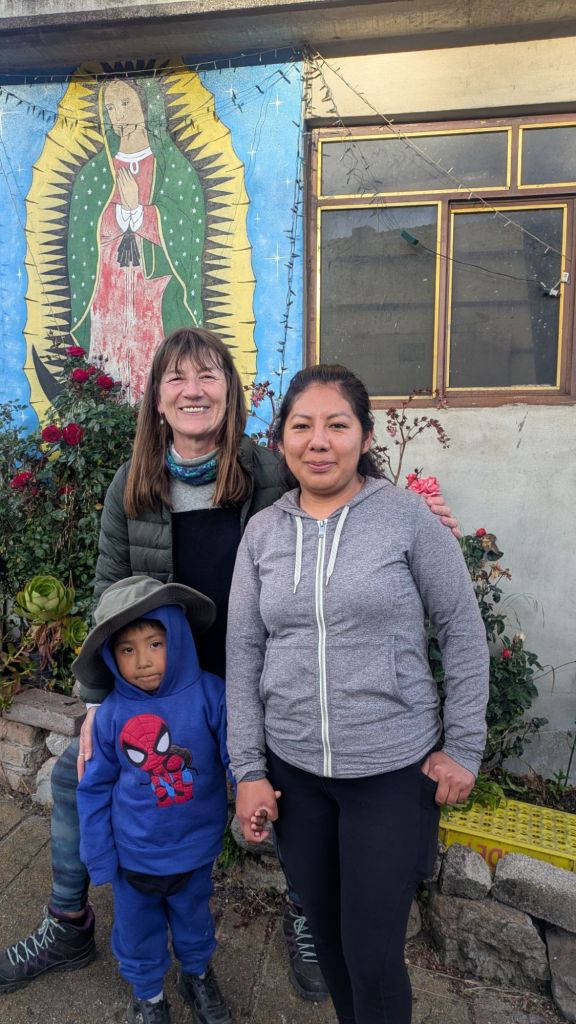
Janet and her nephew

The village was a lesson on the power of community or what people can do when they come together. The villages, although remote were more prosperous than many others that we have seen in Mexico. There was an air of industry and friendliness and a palpable sense of pulling together.

The idea of community cooperation was not new to the Zapotec in the region. They had set up a logging company years before when developers were sniffing around the forests. It was moderately profitable but the eco-tourism venture has been spectacularly successful. Nowadays, they do not cut down trees but only use the dead wood or whatever falls naturally in the storms. We probed Janet, trying to get her to tell us stories of greed, jealousy and disharmony but she insisted that all was well and that everybody abided by the rules which benefited the whole community.

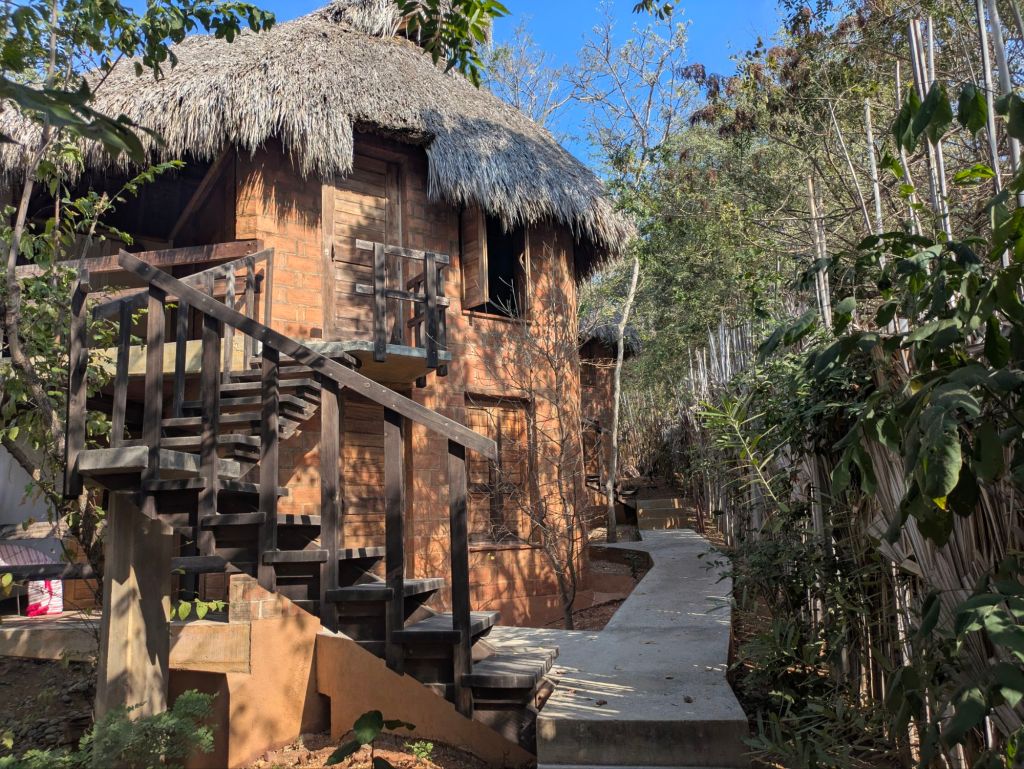
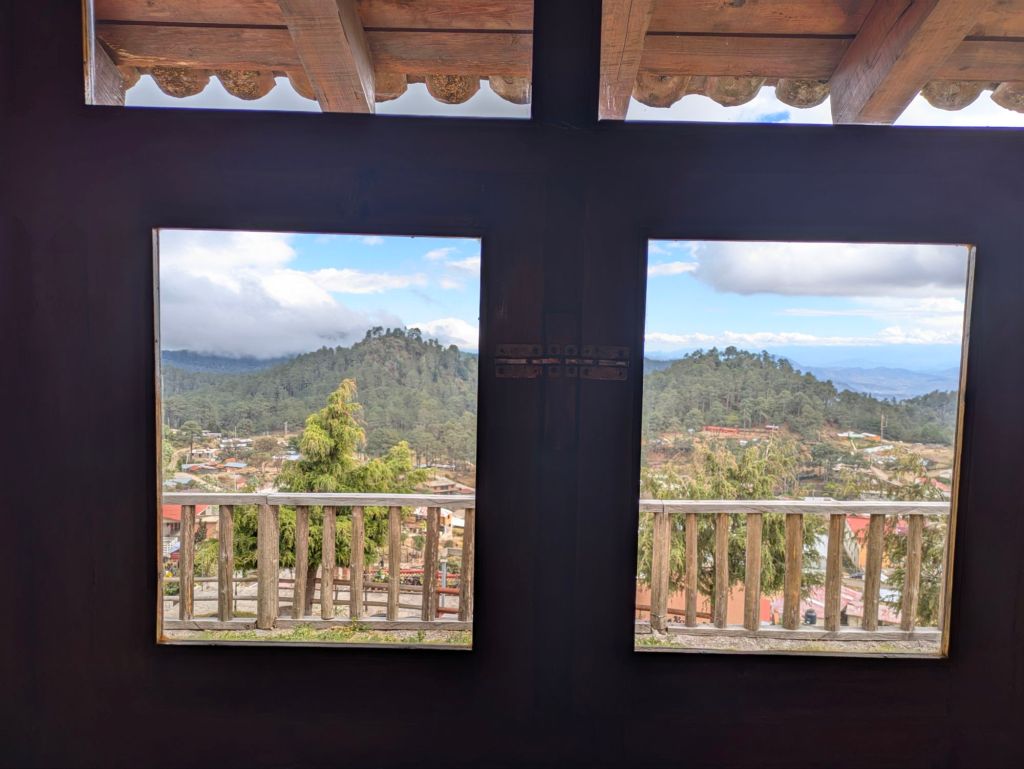
Our cabin for the night was a surprise, It was on the hill overlooking the town and exceeded our expectations with a fireplace, a comfortable  double bed and some bunk beds. Sitting outside in the late afternoon, with sounds of goats and dogs barking floating up from the village below us, it was incredibly peaceful. A retired couple from New York were staying in the cabin next to us and were also really taken by the sense of community in the area.
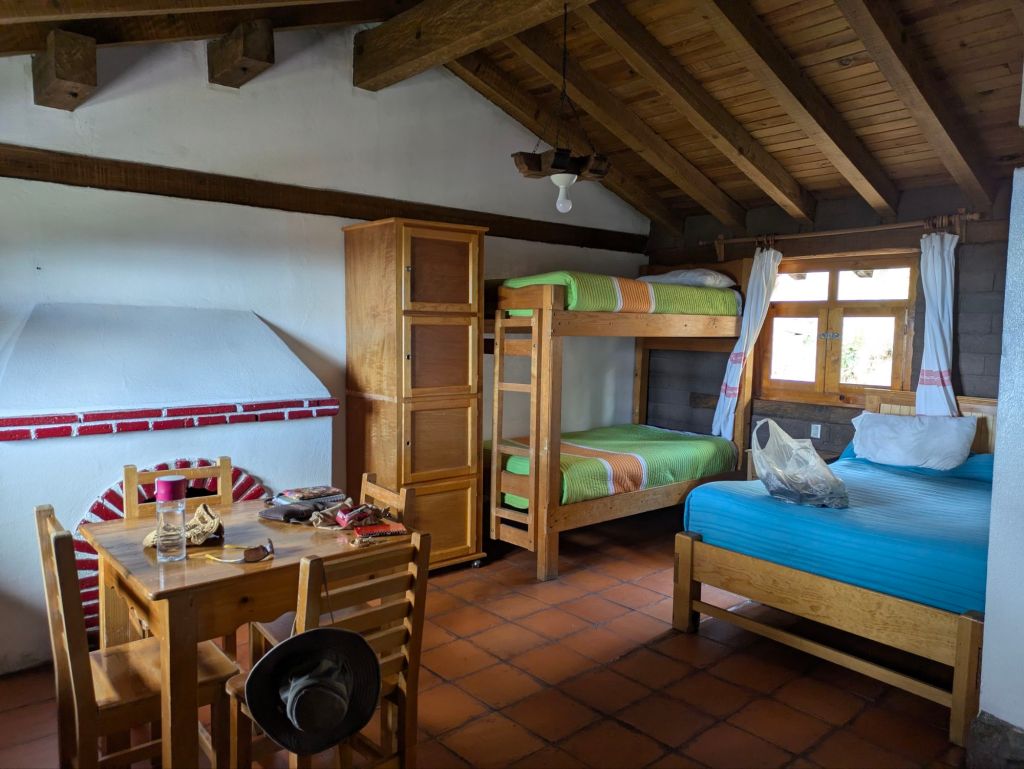
Our Cabin
View from our Cabin

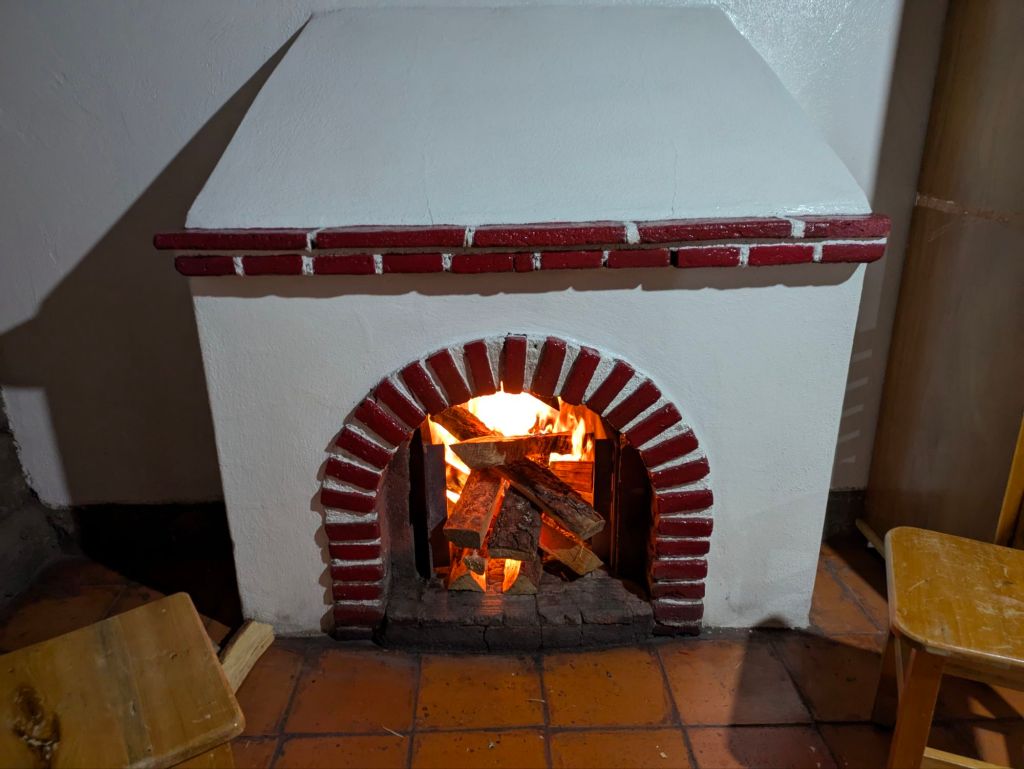
It got cold in the mountains when the sun went down, dipping to almost zero. The cabin, though comfortable, was not well insulated. There were huge gaps under and over the door and  the sides of the windows. After dinner one of the locals came in with an armful of timber logs and lit a huge wood fire in the fireplace using only a natural firelighter to start it (a piece of Colima bark). It was one of those fires where your front was roasting but your back was freezing but at least the bed was piled high with blankets.
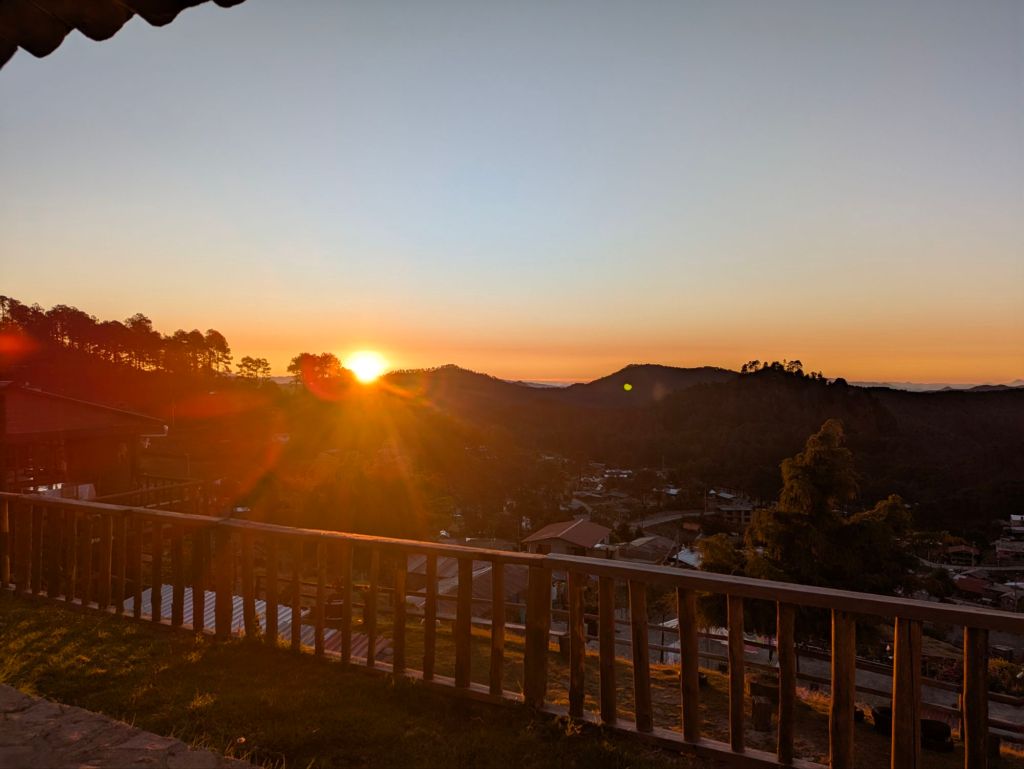
Sunset over the Village
A Welcome Wood Fire

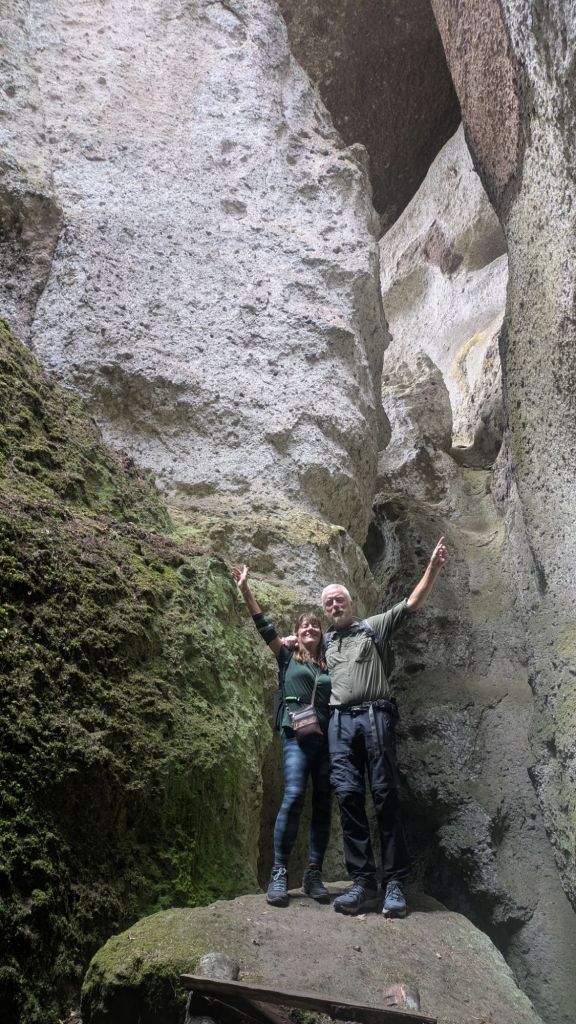
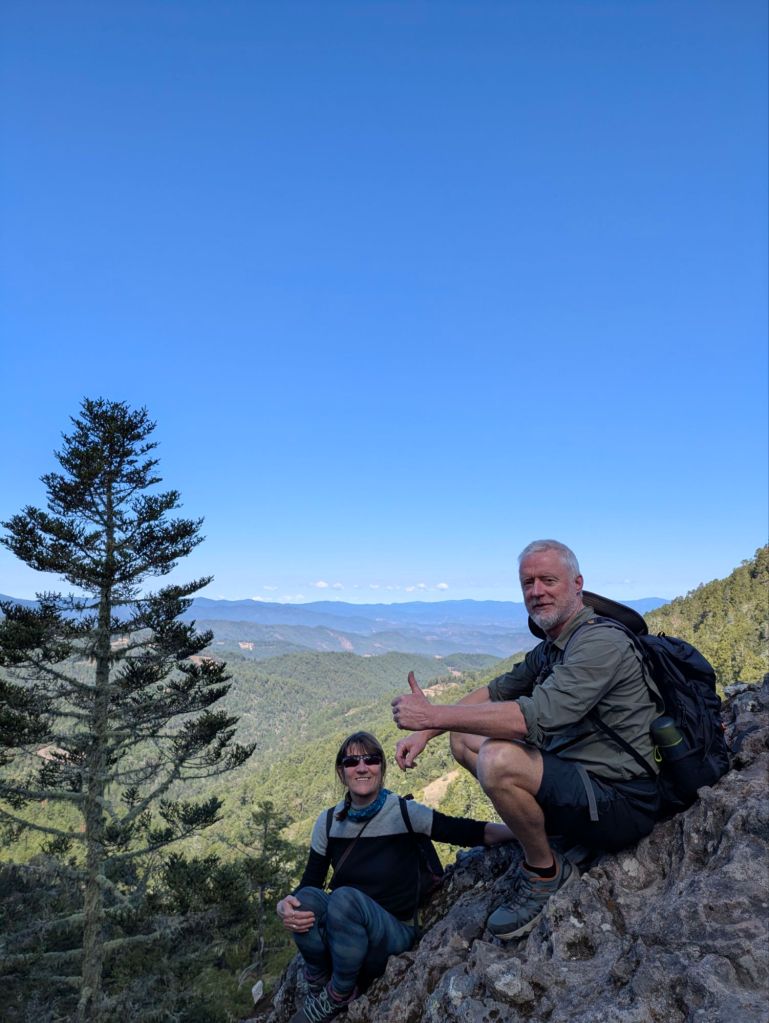
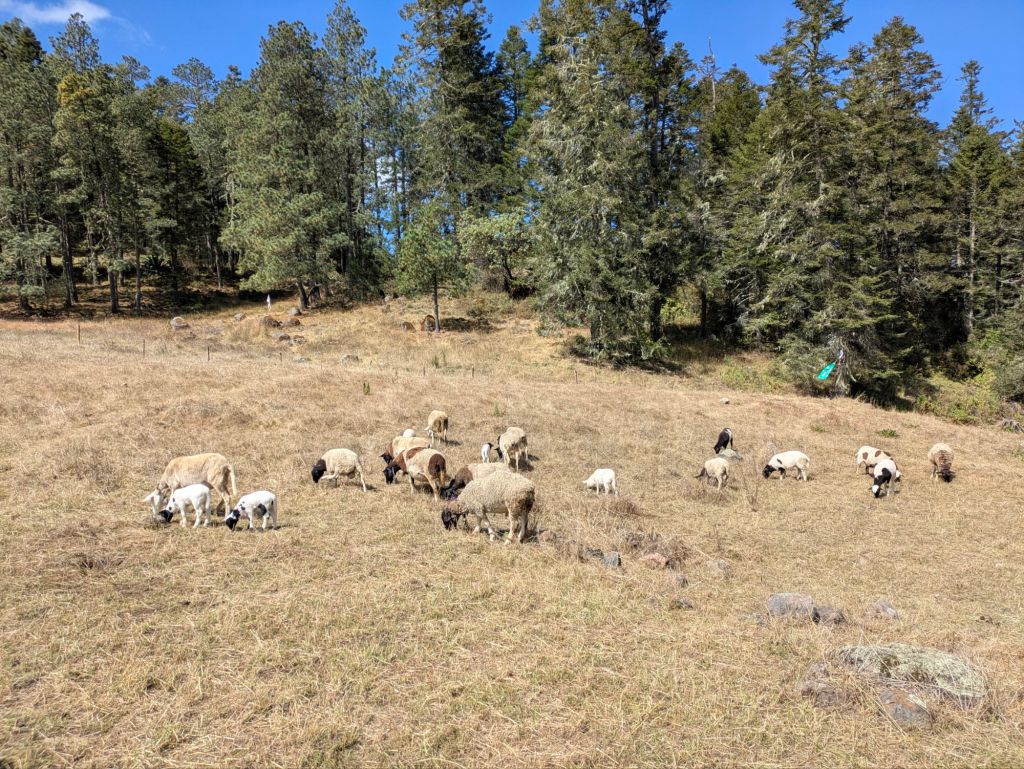
Our second day’s hike was the stunning Canon del Coyote which was even more spectacular than the day before, involving a hike through caves and a scramble up on sheer rock to a mirador (a lookout point) with breathtaking views. We listened to an assortment of birds in the forest,  hummingbirds, jays and warblers and at the lower levels passed steep fields of sheep and lambs.
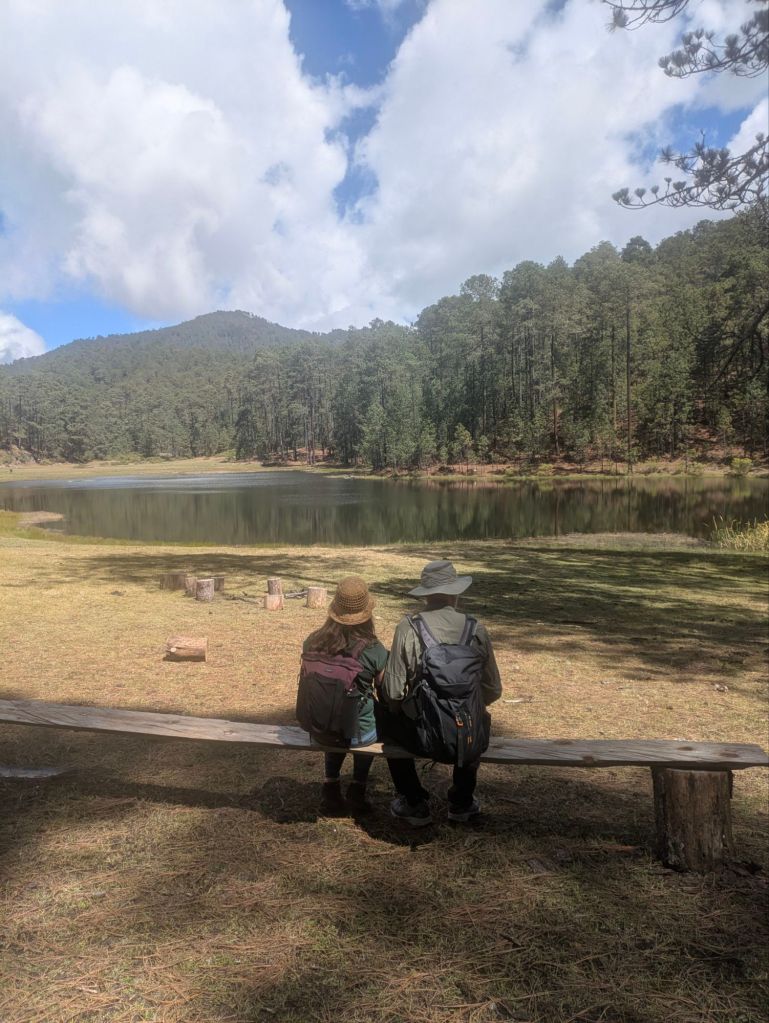
The sensible thing to do after our hike would have been to return to Oaxaca city and use a relatively major roads through the valleys to get over the Sierra Juarez mountain range.  Of course we didn’t do that. Instead we drove deeper into the mountains, winding our way on dirt roads in remote countryside. A stunning and grueling drive in equal measure, the dirt roads for the first hour passed through gorgeous villages. In one puebla,  two of the most enormous turkeys I have ever seen, gobbled at the side of the road while in another an old woman with long plaited hair and no teeth gave us a cheery wave. For the most part, there was little traffic of any kind.  We stopped at a Mirador to admire the view of  the fluffy clouds laid out  beneath us.

We weren’t quite so enamored when we were driving down through them a short while later. Visibility reduced to almost zero and  the world became a thick opaque  grey.  It was almost impossible to distinguish road from verge on the twisty road. Thankfully the surface was reasonable and there wasn’t a lot of traffic. The mist and fog lightened every so often to reveal gigantic ferns and thick moss covered trees and we were fooled into believing that we almost down, only for it to thicken again and plunge us into grey again. It took almost an hour of white-knuckle crawling, but eventually we were below the clouds although we were still in the mountains and the temperatures rose.

After all that excitement and tension, we needed a place to stay.  The town of San Juan Bautiste Valle National sounded like a bit of a mouthful but it was relatively close. It wasn’t the sort of place that had anything on Booking.com but it looked big enough on a map to have some hotels. Stopping for an ice cream and a look around, we found a friendly town, very friendly. Lots of men looked like they had been working hard all week in the fields, hadn’t had a shower in a long time and had been on a bender for a least two days. Two guys staggered out of the shop after shaking our hands, carrying bags of clinking cans. One got into a battered pick-up and the other ambled unsteadily to a motorbike. Both drove off, still waving to us. We decided to push on.

 A little outside the town, we spotted a sign for Hotel Hniu Li, pointing down a little track off the highway. It looked good, a double story buildings with a breezy balcony on the edge of a field of maize with a few banana trees in front. There was no reception area but an old woman called to us from the doorway of a little shop on the corner. She told us that the room was 500pesos for the night( less than 25 euros), cash, with no signing registers or checking of passport. The room was small bit adequate, spotlessly clean but the bathroom was jaw-droppingly gorgeous, like something out of an upmarket spa, almost as big as the bedroom with polished stone walls and lashings of high-pressure hot water,   It was perfect……just what we needed. A dog called Lala befriended us and the woman in the shop who sold beer but didn’t have any cold ones, put two in the freezer for us.

Cheers

Thanks for reading.
Mexico: Then and Now

Mexico: Gone to the Beach

It was the start of a long day, a very long day. It was barely ten degrees, a bright, chilly and pine-scented morning in the gorgeous, mountain-town of San Christobel de Las Casas. Leaving the town behind us with some regret, we travelled on a wide tolled road, the first toll road we have encountered so far.  Descending rapidly to the lowlands, the temperature ascended just as rapidly and we were reaching for the car air-con within forty minutes.    

We hadn’t a definite destination in mind, just headed in the general direction of the beaches on the Pacific coast of Oaxaca. A French woman we met on a tour of the archaeological ruins at Palenque had raved about  the small seaside town of Mazunte so we thought we might go there. The only problem was that it was at least  an eight and a half hour drive without breaks. So we drove on, seeing how far we would get.

Stopping for something to eat in the middle of nowhere, the simple family-run restaurant was just a few tables covered in bright tablecloths.  An elderly man in a wheelchair and three women of various ages sat watching some soap on the TV when we poked our heads inside the door.  It wasn’t obvious whether it was open for business but they all sprang into action and produced a plate of scrambled eggs, some sort of creamed cheese accompanied by a basket of warm tortillas, a tongue-searingly hot sauce and mugs of black coffee.  

For the first time since we arrived in the country, the terrain became more typically ‘Mexican’, dry and dusty with scrubby red hills under a blindingly blue sky. Our main problem on this journey was not the speed bumps or the threat of protesters, this time it was the sheer number of pot-holes and craters in some sections. At one stage we were behind a police car which was swerving like a crazy drunk to avoid them with oncoming traffic doing the same dangerous dance.

It was well after 4pm and decision time. Mexico was not a country to be driving around in the dark. With no cafes in sight, we stopped at a  ramshackle, roadside shop in a stiflingly hot dusty town to discuss our options. An overweight teenager, swinging in a hammock and playing on his phone, could barely rouse himself  to take our money for a Coke and some chocolate. Mazunte was still at least two and half hours away but with sugar rushing through our veins, we decided to press on and booked a place to stay. The online reviews were good, claiming it was a quiet relaxing place between the two beaches on either side of the town.

Descending from the mountains that stretched almost to the coast, we arrived just after sunset. It was already dark and Mazunte was full of gringos, (many of them barefoot and scantily dressed) wandering in the middle of a narrow street full of cafes, restaurants and jewellery stalls. Turning up the unpaved road to our accommodation, pedestrians streamed down the hill and cars abandoned everywhere. The road was so narrow that we had to reverse to allow the traffic that was coming against us to pass.  We had arrived, not only at the busiest time of the evening but the busiest time of the week. Weekend crowds were returning  after viewing the sunset on the west-facing beach near our accommodation. Thankfully, calm returned within twenty minutes and the traffic disappeared.

Mazunte

 Our landlord wasn’t available because of the short notice and our room wasn’t ready either. We whiled away the time, sitting outside the shop next door and drinking cans of ice-cold beers ….probably the nicest and most welcome drink we’d ever had. It was after 7 pm and still thirty degrees.

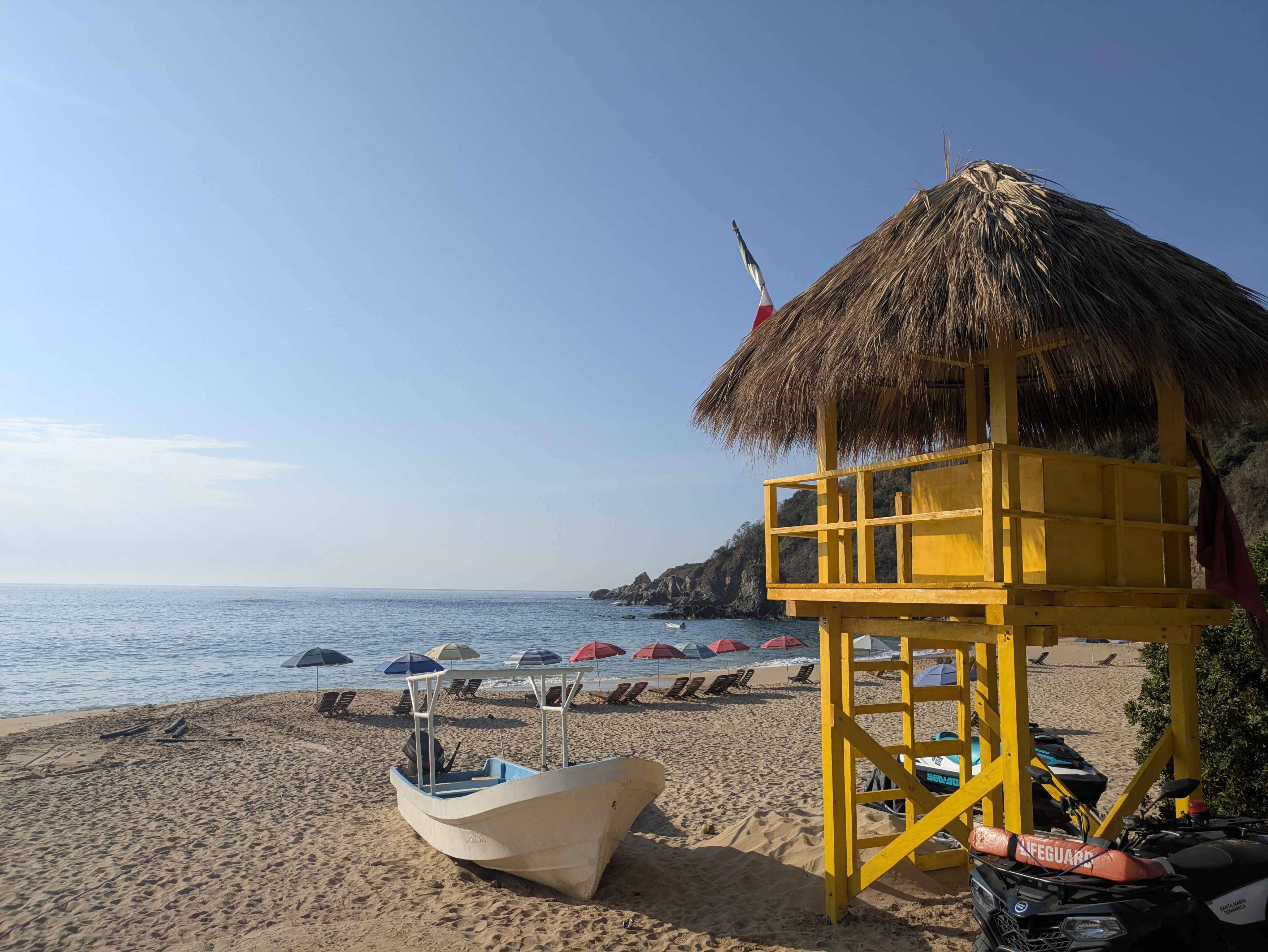
Mazunte had a holiday, hippy vibe with many vegetarian and vegan eateries, full of ‘cool’ people of all ages…..our kind of place, at least for a few days. Hotels, bungalows and cabanas with thatched roofs stretched up into the hills, half-hidden among the coconut trees and the flowering shrubs. The pace of life was slow here, people ambled around in a heat haze. The cocktails were always on ‘special offer’, the coffee was strong and stands selling coco frio, cold coconut water drunk directly from the shell were everywhere.

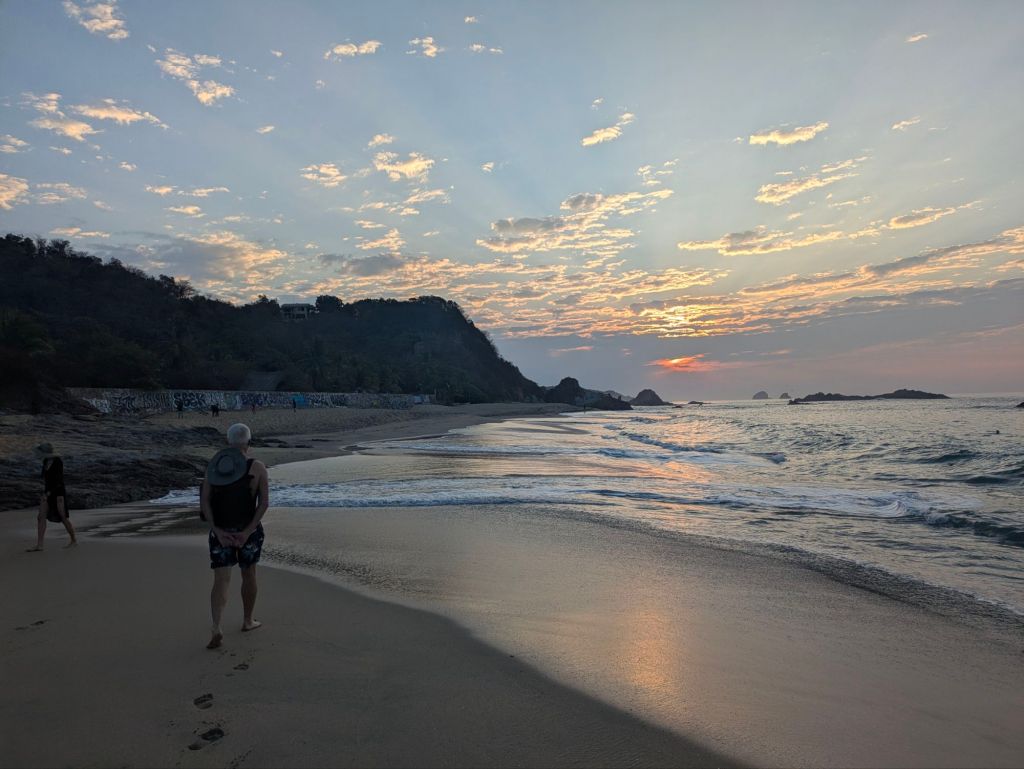
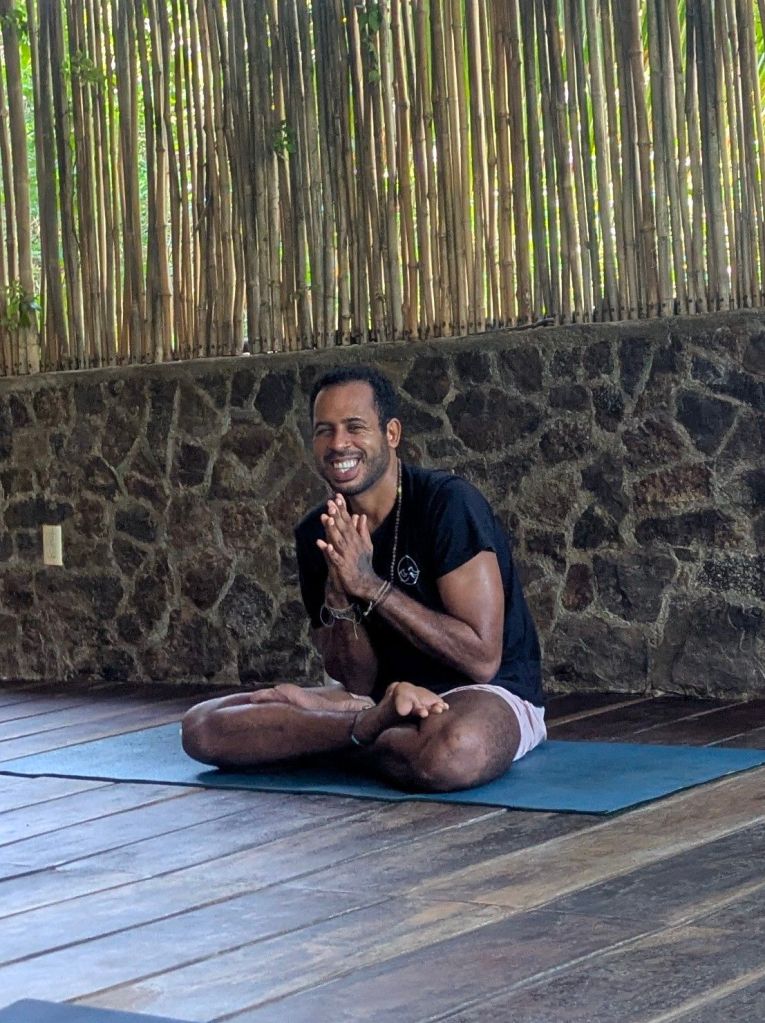
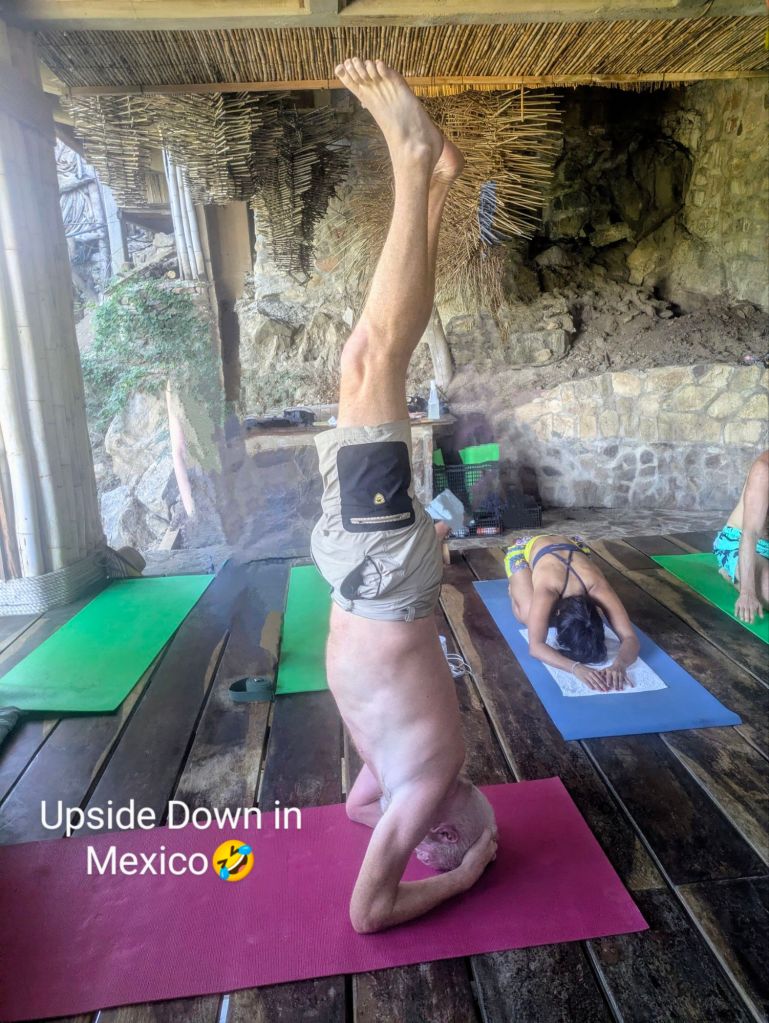
The sweet period in Mazunte was early morning from 6am to 9am. After that it was time to look for shade until the late afternoon. It was a few days of sunrise walks, sunset swims and yoga sessions. Practising  yoga  on a thatched veranda overlooking the beach was like’ hot’ yoga without the need for heaters. Sweat trickled down my face, my hands slipped on the mat and I tried to catch a breeze from the Pacific Ocean. It was 8.30 am and already 29 degrees. Paulo, our instructor was Mexican but had spent five years living in Dublin and still had lots of friends there. On this trip, we have met so many people of different nationalities who have visited Ireland and all have only good things to say about it.

Paulo, Yoga Instructor

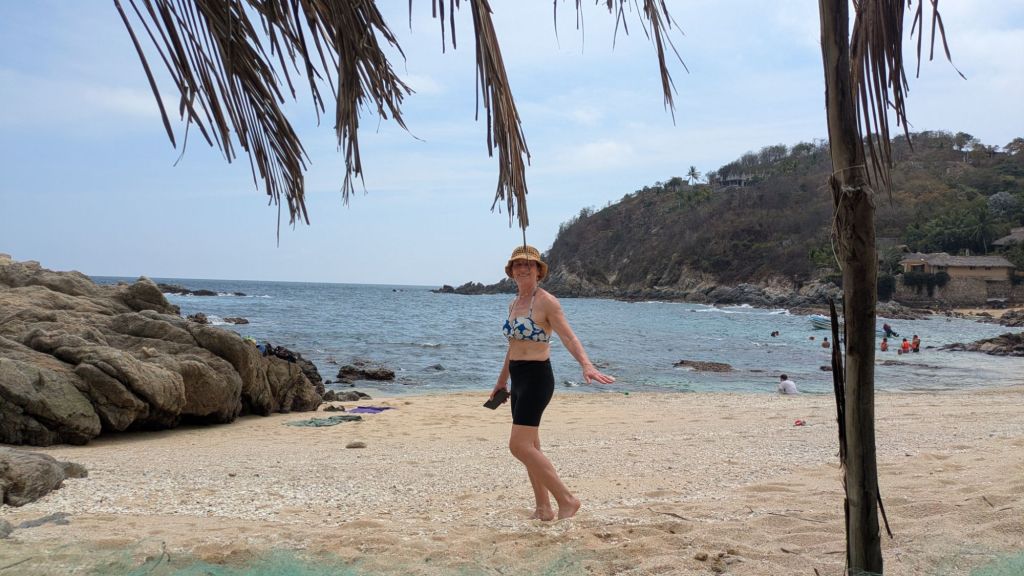
The coast to the east and west of Mazunte was gorgeous, full of beaches with something to suit everyone,  some were more suitable for surfing, others were perfect for swimming and snorkelling but all were ideal for lolling around.

It wasn’t just humans that flocked to this dusty, sun-baked stretch of coast. Whales also made their way from the frigid waters of Northern Canada to the warm seas of Mexico’s Pacific coast to breed and nurse their young usually from December to March. Several varieties  of turtles laid their eggs on the sandy beaches and there were several turtle research stations in the area.

It was hard for us to believe but it was winter season here, the coolest  and driest time of the year. The rainy season is between May and October but the temperatures begins to creep up in March until forty degrees is fairly common.  Jonathon, our landlord, pointed out where water runs down the hill between the bungalows and the unpaved road becomes a river. We stayed in a very unusual place, an architecturally designed cabana, angled to catch the breeze and stay cool without air con. It had a series of sliding shutters but was open on all sides so we could hear the squirrels scampering in the trees outside and the sound on the waves breaking on the beach down the road,

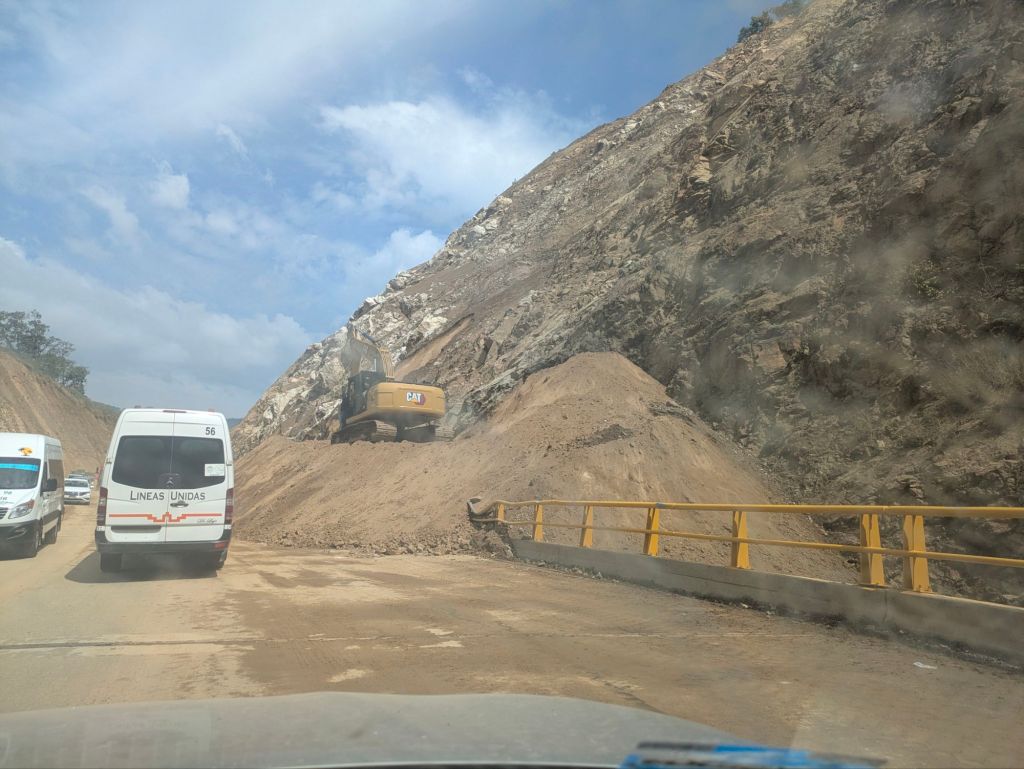
After four nights, it was time to go or we might never have left. The city of Oaxaca, about which we had heard so many good things, was calling us.  We travelled for about an hour on a highway going towards Acapulco with coconut stalls, cacti, flowering shrubs and bridges over (almost dry) river beds. The song Going Loco in Acapulco was going round and round in my head but soon we turned inland towards the hills, climbing again, ears popping and chewing on the dust that seeped into the car. Huge efforts were in progress to stop the steep mountains  from sliding onto the road, There are many  tailbacks as rock falls were being cleared. Road workers climbed like abseiling ants in high-vis jackets up the vertical rocky slopes, trying to secure the sides and prevent more erosion.

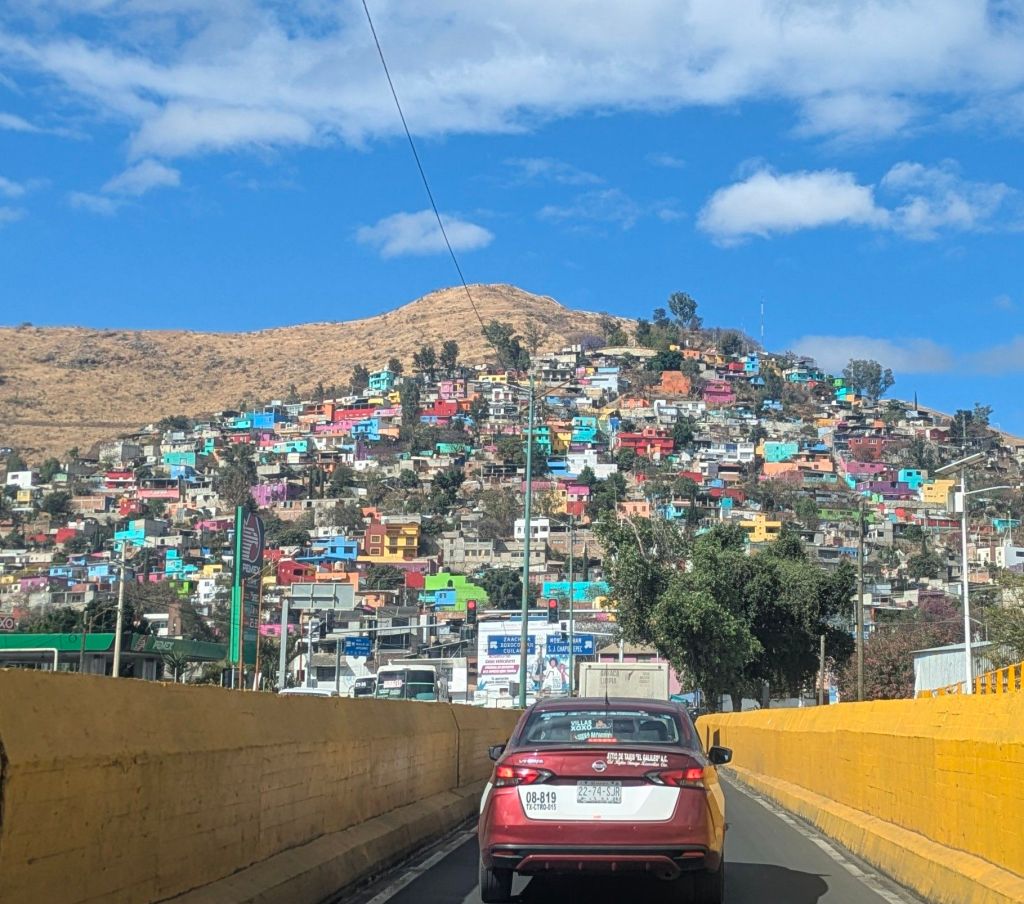
Oaxaca is in a central valley, at 1550m, ringed by mountains with brightly painted houses sprawling up the hills. The historic centre is an UNESCO World Heritage site, laid out on a grid system with handsome buildings, artisan craft shops and art galleries in sixteenth century buildings with stout walls, shady courtyards and subdued signage.

Approaching Oaxaca

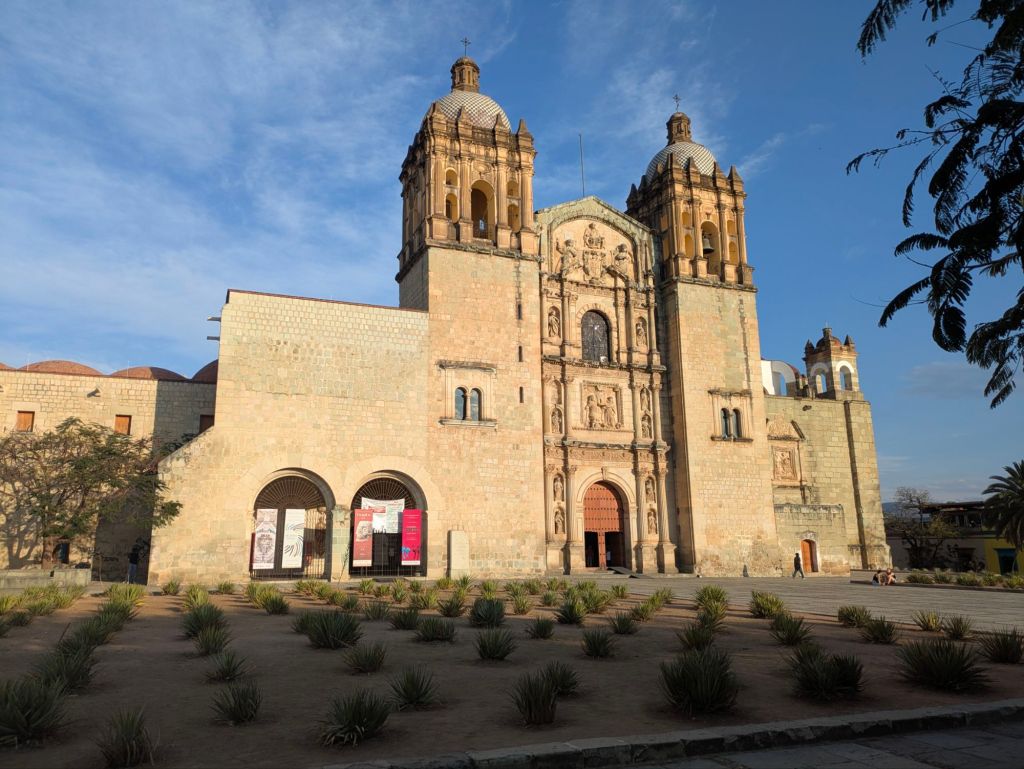
The centre was full of tree-shaded plazas, a magnificent cathedral made of the local rock which has a green tinge. There were churches and monasteries on almost every corner. The church of San Domingo was the most splendid, a solid baroque exterior with a sumptuous interior of gold, gilt and bas reliefs.

Santa Domingo

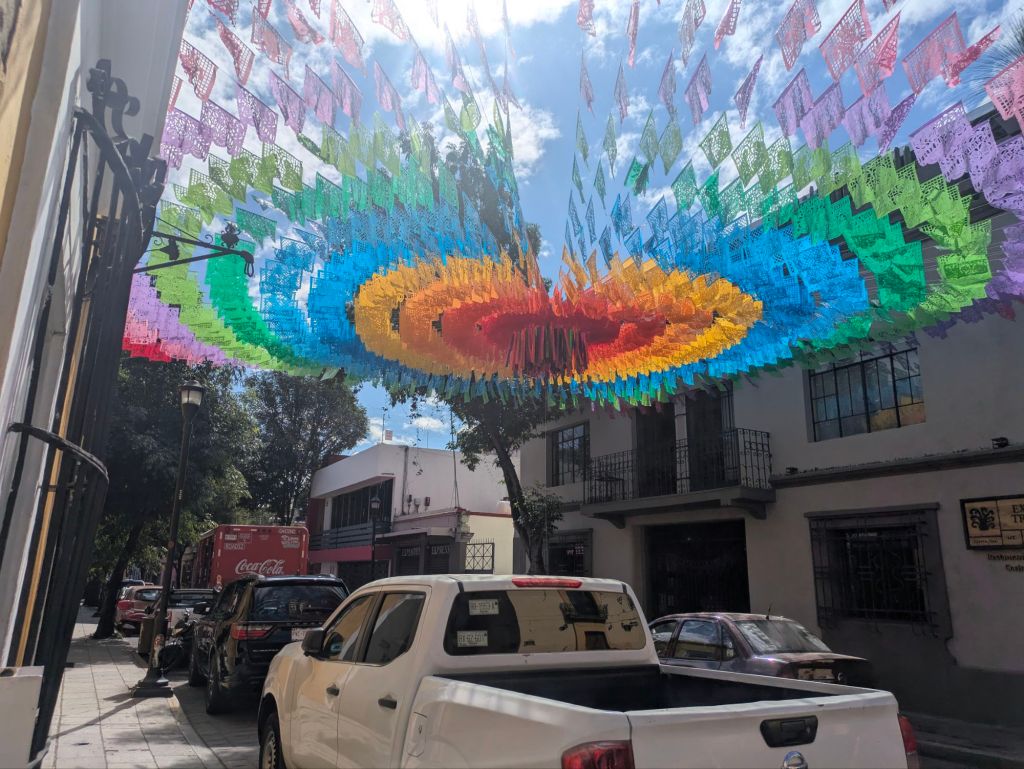
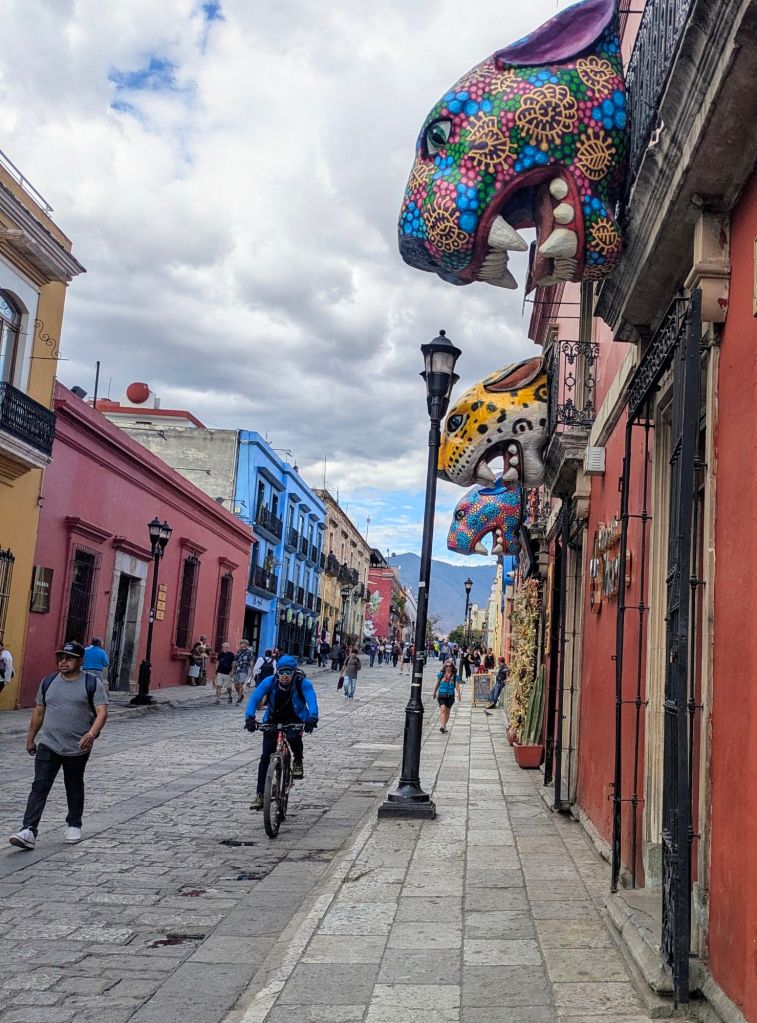
 As we wandered around the breezy, cobbled streets under festive buntings, homeless people thrust clinking cups under our noses, begging for change.  The stench of urine even in the main plazas was oppressive and one street away from the touristy centre, belching buses and honking taxis destroyed the peace. The shoe shine people, who were mainly weather beaten, middle-aged men, ignored us after glancing at our runners.  Oaxaca seemed a beautiful but complex place, with a significant underbelly of deprivation co-existing with the wealth and glamour.

Oaxaca Street
Oaxaca

It was a city of music with buskers of every sort and ability, playing and singing all over the place. A small orchestra set up outside the Santa Domingo church and  we stumbled across a parade of women in swirling  long dresses, dancing to the drumming of a marching band.

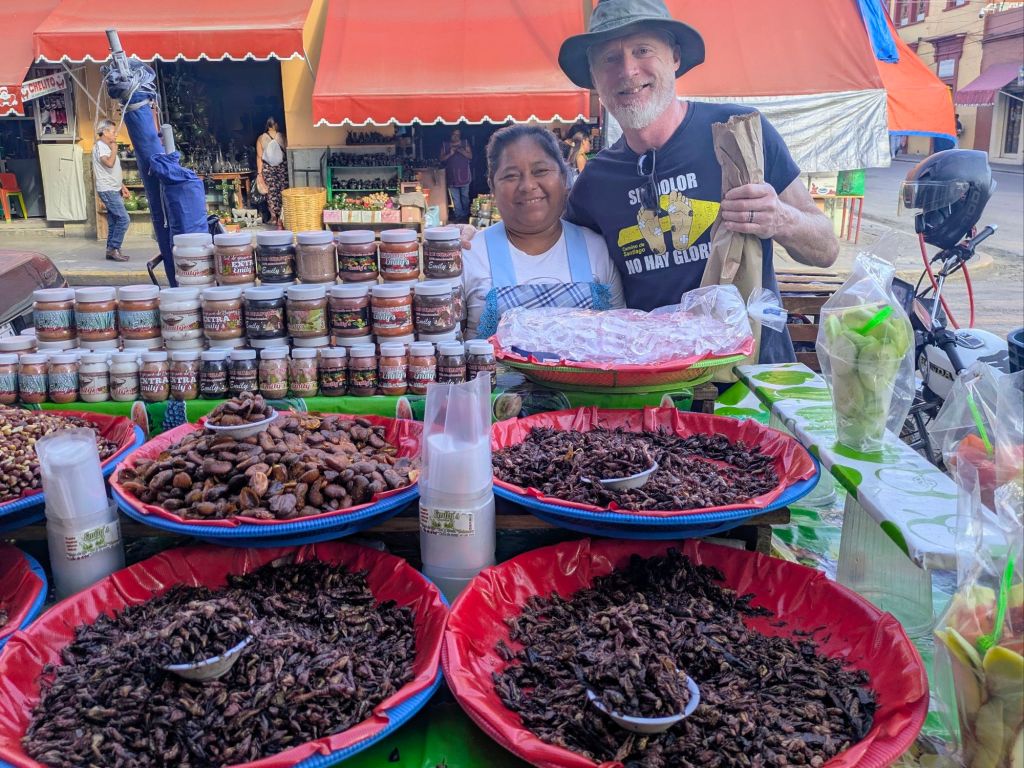
Oaxaca is also the culinary capital of Mexico. One of the more unusual ingredients was roasted grasshoppers (chapulines) which were sold in big basins on every street corner and eaten as a snack or as garnish or topping on dishes. They were regarded as a fantastic source of protein and may actually become the food of the future,  at least according to our guide on our walking tour of the city. We haven’t tasted them…..yet.  

Basins of Roasted Grasshoppers

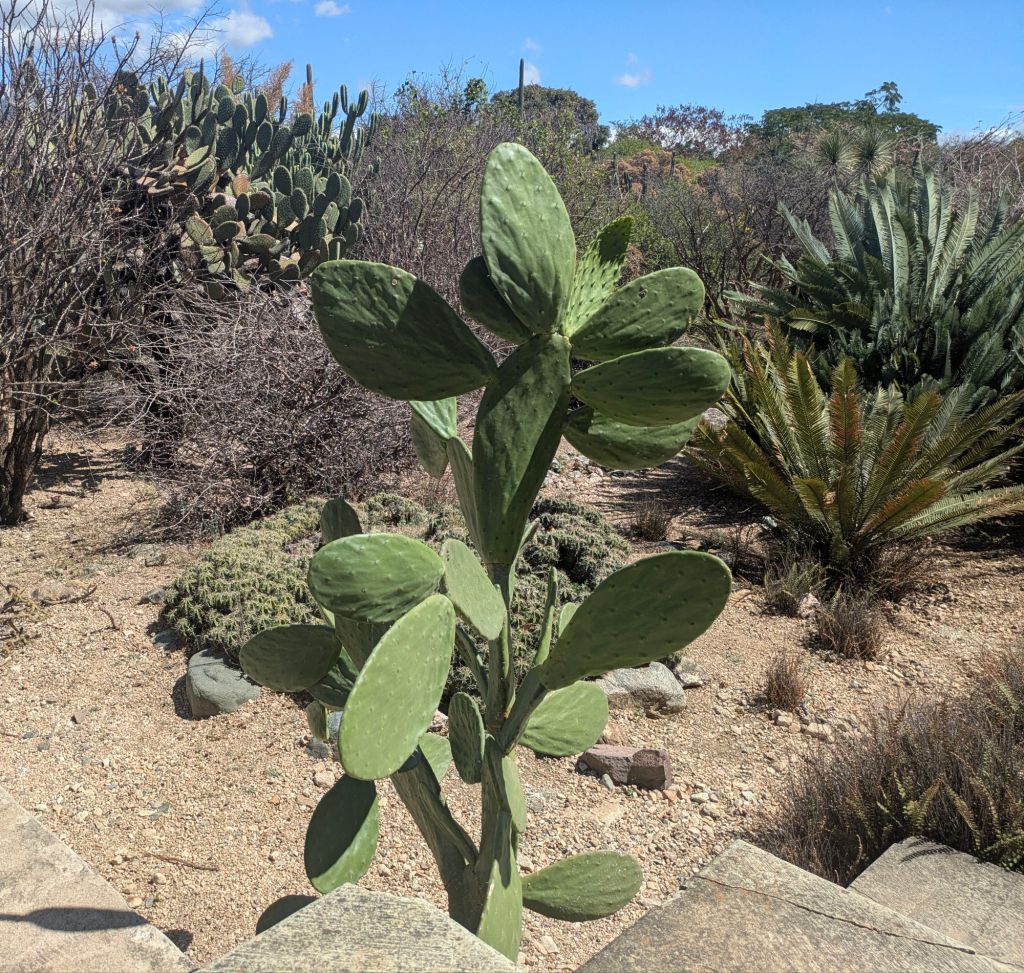
In the botanical gardens which is famous for its huge variety of cacti and local flora from the region, the only available tours were in Spanish as the tours in English had been discontinued.  This is admirable in one way but slightly baffling in a city whose income is almost totally derived from tourism. At least half the thirty people on the tour had difficulty understanding the guide. Although we followed some of what he was saying with our rudimentary Spanish, we would have appreciated being able to fully grasp the intricacies of the garden.

Botanical Garden

Located just a few kilometres from Oaxaca City lies Mount Alban, one of the most impressive archaeological sites in Mexico. It was founded around 500 BC and continued for almost one thousand, three hundred years. It became so influential that it has been called the Rome of the Americas.  

Mount Albán

The location of Mount Alban was spectacular with views of the valleys and surrounding mountains.  Oaxaca was spread out at our feet, looking much bigger than when we were in it. At this time of year, the site was sunbaked and dry with vast open areas between the temple complexes.  Shade was at a premium and people huddled under the occasional trees. Just as in Palenque, the museum was excellent in a beautiful modern building.

The ancient Zapotec built these complexes and ruled vast kingdoms.  They were known as ‘cloud people’ because they believed they originated from clouds and also because they lived at high altitude in areas that are often shrouded in clouds. Now the descendants of the Zapotec live in villages to the northeast of Oaxaca. It is possible to visit the area and hike from village to village.  

We organised a hiking trip in an office in Oaxaca, run entirely by women from the Zapotec. They were helpful and welcoming but drove a hard bargain. Eventually we settled on a price although no English speaking guides were available.

Tomorrow, we head  up into the clouds for some high altitude hiking as the villages are at 3200 m…..it should be an interesting breathless challenge

Thanks for reading

Hasta luego, amigos.

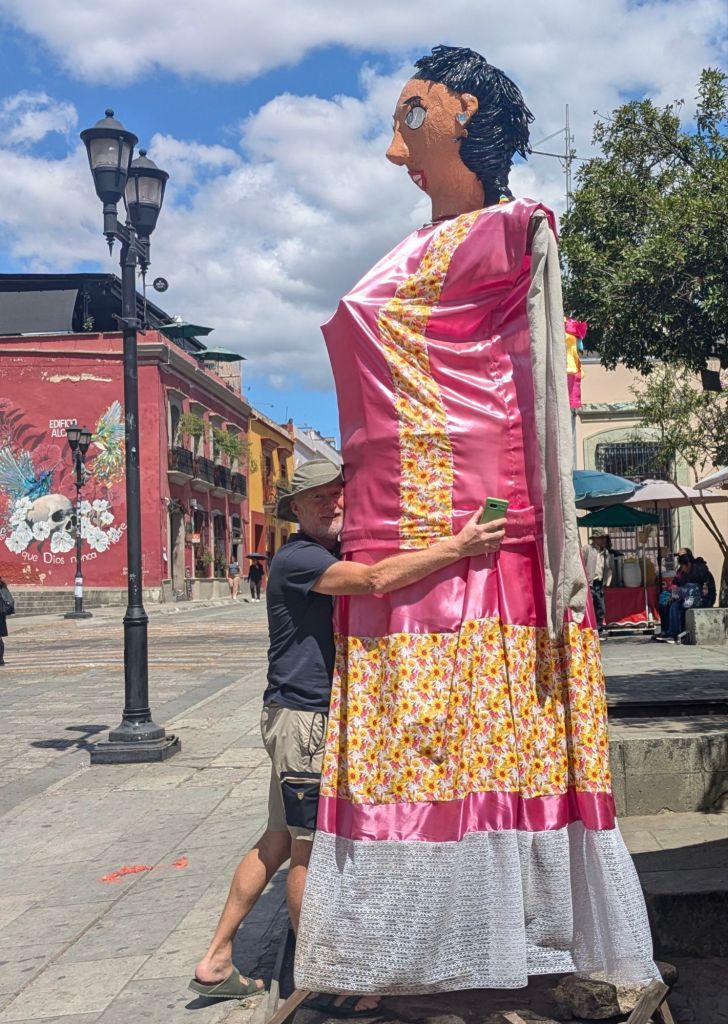
I NEED a hug💕
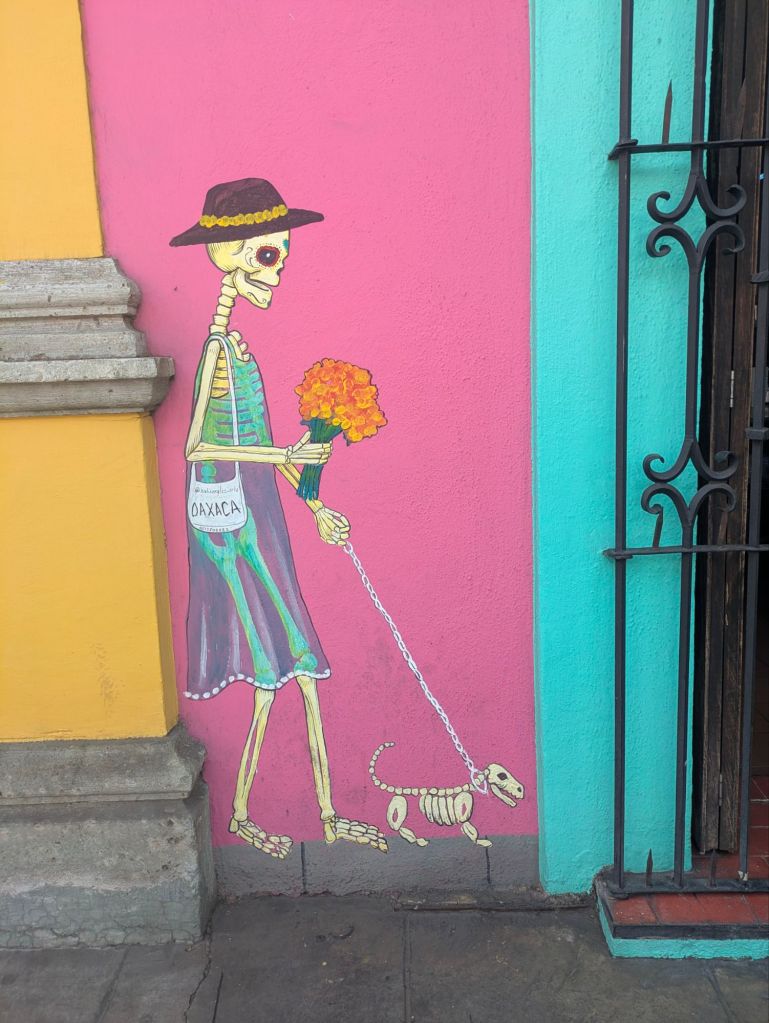
Street Art, Oaxaca

Mexico: Gone to the Beach